Blue Vervain Verbena hastata
Also called Swamp Verbena, Swamp Vervain, Blue Verbena, Simpler's Joy, čhaŋȟlóǧaŋ pȟežúta (Lakota), pȟéstola (Lakota)
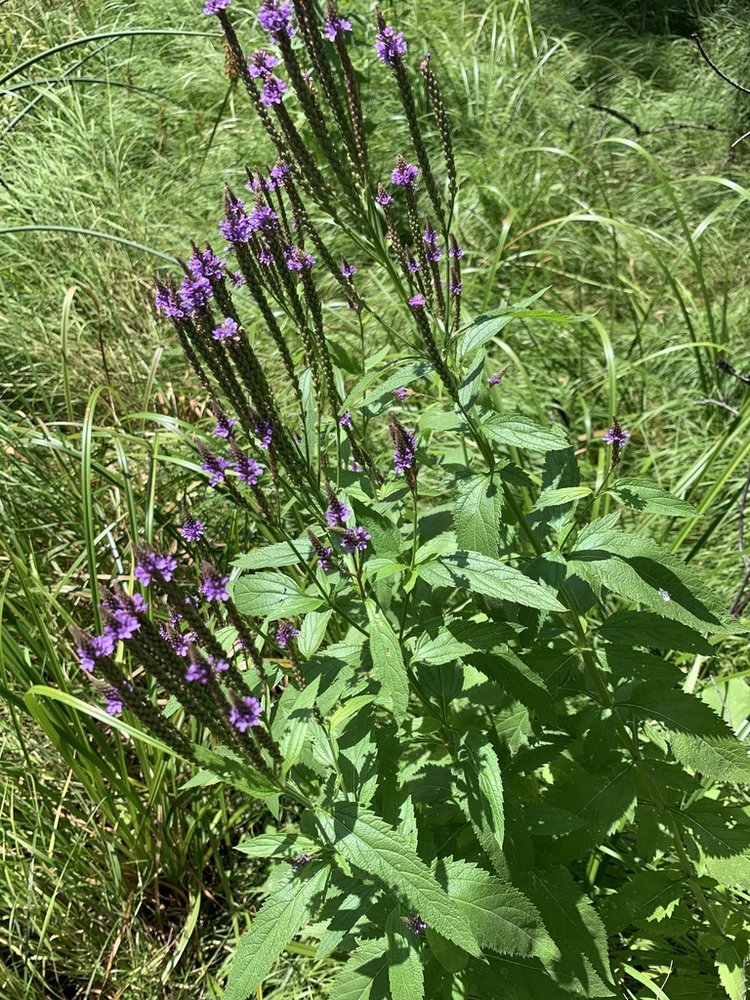
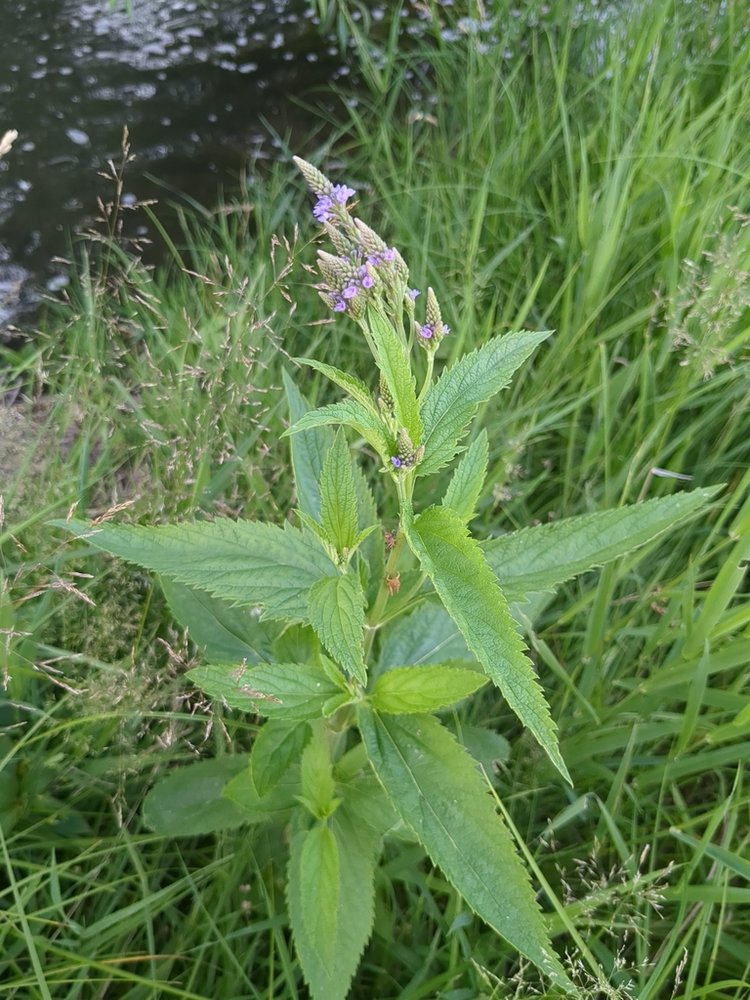
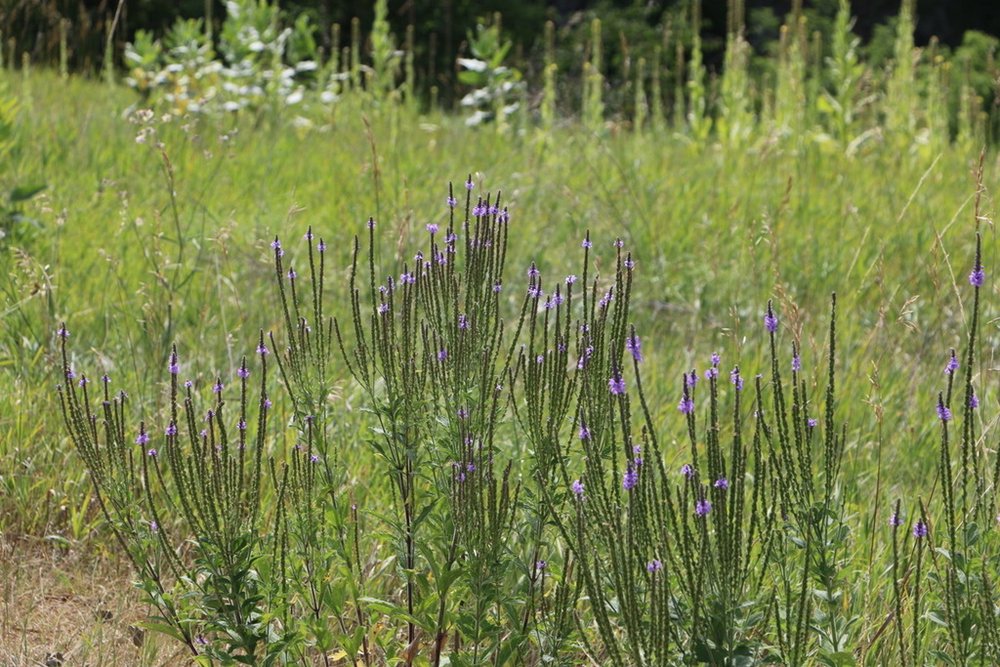
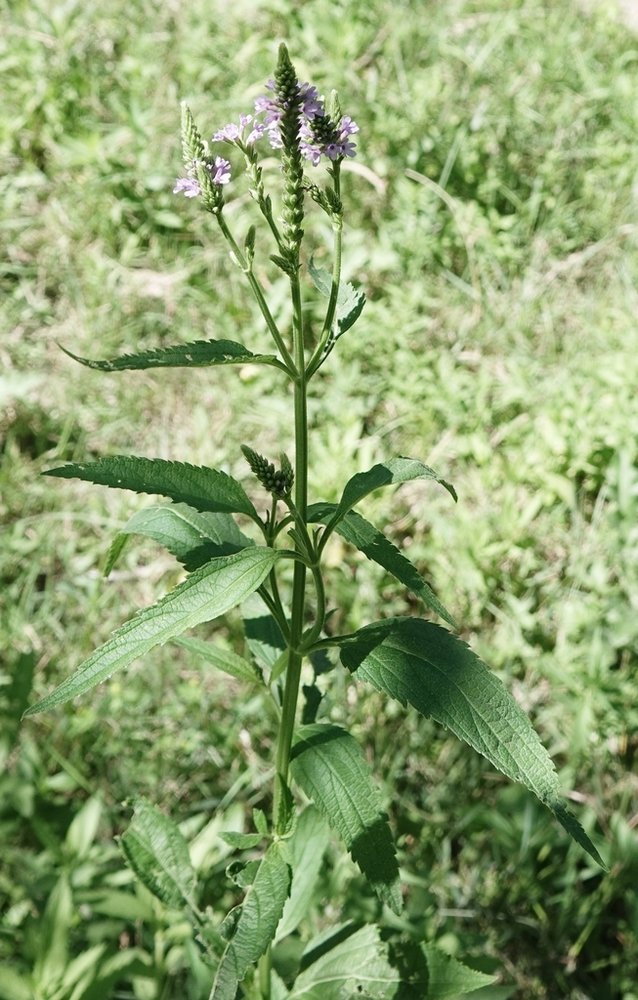
Blue Vervain (Verbena hastata) is a tall native perennial of wet ground, 50–250 cm (20–98 in), whose square stem branches at the top into a candelabra of thin, stiff spikes, each carrying a ring of tiny blue-violet flowers that climbs from the bottom up from June into September. In the Black Hills it grows on creek banks, floodplains and marshes; the National Park Service lists it at Wind Cave and Mount Rushmore, and herbarium specimens come from Pennington, Custer, Lawrence and Fall River counties and from the Bear Lodge Mountains in Wyoming.
Free photos from other sources
| Family | Verbenaceae · Verbena |
|---|---|
| Status | Native perennial |
| Blooms | June into September, in the Hills mostly July and August |
| Height | 50–250 cm (20–98 in) |
| Where | Wet ground in full sun: creek banks, lake shores, marshes, wet meadows, ditches and springs |
| Also called | Swamp Verbena, Swamp Vervain, Blue Verbena, Simpler's Joy, čhaŋȟlóǧaŋ pȟežúta (Lakota), pȟéstola (Lakota) |
| Toxicity | The USDA fact sheet says large doses cause vomiting and diarrhea. |
| Traditional use | Black Elk and Flying By (1998) record that the Lakota used an infusion of the roots and leaves for stomachache, fevers and kidney stones, and ground the seeds into flour. The BRIT ethnobotany database (NAEB) lists a Dakota decoction of the leaves for stomachache and an Omaha tea made from the leaves. |
Roots, seeds & germination
Root: Fibrous roots and rhizomes (horizontal underground stems) that send up new plants, so it often grows in small colonies. SDSU calls it short-lived but quick to reseed.
Seed: Each flower leaves four reddish-brown nutlets up to 2 mm long, held in the persistent calyx, ripening about six weeks after bloom. Sparrows, juncos and cardinals eat them, and the plant readily reseeds itself.
Germination: SDSU says the seed needs a short cold treatment and can be sown in early spring while the ground is still cold, or in fall. The USDA fact sheet stratifies it in wet sand or peat at 3–4 °C (38–40 °F) for three months, then keeps the sown seed well lit at 16–27 °C (60–80 °F). Stem-tip cuttings taken in early spring root in a sand and perlite mix in 4 to 5 weeks.
How do you identify Blue Vervain?
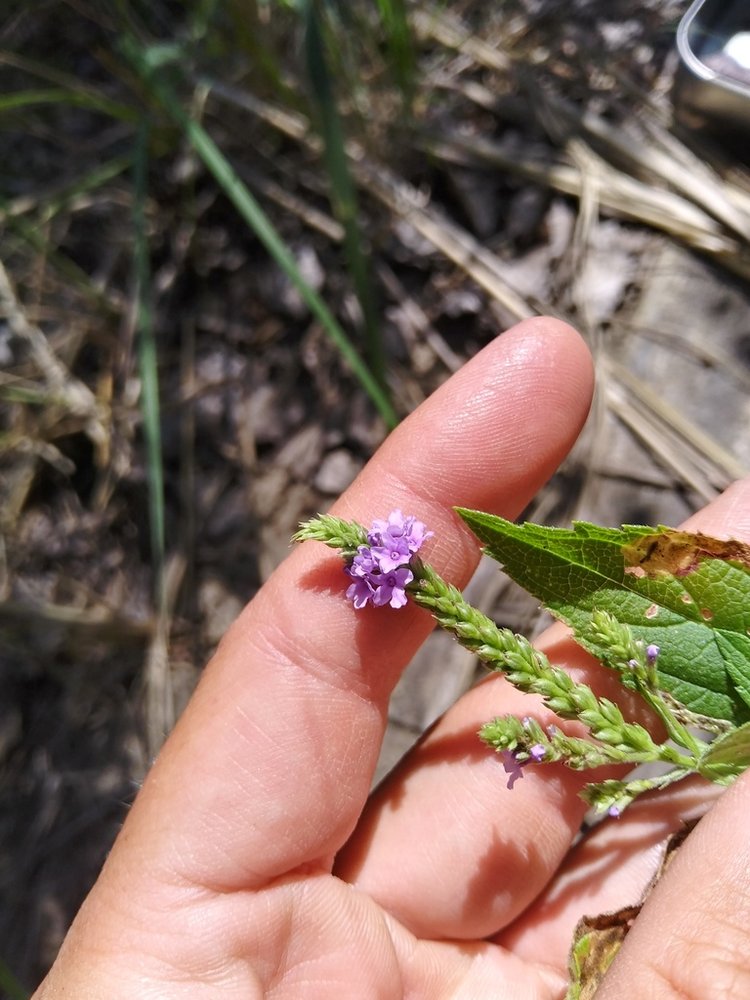
Look for many thin, stiff, pencil-like spikes 5–15 cm (2–6 in) long branching from the top of the plant like a candelabra, each with a ring of open flowers that moves up the spike, with fruit forming below it. The flowers are tiny, about 6 mm (¼ in) across, blue to violet, rarely pink or white, with 5 lobes on a short tube. The stem is square, green to reddish, rough-hairy and usually branched above, and the leaves are opposite, on short stalks, lance-shaped and coarsely toothed, 4–18 cm (1½–7 in) long, rough on top and hairy beneath, some with two lobes at the base. It can be mistaken for Hoary Vervain, which has larger flowers and stalkless, broadly egg-shaped leaves, is densely hairy and prefers drier ground; Blue Vervain's leaves have short but distinct stalks, and it grows in wet places.
When does it bloom?
June into September, in the Hills mostly July and August.
Where does it grow?
Wet ground in full sun or part shade: creek banks, lake shores, marshes, wet meadows, pastures, ditches and springs; SDSU says it grows along streams and springs in all but the northwest corner of South Dakota. Black Hills herbarium labels from 1924 to 2005 record it along streams and brooks, on floodplains, in a marsh, by a stream in a pasture and on roadsides, with specimens from Pennington, Custer, Lawrence and Fall River counties, including Wind Cave and Custer State Park, and from the Bear Lodge Mountains in Crook County, Wyoming. The National Park Service lists it at Wind Cave and Mount Rushmore, and iNaturalist has 22 research-grade Black Hills records, July and August.
Other vervains in this guide
Sources: Verbenaceae: Verbena hastata — SDSU Open PRAIRIE; Verbena hastata (Blue Vervain) — Minnesota Wildflowers; Verbena hastata (Blue verbena) — Kansas Wildflowers and Grasses; Blue Vervain (Verbena hastata) — Illinois Wildflowers; Plant Fact Sheet: Blue Vervain, Verbena hastata (Kirk and Belt 2010) — USDA NRCS; USDA PLANTS Database: Verbena hastata (VEHA2); Verbena hastata — Lady Bird Johnson Wildflower Center; Blue Vervain — Missouri Department of Conservation field guide; NPSpecies checklist, Wind Cave National Park vascular plants; NPSpecies checklist, Mount Rushmore National Memorial vascular plants; GBIF occurrence search: Verbena hastata, South Dakota herbarium specimens; GBIF occurrence search: Verbena hastata, Wyoming herbarium specimens; iNaturalist: research-grade Blue Vervain observations near the Black Hills; Culturally Important Plants of the Lakota (Black Elk and Flying By, 1998), filed with the South Dakota PUC; Native American Ethnobotany Database (BRIT): Verbena hastata.