Vetches of the Black Hills
All 4 vetches in this guide, side by side, A to Z. Compare the photos, bloom time, height and where each grows, then open the one that fits for more photos and the full ID notes. Each plant's page lists its sources.
| Plant | Color | Blooms | Height | Where | How to tell it apart |
|---|---|---|---|---|---|
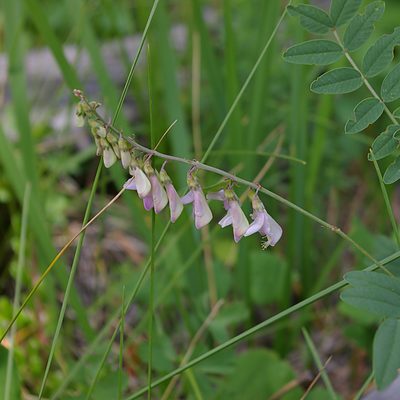 Alpine SweetvetchHedysarum alpinum | Purple, Pink | June into August | 20–70 cm (8–28 in) | Moist to dry openings and edges in pine, spruce, aspen and birch forest, meadows, stream banks and rocky slopes | Look for a clump of several upright or outward-leaning leafy stems from a woody base. The leaves are alternate and pinnately divided, 5–15 cm long, into 7 to 31 narrow elliptic leaflets 10–25 mm long, with the side veins plainly visible and very little hair underneath. The flowers hang in a long one-sided raceme (a spike with the flowers on short equal stalks, all turned to one side) of 20 to 60 pink-purple to pink or white pea flowers, each 9–18 mm long. The fruit settles it: a flat pod pinched into a chain of 2 to 5 rounded, one-seeded joints that break apart rather than splitting open. Northern Sweetvetch, a close relative recorded at Devils Tower, is very hard to tell from it except by the leaves, which have much less visible veins and a hairier underside. Lambert's Crazyweed has no stem, only basal leaves with its flower stalks rising from the base, and cylinder-shaped, silky pods. Canada Milkvetch carries pale yellow to creamy white flowers in dense spike-like clusters and smooth oval pods about 1.3 cm (½ in) long, and American Vetch is a climbing vine whose leaves end in a tendril. |
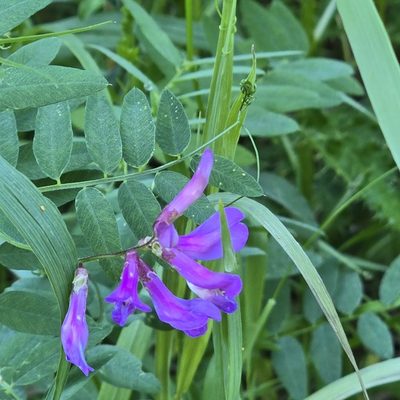 American VetchVicia americana | Purple | Late May into July, with a few into August | 30–100 cm (12–40 in) | Open pine and aspen woods, forest edges, meadows, roadsides and mixed-grass prairie | Each leaf has 8–16 paired leaflets and ends in a thin, curling tendril instead of a last leaflet. At the base of each leaf stalk is a pair of small, sharply toothed flaps (stipules) that often look star-like, a good check when the plant isn't in flower. The 3–9 pea flowers, 1.5–2.5 cm (⅝–1 in) long, sit in a loose cluster on a stalk shorter than the leaf and run from bluish to reddish purple, sometimes pink. Prairie plants are shorter and more upright, with narrow, stiff leaflets. |
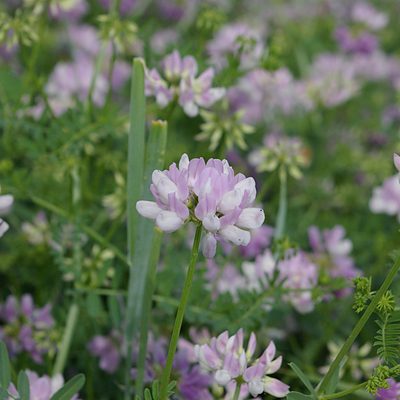 Crown VetchSecurigera varia | Pink | June through September | 30–90 cm (12–36 in) | Roadsides, embankments, old fields, disturbed ground, meadows and stream banks | Look for rounded umbels, clusters in which every flower stalk starts from one point like the spokes of a wheel, of up to about 25 pea flowers, each about 1 cm (½ in) long, with a pink upper petal and paler pink to white lower petals. Each umbel sits on a bare stalk up to 15 cm (6 in) long rising from a leaf joint. The leaves are pinnate (feather-like), with 11 to 25 smooth, oblong leaflets often tipped with a tiny point, and they have no tendrils. After bloom, thin pods up to about 5 cm (2 in) long, beaked at the tip and pinched into one-seeded joints, stand out in a cluster like fingers and ripen reddish brown. The Fire Effects Information System notes that it lacks the tendrils of the true vetches, such as American Vetch, and Illinois Wildflowers notes that its umbels set it apart from other pea-family plants, which mostly bear their flowers in long clusters or, like the clovers, in heads of tiny tubular flowers. |
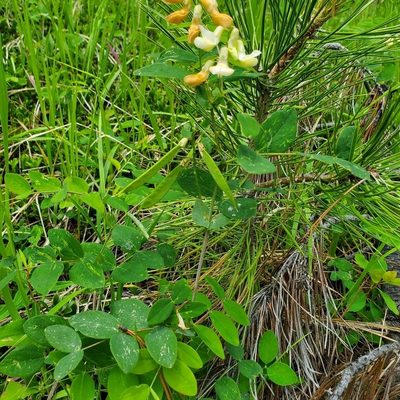 Pale VetchlingLathyrus ochroleucus | Yellow, White | May into July | 30–80 cm (12–32 in) | Moist, open woods and thickets: aspen, birch and spruce stands, shaded pine slopes, creek bottoms and forest edges | Look for creamy white to pale yellow pea flowers, 5 to 10 in a loose cluster on a bare stalk from a leaf axil, each 1.5–2 cm (½–¾ in) long and sometimes turning orange with age. The leaves are alternate, with 3 to 5 pairs of broad, oval, hairless leaflets 2–6 cm (1–2½ in) long, broader and rounder than on most pea-family vines, and each leaf ends in a branched tendril instead of a last leaflet. The surest check is the pair of big leafy flaps (stipules) at the base of each leaf, 2–3 cm (about 1 in) long and shaped like half a heart with a rounded lobe at the bottom; few pea-family plants have stipules that large. The stem is slender, slightly angled but not winged, hairless and clambering, and the pods are flat and hairless, 3–5 cm (1–2 in) long. American Vetch, a pea vine on all four Black Hills park lists, has pink, purple or blue flowers, 2 to 9 in a cluster, 4 to 8 pairs of narrow leaflets about 6 mm (¼ in) wide, and small stipules with three sharp teeth on the lower half. |
Other look-alike groups: 38 groups
- Anemones (4)
- Asters (4)
- Beardtongues (5)
- Buttercups (3)
- Cacti (4)
- Cinquefoils (7)
- Clovers (6)
- Coneflowers (4)
- Currants and gooseberries (5)
- Daisies (5)
- Dandelions (3)
- Docks and buckwheats (4)
- Evening primroses (4)
- Ferns (4)
- Gentians (4)
- Grasses (11)
- Groundsels and ragworts (3)
- Lilies (5)
- Mayflowers and false Solomon's seals (3)
- Milkvetches and locoweeds (12)
- Milkweeds (6)
- Mints (8)
- Mustards (11)
- Orchids (8)
- Paintbrushes (3)
- Pines (3)
- Raspberries and thimbleberries (3)
- Sagebrushes and sageworts (3)
- Sedges (3)
- Speedwells and kittentails (3)
- Sunflowers (4)
- Thistles (6)
- Vervains (3)
- Violets (7)
- Wild lettuces (3)
- Wild onions (3)
- Wild plums and cherries (3)
- Willows (3)