Willows of the Black Hills
All 3 willows in this guide, side by side, A to Z. Compare the photos, bloom time, height and where each grows, then open the one that fits for more photos and the full ID notes. Each plant's page lists its sources.
| Plant | Blooms | Height | Where | How to tell it apart |
|---|---|---|---|---|
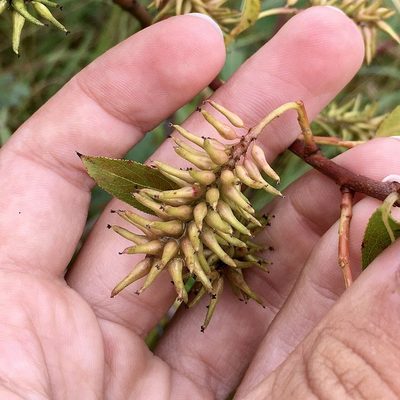 Autumn WillowSalix serissima | Catkins in June and early July, with the leaves; the fruit ripens in late summer and often hangs on into winter | 1–4 m (3–13 ft) | Cold, permanently saturated fens and sedge meadows with peaty soil, fed by springs and seeps | Look for a shrub of wet peat with leaves that shine on top: 4–11 cm (2–4 in) long, lance-shaped, tapering to a point, with fine teeth along a flat edge and no hairs on either side, paler and sometimes faintly whitened underneath. Check the leaf stalk for pairs of tiny round glands by the blade, and note that there are no stipules (leaf-like flaps) at its base, or only tiny ones. Twigs are glossy and hairless, yellow-brown to red-brown. Each male flower has 3 to 9 stamens. The hairless seed capsules are 7–12 mm long and ripen in late summer, later than other willows, and often stay on the shrub over winter. Shining Willow, a close relative that is even rarer in the Black Hills, has longer-tapered leaf tips and shorter capsules, 4–6.5 mm, that usually shed their seed by the end of June. Bebb Willow, which grows with it in the same fens, has dull or slightly glossy leaves with a sunken network of veins on top and usually hairs underneath, and long-beaked capsules 5–9 mm long; its catkins open from April into June. |
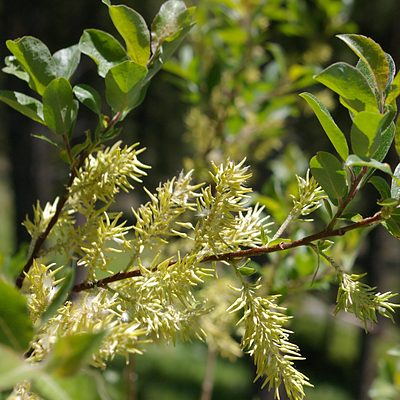 Bebb WillowSalix bebbiana | Catkins from April into June, just before or with the leaves | 1.2–7.6 m (4–25 ft) | Creek banks and floodplains, streamside thickets, wet meadows and fens, lake shores, and meadow edges in pine and aspen forest | Look for a tight clump of several stems with thin, smooth gray bark when young and dark, furrowed bark on old trunks, and hairy twigs that branch off at wide angles. The leaves are 2–9 cm (1–3½ in) long, oval to narrowly oblong with a pointed tip, toothless or with shallow rounded teeth, dull green above with a sunken network of veins, and pale gray-green and hairy below. Male catkins open just before the leaves and female ones with them; each capsule in the loose, hairy female catkin is 5–9 mm long with a long slender beak (beaked willow is another of its names). Older stems can carry diamond-shaped sunken patches where fungi attack at a branch junction, and Bebb Willow is the main source of the carved diamond willow. After Bebb Willow, the willows with the most Black Hills iNaturalist records are Sandbar Willow and Peachleaf Willow. Sandbar Willow (Salix interior) spreads by root suckers into dense stands on sandy floodplains, creek banks and shores and has very narrow leaves, 6–16 cm (2½–6 in) long and only 4–11 mm wide, about the same green on both sides, and it keeps flowering into July. Peachleaf Willow (Salix amygdaloides) grows as a tree 4–20 m (13–65 ft) tall with hairless twigs and hairless, finely toothed, lance-shaped leaves that taper to a long tip and are pale blue-green beneath. Pussy Willow has similar fruits, but its floral bracts are blackish and densely hairy, its flower stalks are 3 mm or shorter, it blooms earlier, and its leaves lack the strong veining. |
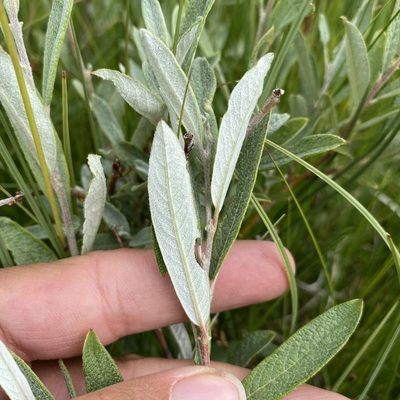 Sageleaf WillowSalix candida | Catkins in May and into June, as the leaves come out | 0.3–1.5 m (1–5 ft), sometimes to 3 m (10 ft) | Open, spring-fed fen meadows on saturated, lime-rich peat | Turn a leaf over: the underside is silvery white with dense, crinkled wool, while the top is dark green with a network of sunken veins. The leaves are narrow, about 5–10 cm (2–4 in) long and under 2 cm wide, with no teeth and edges rolled under, and small hairy stipules (leaf-like flaps) sit at the base of the leaf stalk. New twigs are white-woolly as well. Catkins open as the leaves emerge, the male ones with purple anthers that turn yellow, the female ones with woolly seed capsules 4–6 mm long. The Forest Service says the dense wool on its twigs and leaves sets it apart from other Black Hills willows. Bebb Willow, which grows with it in the same fens, has leaves with white or gray, silky to sparse hairs underneath, sometimes almost none, and long-beaked capsules 5–9 mm long. |
Other look-alike groups: 38 groups
- Anemones (4)
- Asters (4)
- Beardtongues (5)
- Buttercups (3)
- Cacti (4)
- Cinquefoils (7)
- Clovers (6)
- Coneflowers (4)
- Currants and gooseberries (5)
- Daisies (5)
- Dandelions (3)
- Docks and buckwheats (4)
- Evening primroses (4)
- Ferns (4)
- Gentians (4)
- Grasses (11)
- Groundsels and ragworts (3)
- Lilies (5)
- Mayflowers and false Solomon's seals (3)
- Milkvetches and locoweeds (12)
- Milkweeds (6)
- Mints (8)
- Mustards (11)
- Orchids (8)
- Paintbrushes (3)
- Pines (3)
- Raspberries and thimbleberries (3)
- Sagebrushes and sageworts (3)
- Sedges (3)
- Speedwells and kittentails (3)
- Sunflowers (4)
- Thistles (6)
- Vervains (3)
- Vetches (4)
- Violets (7)
- Wild lettuces (3)
- Wild onions (3)
- Wild plums and cherries (3)