Paintbrushes of the Black Hills
All 3 paintbrushes in this guide, side by side, A to Z. Compare the photos, bloom time, height and where each grows, then open the one that fits for more photos and the full ID notes. Each plant's page lists its sources.
| Plant | Color | Blooms | Height | Where | How to tell it apart |
|---|---|---|---|---|---|
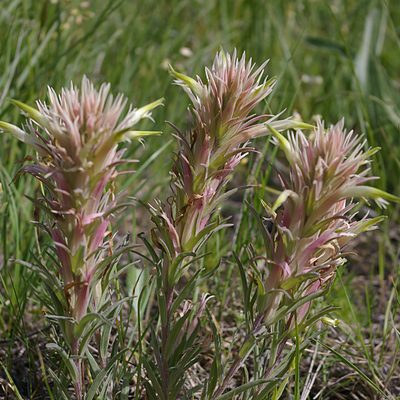 Downy PaintbrushCastilleja sessiliflora | Yellow, Pink | May and June, a few into July | 10–30 cm (4–12 in) | Dry mixed-grass prairie and rocky or red-soil hillsides at low to middle elevations | Look for a low clump of unbranched stems, usually 10–30 cm tall, soft and densely hairy. The leaves are narrow and crowded along the stem, the upper ones often split into three narrow lobes, and the bracts in the spike stay green, sometimes pink-tipped. The key mark is the flowers: slender, curved tubes 3.5–5.5 cm (1.4–2.2 in) long, pale yellow, cream or pinkish, that stick far out past the bracts. Northern Paintbrush, listed by the Forest Service as Sulphur Paintbrush (Castilleja sulphurea), grows in pine and mixed forest of the central and northern Hills, with greenish-yellow flowers in tufted spikes at the tops of upright stems. |
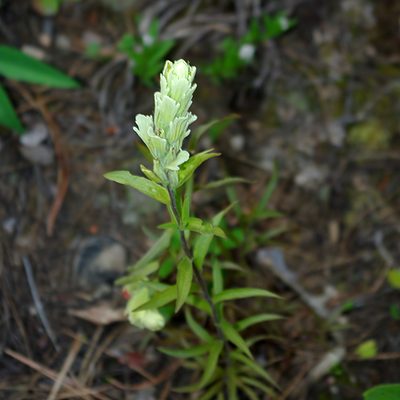 Northern PaintbrushCastilleja septentrionalis | Yellow, White | June through August | 20–60 cm (8–24 in) | Openings, meadows and edges in pine, spruce and mixed forest | Look for one spike at the top of each stiff, upright stem, often several stems together. The color comes from broad, hairy bracts, pale greenish-yellow to cream or nearly white. The true flowers are slim, greenish-white tubes tucked between the bracts, with only their tips peeking out. Stem leaves are lance-shaped, smooth and usually unlobed, with 3–5 parallel-looking veins. Downy Paintbrush grows on dry prairie, is shorter and soft-hairy, has lobed upper leaves and green bracts, and its long, curved flower tubes stick out well past the bracts. The bracts are sometimes tinged with purple. |
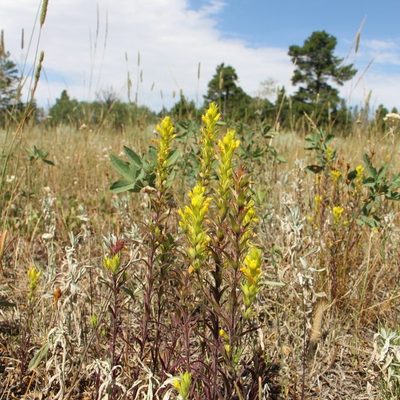 Yellow Owl's-cloverOrthocarpus luteus | Yellow | July and August | 10–40 cm (4–16 in) | Dry open prairie and grassland, grassy meadows and openings in ponderosa pine, from the plains to moderate mountain elevations | Look for one stiff, upright, usually unbranched stem, often deep purplish red, with crowded narrow leaves 1.5–5 cm long that stand up along it; the whole plant is densely covered in glandular (gland-tipped) hairs, and the upper leaves split into three narrow lobes and grade into the bracts of the spike. The spike is leafy and tightly packed, and each flower sits in a green or purple-tinged three-lobed bract. The flowers are golden yellow, 10–15 mm (about ½ in) long, and club-shaped: a puffed-up lower lip with three tiny teeth and a small hooded upper lip with a minute hook at its tip. Minnesota Wildflowers says it is easy to identify from the leafy spikes of club-shaped yellow flowers and the dense glandular hairs, and that it bears little resemblance to true clovers. It is a relative of the paintbrushes in this guide, Downy Paintbrush and Northern Paintbrush. Flora of North America describes owl's-clovers as annuals with a club-shaped flower whose upper lip is a rounded hood, and paintbrushes as plants whose upper lip is drawn out into a two-lobed beak, with bracts that are often brightly colored. |
Other look-alike groups: 38 groups
- Anemones (4)
- Asters (4)
- Beardtongues (5)
- Buttercups (3)
- Cacti (4)
- Cinquefoils (7)
- Clovers (6)
- Coneflowers (4)
- Currants and gooseberries (5)
- Daisies (5)
- Dandelions (3)
- Docks and buckwheats (4)
- Evening primroses (4)
- Ferns (4)
- Gentians (4)
- Grasses (11)
- Groundsels and ragworts (3)
- Lilies (5)
- Mayflowers and false Solomon's seals (3)
- Milkvetches and locoweeds (12)
- Milkweeds (6)
- Mints (8)
- Mustards (11)
- Orchids (8)
- Pines (3)
- Raspberries and thimbleberries (3)
- Sagebrushes and sageworts (3)
- Sedges (3)
- Speedwells and kittentails (3)
- Sunflowers (4)
- Thistles (6)
- Vervains (3)
- Vetches (4)
- Violets (7)
- Wild lettuces (3)
- Wild onions (3)
- Wild plums and cherries (3)
- Willows (3)