Yellow Owl's-clover Orthocarpus luteus
Also called Yellow Owlclover, Golden-tongue Owl-clover, Yellow Owl-clover
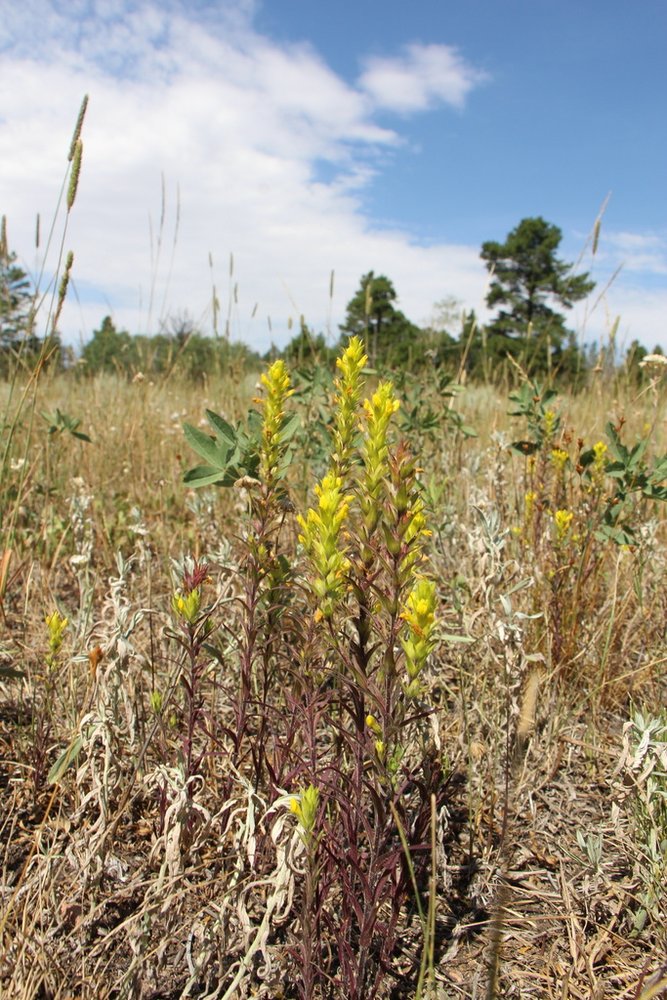
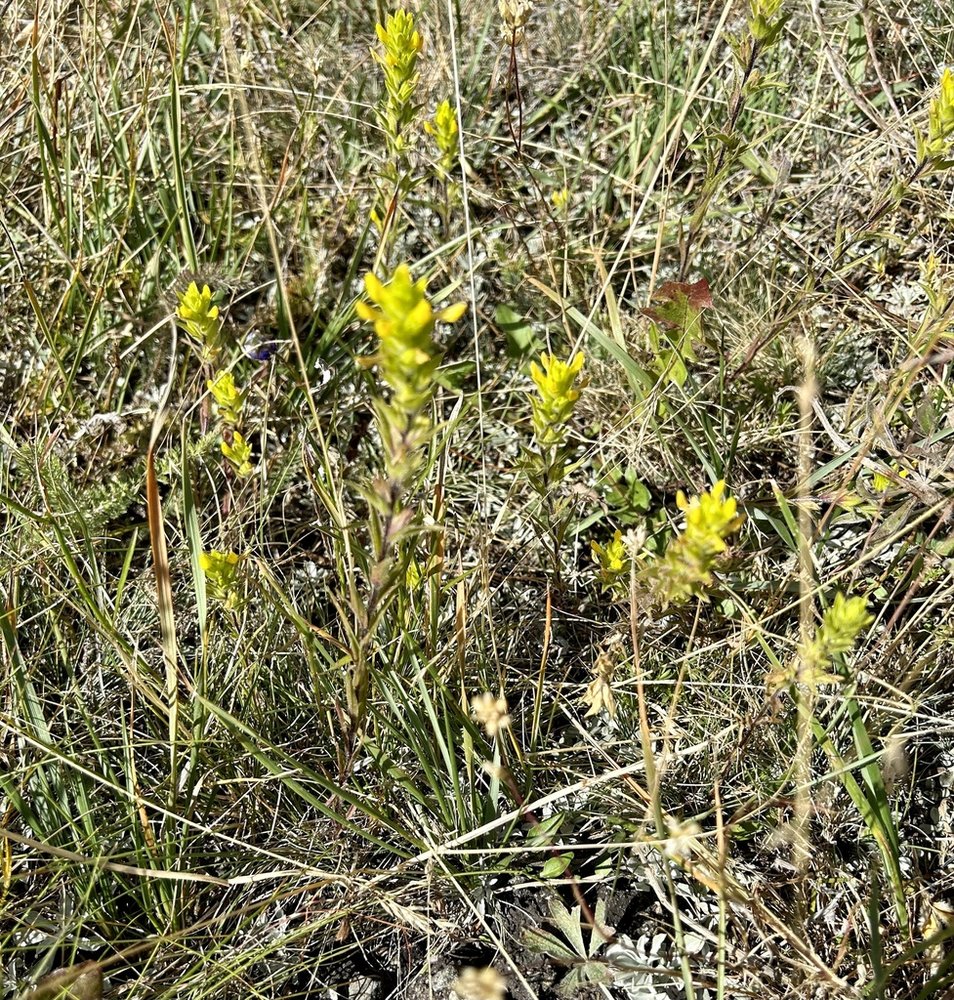
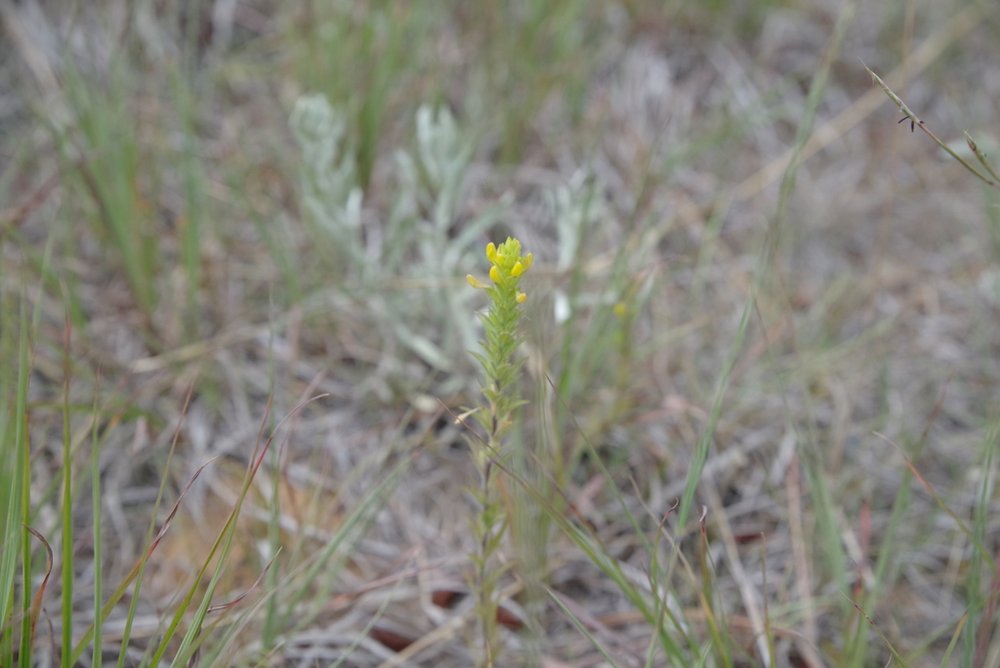
Yellow Owl's-clover (Orthocarpus luteus) is a slim native annual, 10–40 cm (4–16 in) tall, with a single stiff, often purplish stem, narrow leaves and a leafy spike packed with small club-shaped golden-yellow flowers in July and August. Like the paintbrushes it is related to, it is semi-parasitic on the plants around it, and it grows in dry open prairie and grassy openings in the pine forest of the Black Hills, where the National Park Service lists it at Wind Cave, Jewel Cave and Devils Tower.
Free photos from other sources
| Family | Orobanchaceae · Broomrape |
|---|---|
| Status | Native annual |
| Blooms | July and August |
| Height | 10–40 cm (4–16 in) |
| Where | Dry open prairie and grassland, grassy meadows and openings in ponderosa pine, from the plains to moderate mountain elevations |
| Also called | Yellow Owlclover, Golden-tongue Owl-clover, Yellow Owl-clover |
| Note | A hemiparasite: a green plant that also lives partly off the plants around it. Older lists file it in the figwort family, Scrophulariaceae. |
Roots, seeds & germination
Root: Flora of North America calls the genus hemiparasitic (green, but partly living off other plants), and Minnesota Wildflowers says the plant is semi-parasitic on the plants around it, like the paintbrushes, louseworts and broomrapes it is related to.
Seed: The capsule is 5–7 mm long with a notched tip and sits inside the dried calyx. It holds 20 to 35 egg-shaped seeds 1.2–1.5 mm long, yellow or dark brown, with a netted, ridged surface.
How do you identify Yellow Owl's-clover?
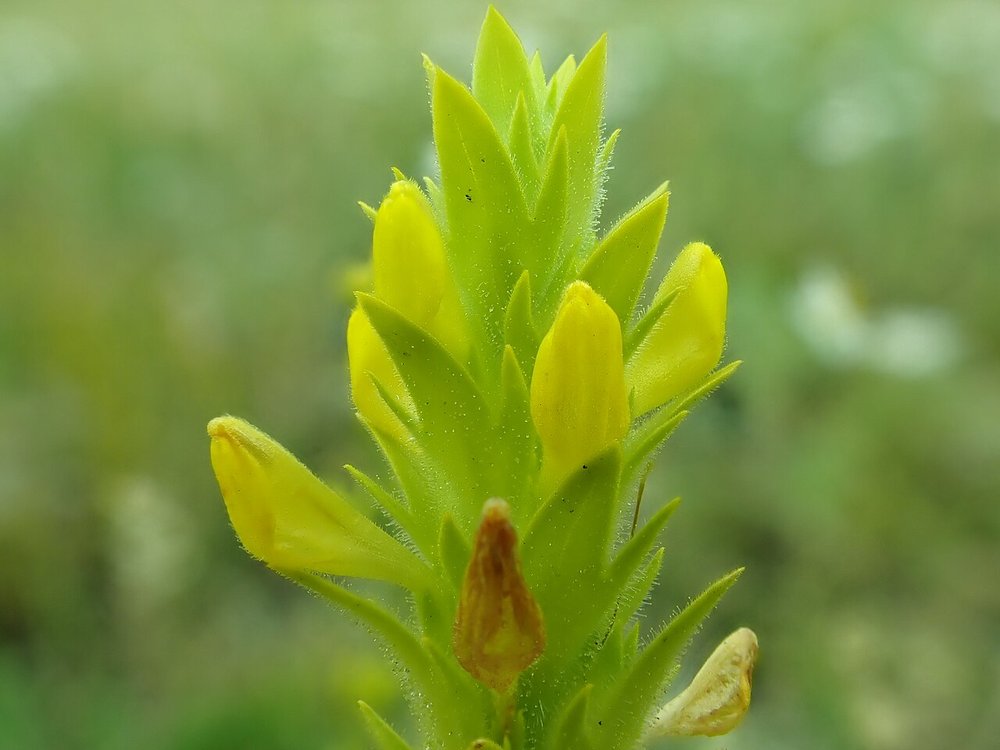
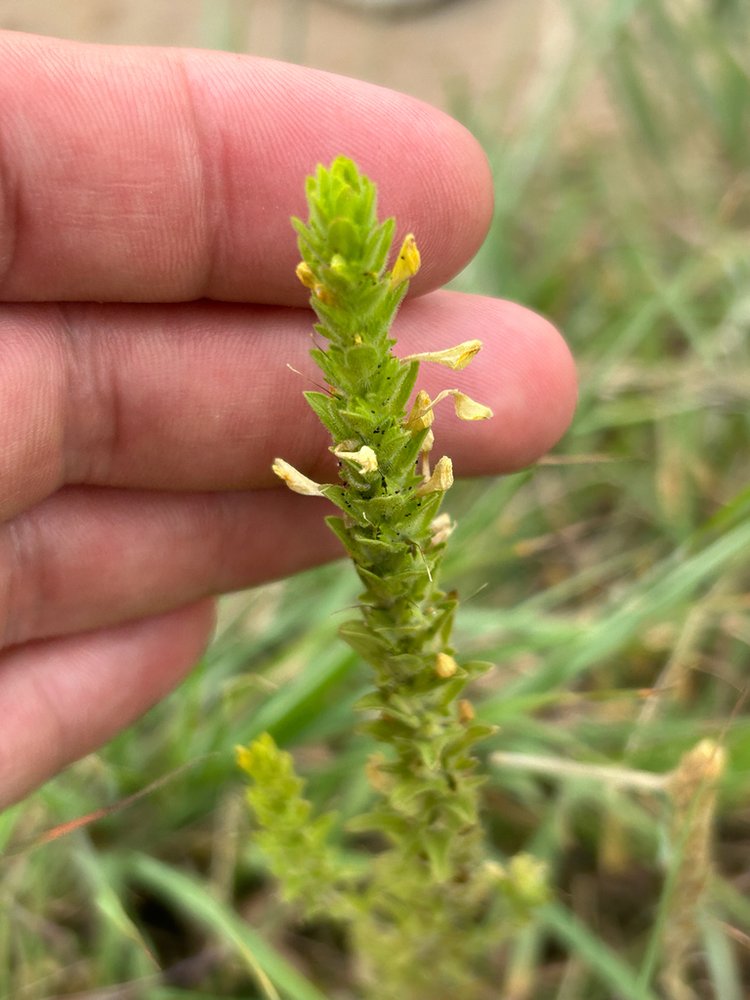
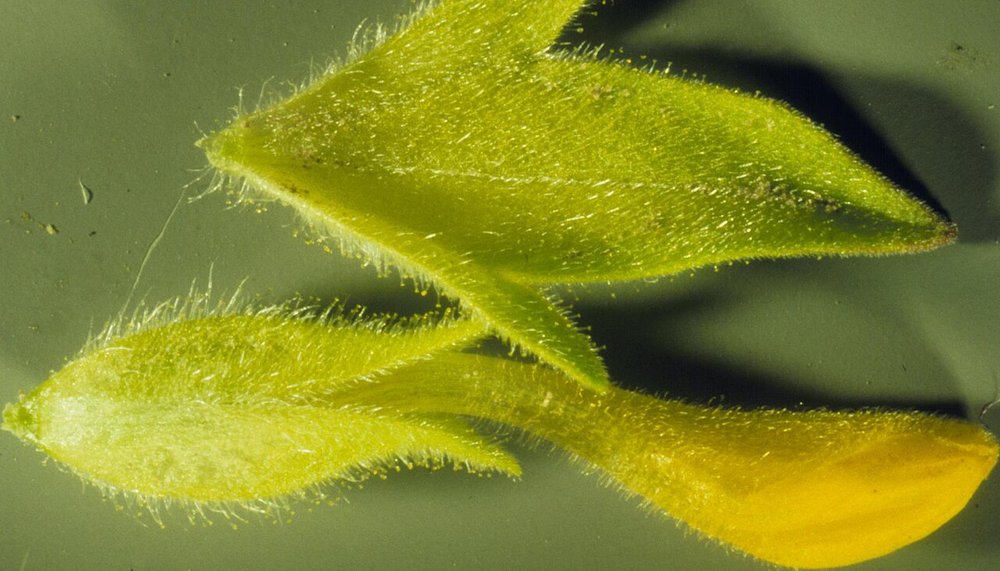
Look for one stiff, upright, usually unbranched stem, often deep purplish red, with crowded narrow leaves 1.5–5 cm long that stand up along it; the whole plant is densely covered in glandular (gland-tipped) hairs, and the upper leaves split into three narrow lobes and grade into the bracts of the spike. The spike is leafy and tightly packed, and each flower sits in a green or purple-tinged three-lobed bract. The flowers are golden yellow, 10–15 mm (about ½ in) long, and club-shaped: a puffed-up lower lip with three tiny teeth and a small hooded upper lip with a minute hook at its tip. Minnesota Wildflowers says it is easy to identify from the leafy spikes of club-shaped yellow flowers and the dense glandular hairs, and that it bears little resemblance to true clovers. It is a relative of the paintbrushes in this guide, Downy Paintbrush and Northern Paintbrush. Flora of North America describes owl's-clovers as annuals with a club-shaped flower whose upper lip is a rounded hood, and paintbrushes as plants whose upper lip is drawn out into a two-lobed beak, with bracts that are often brightly colored.
When does it bloom?
July and August.
Where does it grow?
Dry open prairie and grassland, grassy meadows and openings in ponderosa pine, from the plains to moderate mountain elevations. The National Park Service lists it at Wind Cave, Jewel Cave and Devils Tower, and the 1986 Jewel Cave plant survey records it. Herbarium specimens come from all five Black Hills counties in South Dakota and from Crook and Weston counties in Wyoming, from about 1,220 m (4,000 ft) to 1,690 m (5,550 ft). Their labels give open meadows and grassy parkland in ponderosa pine, a swale in open pine forest, upland grassland on a ridge, grassy meadows, a moist creek-bed meadow, a meadow in Custer State Park, a grassy valley in Wind Cave National Park, and a mountain meadow in the Bear Lodge Mountains.
Other paintbrushes in this guide
Broomrape family (Orobanchaceae): 4 other plants in this guide
Sources: Burke Herbarium Image Collection: Orthocarpus luteus, with the Flora of North America vol. 17 description — University of Washington; Burke Herbarium Image Collection: genus Orthocarpus (Flora of North America genus description); Burke Herbarium Image Collection: genus Castilleja (Flora of North America genus description); Minnesota Wildflowers: Orthocarpus luteus (Yellow Owl-clover); Lady Bird Johnson Wildflower Center: Orthocarpus luteus (ORLU2); ITIS: Orthocarpus luteus, TSN 33437; Wildflowers — Devils Tower National Monument, National Park Service; NPSpecies checklist, Wind Cave National Park vascular plants; NPSpecies checklist, Jewel Cave National Monument vascular plants; NPSpecies checklist, Devils Tower National Monument vascular plants; Marriott and Hartman 1986, A Survey of the Vegetation of Jewel Cave National Monument; GBIF occurrence search: Orthocarpus luteus herbarium specimens, South Dakota and Wyoming; GBIF specimen 2512333000: Pennington County, 2010, open meadow in ponderosa forest; GBIF specimen 2270237790: Pennington County, 1983, ponderosa parkland, 1585 m; GBIF specimen 2512286731: Wind Cave National Park, 1924, grassy valley; GBIF specimen 2859197333: Custer State Park, 1956, meadow; GBIF specimen 3071262478: Bear Lodge Mountains, Crook County, Wyoming, 1965, mountain meadow; GBIF specimen 1258914769: Crook County, Wyoming, 1979, sagebrush plains and pine slope, 1219 m; GBIF specimen 5159120081: Weston County, Wyoming, 2007, steep grassland, 1692 m.