Milkweeds of the Black Hills
All 6 milkweeds in this guide, side by side, A to Z. Compare the photos, bloom time, height and where each grows, then open the one that fits for more photos and the full ID notes. Each plant's page lists its sources.
| Plant | Color | Blooms | Height | Where | How to tell it apart |
|---|---|---|---|---|---|
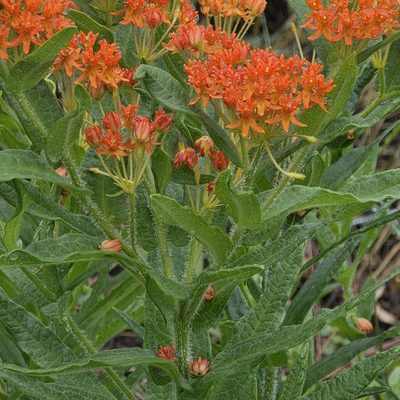 Butterfly MilkweedAsclepias tuberosa | Orange & Red | June into September; SDSU gives May to August for South Dakota | 30–90 cm (12–36 in) | Dry, sandy or rocky ground: prairie, open woodland and roadsides | Break a leaf: the sap is clear and watery. That sets it apart from Showy Milkweed and the other milkweeds in this guide, which the Forest Service says have thick milky sap; Flora of North America calls the clear sap unusual in the genus. The flowers are bright orange, sometimes reddish or yellow, in flat-topped clusters of 5 to 27 at the stem tips and upper leaf axils, each with five petals bent down and a crown of five upright hoods, each hood with a thin horn arching over the center. The stems are stout, erect and densely hairy, one to many from a single crown, with crowded, alternate, nearly stalkless, lance-shaped leaves 2–12 cm (1–5 in) long that are hairy, most of all on the midrib beneath. The pods are hairy, spindle-shaped, 7–14 cm (3–5½ in) long and held upright. |
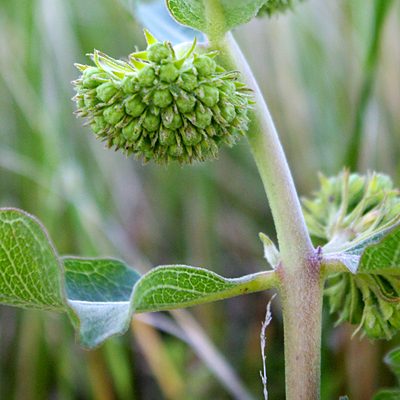 Green Comet MilkweedAsclepias viridiflora | Green & Brown | June into August | 10–60 cm (4–24 in) | Sandy to rocky prairies | Look for round clusters about 2 inches across, growing from the leaf axils on the upper half of the stem, with 20 to 80 pale green flowers whose petals bend straight back and whose hoods have no horns. Leaves are toothless and mostly opposite, ranging from narrow to nearly round, and the broader ones are often very wavy along the edges. |
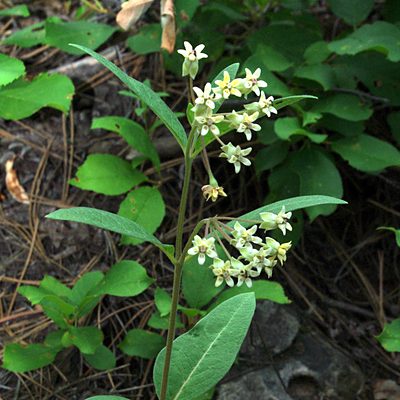 Oval-leaf MilkweedAsclepias ovalifolia | White | June and July, a few into August | 25–60 cm (10–24 in) | Dry sandy or silty ground in prairie, open pine woods, wood edges and roadsides | Look for a short, upright, unbranched plant, 25–60 cm (10–24 in) tall, covered in fine downy hairs, with just a few pairs of opposite oval leaves 5–7.5 cm (2–3 in) long and 2.5–4 cm (1–1½ in) wide on short stalks, green and hairless above and pale and fuzzy underneath. The flowers sit in a rounded, dome-shaped cluster under 5 cm (2 in) wide at the top of the stem, usually with one or two more from the upper leaf axils; each is about 6 mm (¼ in) across, with five petals bent down, white with pale green or pinkish-purple tones, and five clear white hoods about twice the height of the central column, each with a horn, and the whole flower fades to yellow with age. The pods are upright, spindle-shaped and finely hairy, 5–7.5 cm (2–3 in) long. Showy Milkweed has stout hairy stems, opposite oval leaves and pink and cream flowers, the largest of any North American milkweed. Green Comet Milkweed has mostly opposite, usually wavy-edged leaves, dense rounded clusters of 20 to 80 pale green flowers in the upper leaf axils, and hoods with no horns. Plains Milkweed has thread-thin alternate leaves. |
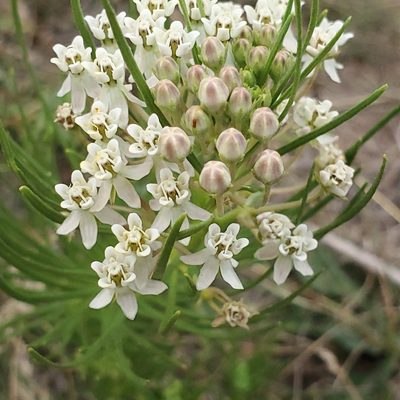 Plains MilkweedAsclepias pumila | White | June into September | 8–30 cm (3–12 in) | Dry, sandy or rocky prairie, hillsides, roadsides, prairie dog towns and open pine woods | Look for an ankle-high plant, 8–30 cm (3–12 in) tall, with one to several stems rising from a branched base, each packed in a tight spiral of thread-thin leaves 1.5–6 cm (⅝–2⅜ in) long and about 1 mm wide, some whorled near the base. The flowers are small, 5–8 mm long, in round clusters of 4–20 in the upper leaf axils and at the stem tips; the five petals bend straight back and are white, sometimes pink-tinged or yellow-green, and five white hoods stand up around the center, each with a needle-like horn 1.5 to 2 times as long as the hood. The stems bleed milky sap, and the pods are erect, slender and spindle-shaped, 4–6 cm (1½–2⅜ in) long. Green Comet Milkweed stands 10–100 cm (4–40 in) tall, with mostly opposite, usually wavy-edged leaves, dense rounded clusters of 20 to 80 pale green flowers in the upper leaf axils, and hoods with no horns. Showy Milkweed has stout hairy stems, opposite oval leaves and large pink and cream flowers. |
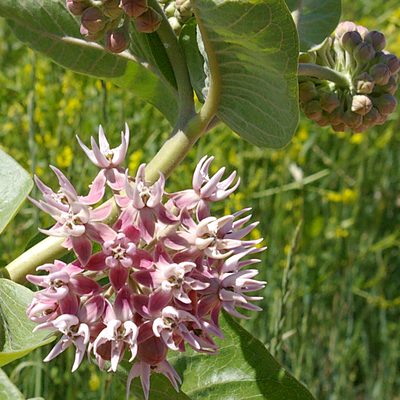 Showy MilkweedAsclepias speciosa | Pink | June and July | 50–100 cm (20–39 in) | Moist prairie, stream and pond banks, roadsides | Each flower has 5 light pink hoods about three times the length of the central column, with slender horns that curve inward but do not touch. Leaves are opposite, oval, up to 8 inches long, with a reddish midvein and a hairy underside. Common Milkweed is the usual look-alike, but its petal lobes are shorter and wider. |
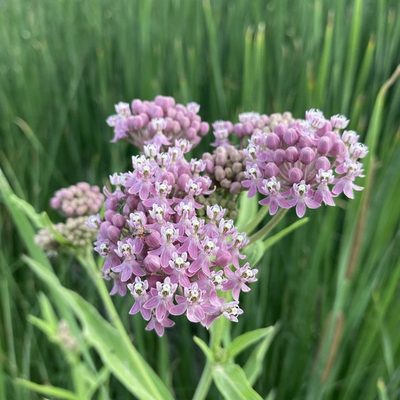 Swamp MilkweedAsclepias incarnata | Pink | June into September | 70–200 cm (28–79 in) | Marshes, wet meadows, stream banks, lake and pond edges and ditches, in full sun | Look for rounded clusters of 10 to 40 small flowers, 5–8 cm (2–3 in) across, at the top of a stem that usually branches near the top. Each flower is about 1 cm (⅜ in) tall: five bright pink petals bend sharply back, and above them sit five pinkish or whitish hoods, each with a needle-like white horn curving over the short central column. The leaves grow in pairs, narrow and lance-shaped, 5–15 cm (2–6 in) long but only 1–3 cm (⅜–1¼ in) wide, hairless and smooth-edged, on stalks under 2 cm (¾ in). The stem is mostly hairless, 70–200 cm (2–6½ ft) tall, and every part bleeds white milky juice when broken. The pods are slender and upright, 5–8 cm (2–3 in) long, tapered at both ends. Minnesota Wildflowers says the long, narrow leaves set it apart from the other pink-flowered milkweeds; Showy Milkweed has broad oval leaves 8–20 cm (3–8 in) long and 2.5–10 cm (1–4 in) wide, thickly hairy underneath, and Common Milkweed is shorter, less branched and wider-leaved. |
Other look-alike groups: 38 groups
- Anemones (4)
- Asters (4)
- Beardtongues (5)
- Buttercups (3)
- Cacti (4)
- Cinquefoils (7)
- Clovers (6)
- Coneflowers (4)
- Currants and gooseberries (5)
- Daisies (5)
- Dandelions (3)
- Docks and buckwheats (4)
- Evening primroses (4)
- Ferns (4)
- Gentians (4)
- Grasses (11)
- Groundsels and ragworts (3)
- Lilies (5)
- Mayflowers and false Solomon's seals (3)
- Milkvetches and locoweeds (12)
- Mints (8)
- Mustards (11)
- Orchids (8)
- Paintbrushes (3)
- Pines (3)
- Raspberries and thimbleberries (3)
- Sagebrushes and sageworts (3)
- Sedges (3)
- Speedwells and kittentails (3)
- Sunflowers (4)
- Thistles (6)
- Vervains (3)
- Vetches (4)
- Violets (7)
- Wild lettuces (3)
- Wild onions (3)
- Wild plums and cherries (3)
- Willows (3)