Daisies of the Black Hills
All 5 daisies in this guide, side by side, A to Z. Compare the photos, bloom time, height and where each grows, then open the one that fits for more photos and the full ID notes. Each plant's page lists its sources.
| Plant | Color | Blooms | Height | Where | How to tell it apart |
|---|---|---|---|---|---|
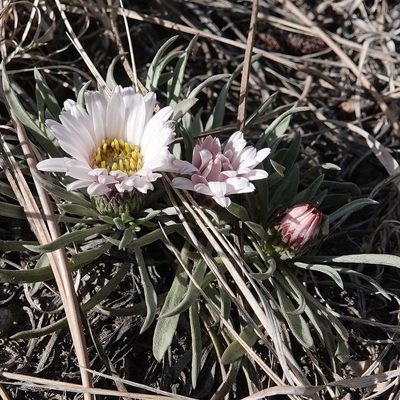 Easter DaisyTownsendia exscapa | White, Pink | Late March into May, one of the first flowers of spring | 2–8 cm (1–3 in) | Dry open prairie, eroding clay and limestone slopes, gravelly hills, sandy ground and openings in pine forest | Look for a daisy with no visible stem: the heads, 2.5–4 cm (1–1½ in) across, sit directly in a crowded tuft of narrow, grass-like leaves 1–5 cm (½–2 in) long that are covered in stiff or silky flattened hairs. Each head has 20 to 40 narrow white to pink rays, often with a dark stripe on the underside, around a yellow center, and the rays curl under at night. Under the head, the bracts overlap in 4 to 7 rows, narrow and pointed with purple tips and hairy edges, but not ending in a tuft of hairs. The plant grows from a woody taproot and a branched crown and forms small mats. Hooker's Townsend Daisy, a rarer relative in the Hills, looks much like it. |
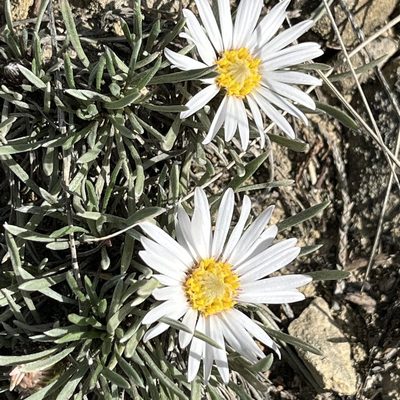 Hooker's Townsend DaisyTownsendia hookeri | White, Pink | April into June | 1–3 cm (0.5–1 in) | Sparse grassland, bare ground, gravelly benches and sandy slopes | The whole plant is a tight cushion of narrow, silvery-hairy, fleshy leaves 5–30 mm (0.2–1.2 in) long, and the flower heads sit on it with almost no stalk. Each head is 8–18 mm (0.3–0.7 in) across the cup of bracts, with 15 to 35 white rays (pink on some plants) 8–12 mm (0.3–0.5 in) long around a yellow center. The cup of bracts under the head is 7–12 mm (0.3–0.5 in) high, and each bract tapers to a fine point with a tuft of hairs at the tip and hairy edges. Easter Daisy (Townsendia exscapa) grows in the same kind of grassland and looks much alike, but its heads are bigger, with a bract cup 12–20 mm (0.5–0.8 in) high and rays 12–18 mm (0.5–0.7 in) long, its bracts have hairy edges but no tuft of hairs at the tip, and its leaves are longer, 10–40 mm (0.4–1.6 in), and not fleshy. |
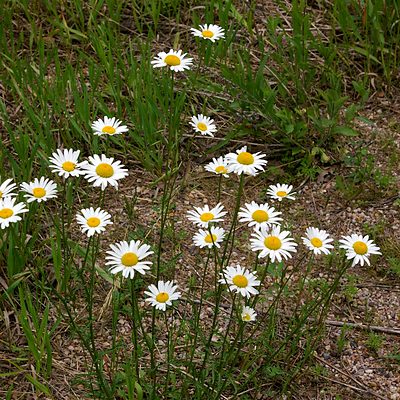 Oxeye DaisyLeucanthemum vulgare | White | May into August | 20–80 cm (8–31 in) | Disturbed prairie, grasslands, meadows, fields and roadsides | Look for a single flower head on a long, nearly bare stalk, with 15 to 35 white rays around a golden-yellow button center, and spoon-shaped lower leaves with narrow lobes or large teeth. Fleabanes have many very thin white rays, and chamomiles have very fine, thin leaves. |
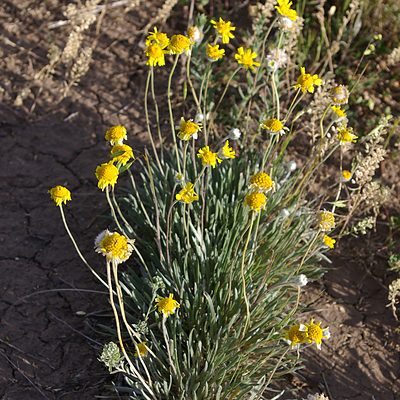 Stemless Four-nerve DaisyTetraneuris acaulis var. acaulis | Yellow | Mostly May into July, peaking in June, with a few into October | 10–30 cm (4–12 in) | Dry rocky ridges, limestone outcrops, rocky hillsides and roadsides | Look for a tuft of narrow, spoon- to strap-shaped leaves, 1.5–8 cm (½–3 in) long, all at the base and covered with flat-lying silky hairs that make them look silvery. Each bare, silky stalk holds one head, with 8–14 yellow rays 9–15 mm (⅜–⅝ in) long around a yellow button center; each ray has four fine parallel veins, which give the plant its name. The bracts under the head are densely hairy. |
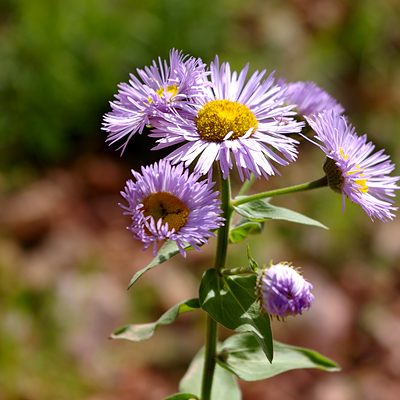 Threenerve FleabaneErigeron subtrinervis | Purple | July and August | Up to 90 cm (36 in) | Meadows and open pine and mixed forest | Look for heads with 100 to 150 thin rays, far more than an aster's, in pale purple to lavender around a yellow center. Each leaf has 3 veins, the center one strongest, with fine hairs along the edges and on both faces. Showy Fleabane is almost identical, but its leaves have hairs only along the edges. |
Other look-alike groups: 38 groups
- Anemones (4)
- Asters (4)
- Beardtongues (5)
- Buttercups (3)
- Cacti (4)
- Cinquefoils (7)
- Clovers (6)
- Coneflowers (4)
- Currants and gooseberries (5)
- Dandelions (3)
- Docks and buckwheats (4)
- Evening primroses (4)
- Ferns (4)
- Gentians (4)
- Grasses (11)
- Groundsels and ragworts (3)
- Lilies (5)
- Mayflowers and false Solomon's seals (3)
- Milkvetches and locoweeds (12)
- Milkweeds (6)
- Mints (8)
- Mustards (11)
- Orchids (8)
- Paintbrushes (3)
- Pines (3)
- Raspberries and thimbleberries (3)
- Sagebrushes and sageworts (3)
- Sedges (3)
- Speedwells and kittentails (3)
- Sunflowers (4)
- Thistles (6)
- Vervains (3)
- Vetches (4)
- Violets (7)
- Wild lettuces (3)
- Wild onions (3)
- Wild plums and cherries (3)
- Willows (3)