Easter Daisy Townsendia exscapa
Also called Stemless Townsend Daisy, Townsend's Daisy, Stemless Townsendia, Silky Townsend-daisy, iȟ'éȟ'e čhaŋȟlóǧaŋ (Lakota)
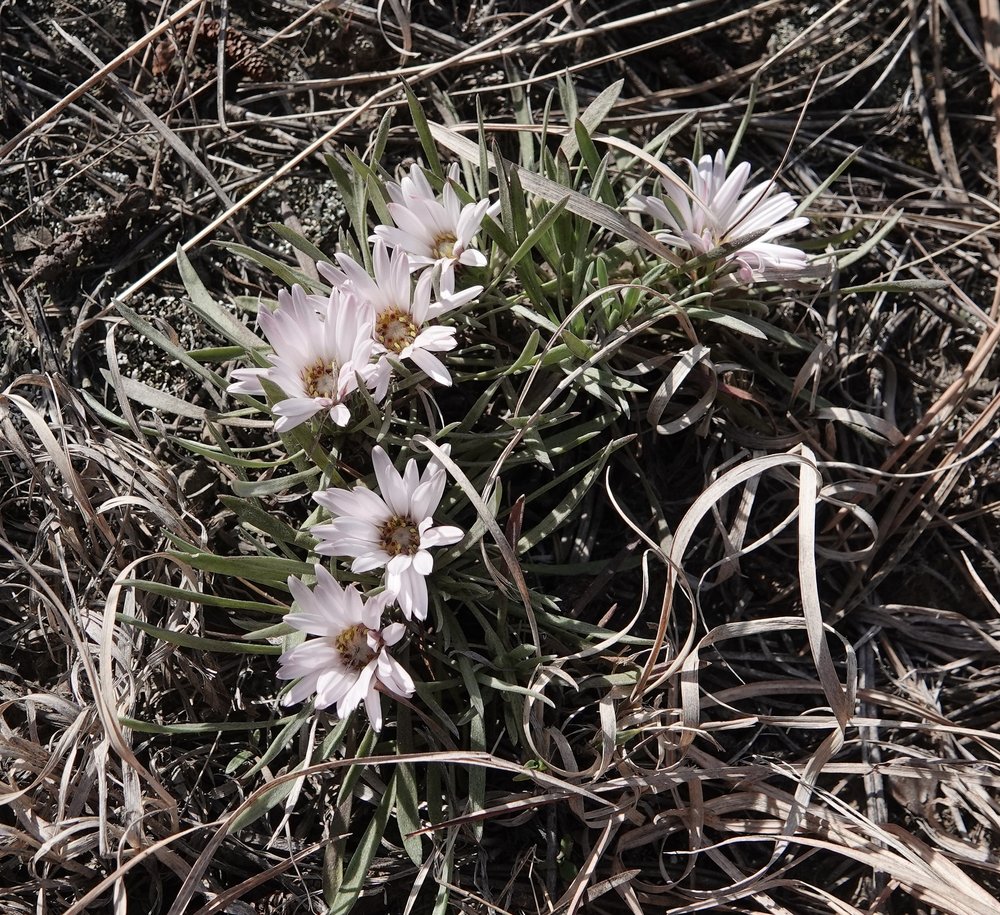
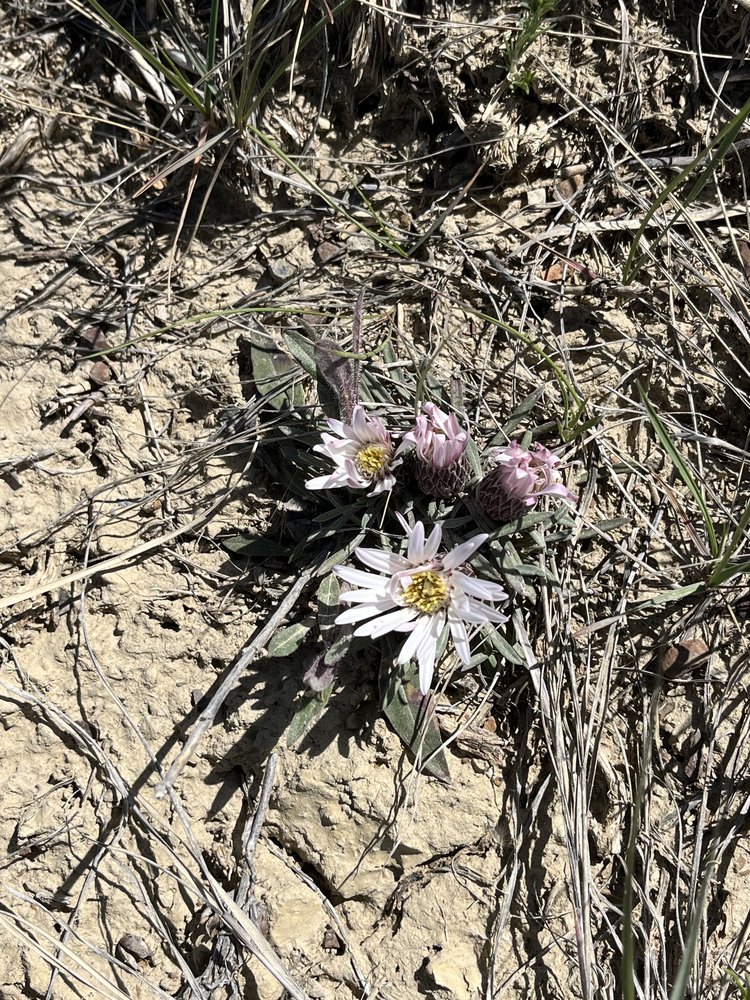
Easter Daisy (Townsendia exscapa) is a native perennial of the aster family that forms a low cushion of narrow, silky-hairy leaves only 2–8 cm (1–3 in) high, with daisy heads 2.5–4 cm (1–1½ in) across sitting right on the leaves: 20 to 40 white to pink rays around a yellow center. It is one of the first flowers of spring, blooming from late March into May on dry prairie, eroded clay and gravel slopes and openings in pine forest, and in the Black Hills the National Park Service lists it at Wind Cave and Devils Tower.
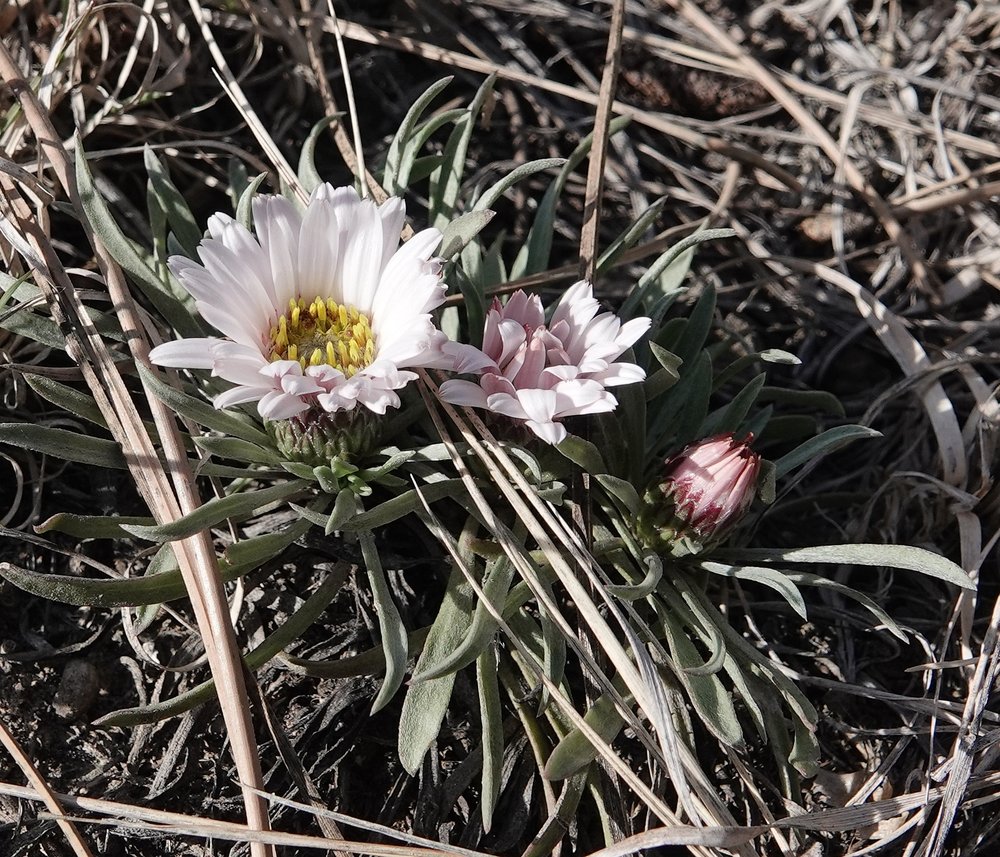
Free photos from other sources
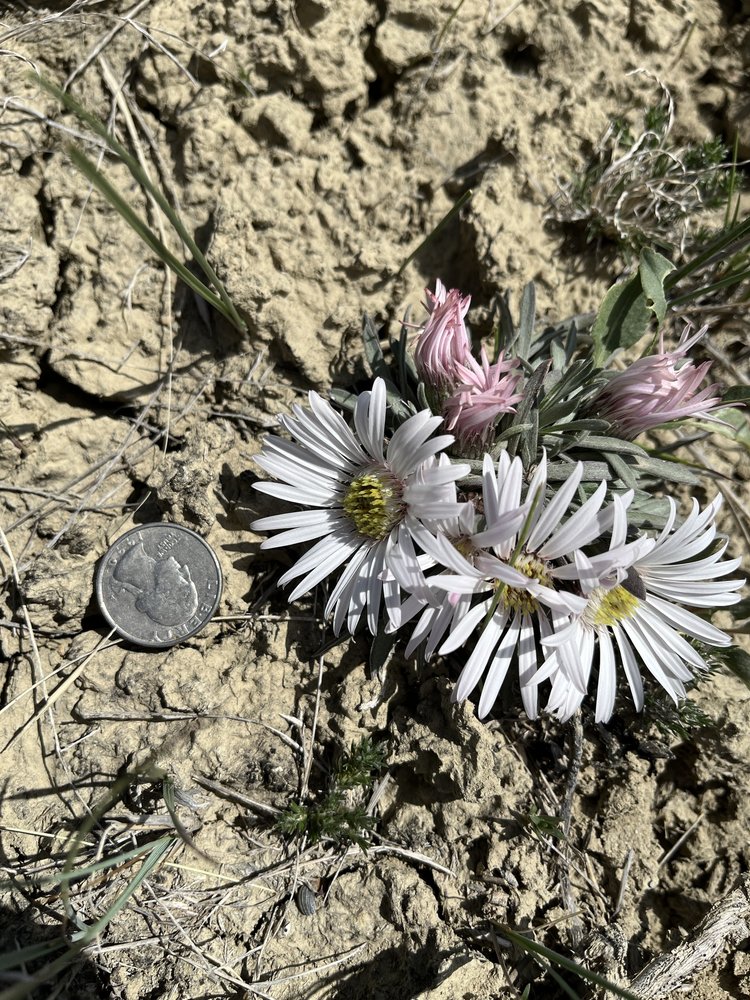
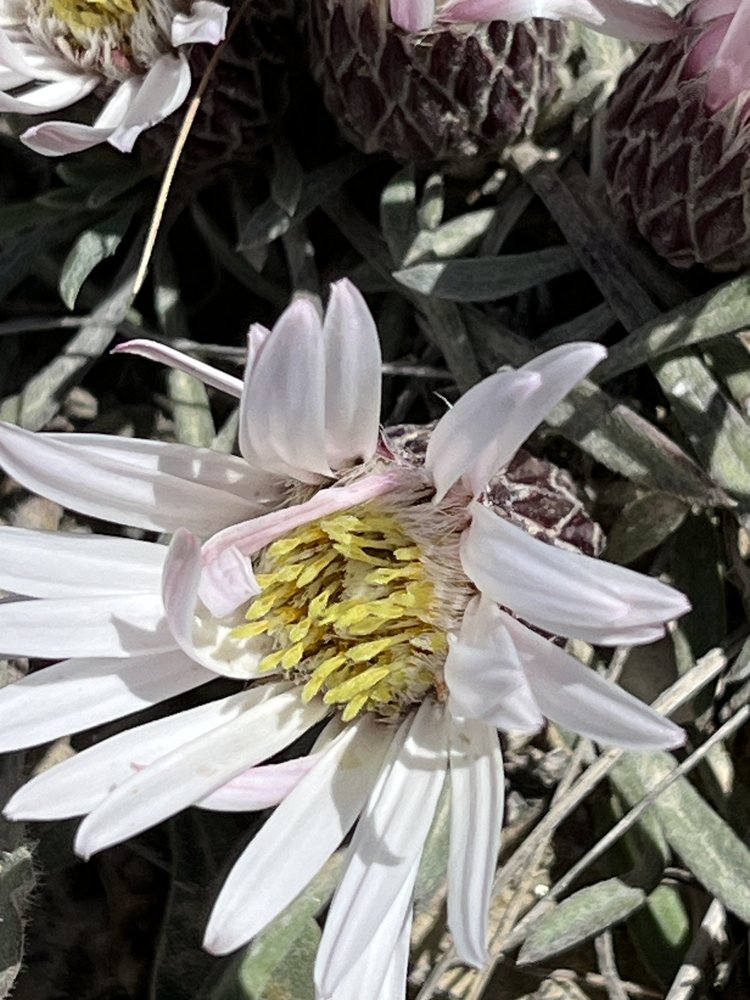
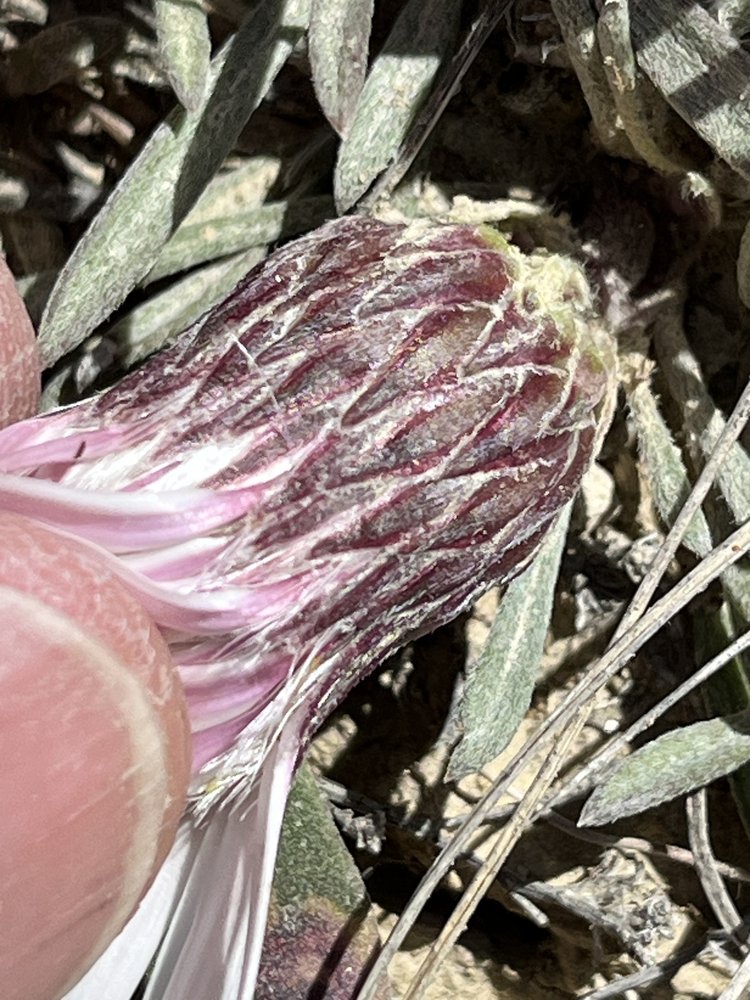
| Family | Asteraceae · Aster |
|---|---|
| Status | Native perennial |
| Blooms | Late March into May, one of the first flowers of spring |
| Height | 2–8 cm (1–3 in) |
| Where | Dry open prairie, eroding clay and limestone slopes, gravelly hills, sandy ground and openings in pine forest |
| Also called | Stemless Townsend Daisy, Townsend's Daisy, Stemless Townsendia, Silky Townsend-daisy, iȟ'éȟ'e čhaŋȟlóǧaŋ (Lakota) |
| Synonym | Townsendia sericea, Aster exscapus |
| Traditional use | Black Elk and Flying By (1998) say the Lakota know it as one of the first flowers of spring. Kansas Wildflowers reports that the Blackfeet made a root decoction to treat tired horses. Moerman's database records that the Ramah Navajo chewed the plant, or took an infusion of it, to ease childbirth (Vestal 1952). |
| Note | South Dakota's Natural Heritage Program ranks it S4? and calls it uncommon in the grasslands of western South Dakota. |
Traditional use: first drafted by Google AI, then checked against the sources on this page.
Roots, seeds & germination
Root: A woody taproot topped by a branched crown, from which the plant spreads into a small mat.
Seed: Each head makes flattened, hairy seeds 3.5–6 mm long, each tipped with a pappus of 20 to 30 stiff bristles 6–11 mm long, about twice the seed's length. The seed heads look like dandelion puffballs and ripen in May.
Germination: SDSU says the seeds germinate under moist, cold conditions, and recommends collecting them in May and growing the plant in well-drained sandy or rocky soil in full sun to part shade.
How do you identify Easter Daisy?
Look for a daisy with no visible stem: the heads, 2.5–4 cm (1–1½ in) across, sit directly in a crowded tuft of narrow, grass-like leaves 1–5 cm (½–2 in) long that are covered in stiff or silky flattened hairs. Each head has 20 to 40 narrow white to pink rays, often with a dark stripe on the underside, around a yellow center, and the rays curl under at night. Under the head, the bracts overlap in 4 to 7 rows, narrow and pointed with purple tips and hairy edges, but not ending in a tuft of hairs. The plant grows from a woody taproot and a branched crown and forms small mats. Hooker's Townsend Daisy, a rarer relative in the Hills, looks much like it.
When does it bloom?
Late March into May, one of the first flowers of spring.
Where does it grow?
Dry, open ground: prairie and plains, eroding clay and limestone slopes, gravelly hills, sandy soil and openings in pine forest, from the plains at the foot of the Hills, about 1,000 m (3,300 ft), to about 1,830 m (6,000 ft) on specimen labels. The National Park Service lists it as present at Wind Cave and Devils Tower, and the Devils Tower native plants page lists it among the wildflowers seen along its trails. Herbarium specimens from 1924 to 2002 come from Pennington, Meade, Fall River, Custer and Lawrence counties and from Crook and Weston counties in Wyoming, with labels naming prairie, an eroded clay slope, sunny semi-barren slopes, sandy soil near Devils Tower, pine forest, and open deciduous woods in a shallow ravine in the Bear Lodge Mountains.
Other daisies in this guide
Aster family (Asteraceae): 62 other plants in this guide
- Aromatic Aster
- Arrowleaf Balsamroot
- Arrowleaf Sweet Coltsfoot
- Bachelor's Button
- Balsam Ragwort
- Black-eyed Susan
- Blanket Flower
- Blue Lettuce
- Broom Snakeweed
- Bull Thistle
- Canada Hawkweed
- Canada Lettuce
- Canada Thistle
- Chicory
- Common Burdock
- Common Dandelion
- Common Sunflower
- Common Tansy
- Common Yarrow
- Curlycup Gumweed
- Cutleaf Coneflower
- Dotted Gayfeather
- Drummond's Thistle
- False Boneset
- Fetid Marigold
- Field Pussytoes
- Fringed Sagewort
- Hairy Golden Aster
- Heart-leaved Arnica
- Hooker's Townsend Daisy
- Horseweed
- Jerusalem Artichoke
- Lambstongue Groundsel
- Maximilian Sunflower
- Missouri Goldenrod
- Mountain Dandelion
- Musk Thistle
- Oxeye Daisy
- Pearly Everlasting
- Pineapple Weed
- Prairie Coneflower
- Prairie False Dandelion
- Purple Coneflower
- Rocky Mountain Blazing Star
- Rosy Pussytoes
- Rubber Rabbitbrush
- Rush Skeletonplant
- Scotch Thistle
- Silver Sagebrush
- Smooth Blue Aster
- Spotted Joe-Pye Weed
- Stemless Four-nerve Daisy
- Stiff Goldenrod
- Stiff Sunflower
- Threenerve Fleabane
- Wavyleaf Thistle
- Western Ragweed
- White Hawkweed
- White Prairie Aster
- White Sagebrush
- Woolly Groundsel
- Yellow Salsify
Sources: SDSU Open PRAIRIE: Asteraceae: Townsendia exscapa (R. Neil Reese); USDA PLANTS Database: Townsendia exscapa (TOEX2); GBIF species page: Townsendia exscapa (Richards.) Porter; Flora of North America Vol. 20: Townsendia exscapa, eFloras; Montana Field Guide: Silky Townsend-daisy, Townsendia exscapa; Kansas Wildflowers and Grasses: Townsendia exscapa, Easter daisy; South Dakota Game, Fish and Parks: Rare Plants of South Dakota; NPSpecies checklist, Wind Cave National Park vascular plants; NPSpecies checklist, Devils Tower National Monument vascular plants; National Park Service, Devils Tower National Monument: Native Plants; GBIF occurrence search: Townsendia exscapa herbarium specimens, South Dakota and Wyoming; Culturally Important Plants of the Lakota (Black Elk and Flying By, 1998), filed with the South Dakota PUC; Moerman, Native American Ethnobotany database: Townsendia exscapa.