Drummond's Thistle Cirsium drummondii
Also called Dwarf Thistle, Short-stemmed Thistle
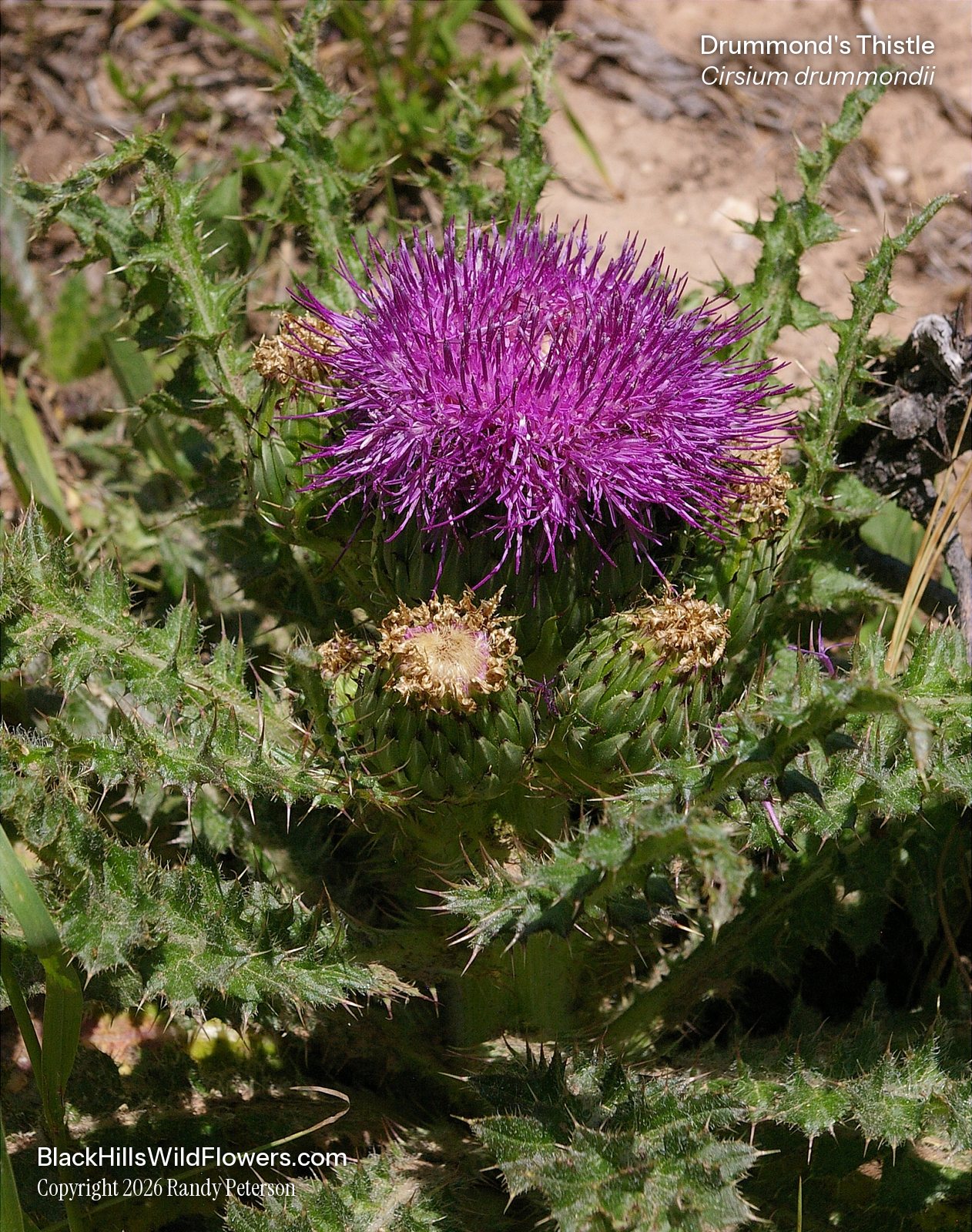
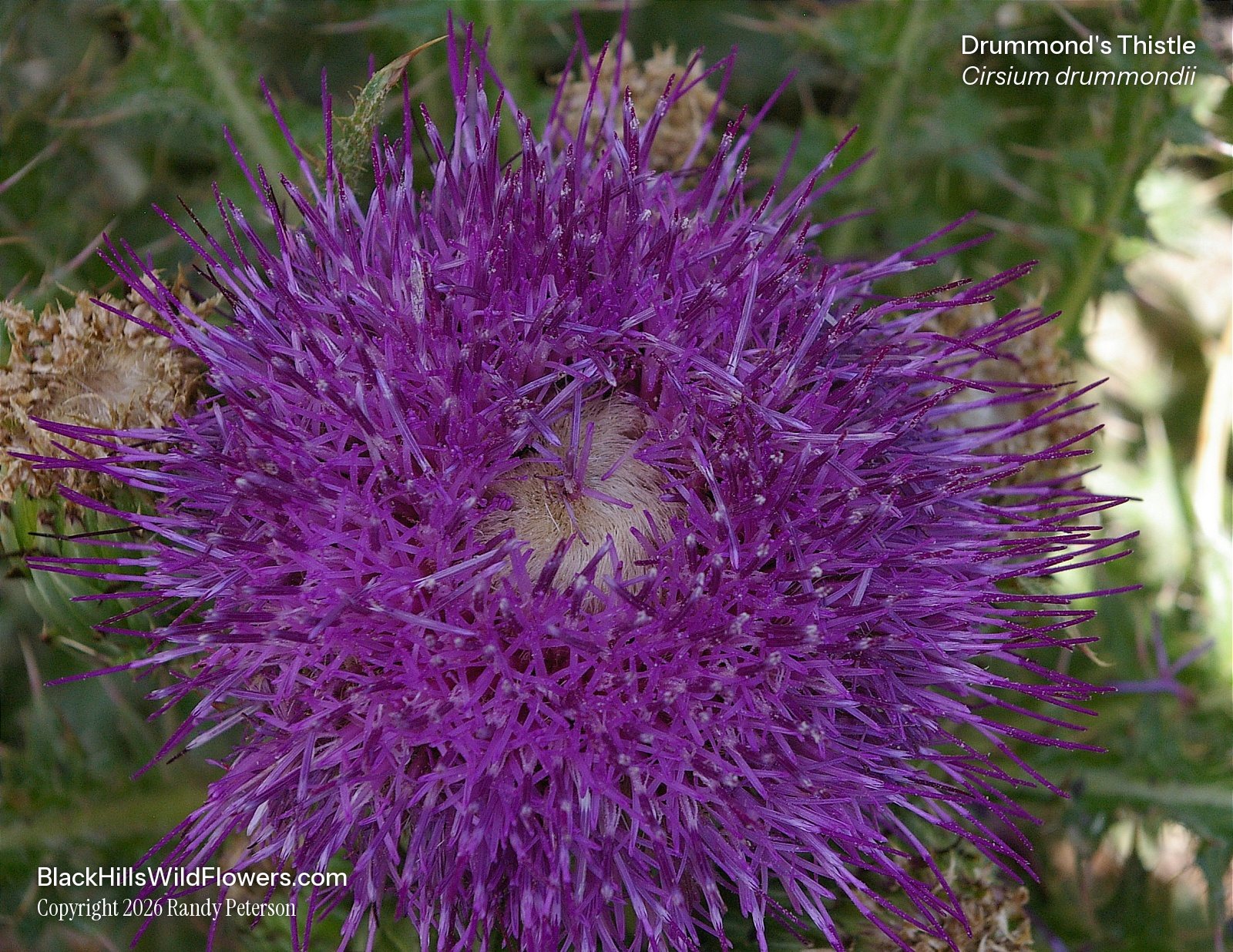
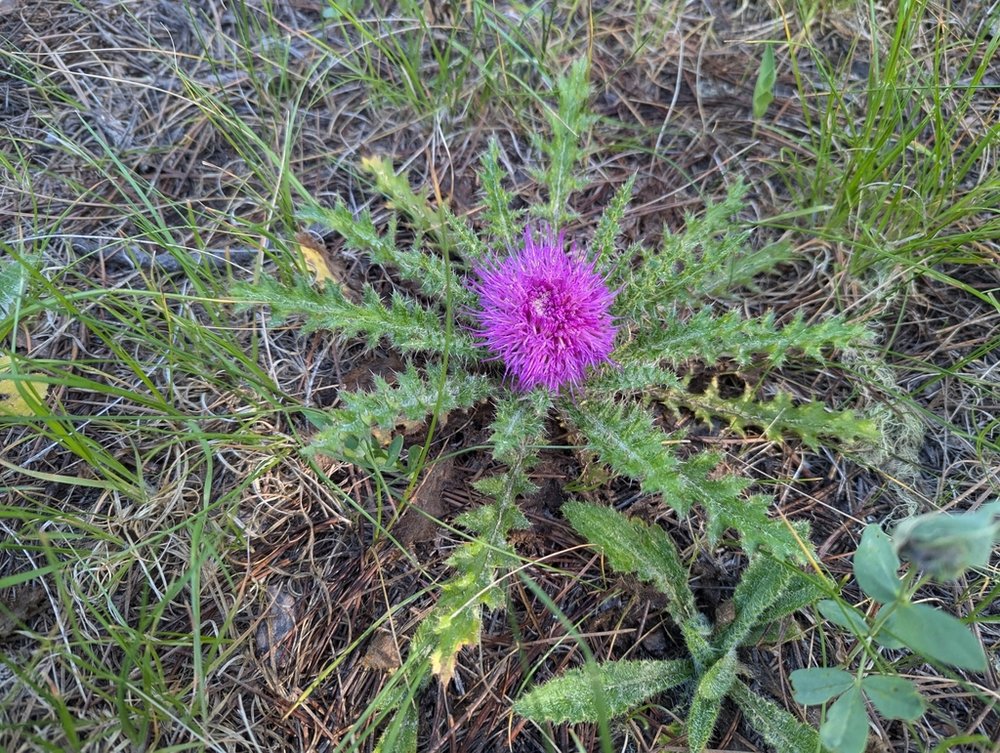
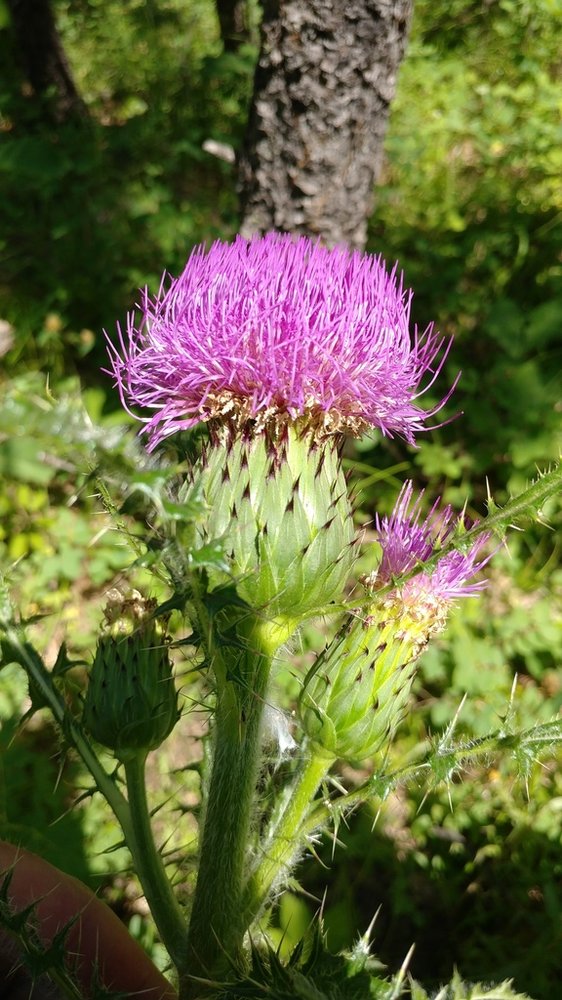
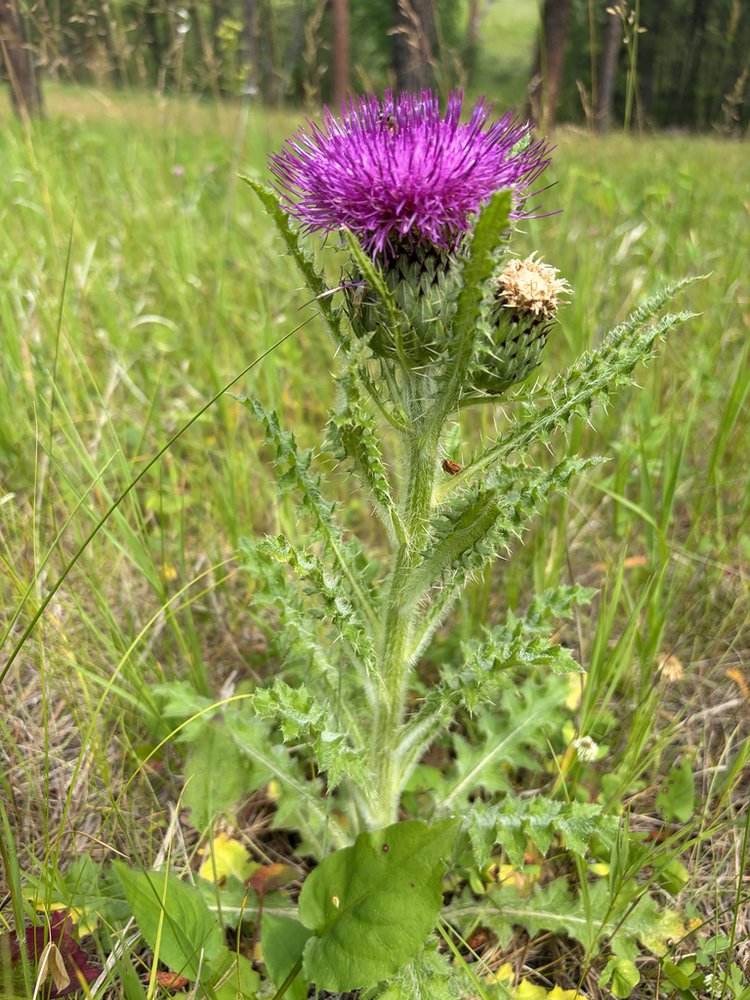
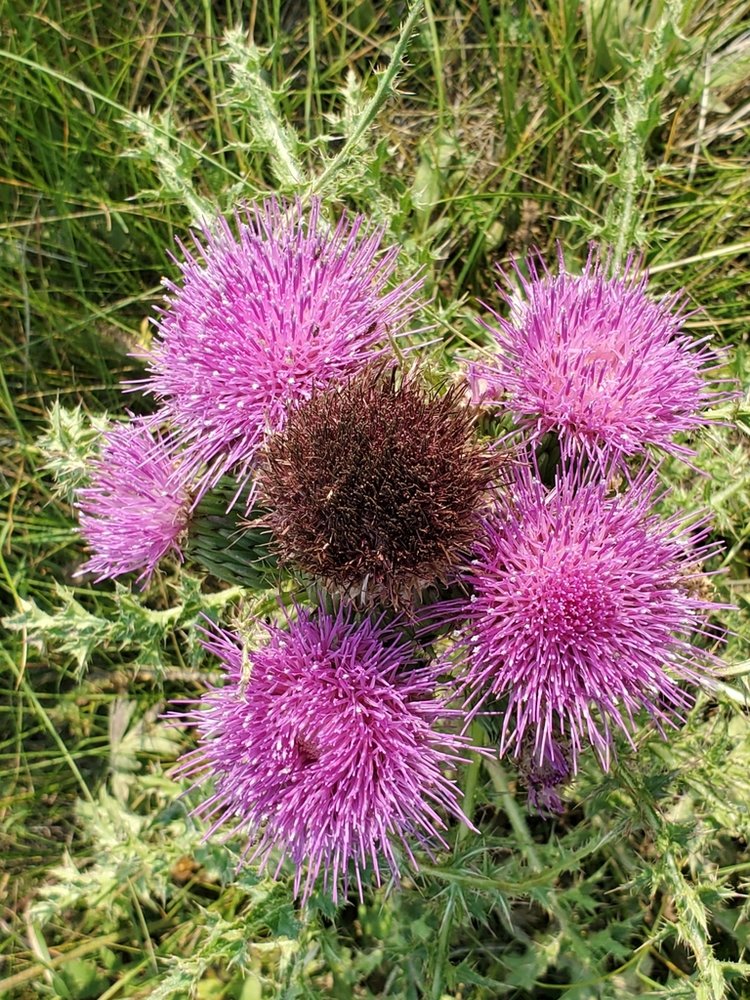
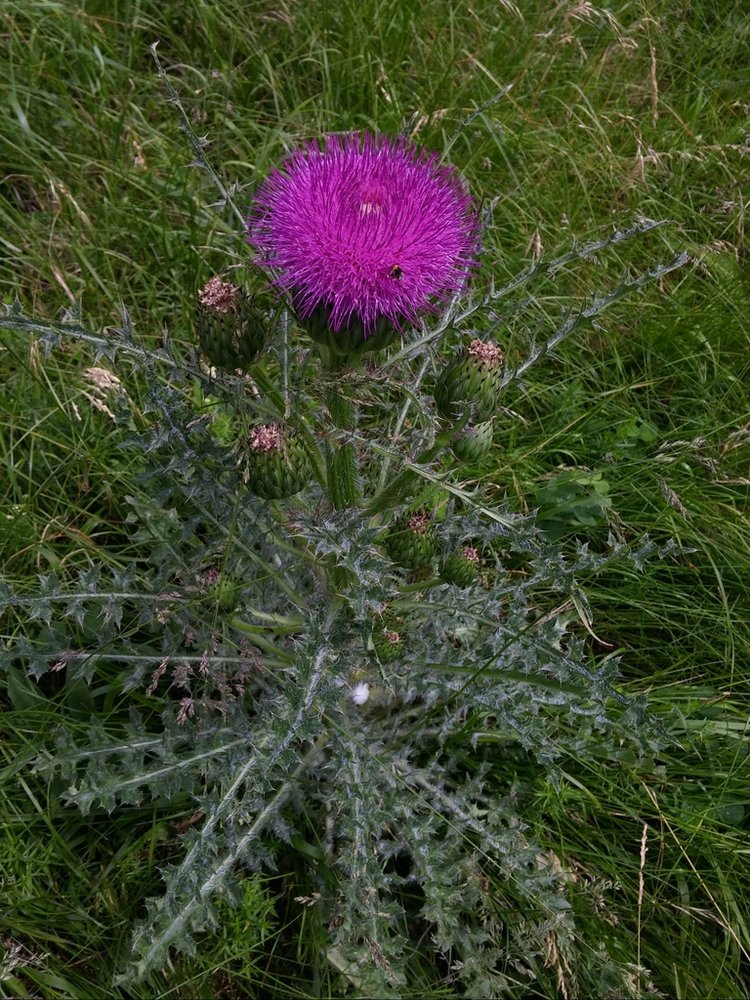
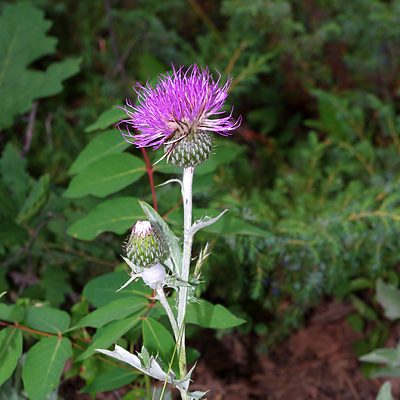
Drummond's Thistle (Cirsium drummondii) is a native thistle whose big purple heads, about 7 cm (2¾ in) across, can sit almost stemless among its spiny leaves, though other plants send up a stout leafy stem to 110 cm (43 in). It blooms from June into August in moist meadows, pine woodlands and along roadsides. It is widespread across Canada, but the only documented modern populations in the United States are in the Black Hills of South Dakota and Wyoming, where the National Park Service lists it at Wind Cave and Mount Rushmore. Photographed in the Black Hills.
Free photos from other sources
| Family | Asteraceae · Aster |
|---|---|
| Status | Native biennial or perennial |
| Blooms | June into August |
| Height | 5–110 cm (2–43 in) |
| Where | Moist meadows, pine woodlands, woodland openings, forest edges and roadsides |
| Also called | Dwarf Thistle, Short-stemmed Thistle |
| Synonym | Cirsium coccinatum, Carduus drummondii, Cnicus drummondii |
| Traditional use | Black Elk and Flying By (1998) record that the Lakota peeled thistle roots and stems and ate them raw or in soups and stews; their entry covers thistles in general (Cirsium spp.), which it names tȟókahu. |
| Note | A native thistle, not a listed weed in South Dakota or Wyoming. Flora of North America says the Black Hills hold the only documented modern populations in the United States. |
Traditional use: first drafted by Google AI, then checked against the sources on this page.
Roots, seeds & germination
Root: A stout taproot.
Seed: Each seed-like fruit is straw-colored to light brown with purplish streaks, 3.5–5.5 mm long, with a narrow yellow rim at the top and a tuft of bristles 30–42 mm (1¼–1⅝ in) long. SDSU says to collect in mid to late summer, when the fruits turn dark yellow and the heads look fuzzy.
Germination: SDSU says the seed needs no pretreatment. It recommends sandy or other well-drained soil with moderate to high organic matter, full sun and moist conditions.
How do you identify Drummond's Thistle?
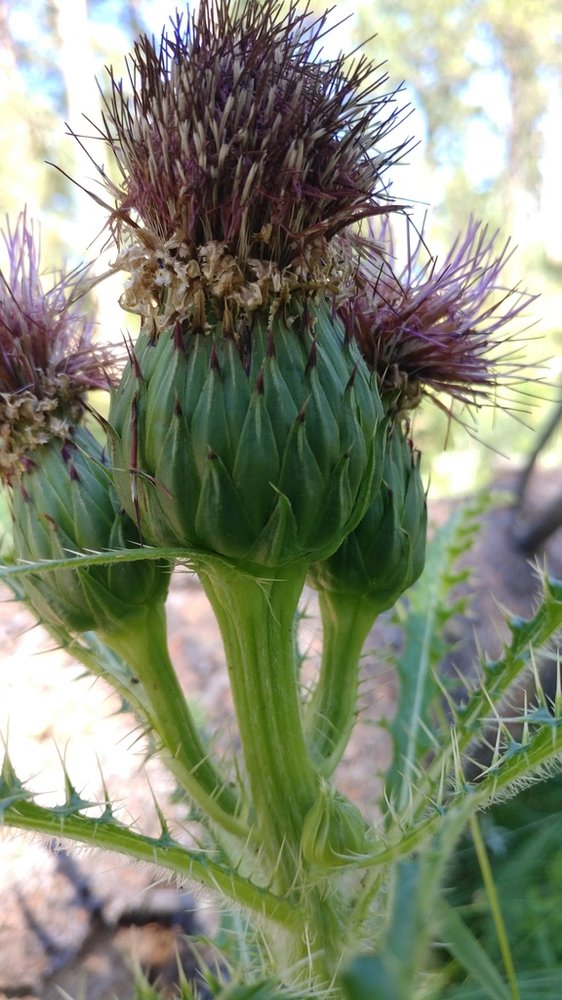
Look for a thick, fleshy, leafy stem, 5–110 cm (2–43 in) tall and hairy with long jointed hairs, that can be so short the heads sit down among the leaves. The leaves are 15–30 cm (6–12 in) long and cut into spreading lobes separated by broad U-shaped gaps, with slender spines 2–5 mm long on the edges; both faces are hairy with long jointed hairs. The 1 to 5 heads, sometimes more, sit single or crowded at the stem tip on stalks usually no more than 5 cm (2 in) long, closely surrounded and often overtopped by the upper leaves. The cup of bracts under each head is 3.5–5 cm (1½–2 in) tall, with 4 to 6 rows of overlapping bracts pressed flat, each with a narrow sticky ridge down the back and a short erect spine 2–3 mm long; the purple florets are 30–48 mm (1¼–2 in) long. Wavyleaf Thistle is a perennial from deep runner roots with densely gray-felted stems, strongly wavy leaf edges and heads on stalks up to 25 cm (10 in). Canada Thistle grows in colonies from creeping roots and carries many small heads only 1–2 cm (½–¾ in) tall, with bract spines no more than 1 mm. Bull Thistle has long spiny wings down the stem and bristle-like spines on the upper face of its leaves, a mark no other North American thistle has.
When does it bloom?
June into August.
Where does it grow?
Moist meadows, pine woodlands, woodland openings, forest edges and roadsides, on dry to moist soil; Flora of North America gives 300–2300 m (1,000–7,500 ft) for the species, and Black Hills specimen labels run from about 1,350 to 2,130 m (4,420–7,000 ft). The National Park Service lists it at Wind Cave National Park and Mount Rushmore National Memorial. Herbarium specimens from 1892 to 2011 come from Lawrence, Pennington and Custer counties in South Dakota and Crook and Weston counties in Wyoming. Their labels name open pine on a talus glade, white spruce forest above a creek, a moist meadow with willow thickets, a moist meadow by a beaver pond in the Bear Lodge Mountains, an aspen bottom in the Black Elk Wilderness, open woodlands in the Black Hills National Forest, and the edge of a lawn by open ponderosa pine. iNaturalist has 66 research-grade records within 100 km of the central Hills, June to August.
Other thistles in this guide
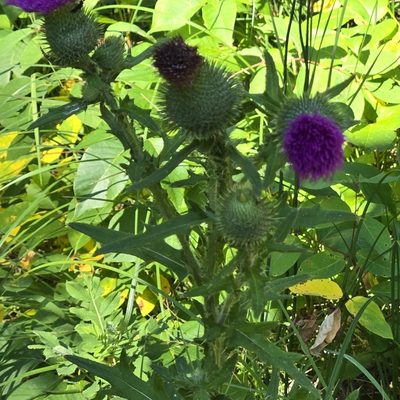
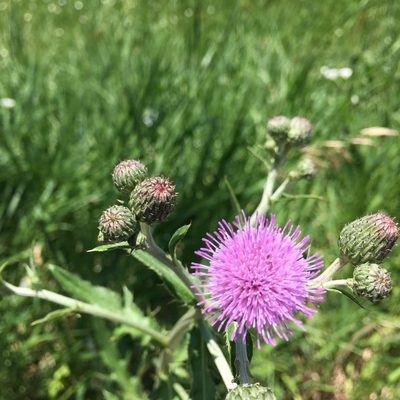
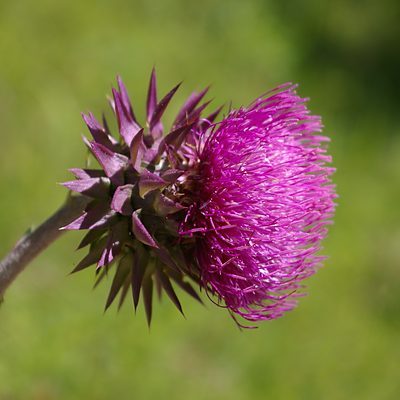
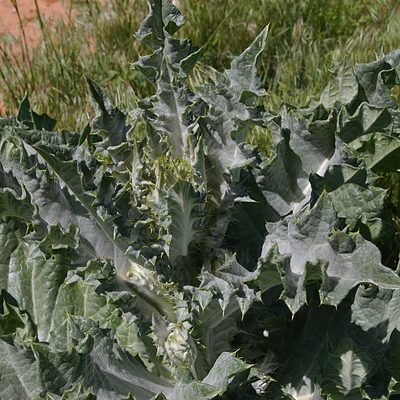
Aster family (Asteraceae): 62 other plants in this guide
- Aromatic Aster
- Arrowleaf Balsamroot
- Arrowleaf Sweet Coltsfoot
- Bachelor's Button
- Balsam Ragwort
- Black-eyed Susan
- Blanket Flower
- Blue Lettuce
- Broom Snakeweed
- Bull Thistle
- Canada Hawkweed
- Canada Lettuce
- Canada Thistle
- Chicory
- Common Burdock
- Common Dandelion
- Common Sunflower
- Common Tansy
- Common Yarrow
- Curlycup Gumweed
- Cutleaf Coneflower
- Dotted Gayfeather
- Easter Daisy
- False Boneset
- Fetid Marigold
- Field Pussytoes
- Fringed Sagewort
- Hairy Golden Aster
- Heart-leaved Arnica
- Hooker's Townsend Daisy
- Horseweed
- Jerusalem Artichoke
- Lambstongue Groundsel
- Maximilian Sunflower
- Missouri Goldenrod
- Mountain Dandelion
- Musk Thistle
- Oxeye Daisy
- Pearly Everlasting
- Pineapple Weed
- Prairie Coneflower
- Prairie False Dandelion
- Purple Coneflower
- Rocky Mountain Blazing Star
- Rosy Pussytoes
- Rubber Rabbitbrush
- Rush Skeletonplant
- Scotch Thistle
- Silver Sagebrush
- Smooth Blue Aster
- Spotted Joe-Pye Weed
- Stemless Four-nerve Daisy
- Stiff Goldenrod
- Stiff Sunflower
- Threenerve Fleabane
- Wavyleaf Thistle
- Western Ragweed
- White Hawkweed
- White Prairie Aster
- White Sagebrush
- Woolly Groundsel
- Yellow Salsify
Sources: Flora of North America Vol. 19: Cirsium drummondii (D. J. Keil), eFloras; Flora of North America Vol. 19: Cirsium undulatum, eFloras; Flora of North America Vol. 19: Cirsium arvense, eFloras; Flora of North America Vol. 19: Cirsium vulgare, eFloras; SDSU Open PRAIRIE, South Dakota Native Plant Research: Cirsium drummondii, Drummond's thistle (R. Neil Reese); USDA PLANTS Database: Cirsium drummondii (CIDR2); ITIS: Cirsium drummondii, TSN 36364; GBIF Backbone Taxonomy: Cirsium drummondii (synonyms); GBIF occurrence search: Cirsium drummondii herbarium specimens, South Dakota and Wyoming; GBIF specimen 6439413608: Custer County, 1892, in flower and fruit, 1,676 m (5,500 ft); GBIF specimen 5835938012: Pennington County, 1969, about 7,000 ft (2,130 m); GBIF specimen 2512284120: Black Hills National Forest, Crook County, Wyoming, 2010, beside a small spring, 4,420 ft (1,350 m), in fruit; GBIF specimen 2890632321: Lawrence County, 1939, open pine on a talus glade, flowering July 3; GBIF specimen 2512331974: Lawrence County, 2011, white spruce forest above a creek; GBIF specimen 2890632324: Weston County, Wyoming, 1982, moist meadow with willow thickets, flowering; GBIF specimen 1930841193: Bear Lodge Mountains, Crook County, Wyoming, 1980, moist meadow near a beaver pond; GBIF specimen 2562611006: Black Elk Wilderness, Pennington County, 2009, aspen bottom, flowering July 22; GBIF specimen 1990128012: Black Hills National Forest, Pennington County, 2009, open woodlands; GBIF specimen 5159123315: Custer County, 1984, edge of a lawn near open ponderosa pine forest, in flower; NPSpecies checklist, Wind Cave National Park vascular plants; NPSpecies checklist, Mount Rushmore National Memorial vascular plants; iNaturalist: research-grade Cirsium drummondii observations within 100 km of the Black Hills; South Dakota DANR: Locally Noxious Weed Pest List (checked; not listed); Wyoming Weed and Pest Council: State Designated Weed List (checked; not listed); Black Elk & Flying By 1998, Culturally Important Plants of the Lakota (Sitting Bull College); Moerman, Native American Ethnobotany Database (BRIT): Cirsium drummondii.