Wavyleaf Thistle
Cirsium undulatum
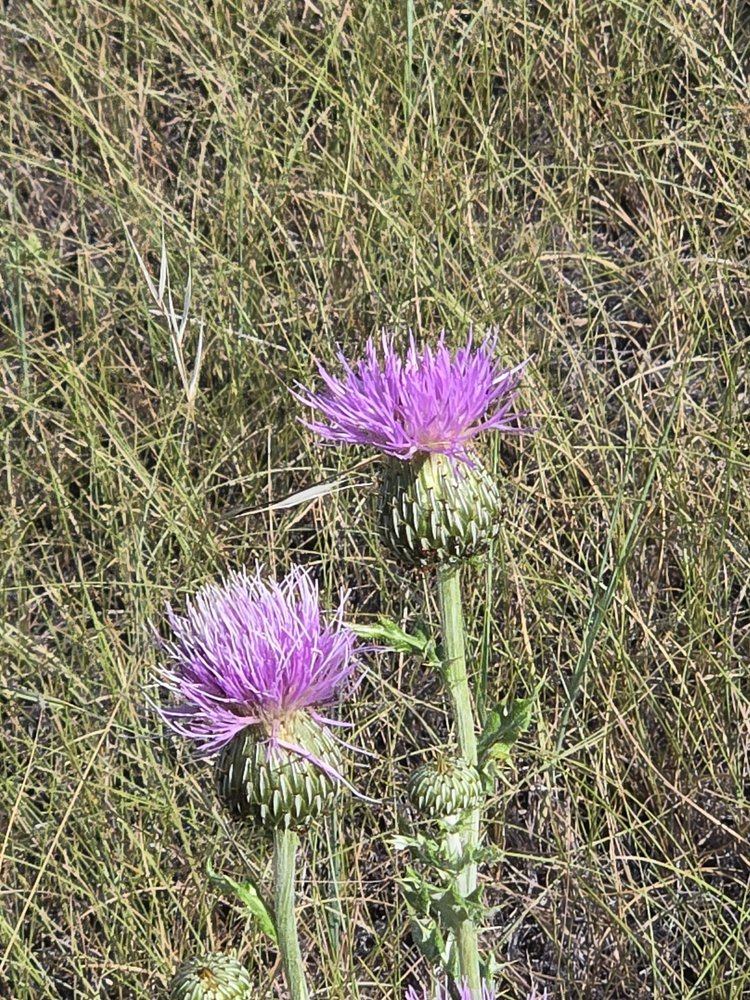
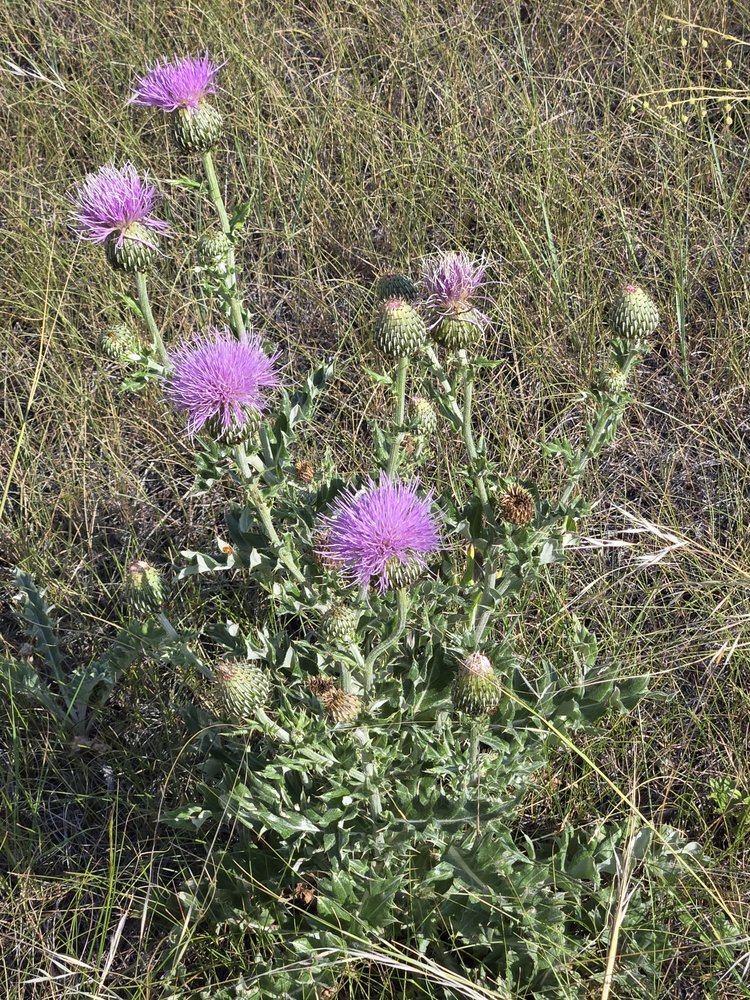
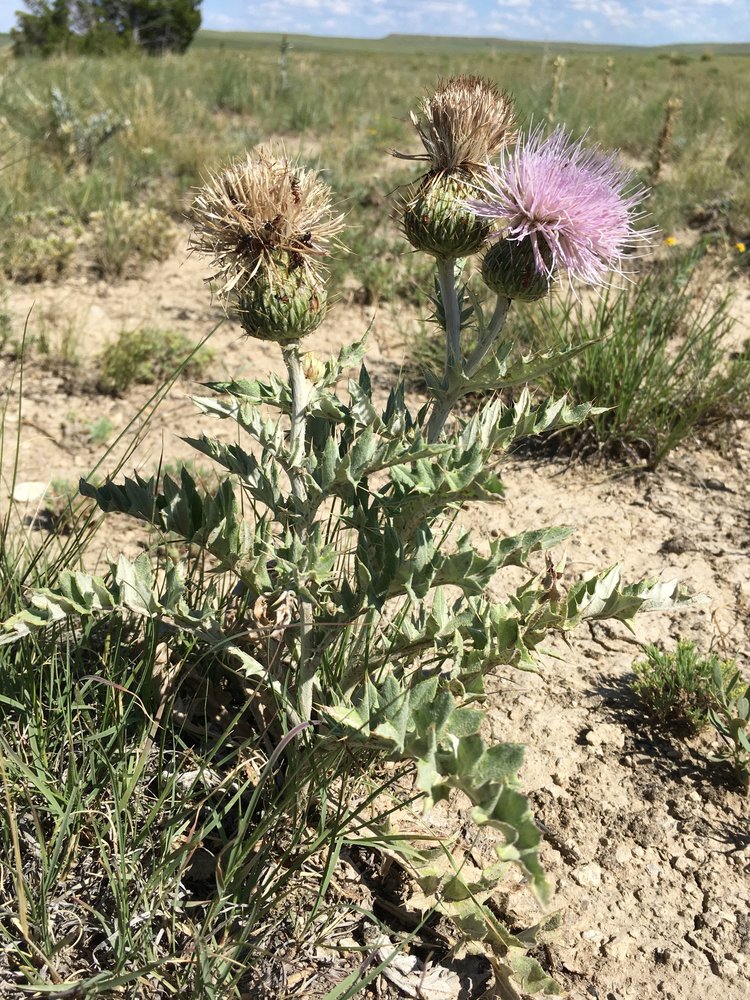
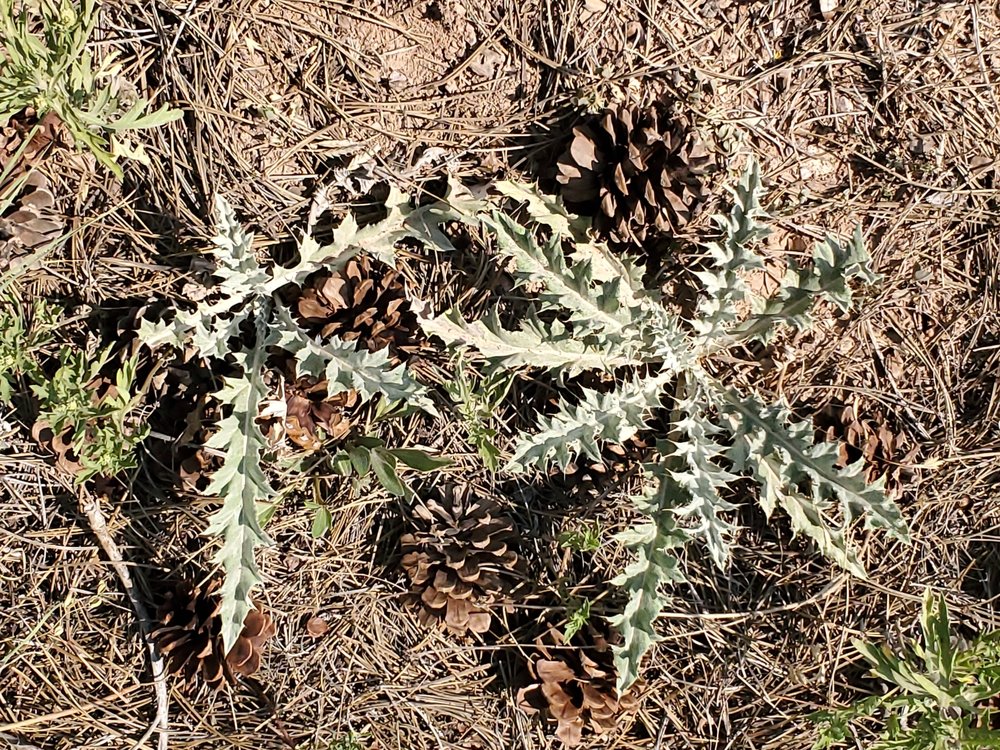
Wavyleaf Thistle (Cirsium undulatum) is a native perennial thistle whose stems and wavy-edged leaves are covered in gray wool. It opens big pink-lavender, sometimes white, heads from late June into August on dry prairie, rocky slopes and open pine woods, and the National Park Service records it at Jewel Cave, Wind Cave, Mount Rushmore and Devils Tower in the Black Hills.
Free photos from other sources
| Family | Asteraceae · Aster |
|---|---|
| Status | Native perennial |
| Blooms | Late June through July, with some into August |
| Height | 30–120 cm (12–47 in) |
| Where | Dry mixed-grass prairie, rocky slopes, open ponderosa pine woods, pastures and roadsides |
| Also called | Gray Thistle, Pasture Thistle, Wavy-leaf Thistle, Plumed Thistle, tȟókahu (Lakota) |
| Synonym | Carduus undulatus, Cnicus undulatus, Cirsium megacephalum, Cirsium undulatum var. megacephalum, Carduus megacephalus |
| Traditional use | Sitting Bull College's 1998 Culturally Important Plants of the Lakota says the Lakota peeled the root and stems and ate them raw or in soups and stews, or dried them for winter, and used a cool root tea as an eye wash. |
Roots, seeds & germination
Root: A stout, deep taproot grows below a woody crown, with horizontal runner roots that carry buds and send up new shoots, so an old plant can become a small clump. After fire or grazing it sprouts again from the crown and the root buds.
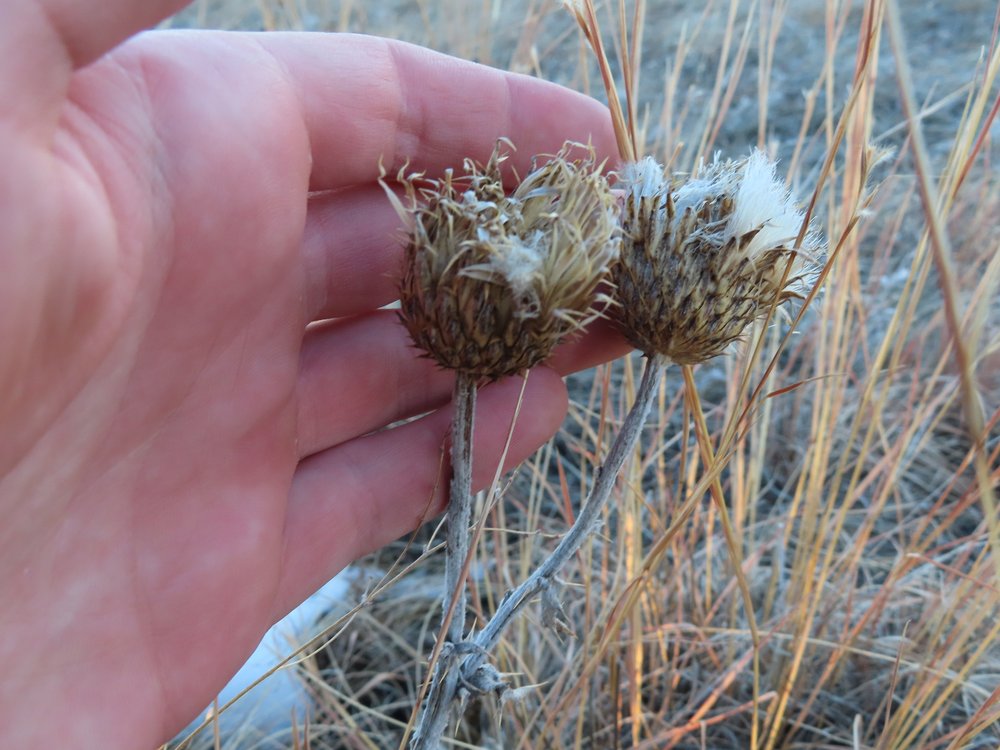
Seed: The heads ripen into fluffy balls. Each seed is light to dark brown, about 6–7 mm (¼ in) long, with a plume of white bristles 2–4 cm (¾–1½ in) long that carries it on the wind. Goldfinches line their nests with the down, and songbirds eat the seeds.
Germination: No germination tests for this species were found. The Xerces Society says native thistle seed is often dormant when shed and that 50–85 days of cold, moist stratification is likely enough.
How do you identify Wavyleaf Thistle?
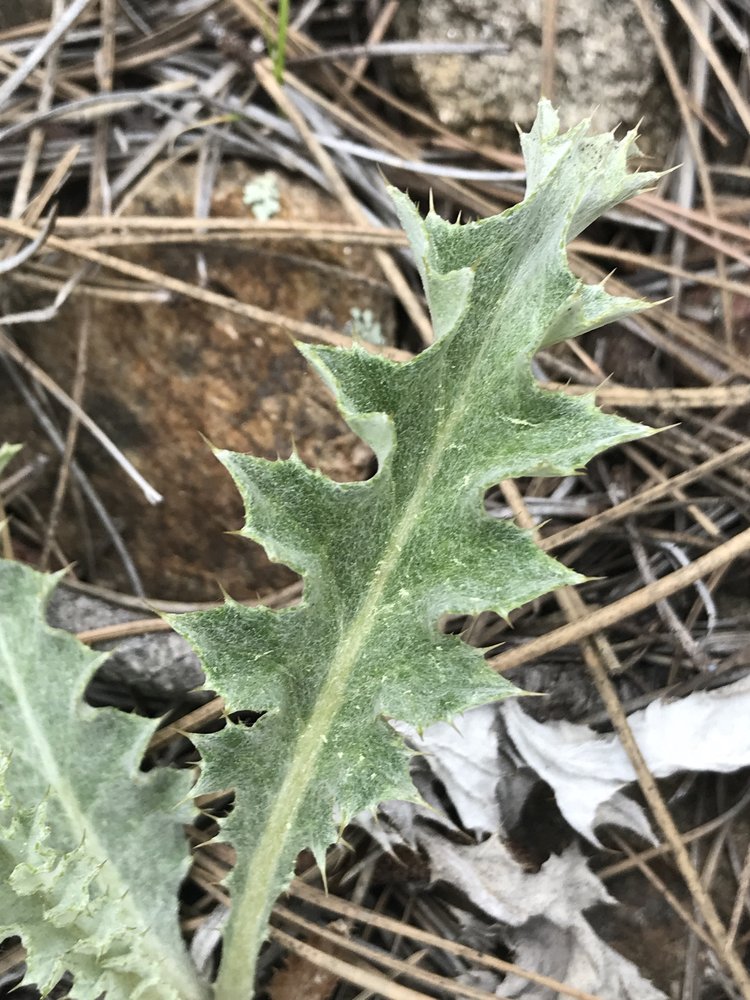
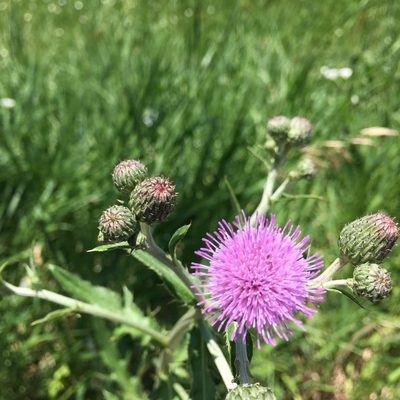
The whole plant looks gray: the stems are thickly woolly, and the leaves are woolly underneath and thinly woolly on top. The leaves are 10–40 cm (4–16 in) long with strongly wavy edges, cut into lobes that end in stiff yellowish spines, and they clasp the stem without running down it as spiny wings. Each stem carries 1 to about 10 large heads, 2.5–4.5 cm (1–1¾ in) tall, and each bract on the head has a pale, sticky ridge down the middle and a short spreading spine. Introduced Canada Thistle has many small heads on green, nearly spineless stems, and Bull and Musk Thistle have spiny wings on the stem. Native Flodman's Thistle is green on top of the leaf and white-woolly below.
When does it bloom?
Late June through July, with some into August.
Where does it grow?
Dry, open ground: mixed-grass and shortgrass prairie, rocky and gravelly slopes, open ponderosa pine woods and their meadows, pastures and roadsides. It is common in healthy native grassland, not just on disturbed ground. The 1986 plant survey of Jewel Cave lists it, and the National Park Service records it at Wind Cave, Mount Rushmore and Devils Tower. Herbarium specimens come from Lawrence, Fall River, Custer, Pennington and Meade counties in South Dakota and Crook and Weston counties in Wyoming.
Other flowers to compare
Sources: Flora of North America Vol. 19–21: Cirsium undulatum (efloras.org); Flora of North America: Cirsium flodmanii (efloras.org); Flora of North America: Cirsium arvense (efloras.org); Flora of North America: Cirsium vulgare (efloras.org); Flora of North America: Carduus nutans (efloras.org); USDA Forest Service Celebrating Wildflowers, Plant of the Week: Wavyleaf Thistle (J. L. Welborn); USDA PLANTS Database: Cirsium undulatum (CIUN); Black Elk & Flying By 1998, Culturally Important Plants of the Lakota (Sitting Bull College; SD PUC docket HP14-001 exhibit), entries 79–80; Marriott & Hartman 1986, Vegetation of Jewel Cave National Monument (npshistory.com); NPSpecies checklist – Wind Cave National Park; NPSpecies checklist – Jewel Cave National Monument; NPSpecies checklist – Mount Rushmore National Memorial; NPSpecies checklist – Devils Tower National Monument; GBIF occurrence search: Cirsium undulatum, preserved specimens, South Dakota; GBIF occurrence search: Cirsium undulatum, preserved specimens, Wyoming; GBIF occurrence search: Cirsium flodmanii, preserved specimens, South Dakota; Manske 2017, Wavyleaf Thistle (NDSU Dickinson Research Extension Center); Kansas Wildflowers and Grasses: Cirsium undulatum; Xerces Society 2017, Native Thistles: A Conservation Practitioner's Guide (Idaho Fish & Game copy); SDSU Open PRAIRIE, South Dakota Native Plant Research: Flodman's Thistle; Thistle ID Fact Sheet (Nebraska); Oklahoma State University Extension: Thistles in Oklahoma and Their Identification; South Dakota DANR: State Noxious Weeds; South Dakota DANR: Locally Noxious Weeds by County (updated 2024); Lady Bird Johnson Wildflower Center: Cirsium undulatum; Wikipedia: Cirsium undulatum (synonyms); iNaturalist: Cirsium undulatum research-grade observations near the Black Hills.