Thistles of the Black Hills
All 6 thistles in this guide, side by side, A to Z. Compare the photos, bloom time, height and where each grows, then open the one that fits for more photos and the full ID notes. Each plant's page lists its sources.
| Plant | Color | Blooms | Height | Where | How to tell it apart |
|---|---|---|---|---|---|
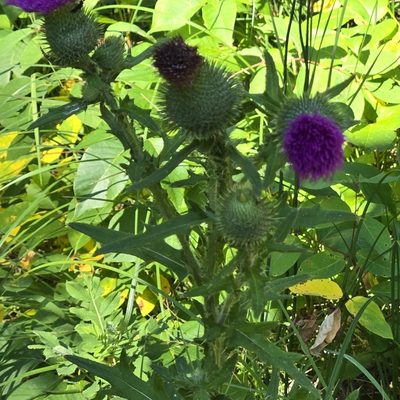 Bull ThistleCirsium vulgare | Pink, Purple | July into September | 30–200 cm (12–79 in) | Roadsides, pastures, meadows, forest openings, logged forest and other disturbed sites | The top of each leaf is prickly, covered with short bristle-like spines that lie flat, and each of the rigid lobes ends in a sharp yellow spine up to 1 cm (⅜ in) long, while the underside is gray and woolly. The leaves are 15–40 cm (6–16 in) long, and the bases of at least the upper leaves run down the stem as long spiny wings. The heads, 4–5 cm (1½–2 in) across and reddish-purple, sit singly or a few together at the branch tips on stalks 1–6 cm (½–2½ in) long, each in a cobwebby cup 3–4 cm (1¼–1½ in) tall made of 10 to 12 rows of narrow bracts whose spine tips point outward. Plants stand 30–200 cm (1–6½ ft) tall and are usually much branched. Minnesota Wildflowers says it resembles Plumeless Thistle, whose heads are usually 2.5 cm (1 in) across or less, whose leaves are mostly hairless on top, and which is even spinier. Musk Thistle carries big 5 cm (2 in) heads singly, nodding on curved stalks, with broad bracts that bend back. Canada Thistle is a creeping perennial with many small heads about 2 cm (¾ in) across and no spiny wings running down the stem. The native Wavyleaf Thistle has densely gray-felted stems and leaf undersides and strongly wavy leaf edges, and native Drummond's Thistle holds its heads on stalks usually no more than 5 cm (2 in) long, crowded and overtopped by the upper leaves. |
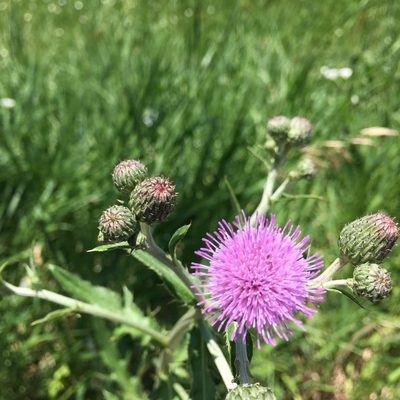 Canada ThistleCirsium arvense | Pink, Purple | July through September, a few into October | 30–120 cm (12–47 in) | Disturbed, sunny ground: roadsides, pastures, stream banks, springs and forest openings | Canada Thistle grows in dense patches of many stems joined by roots, with many small pink to purple heads, about 1–2 cm (½–¾ in) tall, in loose, branched clusters. The bracts under each head end in tiny spines no more than 1 mm long, and its leaves clasp the stem or run only a short way down it, without long spiny wings. Musk Thistle (Carduus nutans) has single big red-purple heads, 2–7 cm (¾–2¾ in) across, often nodding on long stalks that are bare near the top, with broad, spine-tipped bracts that spread or bend back. Bull Thistle (Cirsium vulgare) has heads wrapped in many narrow, spine-tipped bracts, and the upper side of its leaves is covered with short, bristly spines, the only North American thistle with that mark. Musk and Bull Thistle have spiny-winged stems, while native Wavyleaf Thistle has gray-woolly stems and leaf undersides, a few large heads and leaves that clasp the stem without long wings. |
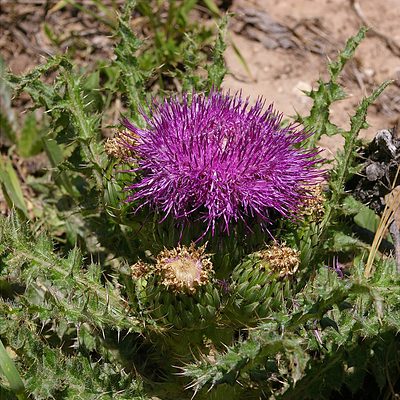 Drummond's ThistleCirsium drummondii | Pink, Purple | June into August | 5–110 cm (2–43 in) | Moist meadows, pine woodlands, woodland openings, forest edges and roadsides | Look for a thick, fleshy, leafy stem, 5–110 cm (2–43 in) tall and hairy with long jointed hairs, that can be so short the heads sit down among the leaves. The leaves are 15–30 cm (6–12 in) long and cut into spreading lobes separated by broad U-shaped gaps, with slender spines 2–5 mm long on the edges; both faces are hairy with long jointed hairs. The 1 to 5 heads, sometimes more, sit single or crowded at the stem tip on stalks usually no more than 5 cm (2 in) long, closely surrounded and often overtopped by the upper leaves. The cup of bracts under each head is 3.5–5 cm (1½–2 in) tall, with 4 to 6 rows of overlapping bracts pressed flat, each with a narrow sticky ridge down the back and a short erect spine 2–3 mm long; the purple florets are 30–48 mm (1¼–2 in) long. Wavyleaf Thistle is a perennial from deep runner roots with densely gray-felted stems, strongly wavy leaf edges and heads on stalks up to 25 cm (10 in). Canada Thistle grows in colonies from creeping roots and carries many small heads only 1–2 cm (½–¾ in) tall, with bract spines no more than 1 mm. Bull Thistle has long spiny wings down the stem and bristle-like spines on the upper face of its leaves, a mark no other North American thistle has. |
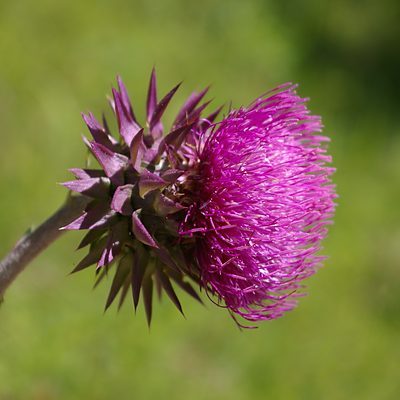 Musk ThistleCarduus nutans | Pink, Purple | June into September | 40–200 cm (16–79 in) | Pastures, rangeland, roadsides, fields and disturbed ground, along creeks and stock ponds | Look for a single big head at the end of each branch, often nodding, on a stalk 2–30 cm (1–12 in) long that has no spiny wings near the top. The head is 4–8 cm (1½–3 in) across, rose-purple, and sits on a ring of broad, triangular bracts, green or tinged purple, that spread or bend back and end in spines 1–4 mm long. Below the heads the stem carries spiny wings with spines 2–10 mm long. The leaves are coarsely lobed and toothed, dark green with a white midrib, spine-tipped, and mostly hairless except along the main veins underneath; basal leaves reach 10–40 cm (4–16 in). Plants stand 40–200 cm (16–79 in) tall. Plumeless Thistle, listed with it on the county weed lists, is its close relative; Minnesota Wildflowers says its heads are rather smaller, with narrow bracts, and SDSU gives them as 1.3–2 cm (½–¾ in) across, in clusters. Bull Thistle has bristle-like spines on the upper face of its leaves, a mark no other North American thistle has, and heads 2.5–5 cm (1–2 in) wrapped in narrow spine-tipped bracts. Canada Thistle is a creeping perennial with many small heads about 2 cm (¾ in) across. The native Wavyleaf Thistle has densely gray-felted stems and leaf undersides, and native Drummond's Thistle carries its heads on stalks usually no more than 5 cm (2 in) long, crowded and overtopped by the upper leaves, with bracts pressed flat. |
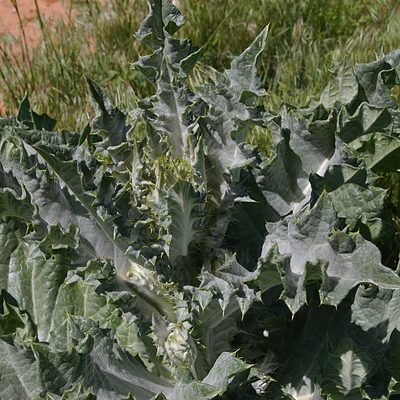 Scotch ThistleOnopordum acanthium | Green & Brown | July in the Black Hills-area specimens found in flower; June to September across its range (FNA) | 0.5–4 m (1½–13 ft) | Pastures, rangeland, roadsides, disturbed ground and creek bottoms | In its first year look for a rosette of very broad, blue-gray, woolly leaves whose edges are cut into short, broad, triangular, spine-tipped lobes; a big rosette can reach 1.5 m (5 ft) across. In the second year a stout stem bolts, with spiny, ribbon-like wings up to 15 mm wide that run all the way up to the flower heads. The leaves reach 60 cm (2 ft) long and are thickly woolly, especially underneath. The round heads, 2–5 cm (1–2 in) across, sit 2 or 3 together at the branch tips, with purple or white florets above narrow, spine-tipped bracts. Utah State University Extension notes that its leaves are wider, with shorter lobes and a lighter color, than those of Bull Thistle and Musk Thistle; its heads stay upright, where Musk Thistle's often nod; and its spiny bracts stay green, while Musk Thistle's take on the color of the flower. |
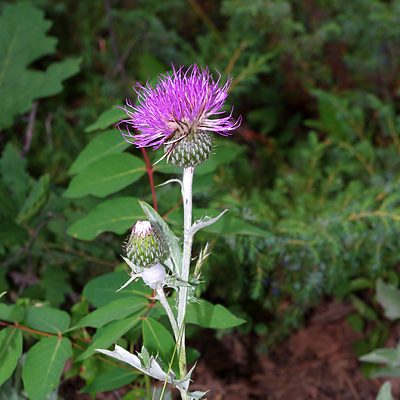 Wavyleaf ThistleCirsium undulatum | Pink, Purple | June through August, a few into September | 30–120 cm (12–47 in) | Dry mixed-grass prairie, rocky slopes, open ponderosa pine woods, pastures and roadsides | The whole plant looks gray: the stems are thickly woolly, and the leaves are woolly underneath and thinly woolly on top. The leaves are 10–40 cm (4–16 in) long with strongly wavy edges, cut into lobes that end in stiff yellowish spines, and their bases clasp the stem or run only a short way down it. Each stem carries 1 to about 10 large heads, 2.5–4.5 cm (1–1¾ in) tall, and each bract on the head has a pale, sticky ridge down the middle and a short spreading spine. Introduced Canada Thistle has many small heads in clusters and no spiny wings on its stems, while Bull and Musk Thistle have spiny wings on the stem. Native Flodman's Thistle usually grows in wetter places, and the top of its leaf is greener, with less hair. |
Other look-alike groups: 38 groups
- Anemones (4)
- Asters (4)
- Beardtongues (5)
- Buttercups (3)
- Cacti (4)
- Cinquefoils (7)
- Clovers (6)
- Coneflowers (4)
- Currants and gooseberries (5)
- Daisies (5)
- Dandelions (3)
- Docks and buckwheats (4)
- Evening primroses (4)
- Ferns (4)
- Gentians (4)
- Grasses (11)
- Groundsels and ragworts (3)
- Lilies (5)
- Mayflowers and false Solomon's seals (3)
- Milkvetches and locoweeds (12)
- Milkweeds (6)
- Mints (8)
- Mustards (11)
- Orchids (8)
- Paintbrushes (3)
- Pines (3)
- Raspberries and thimbleberries (3)
- Sagebrushes and sageworts (3)
- Sedges (3)
- Speedwells and kittentails (3)
- Sunflowers (4)
- Vervains (3)
- Vetches (4)
- Violets (7)
- Wild lettuces (3)
- Wild onions (3)
- Wild plums and cherries (3)
- Willows (3)