Dandelions of the Black Hills
All 3 dandelions in this guide, side by side, A to Z. Compare the photos, bloom time, height and where each grows, then open the one that fits for more photos and the full ID notes. Each plant's page lists its sources.
| Plant | Color | Blooms | Height | Where | How to tell it apart |
|---|---|---|---|---|---|
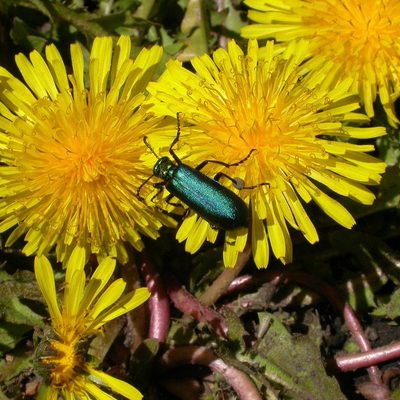 Common DandelionTaraxacum officinale | Yellow | April into September, heaviest in late spring | 5–40 cm (2–16 in) | Lawns, roadsides, pastures, campgrounds, disturbed ground and open woods, often on damp low ground | Look under the head: the 12–18 narrow outer bracts bend sharply down and back against the stalk, while the inner bracts stand up around the head. Each head, 2–5 cm (1–2 in) across, sits alone on a hollow, leafless stalk that bleeds milky sap, and is made only of strap-shaped yellow rays, 40 to 100 or more. The leaves all rise from the ground, 5–45 cm (2–18 in) long, broadest toward the tip, cut into sharp, backward-pointing lobes with the end lobe usually the biggest. The seed head is a round white clock, each olive to gray-brown seed on a long slender beak. Red-seeded Dandelion, also in the Hills, has red seeds instead of dull olive ones, heads usually under 2.5 cm (1 in) and leaves more deeply and evenly lobed from the start. Mountain Dandelion, a native of prairie and meadows, has a head that is less full and looks coarser than a dandelion's, a coarser seed head with fewer seeds, long narrow leaves that are usually toothless, and outer bracts that are shorter and broader than the inner ones. Prairie False Dandelion can pass for a dandelion at a glance, but its long, narrow, nearly grass-like leaves with crisp wavy edges set it apart. Yellow Salsify has about 13 green bracts that stick out well beyond its pale lemon-yellow rays, grass-like leaves on a leafy stem, and a seed head about 7.5 cm (3 in) across. |
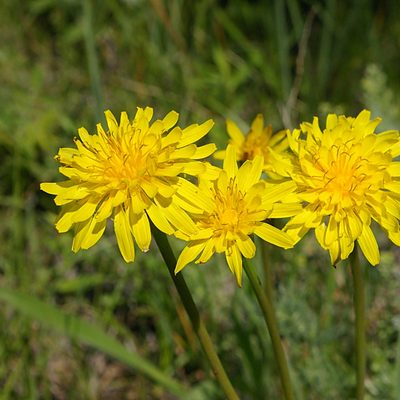 Mountain DandelionAgoseris glauca | Yellow | May into June | Up to 76 cm (30 in) | Open meadows and openings in conifer forest and sagebrush; well-drained soil | Look for one yellow head on a bare stalk, milky sap, and strap-like leaves 5–36 cm (2–14 in) long that grow only from the base, often with a red or purple midvein. The seeds are beaked and topped with white bristles. |
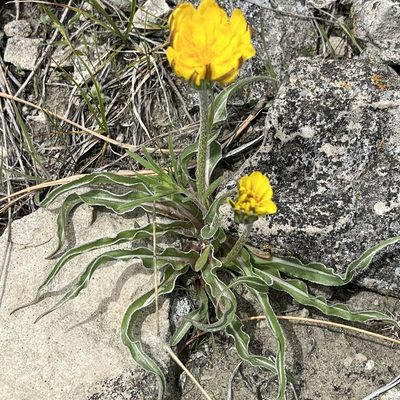 Prairie False DandelionNothocalais cuspidata | Yellow | April into June | 7–35 cm (3–14 in) | Dry open prairie, gravelly and rocky hillsides, ridges and slopes | Look for a single yellow head 2.5–5 cm (1–2 in) across on a leafless, often woolly stalk, made only of strap-shaped rays with 5 teeth at the squared tip, backed by one row of sharp-pointed, hairless bracts that are often striped or dotted with red. The leaves all grow from the base and are long and narrow like grass blades, 7–30 cm (3–12 in) long, with a pale midrib and crisp, wavy edges fringed with short white hairs, and they are often folded lengthwise. After bloom the head turns into a white puff of seeds, each 7–10 mm long with a tuft of 40 to 80 bristles. It could pass for a Common Dandelion at a glance, but the long, narrow, grass-like leaves set it apart. Mountain Dandelion looks very similar too, but its long narrow leaves are more limber and glossy smooth, and its seeds narrow sharply below the tip, while these narrow only slightly or not at all. |
Other look-alike groups: 38 groups
- Anemones (4)
- Asters (4)
- Beardtongues (5)
- Buttercups (3)
- Cacti (4)
- Cinquefoils (7)
- Clovers (6)
- Coneflowers (4)
- Currants and gooseberries (5)
- Daisies (5)
- Docks and buckwheats (4)
- Evening primroses (4)
- Ferns (4)
- Gentians (4)
- Grasses (11)
- Groundsels and ragworts (3)
- Lilies (5)
- Mayflowers and false Solomon's seals (3)
- Milkvetches and locoweeds (12)
- Milkweeds (6)
- Mints (8)
- Mustards (11)
- Orchids (8)
- Paintbrushes (3)
- Pines (3)
- Raspberries and thimbleberries (3)
- Sagebrushes and sageworts (3)
- Sedges (3)
- Speedwells and kittentails (3)
- Sunflowers (4)
- Thistles (6)
- Vervains (3)
- Vetches (4)
- Violets (7)
- Wild lettuces (3)
- Wild onions (3)
- Wild plums and cherries (3)
- Willows (3)