Gentians of the Black Hills
All 4 gentians in this guide, side by side, A to Z. Compare the photos, bloom time, height and where each grows, then open the one that fits for more photos and the full ID notes. Each plant's page lists its sources.
| Plant | Color | Blooms | Height | Where | How to tell it apart |
|---|---|---|---|---|---|
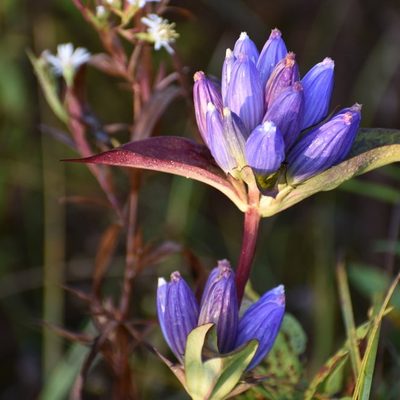 Closed GentianGentiana andrewsii | Blue | August into September | 30–60 cm (12–24 in) | Moist fields, thickets, creek floodplains and lake shores, in sun or part shade | Look for a perennial 30–60 cm (1–2 ft) tall with a thick, smooth stem and opposite, glossy, pointed leaves up to 10 cm (4 in) long and 5 cm (2 in) wide, with no leaf stalk, fine rough hairs on the edges and 3 to 7 parallel veins; just under the flower cluster the leaves form a whorl. The flowers are tubular, 2.5–4 cm (1–1½ in) long, with pleats between the 5 fused petals, and the 5 lobes overlap and have tiny fringe or teeth at the tip. They never open, so they look like large buds. Color is typically blue to purplish, occasionally pink or white. One cluster sits at the top of the main stem, and some plants have smaller clusters at the leaf joints higher up (Minnesota Wildflowers). The fruit is a capsule about 2.5 cm (1 in) long that splits along seams to release many seeds with papery wings (Minnesota Wildflowers). Minnesota Wildflowers says white-flowered plants can be mistaken for Yellow (or Cream) Gentian (Gentiana flavida), which has more clasping leaves and flowers that open a little at the top, and the Lady Bird Johnson Wildflower Center says Blind Gentian (Gentiana clausa) is a very similar species; GBIF holds no specimen of Blind Gentian from South Dakota or Wyoming. |
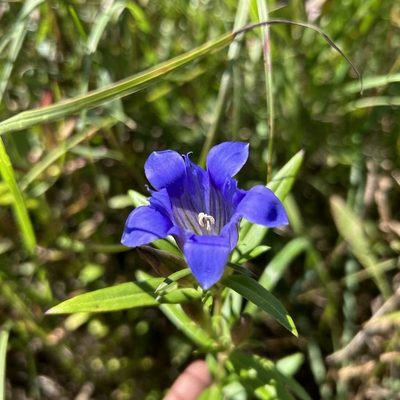 Downy GentianGentiana puberulenta | Blue | Late summer into fall, August to October | 10–60 cm (4–24 in) | Dry upland prairies, open woods and hills, often on lime-rich soil | Look for stout, usually unbranched stems, finely hairy and often tinged red, with pairs of narrow, stalkless, glossy leaves 1.5–7 cm (½–2¾ in) long, each pair at right angles to the pair above and below. The flowers sit in tight clusters at the top of the stem and in the upper leaf axils, upright and bell-like, bright blue to deep blue-violet, with 5 spreading, sharply pointed lobes. Between the lobes is a pleat-like flap of tissue with a ragged outer edge, and inside the tube the base is white with dark blue stripes. Four narrow, leafy bracts spread out below the flower. Flora of North America says Pleated Gentian (Gentiana affinis) has generally much smaller flowers, and that its corolla lobes are less than twice as long as the free part of the pleats, while Downy Gentian's are more than twice as long. |
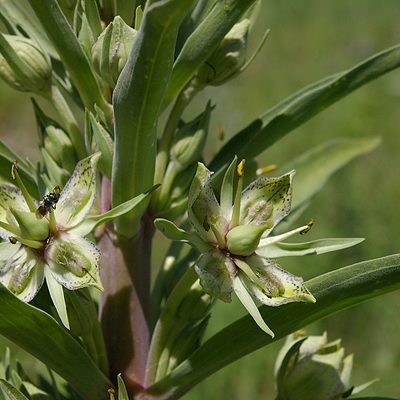 Green GentianFrasera speciosa | Green & Brown | May into August, depending on elevation | 20–150 cm (8–60 in) | Meadows, woodlands and mountain forests | Look for one stout, unbranched stem with lance-shaped leaves in whorls of 3 to 7, rising from a rosette of large leaves. Flowers grow in whorls among leafy bracts along the stem, each with 4 greenish-yellow petals flecked with purple and 2 fringed nectar pits at the base of each petal. |
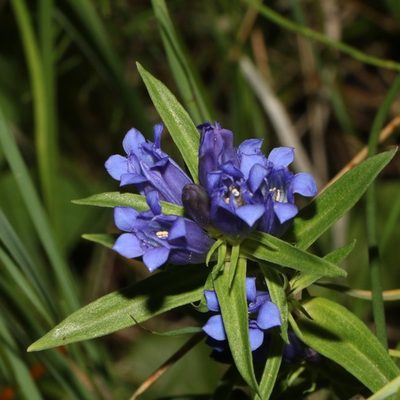 Pleated GentianGentiana affinis | Purple, Blue | August and September | 10–40 cm (4–16 in) | Moist, open meadows, fen edges and stream margins on limestone ground | Look for several stems from one base, often tinged red, 10–40 cm (4–16 in) tall, with pairs of narrow, stalkless, toothless leaves 1–4 cm (⅜–1½ in) long, each pair set at a right angle to the next. The flowers sit stalkless in a cluster at the top of the stem, with a few more on short stalks from the upper leaf joints. Each is an erect, funnel-shaped tube 18–40 mm (¾–1½ in) long that opens into five spreading, sharply pointed lobes; between the lobes is a pleat of tissue with a ragged outer edge, and the inside of the lobes and pleats is bright blue with whitish to greenish spots. Downy Gentian (Gentiana puberulenta) also grows in the Black Hills, on limestone where grassland meets forest. Flora of North America says its flowers are generally much larger, with lobes more than twice as long as the free part of the pleats, while Pleated Gentian's lobes are less than twice as long; Minnesota Wildflowers adds that Downy Gentian's deeper blue-violet flowers have no spotting. Closed Bottle Gentian (Gentiana andrewsii), which also blooms in August and September in wet meadows of western South Dakota, has a closed tube with incurved petals, so its flowers look like large buds that never open. |
Other look-alike groups: 38 groups
- Anemones (4)
- Asters (4)
- Beardtongues (5)
- Buttercups (3)
- Cacti (4)
- Cinquefoils (7)
- Clovers (6)
- Coneflowers (4)
- Currants and gooseberries (5)
- Daisies (5)
- Dandelions (3)
- Docks and buckwheats (4)
- Evening primroses (4)
- Ferns (4)
- Grasses (11)
- Groundsels and ragworts (3)
- Lilies (5)
- Mayflowers and false Solomon's seals (3)
- Milkvetches and locoweeds (12)
- Milkweeds (6)
- Mints (8)
- Mustards (11)
- Orchids (8)
- Paintbrushes (3)
- Pines (3)
- Raspberries and thimbleberries (3)
- Sagebrushes and sageworts (3)
- Sedges (3)
- Speedwells and kittentails (3)
- Sunflowers (4)
- Thistles (6)
- Vervains (3)
- Vetches (4)
- Violets (7)
- Wild lettuces (3)
- Wild onions (3)
- Wild plums and cherries (3)
- Willows (3)