Lilies of the Black Hills
All 5 lilies in this guide, side by side, A to Z. Compare the photos, bloom time, height and where each grows, then open the one that fits for more photos and the full ID notes. Each plant's page lists its sources.
| Plant | Color | Blooms | Height | Where | How to tell it apart |
|---|---|---|---|---|---|
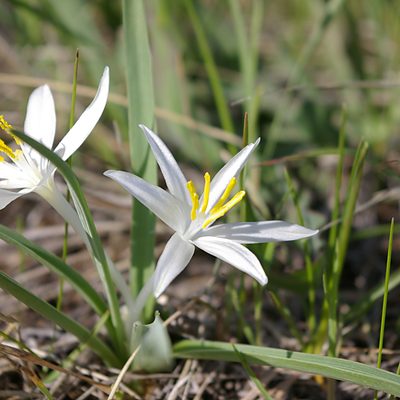 Common StarlilyLeucocrinum montanum | White | Mostly May, from late April into mid-June | 5–10 cm (2–4 in) | Dry grassland, rocky or sandy slopes and open pine woods | Look for a white, six-pointed star of narrow tepals 2–2.5 cm (about 1 in) long, sitting right on the ground in a spray of narrow, grass-like leaves 10–20 cm (4–8 in) long. There is no stem: a long, slender flower tube runs down into the ground. The six tepals are alike and white, with six stamens, and the flower smells sweet. The ovary stays buried at the crown, so the seed pod ripens underground, and after flowering, in late May or June, everything above ground withers away. |
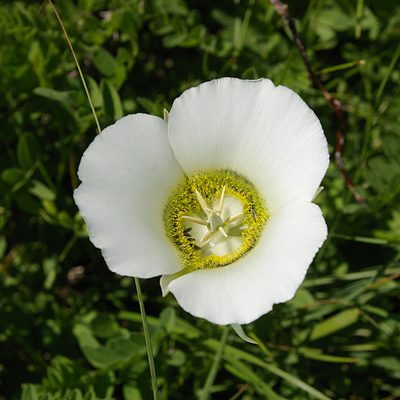 Gunnison's Mariposa LilyCalochortus gunnisonii | White | June into August | 24–55 cm (9–22 in) | Meadows and forest clearings, foothills to high mountains | Look inside the petal: a broad band of yellow hairs sits above an oblong gland, and the gland itself is thick with hairs. Sego Lily has a round gland with a broken maroon band above it. Gunnison's can also have a narrow purple band above the gland and a purple blotch at the petal's narrow base, so check the hairs and the gland shape. |
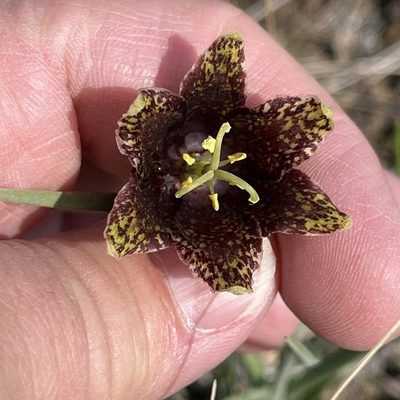 Purplespot FritillaryFritillaria atropurpurea | Green & Brown | May into July | 10–60 cm (4–24 in) | Pine woods, rocky openings and wooded draws | Look for a stem with narrow leaves in whorls of two or three, topped by nodding flowers. The six petal-like parts (tepals) are purplish brown with yellow or white mottling, 1–2.5 cm (⅜–1 in) long, and spread wide open. Fruit is a capsule with sharp angles. Flora of North America says it is easily confused with Fritillaria pinetorum, whose flowers are almost always erect, and whose lowest stem leaves are long enough to pass the flower cluster; in Purplespot Fritillary the flowers nod and the lowest stem leaves almost never reach past the cluster. |
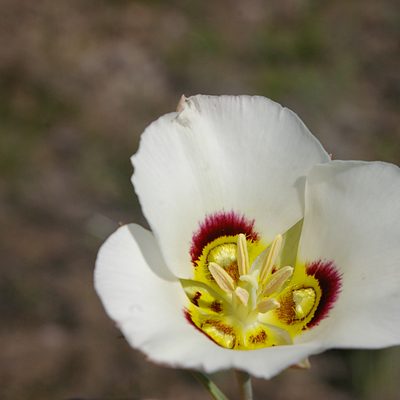 Sego LilyCalochortus nuttallii | White | June and July | 14–44 cm (6–17 in) | Dry prairies and open woods | Look inside the flower. Each of the three broad petals has a round gland near the base, ringed by a fringe, with a broken maroon band just above it. Gunnison's Mariposa Lily has an oblong gland topped by a broad band of yellow hairs. |
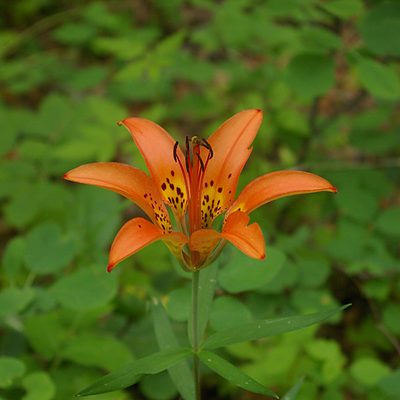 Wood LilyLilium philadelphicum var. andinum | Orange & Red | June and July, a few into August | 30–90 cm (12–36 in) | Open pine and aspen woods, forest edges and meadows | Look for one to three, rarely up to six, red-orange flowers about 6 cm (2½ in) across that open upward. Each of the six tepals narrows abruptly to a slender base and turns yellow toward the center, speckled with dark maroon spots. The single stem is smooth and unbranched, with narrow, toothless leaves scattered up it and one or two whorls just below the flowers. The garden Tiger Lily (Lilium lancifolium) is taller, with many nodding flowers whose tepals curve back, and small purple-black bulbils where the upper leaves meet the stem. After bloom, a cylindrical capsule forms at the top of the stem. |
Other look-alike groups: 38 groups
- Anemones (4)
- Asters (4)
- Beardtongues (5)
- Buttercups (3)
- Cacti (4)
- Cinquefoils (7)
- Clovers (6)
- Coneflowers (4)
- Currants and gooseberries (5)
- Daisies (5)
- Dandelions (3)
- Docks and buckwheats (4)
- Evening primroses (4)
- Ferns (4)
- Gentians (4)
- Grasses (11)
- Groundsels and ragworts (3)
- Mayflowers and false Solomon's seals (3)
- Milkvetches and locoweeds (12)
- Milkweeds (6)
- Mints (8)
- Mustards (11)
- Orchids (8)
- Paintbrushes (3)
- Pines (3)
- Raspberries and thimbleberries (3)
- Sagebrushes and sageworts (3)
- Sedges (3)
- Speedwells and kittentails (3)
- Sunflowers (4)
- Thistles (6)
- Vervains (3)
- Vetches (4)
- Violets (7)
- Wild lettuces (3)
- Wild onions (3)
- Wild plums and cherries (3)
- Willows (3)