Purplespot Fritillary Fritillaria atropurpurea
Also called Spotted Missionbells, Purple Spotted Fritillaria, Leopard Lily, Checker Lily, čhaŋȟlóǧaŋ makȟátȟola pȟežúta (Lakota), wahíŋheya iphíye (Lakota)
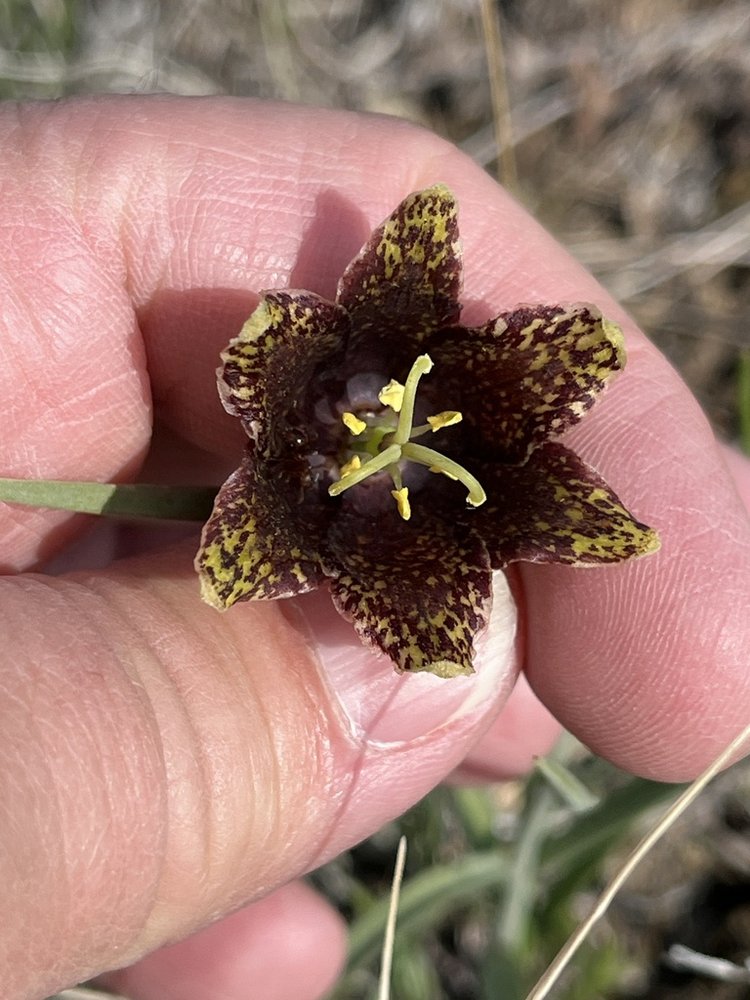
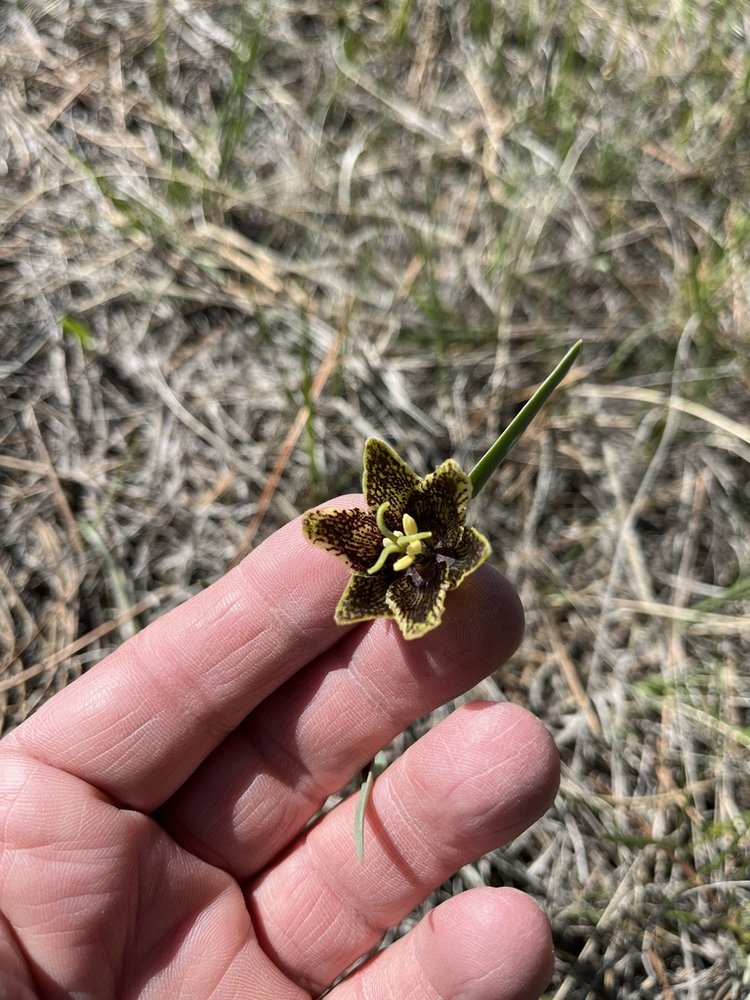
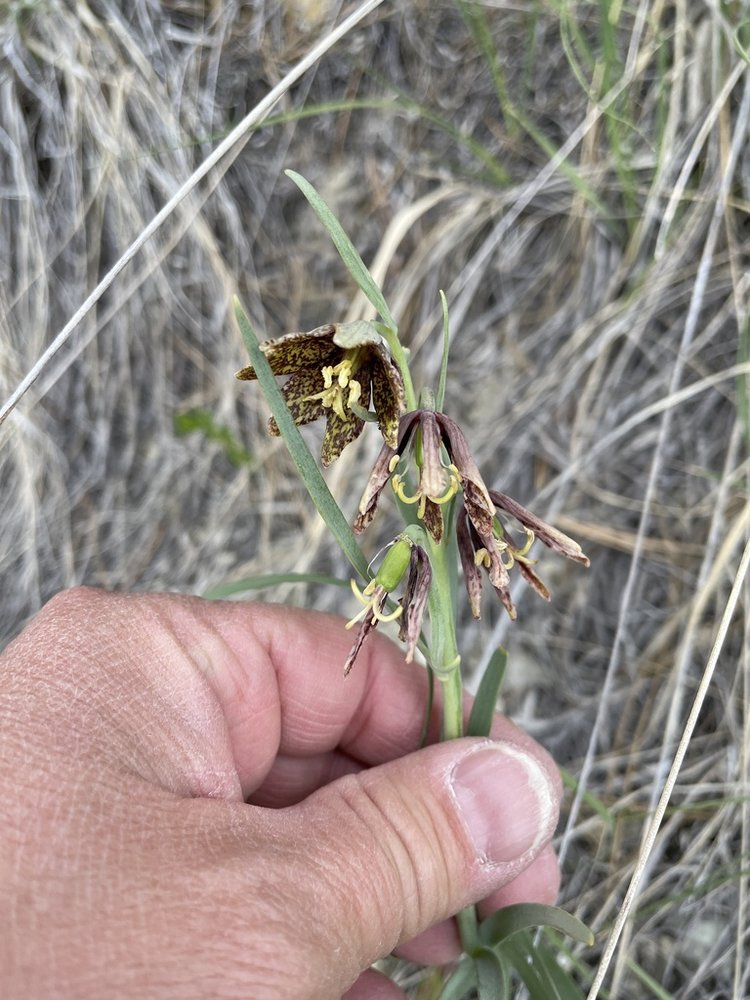
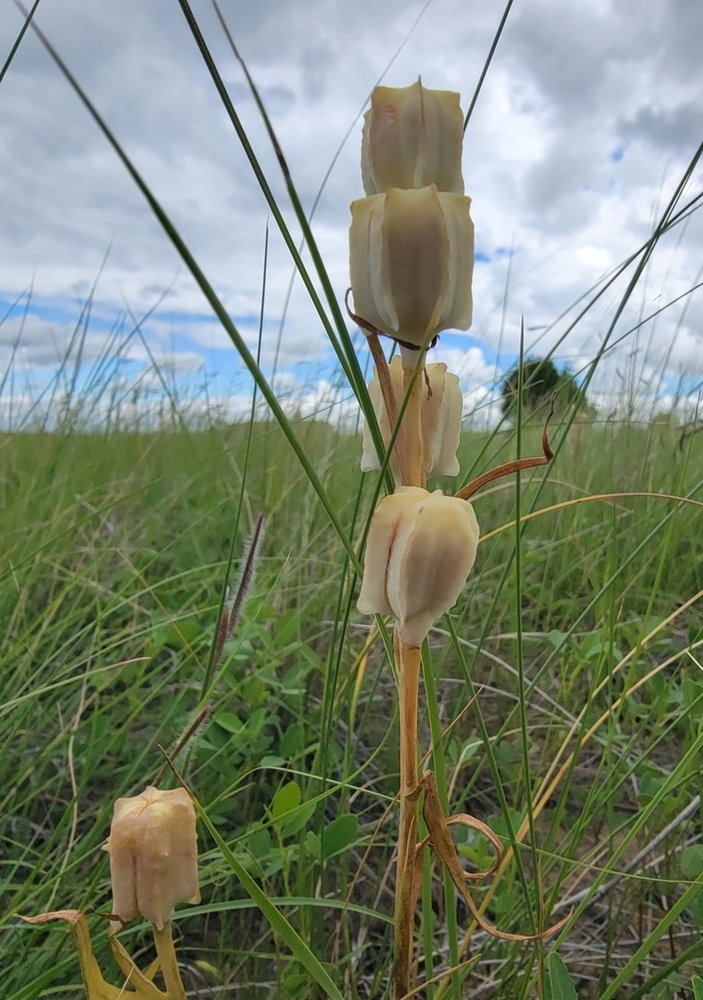
Purplespot Fritillary (Fritillaria atropurpurea) is a native lily with nodding, purplish-brown flowers mottled yellow or white on a stem 10–60 cm (4–24 in) tall. It flowers from May into July, and Black Hills herbarium specimens come from ponderosa pine woods, rocky openings and wooded draws.
Free photos from other sources
| Family | Liliaceae · Lily |
|---|---|
| Status | Native perennial |
| Blooms | May into July |
| Height | 10–60 cm (4–24 in) |
| Where | Pine woods, rocky openings and wooded draws |
| Also called | Spotted Missionbells, Purple Spotted Fritillaria, Leopard Lily, Checker Lily, čhaŋȟlóǧaŋ makȟátȟola pȟežúta (Lakota), wahíŋheya iphíye (Lakota) |
| Synonym | Fritillaria adamantina, Fritillaria gracillima, Fritillaria linearis |
| Traditional use | Rogers 1980 records that the Lakota (Sicangu) pulverized the whole plant into a salve for scrofulous swellings, according to Moerman's database and Flora of North America. Black Elk and Flying By (1998) record that the Lakota ate the scaly bulbs raw or cooked and found them tasty, though small and scarce. Chamberlin's 1909 account of the Ute, according to Moerman's database, records a decoction of the bulbs and roots used as medicine, and in large quantities regarded as dangerously poisonous. |
Traditional use: first drafted by Google AI, then checked against the sources on this page.
Roots, seeds & germination
Root: The bulb has 2 to 5 large scales and about 45 to 50 small ones, according to Flora of North America.
How do you identify Purplespot Fritillary?
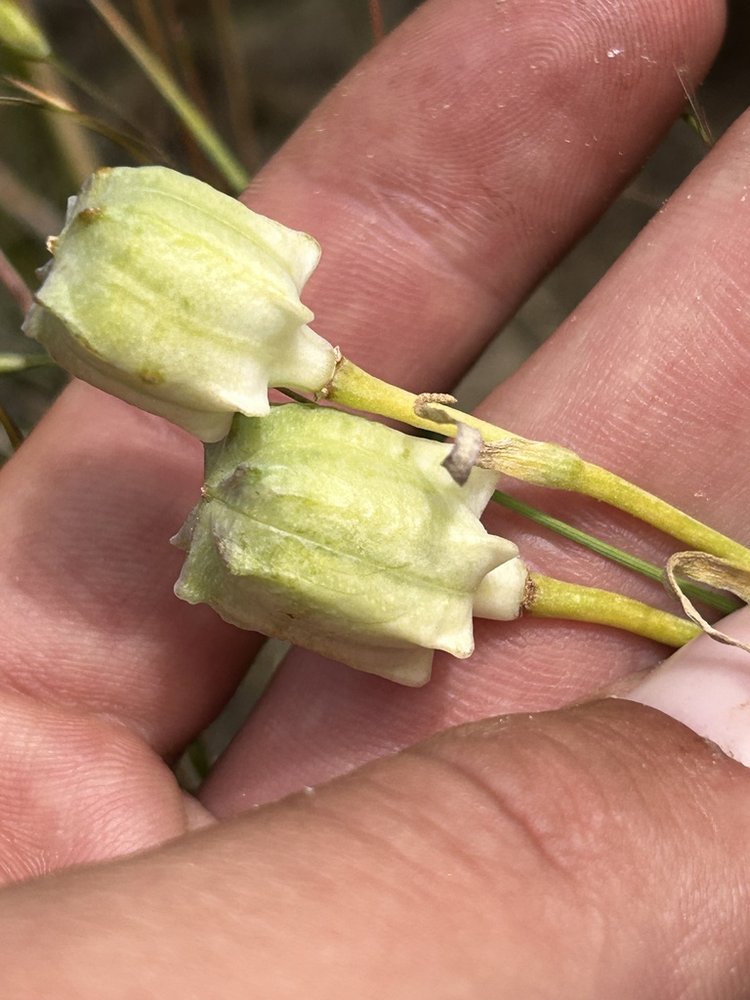
Look for a stem with narrow leaves in whorls of two or three, topped by nodding flowers. The six petal-like parts (tepals) are purplish brown with yellow or white mottling, 1–2.5 cm (⅜–1 in) long, and spread wide open. Fruit is a capsule with sharp angles. Flora of North America says it is easily confused with Fritillaria pinetorum, whose flowers are almost always erect, and whose lowest stem leaves are long enough to pass the flower cluster; in Purplespot Fritillary the flowers nod and the lowest stem leaves almost never reach past the cluster.
When does it bloom?
May into July.
Where does it grow?
Leaf mold under trees and shrubs, 1,000–3,200 m (3,300–10,500 ft), according to Flora of North America. Black Hills herbarium labels give ponderosa pine woods, a rocky outcrop under open pine, the open edge of pine forest, a shady draw among pine and ironwood, a rocky open conifer meadow, aspen with paper birch and loose soil among oaks; one label gives about 2,100 m (6,900 ft). The 32 Black Hills specimens on GBIF, collected from 1896 to 2010, come from Lawrence, Pennington and Custer counties in South Dakota and Crook and Weston counties in Wyoming.
Other lilies in this guide
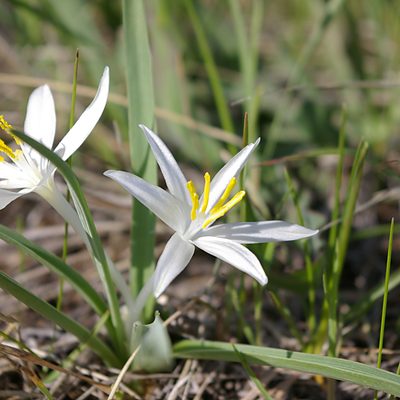
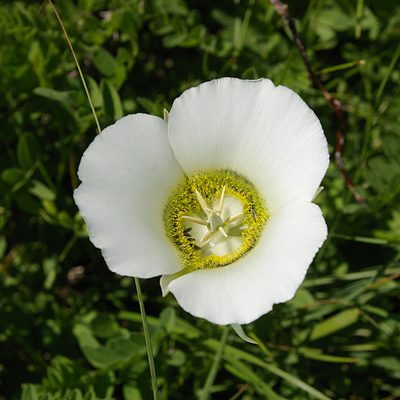
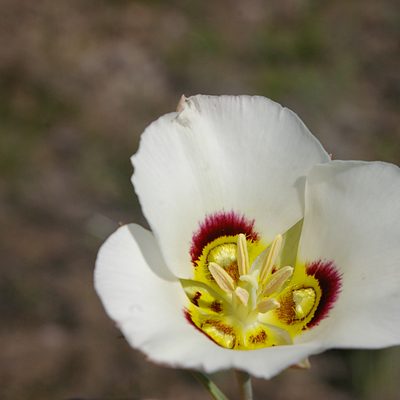
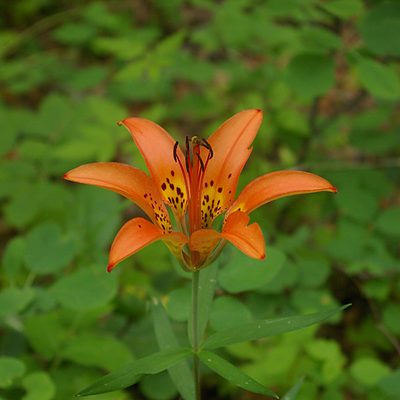
Lily family (Liliaceae): 5 other plants in this guide
Sources: Flora of North America Vol. 26: Fritillaria atropurpurea (Rix and Jones), eFloras; Culturally Important Plants of the Lakota (Black Elk and Flying By, 1998), entry 127, filed with the South Dakota PUC; Native American Ethnobotany Database (BRIT): Fritillaria atropurpurea; GBIF occurrence search: Fritillaria atropurpurea, South Dakota and Wyoming herbarium specimens (Black Hills counties); GBIF specimen 2512332605: Bear/Beaver Gulches Botanical Area, Lawrence County, 2010, "Rocky outcrop under an open Pinus ponderosa forest"; GBIF specimen 2632245247: Bennett 1936, Lawrence County, "Shady draw among pine and ironwood"; GBIF specimen 3091260290: Rominger 1960, Lawrence County, "Open edge of Ponderosa pine forest"; GBIF specimen 5159163825: Weedon 1997, Pennington County, "Ponderosa pine forest, in partial shade"; GBIF specimen 5895884626: Churchill 1975, Custer County, "rocky open conifer me[adow]"; GBIF specimen 4912085538: Kass 1996, Crook County, Wyoming, "Aspen/Paper Birch comm."; GBIF specimen 4073707178: Ownbey 1935, Crook County, Wyoming, "Loose soil among the oaks"; South Dakota Game, Fish and Parks: Rare Plants of South Dakota (Fritillaria atropurpurea not listed).