Wood Lily
Lilium philadelphicum var. andinum
Wood Lily (Lilium philadelphicum var. andinum) is the native orange-red lily of the Black Hills, often called tiger lily locally, with one to three large, spotted flowers that face straight up. It grows from a small bulb and blooms from mid-June through July in open pine and aspen woods, forest edges and mountain meadows, mainly in the central and northern Hills.
Free photos from other sources





| Family | Liliaceae · Lily |
|---|---|
| Status | Native perennial |
| Blooms | Mid-June through July, with a few into early August |
| Height | 30–90 cm (12–36 in) |
| Where | Open pine and aspen woods, forest edges and mountain meadows |
| Also called | Tiger Lily, Western Wood Lily, Western Red Lily, Prairie Lily, Philadelphia Lily, mná ȟčaȟčá (Lakota) |
| Synonym | Lilium andinum, Lilium umbellatum, Lilium montanum |
| Listed | NatureServe ranks it S2S3 (rare to uncommon) in Wyoming; South Dakota does not rank or track it. |
| Toxicity | Like all true lilies, every part of the plant, pollen included, is toxic to cats and can cause kidney failure. |
| Traditional use | Black Elk and Flying By’s 1998 Culturally Important Plants of the Lakota says the Lakota cooked and ate the bulb, used a tea of the bulbs for stomach trouble, coughs and fevers, and put chewed flowers on spider bites. |
| Note | Many people in the Black Hills call this Tiger Lily. Botanists keep that name for an Asian garden lily, Lilium lancifolium. |
Roots, seeds & germination
Root: A small, chunky white bulb of thick, jointed scales, about 2–5 cm (1–2 in) across, with fibrous roots below. Bulbs can stay dormant underground for several years before sending up a stem again.
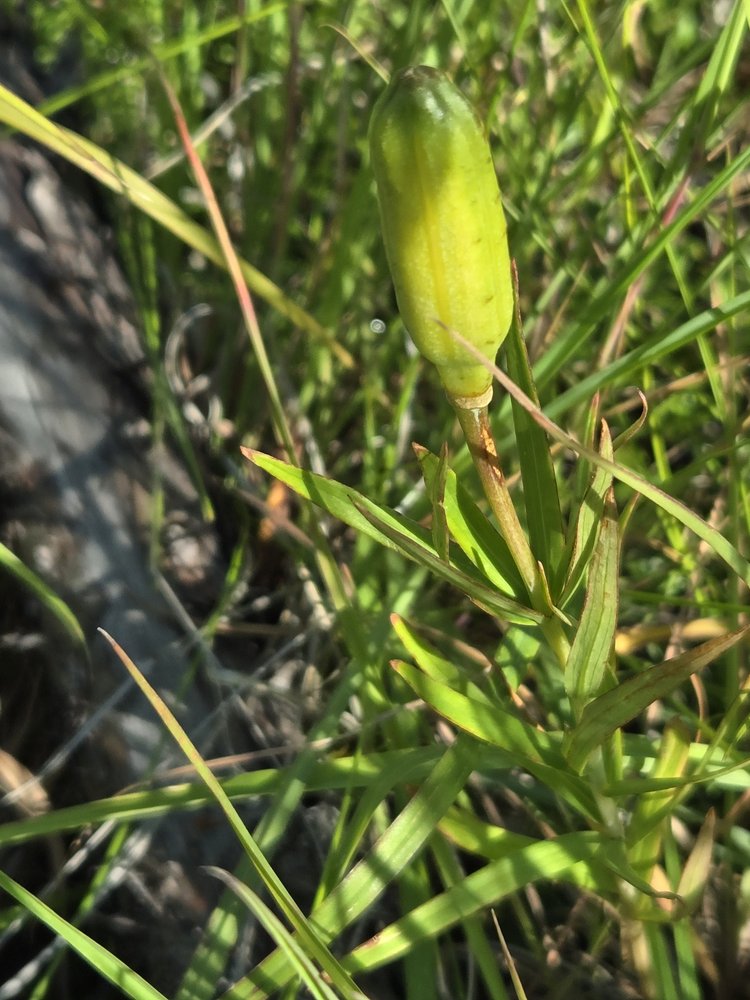
Seed: An upright, narrow capsule 2–8 cm (1–3 in) long that ripens and splits into three parts in August and September. It holds many flat, papery, teardrop-shaped seeds about 4–7 mm long that scatter on the wind.
Germination: Seed sprouts readily. Prairie Moon recommends at least 60 days of cold, moist stratification, though Alberta trials got about 90% germination within a month without it. Seedlings spend several years building a bulb, and seed-grown plants usually take about five years to flower.
How do you identify Wood Lily?
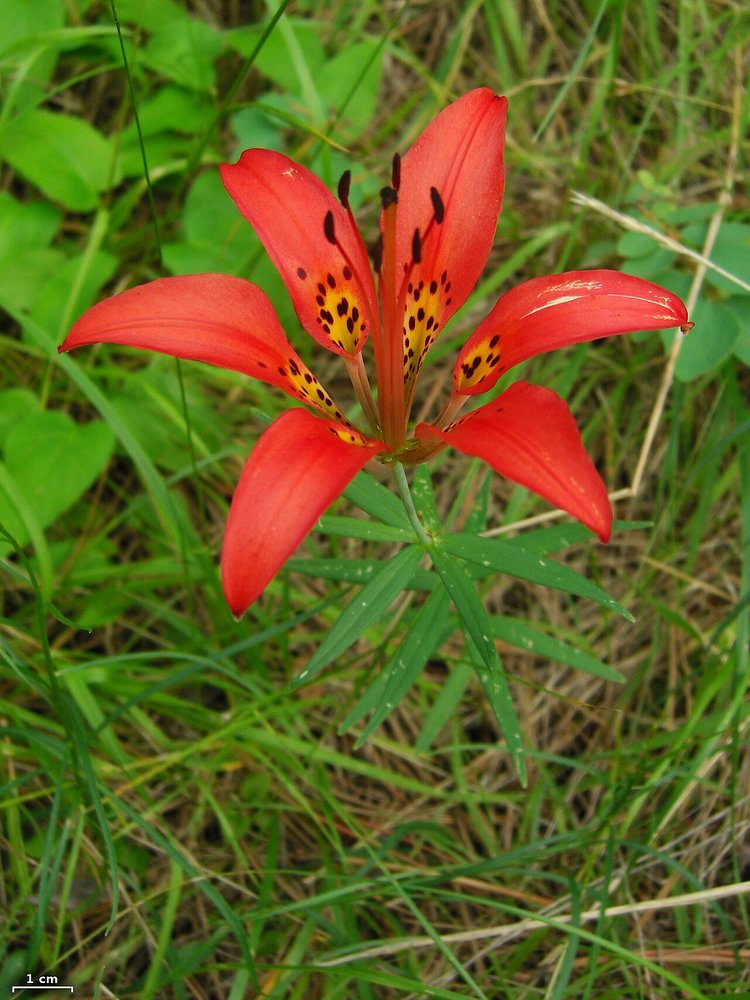
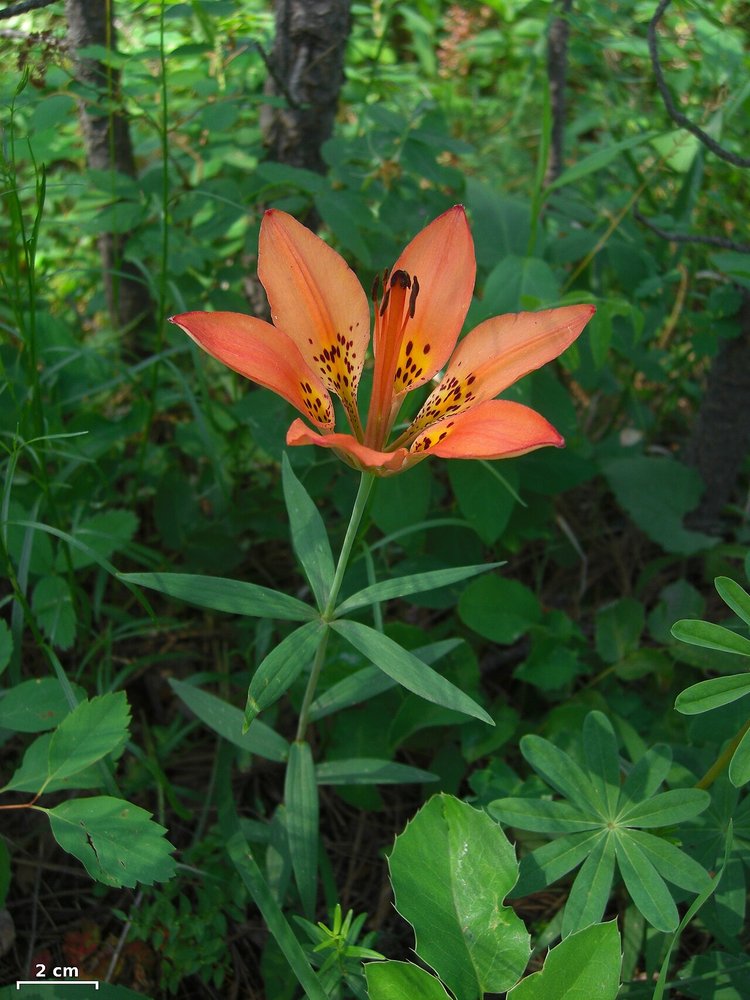
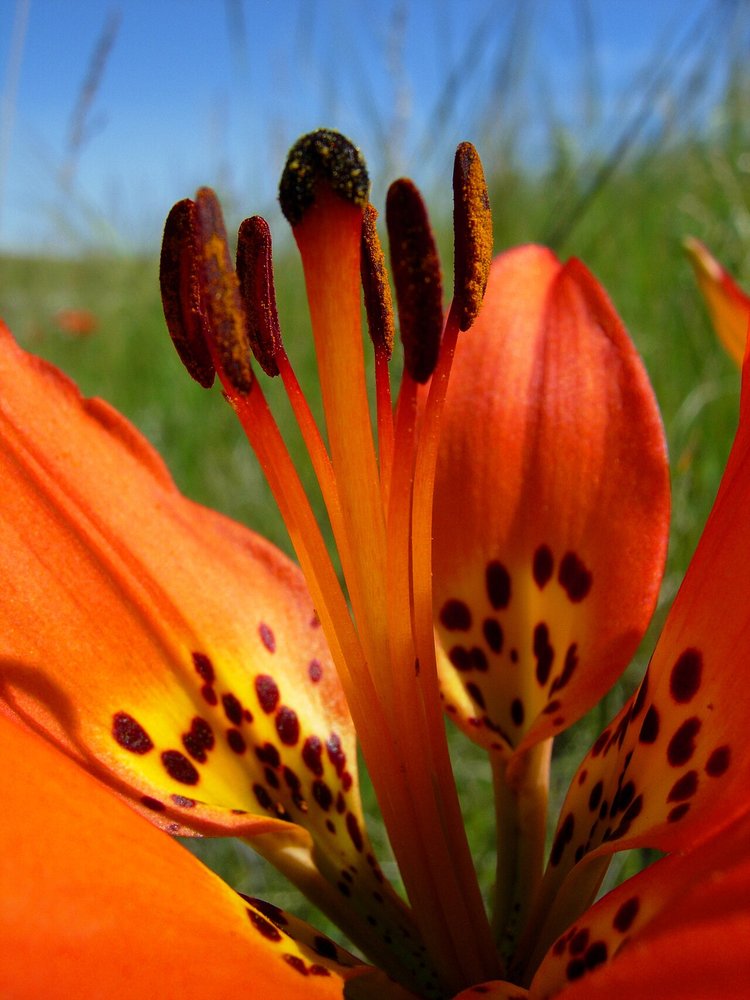
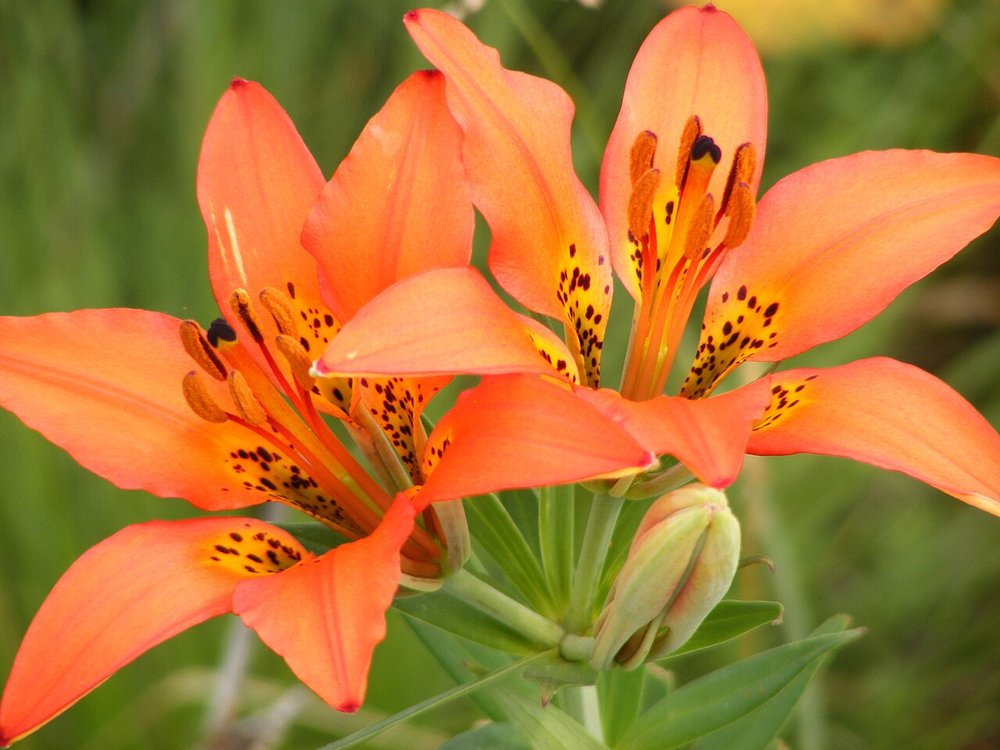
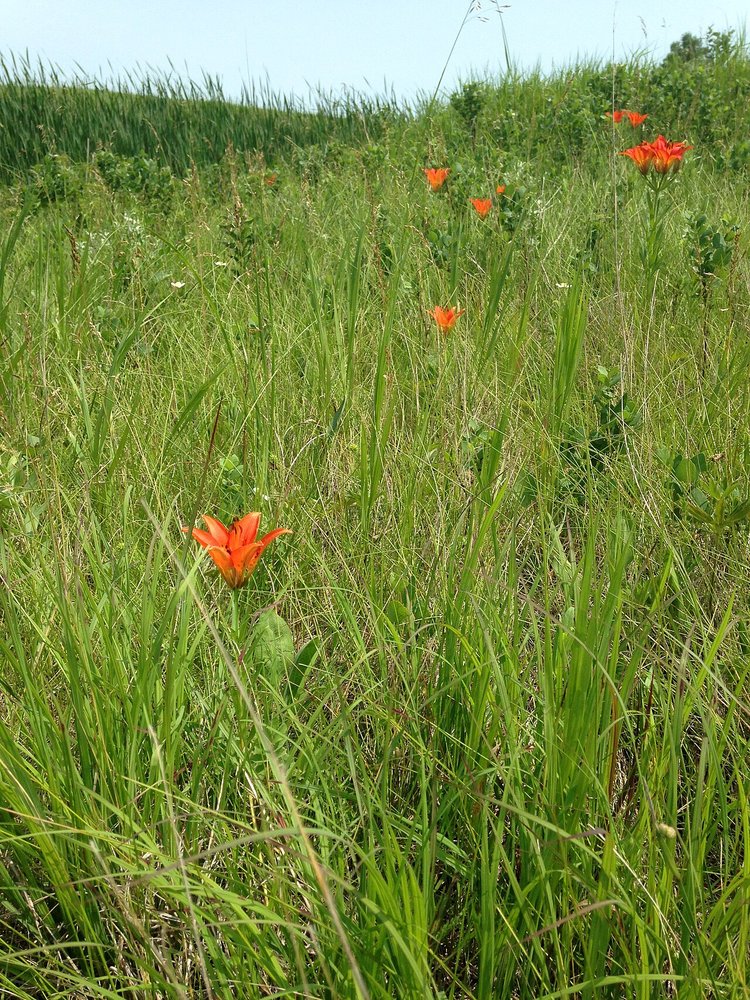
Look for one to three, rarely up to six, red-orange flowers 5–8 cm (2–3 in) across that face straight up like an open cup. Each of the six tepals narrows to a slender stalk at the base, so you can see daylight between them, and turns yellow toward the center, speckled with dark maroon spots. The single stem is smooth and unbranched, with narrow, toothless leaves scattered up it and one whorl just below the flowers. The garden Tiger Lily (Lilium lancifolium), which hangs on around old homesteads, has many nodding flowers with petals curled back and small purple-black bulbils where the upper leaves meet the stem. After bloom, a slim, upright green capsule stands at the top of the stem.
When does it bloom?
Mid-June through July, with a few into early August.
Where does it grow?
Open ponderosa pine forest, aspen and birch woods, forest edges, road cuts and mountain meadows, in sandy to loamy, well-drained soil in sun or part shade. It usually grows as single, scattered plants rather than patches. The Black Hills National Forest lists it as a mid-summer wildflower of the central and northern Hills, the 1986 Jewel Cave survey lists it, and the species lists for Wind Cave and Mount Rushmore include it. Herbarium specimens come from Lawrence, Pennington, Custer, Meade and Fall River counties, SD, and Crook and Weston counties, WY, from about 1,100 to 2,270 m (3,600–7,450 ft).
Sources: Black Hills Native Plants (Black Hills National Forest, USDA Forest Service); Vegetation of Jewel Cave National Monument (Marriott & Hartman 1986); NPSpecies checklist, Wind Cave National Park (vascular plants); NPSpecies checklist, Jewel Cave National Monument (vascular plants); NPSpecies checklist, Mount Rushmore National Memorial (vascular plants); GBIF herbarium specimens of Lilium philadelphicum, South Dakota; GBIF herbarium specimens of Lilium philadelphicum, Wyoming; Lilium philadelphicum, Flora of North America; Lilium philadelphicum var. andinum, USDA PLANTS Database; Wood Lily, Minnesota Wildflowers; Tiger Lily (Lilium lancifolium), Minnesota Wildflowers; Lilium philadelphicum, NatureServe Explorer; Lilium philadelphicum rank report, Montana Natural Heritage Program (2026 draft); Lilium philadelphicum, Colorado Natural Heritage Program; Wood Lily fact sheet, Maryland DNR Rare, Threatened and Endangered Plants; Rare Plants of South Dakota, SD Game, Fish & Parks; Process for Identifying Wildlife and Plant Species of Local Concern and Results, Black Hills NF Phase II Amendment (2005); Black Hills NF Plant Monitoring Guide (2006, archived); Black Hills NF Revised Forest Assessment: At-Risk Species (October 2023); Culturally Important Plants of the Lakota (Black Elk & Flying By, Sitting Bull College 1998); Lilium philadelphicum, ACRRE / University of Alberta native plant profile; Lilium philadelphicum propagation protocol, University of Washington ESRM 412 (2024); Prairie Lily (Lilium philadelphicum), Prairie Moon Nursery; Lilium philadelphicum, Wikipedia; Emblems and Flags, Government of Saskatchewan; Lovely Lilies and Curious Cats: A Dangerous Combination, U.S. Food and Drug Administration.