Groundsels and ragworts of the Black Hills
All 3 groundsels and ragworts in this guide, side by side, A to Z. Compare the photos, bloom time, height and where each grows, then open the one that fits for more photos and the full ID notes. Each plant's page lists its sources.
| Plant | Color | Blooms | Height | Where | How to tell it apart |
|---|---|---|---|---|---|
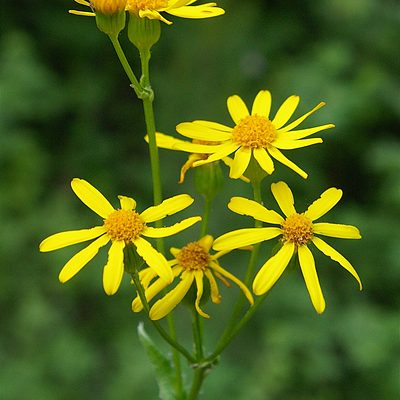 Balsam RagwortPackera paupercula | Yellow | June into August | 20–45 cm (8–18 in) | Moist pine, spruce and aspen woods, meadow edges and stream banks | Look for a mostly smooth stem with a loose, flat-topped cluster of 2 to 20 heads, each about 2 cm (3/4 in) across, with 8 or 13 yellow rays (sometimes none) around a golden center. The green bracts under each head are smooth and often purple at the tip. The leaves at the base are small, lance-shaped to narrowly oval, smooth-edged to toothed, and taper into a long stalk; up the stem the leaves get smaller, sit right on the stem and are deeply cut or lobed. A few wisps of woolly hair may show at the stem base, in the leaf angles and on young upper leaves. Prairie Ragwort (Packera plattensis) has leaves of a similar shape and size, but it is usually densely woolly all over, grows on dry, sandy prairie and has a more branched flower cluster. Flora of North America separates Woolly Groundsel (Packera cana) by its stems, which are coated in gray-white felt or wool. |
 Lambstongue GroundselSenecio integerrimus | Yellow | June into August | 10–70 cm (4–28 in) | Prairies, open woods, meadows and rocky slopes; well-drained soil | Look for one stem from the base, large stalked lower leaves that shrink to small stalkless ones near the top, and cobwebby hairs that fade with age. The narrow bracts under each head are often black-tipped, though var. integerrimus has green tips. Woolly Groundsel is shorter and stays covered in silver-gray felt. |
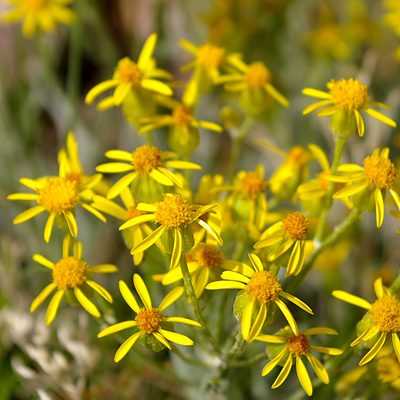 Woolly GroundselPackera cana | Yellow | May into July | 10–30 cm (4–12 in) | Open, dry plains; rocky soil in full sun | Look for a short plant covered in silver-gray felt, with long-stalked oval basal leaves 2.5–5 cm long, much smaller leaves up the stem, and a cluster of 6 to 15 yellow heads with 8 to 13 rays. Lambstongue Groundsel is usually taller and loses most of its hair with age. |
Other look-alike groups: 38 groups
- Anemones (4)
- Asters (4)
- Beardtongues (5)
- Buttercups (3)
- Cacti (4)
- Cinquefoils (7)
- Clovers (6)
- Coneflowers (4)
- Currants and gooseberries (5)
- Daisies (5)
- Dandelions (3)
- Docks and buckwheats (4)
- Evening primroses (4)
- Ferns (4)
- Gentians (4)
- Grasses (11)
- Lilies (5)
- Mayflowers and false Solomon's seals (3)
- Milkvetches and locoweeds (12)
- Milkweeds (6)
- Mints (8)
- Mustards (11)
- Orchids (8)
- Paintbrushes (3)
- Pines (3)
- Raspberries and thimbleberries (3)
- Sagebrushes and sageworts (3)
- Sedges (3)
- Speedwells and kittentails (3)
- Sunflowers (4)
- Thistles (6)
- Vervains (3)
- Vetches (4)
- Violets (7)
- Wild lettuces (3)
- Wild onions (3)
- Wild plums and cherries (3)
- Willows (3)