Cacti of the Black Hills
All 4 cacti in this guide, side by side, A to Z. Compare the photos, bloom time, height and where each grows, then open the one that fits for more photos and the full ID notes. Each plant's page lists its sources.
| Plant | Color | Blooms | Height | Where | How to tell it apart |
|---|---|---|---|---|---|
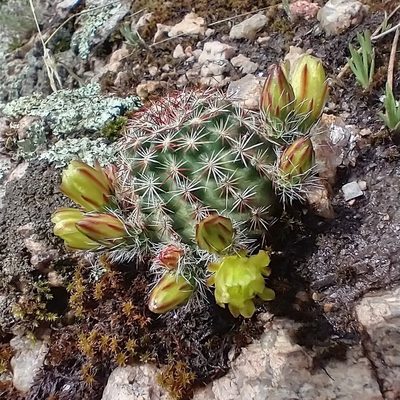 Green-flowered Hedgehog CactusEchinocereus viridiflorus | Green & Brown, Yellow | May and June | 3–35 cm (1–14 in) | Dry, sunny grassland and sandy, gravelly or rocky hillsides in the southern Hills | Look for one short, upright, round to cylindrical green stem, or a few side by side, about 3–9 cm (1¼–3½ in) thick, with 10–20 ribs running top to bottom and spine clusters spaced along each rib. The outer spines lie flat or spread, sometimes in comb-like rows, and are red-and-white, yellowish, whitish or purplish, often with darker tips. The yellowish-green flowers, 2–3.5 cm (¾–1⅓ in) long, have narrow petals, often with a darker stripe down the middle, and come out from the sides of the stem on last year's growth, rarely from the top. Missouri Foxtail Cactus is about as small and also has pale greenish-yellow flowers, but its stem is covered in separate soft bumps instead of ribs, its flowers sit at or close to the top, and its spines are white, pale gray or pale tan. |
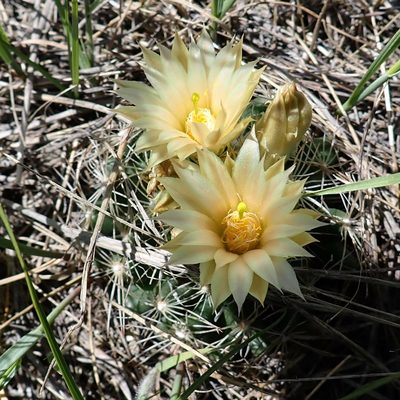 Missouri Foxtail CactusPelecyphora missouriensis | Yellow, Green & Brown | May and June | 2–8 cm (¾–3 in) | Dry, sunny prairie, stony grassland and ponderosa pine woodland, often on limestone or other sedimentary rock | Look for a single low, green ball or flat-topped stem, sometimes a small clump, 2–7.5 cm (¾–3 in) across and nearly flush with the ground. Each bump ends in a cluster of 6–20 thin white, pale gray or pale tan spines pressed close against the stem, often with no central spine. The flowers are pale greenish-yellow, with a green, pink or pale brown stripe down each petal, and the small scarlet berries last through winter. Spinystar has bright magenta to rose-pink flowers, several stouter central spines in each cluster, and a green berry that ripens in late summer. |
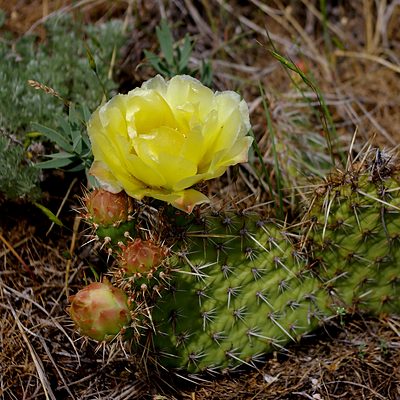 Plains Prickly PearOpuntia polyacantha | Yellow | June, sometimes from late May into early July | 10–30 cm (4–12 in) | Dry, open prairie, rocky slopes and sunny openings among pines | Look for a low cactus of flat, round to oval pads about 5–12 cm (2–5 in) long that stay firmly attached. The spine clusters are crowded, usually less than 1 cm apart, each with up to about 10 spines, the longest at least 2.5 cm (1 in), and each cluster also holds a tuft of glochids, tiny barbed bristles. The flowers are 5–9 cm (2–3½ in) across, with many papery petals, usually yellow but sometimes tinged apricot, pink or red, and the ripe fruit is dry and spiny. Brittle Prickly Pear has small, thick pads up to about 5 cm (2 in) long that break off at a touch, and spines no longer than about 2.5 cm (1 in). |
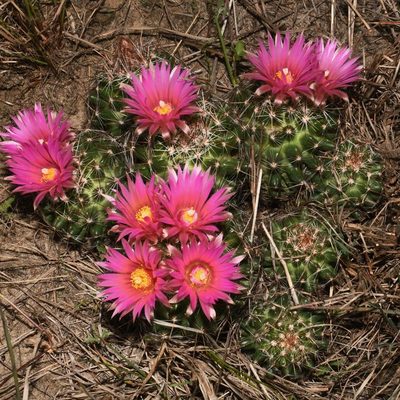 SpinystarPelecyphora vivipara | Pink | June, from late May into July, a few into August | 2.5–13 cm (1–5 in) | Dry, sunny prairie, rocky and gravelly hillsides and sandy ground | Look for a round to egg-shaped green stem about 4–5 cm (1½–2 in) across, alone or in a small clump, covered in raised bumps (tubercles) that each end in a star of 10–40 thin, mostly whitish spines lying flat, plus several stouter brownish central spines that stick out. The magenta to rose-pink flowers are 2.5–6 cm (1–2½ in) across, with many narrow petals around a ring of yellow to orange anthers. Missouri Foxtail Cactus has pale greenish-yellow flowers, fewer and paler spines with few or no central spines, and small scarlet berries in spring, while Spinystar's fruit is a larger green berry. Prickly pears grow as flat pads, with glochids, tiny barbed bristles, in each spine cluster. |
Other look-alike groups: 38 groups
- Anemones (4)
- Asters (4)
- Beardtongues (5)
- Buttercups (3)
- Cinquefoils (7)
- Clovers (6)
- Coneflowers (4)
- Currants and gooseberries (5)
- Daisies (5)
- Dandelions (3)
- Docks and buckwheats (4)
- Evening primroses (4)
- Ferns (4)
- Gentians (4)
- Grasses (11)
- Groundsels and ragworts (3)
- Lilies (5)
- Mayflowers and false Solomon's seals (3)
- Milkvetches and locoweeds (12)
- Milkweeds (6)
- Mints (8)
- Mustards (11)
- Orchids (8)
- Paintbrushes (3)
- Pines (3)
- Raspberries and thimbleberries (3)
- Sagebrushes and sageworts (3)
- Sedges (3)
- Speedwells and kittentails (3)
- Sunflowers (4)
- Thistles (6)
- Vervains (3)
- Vetches (4)
- Violets (7)
- Wild lettuces (3)
- Wild onions (3)
- Wild plums and cherries (3)
- Willows (3)