Pines of the Black Hills
All 3 pines in this guide, side by side, A to Z. Compare the photos, bloom time, height and where each grows, then open the one that fits for more photos and the full ID notes. Each plant's page lists its sources.
| Plant | Blooms | Height | Where | How to tell it apart |
|---|---|---|---|---|
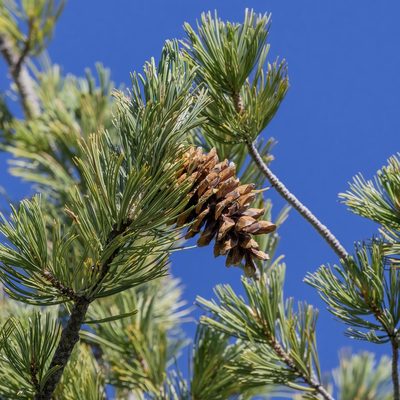 Limber PinePinus flexilis | Pollen in late June and July in Rocky Mountain records (no Black Hills dates found); the seed cones ripen in August and September of their second year | Rarely over 15 m (50 ft) | Open, rocky granite ridges and partly shaded north-facing upper slopes with Ponderosa Pine, White Spruce and Common Juniper, at about 1,950–2,160 m (6,400–7,100 ft) | Count the needles. Limber Pine carries five to a bundle, each only 3–7 cm (1–3 in) long, dark green and clustered at the ends of the branches, where Ponderosa Pine has needles in twos and threes about 18 cm (7 in) long, yellow-green to gray-green, and Lodgepole Pine has two to a bundle. The twigs are flexible enough to tie in a knot, and the trunk is often twisted and strongly tapering, with branches often kept right down to the base. Young bark is smooth and gray to whitish; old trunks break into scaly plates and ridges. The cones are 7–15 cm (3–6 in) long, cylindrical, straw-colored and sticky with resin, with thick, smooth scale tips and no prickle, where Ponderosa cones are 8–15 cm (3–6 in), egg-shaped, with a small prickle on each scale. The seeds are large, 10–15 mm, and wingless or nearly so, and birds and rodents take them so fast they are rarely seen. White Spruce, the other evergreen in the same stands, has single needles rather than bundles. |
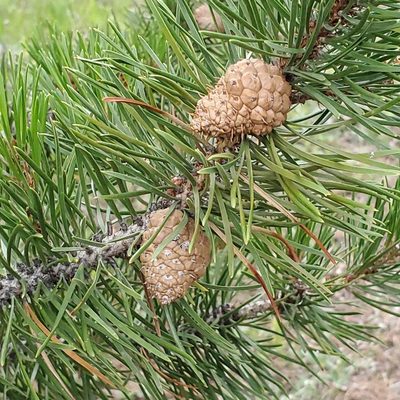 Lodgepole PinePinus contorta | Pollen in May and June; the cones ripen in September and October of their second year, and many stay sealed on the tree for years | 15–30 m (50–100 ft) | Cool, moist, higher-elevation sites and mixed conifer forest on dry soils, with Ponderosa Pine, aspen and spruce, at about 1,700–1,850 m (5,600–6,000 ft) | Count the needles: two to a bundle, 4–8 cm (1½–3 in) long, 1–2 mm wide, yellow-green to dark green and often twisted, with the sheath at the base staying on. Ponderosa Pine's needles also come mainly in twos and threes, but they are 10–17 cm (4–7 in) long, and Limber Pine's come five to a bundle. The bark is thin, only about 6 mm (¼ in) thick, gray-brown to red-brown, scaly and separating into loose plates, not deeply furrowed, and the trunk is straight, slender and evenly tapering with a narrow cone-shaped crown; a trunk only 13 cm (5 in) thick can be 15 m (50 ft) tall. The cones are small, 2–6 cm (1–2½ in), egg-shaped and lopsided, often curved back along the twig, the scales tipped with small prickles, sharpest toward the tip of the cone; Ponderosa cones are 5–10 cm (2–4 in). Many Lodgepole cones are sealed with resin and cling to the branches closed for years until the heat of a fire opens them. The pollen cones are orange-red. |
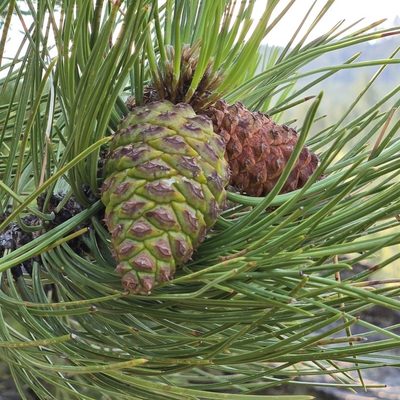 Ponderosa PinePinus ponderosa var. scopulorum | Pollen late May into June; cones ripen in the second fall | Usually up to 24 m (80 ft); can reach 35 m (115 ft) | Almost everywhere, from dry foothills and open savanna to the high peaks | Look for long, stiff needles, 7–18 cm (3–7 in), in bundles of two or three, often both on the same tree, tufted near the twig tips. Young trees have dark, nearly black, furrowed bark. Older trees have thick, flaky bark in broad, flat plates, orange-brown to cinnamon-red, that smells of vanilla or butterscotch when you put your nose to it. The egg-shaped cones are 5–10 cm (2–4 in) long, with a small sharp prickle on each scale. Black Hills Spruce has single needles, not bundles. |
Other look-alike groups: 38 groups
- Anemones (4)
- Asters (4)
- Beardtongues (5)
- Buttercups (3)
- Cacti (4)
- Cinquefoils (7)
- Clovers (6)
- Coneflowers (4)
- Currants and gooseberries (5)
- Daisies (5)
- Dandelions (3)
- Docks and buckwheats (4)
- Evening primroses (4)
- Ferns (4)
- Gentians (4)
- Grasses (11)
- Groundsels and ragworts (3)
- Lilies (5)
- Mayflowers and false Solomon's seals (3)
- Milkvetches and locoweeds (12)
- Milkweeds (6)
- Mints (8)
- Mustards (11)
- Orchids (8)
- Paintbrushes (3)
- Raspberries and thimbleberries (3)
- Sagebrushes and sageworts (3)
- Sedges (3)
- Speedwells and kittentails (3)
- Sunflowers (4)
- Thistles (6)
- Vervains (3)
- Vetches (4)
- Violets (7)
- Wild lettuces (3)
- Wild onions (3)
- Wild plums and cherries (3)
- Willows (3)