Limber Pine Pinus flexilis
Also called Rocky Mountain White Pine
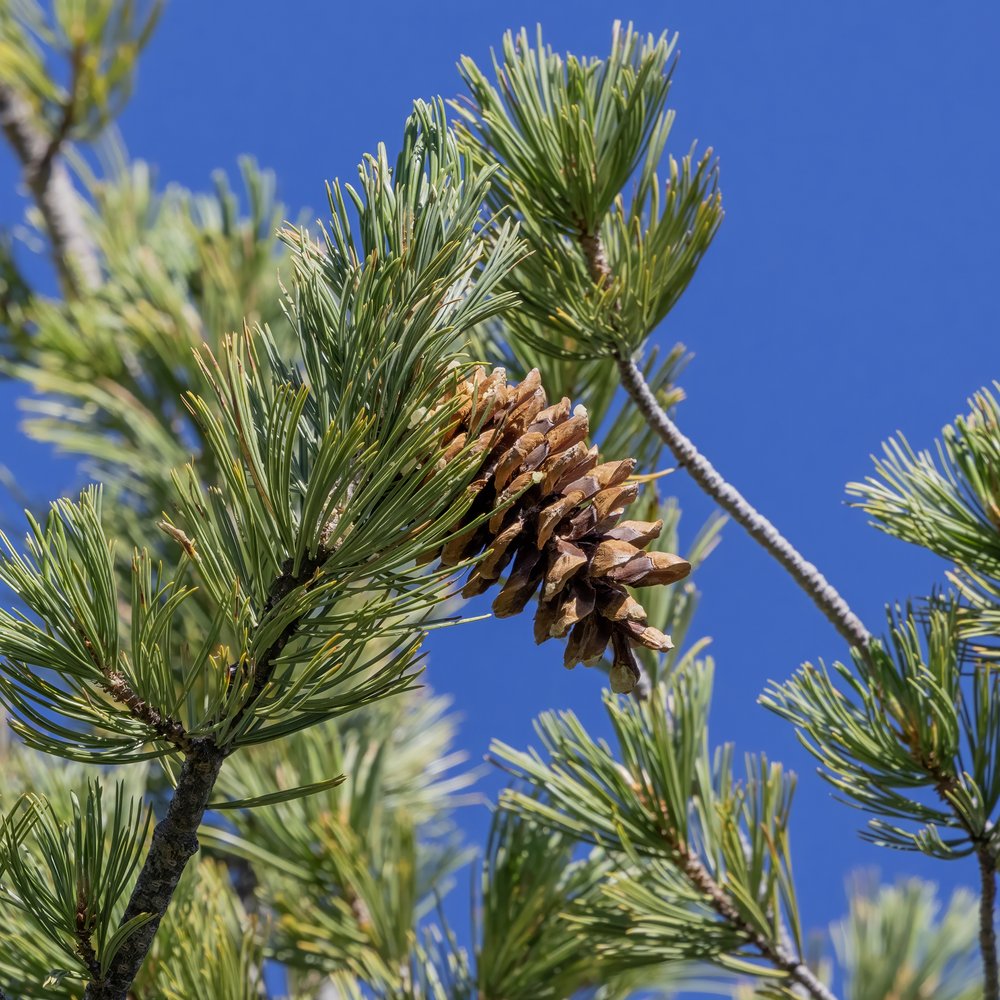
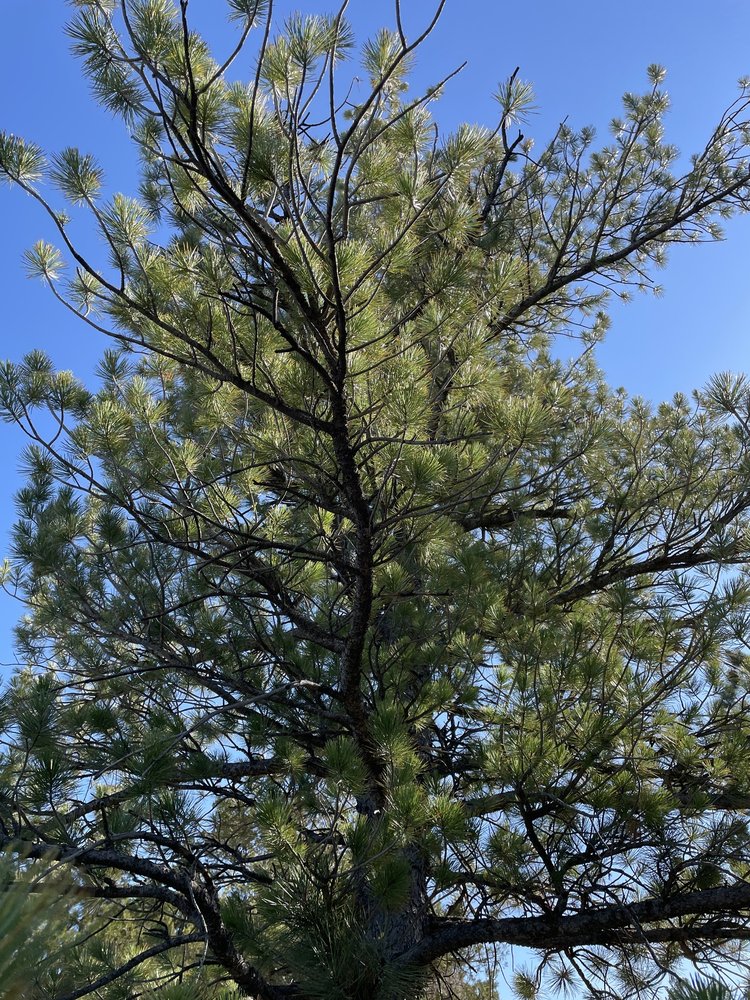
Limber Pine (Pinus flexilis) is a native five-needle pine of high, windy, rocky ground, rarely over 15 m (50 ft) tall, with short dark green needles in bundles of five tufted at the branch tips, smooth gray bark on young trees and twigs flexible enough to tie in a knot. In the Black Hills it survives as a small relict population from the last ice age, on open granite ridges and north-facing upper slopes with Ponderosa Pine and White Spruce; an SDSU Extension survey from 2020 to 2025 counted 185 trees in the largest group and about 24 more, mostly seedlings and saplings, in a much smaller one.
Free photos from other sources
| Family | Pinaceae · Pine |
|---|---|
| Status | Native evergreen tree |
| Blooms | Pollen in late June and July in Rocky Mountain records (no Black Hills dates found); the seed cones ripen in August and September of their second year |
| Height | Rarely over 15 m (50 ft) |
| Where | Open, rocky granite ridges and partly shaded north-facing upper slopes with Ponderosa Pine, White Spruce and Common Juniper, at about 1,950–2,160 m (6,400–7,100 ft) |
| Also called | Rocky Mountain White Pine |
| Synonym | Apinus flexilis |
| Note | The Forest Service lists Limber Pine as a species of conservation concern in the Black Hills, and NatureServe ranks it critically imperiled in South Dakota. This page gives no locations. |
Roots, seeds & germination
Root: Deep taproots; the trees are very windfirm and grow in partnership with root fungi (ectomycorrhizae).
Seed: The cones take two years to ripen and shed their seed in September and October, then fall. Each seed is large, 10–15 mm, and wingless or nearly so, so the wind doesn't spread it well: Clark's nutcracker, which feeds on the seeds, is the main planter, carrying and burying them, and the nutcracker is found nowhere else in South Dakota. Trees first bear seed at 20 to 40 years old, with good crops every 2 to 4 years.
Germination: Fresh seed can sprout without treatment, and up to 90 days of cold, moist stratification improves it. The tree is not shade tolerant: the Black Hills survey found the most seedlings where the Ponderosa Pine canopy had been lost, and planted seedlings have done better on deeper soil without competition than on harsh, thin, rocky sites.
How do you identify Limber Pine?
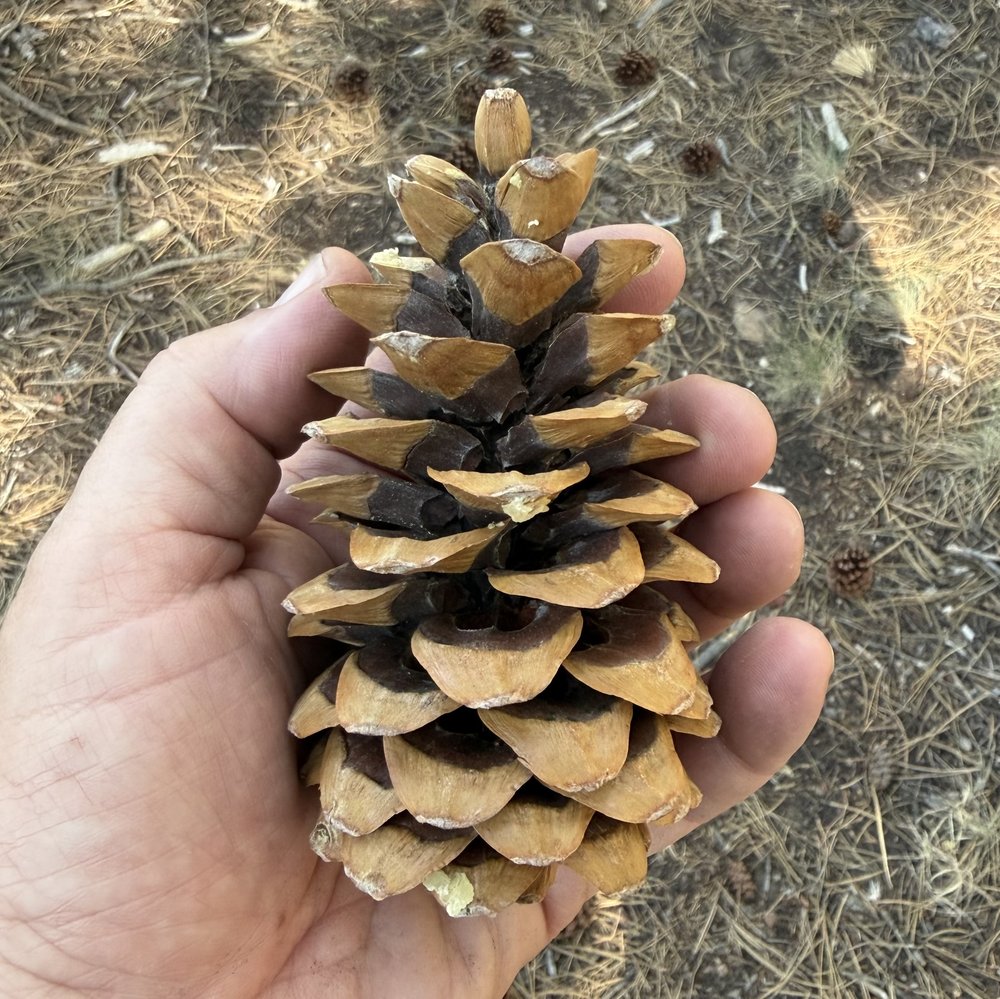
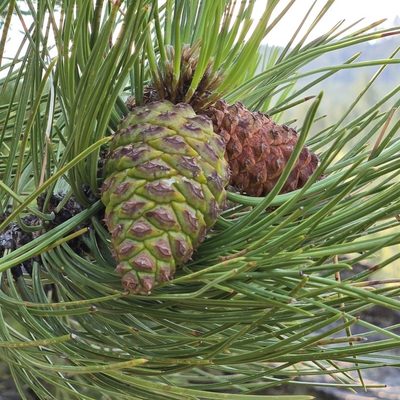
Count the needles. Limber Pine carries five to a bundle, each only 3–7 cm (1–3 in) long, dark green and clustered at the ends of the branches, where Ponderosa Pine has needles in twos and threes about 18 cm (7 in) long, yellow-green to gray-green, and Lodgepole Pine has two to a bundle. The twigs are flexible enough to tie in a knot, and the trunk is often twisted and strongly tapering, with branches often kept right down to the base. Young bark is smooth and gray to whitish; old trunks break into scaly plates and ridges. The cones are 7–15 cm (3–6 in) long, cylindrical, straw-colored and sticky with resin, with thick, smooth scale tips and no prickle, where Ponderosa cones are 8–15 cm (3–6 in), egg-shaped, with a small prickle on each scale. The seeds are large, 10–15 mm, and wingless or nearly so, and birds and rodents take them so fast they are rarely seen. White Spruce, the other evergreen in the same stands, has single needles rather than bundles.
When does it bloom?
Pollen in late June and July in Rocky Mountain records (no Black Hills dates found); the seed cones ripen in August and September of their second year.
Where does it grow?
Steep, rocky, well-drained, windswept ground with poor soil: in the Black Hills, open granite ridges and partly shaded north-facing upper slopes with Ponderosa Pine, White Spruce and Common Juniper, at about 1,950–2,160 m (6,400–7,100 ft). Across its range it grows in high mountain forest, often at timberline, from Alberta to New Mexico, with three small outlying populations east of the Rocky Mountains, in the Black Hills, western Nebraska and North Dakota. SDSU calls the Black Hills population a native glacial relict and says it is more genetically diverse than the other two outlying populations. Its 2020–2025 survey counted 185 trees in the largest group, from seedlings to trees nearly 200 years old, plus a much smaller group of about 24, mostly seedlings and saplings, whose mature trees were killed by mountain pine beetle. The Forest Service reports that many of the pines have recently been killed by mountain pine beetle and white pine blister rust.
Other pines in this guide
Pine family (Pinaceae): 3 other plants in this guide
Sources: Flora of North America Vol. 2: Pinus flexilis — eFloras; Flora of North America Vol. 2: Pinus ponderosa var. scopulorum — eFloras; Flora of North America Vol. 2: Pinus contorta — eFloras; Fire Effects Information System: Pinus flexilis (Johnson 2001) — USDA Forest Service; Limber Pines: A Unique Tree (Ball, Leidholt, Morrison and Prehn, 2025, P-00346) — SDSU Extension; Revised Forest Assessment: At-Risk Species, draft October 2023 — USDA Forest Service; Range Plants of Utah: Limber Pine — Utah State University Extension; Pinus flexilis (PIFL2) — USDA PLANTS Database.