Evening primroses of the Black Hills
All 4 evening primroses in this guide, side by side, A to Z. Compare the photos, bloom time, height and where each grows, then open the one that fits for more photos and the full ID notes. Each plant's page lists its sources.
| Plant | Color | Blooms | Height | Where | How to tell it apart |
|---|---|---|---|---|---|
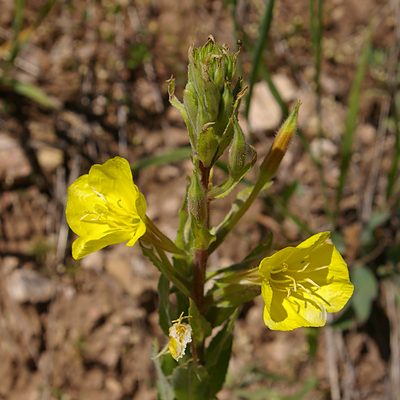 Common Evening PrimroseOenothera villosa | Yellow | June into September | 30–200 cm (12–79 in) | Roadsides, waste ground, rocky slopes, stream and pond edges and open pine woods | Look for an upright stem, usually reddish at least near the base, with lance-shaped leaves 5–20 cm (2–8 in) long whose edges are smooth to finely toothed, and a leafy spike of yellow flowers at the top. Each flower is about 2–4 cm (¾–1½ in) across, with 4 heart-shaped petals, 8 stamens and a cross-shaped stigma, and sits on a slender floral tube 2.3–4.4 cm (about 1–1¾ in) long that looks like a flower stalk. The 4 sepals bend back as the flower opens and are often striped or tinged red. The stem has stiff, flat-lying hairs mixed with longer spreading ones, some with a red or green pimple-like base. The fruit is an upright, hairy capsule 2–4.3 cm (¾–1¾ in) long. The very similar Oenothera biennis, the plant Minnesota Wildflowers calls Common Evening Primrose, also has Black Hills records: Minnesota Wildflowers says it is less densely hairy and green to pale green, its sepals are rarely if ever tinged red, and its pimple-based hairs are green, not red; Flora of North America adds that its petals fade whitish rather than orange, though Minnesota Wildflowers isn't convinced that difference holds. Subspecies strigosa, the form of the Rocky Mountains, has red-striped sepals, red-based hairs and short glandular hairs on the upper stem. Flora of North America notes that some western O. biennis plants also have dark red stems and sepals, so red color alone doesn't settle which species a plant is. |
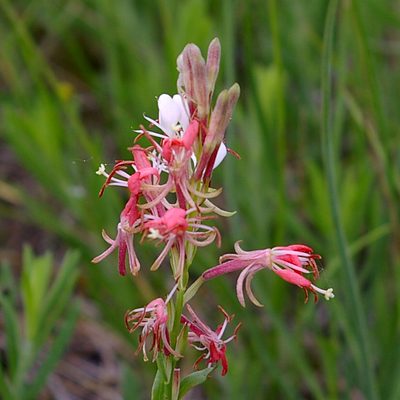 Scarlet BeeblossomOenothera suffrutescens | Pink, Orange & Red | May into August, mostly June | 20–50 cm (8–20 in) | Dry, open prairie, grassy and rocky foothill slopes, road and railroad banks | Look for a low, bushy clump of slender, leafy stems, usually knee-high or less and grayish from fine, short hairs, with small, narrow, stalkless leaves crowded along the stem. The flowers sit in a dense spike at each branch tip, with buds above, one ring of open flowers and hard, cone-shaped fruits below. Each flower is about 1.3 cm (½ in) across and lopsided: the four spoon-shaped petals fan out toward the upper side, while the eight long stamens droop below. |
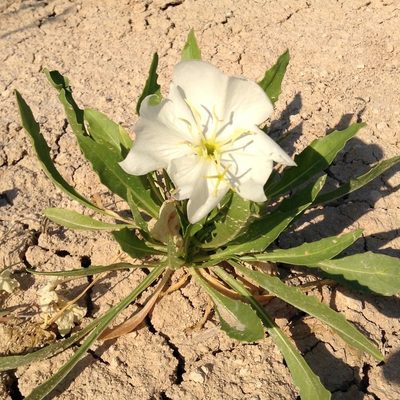 Tufted Evening PrimroseOenothera cespitosa | White | May through August | 15–25 cm (6–10 in) | Dry, rocky or clay prairie, buttes, hillsides and open woodland | Look for a low mound of narrow, gray-green leaves, 3–21 cm (1–8 in) long, from nearly smooth-edged to toothed or deeply lobed, and from hairy to hairless. There is no real stem: each large white flower sits on a slender floral tube 3–8 cm (1–3 in) long, often reddish, that looks like a stem rising from the leaves. The flower has four heart-shaped petals 2.5–5 cm (1–2 in) long and eight yellow stamens, and may reach 10 cm (4 in) across. It opens near sunset with a sweet scent, closes the next morning and fades to pink or red-violet. The seed capsule is hard, lumpy and 2–5 cm (1–2 in) long. Rocky Mountain Flora describes Prairie Evening Primrose (Oenothera albicaulis) with white or pinkish stems up to 30 cm (12 in) tall and Pale Evening Primrose (Oenothera pallida) with arching reddish stems up to 50 cm (20 in) tall; this plant has no real stem. |
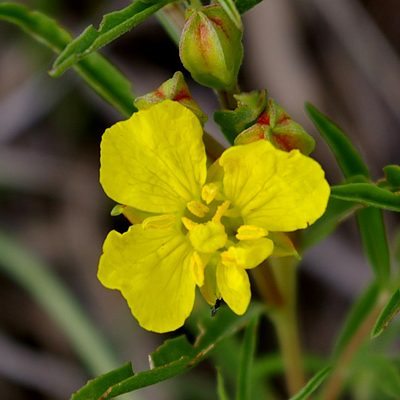 Yellow SundropsOenothera serrulata | Yellow | June into August | 10–60 cm (4–24 in) | Dry rocky, gravelly or sandy prairie, hillsides, rock outcrops and ledges, roadsides and open woods | Look for a low, bushy plant with many branches, woody at the base, crowded with narrow leaves 1–9 cm (½–3½ in) long that are often folded lengthwise and usually edged with small sharp teeth. Each flower sits stalkless in a leaf axil near the top of a stem, with 4 yellow petals 5–12 mm long that are often wrinkled, with wavy edges and a rounded notch at the tip, 8 stamens, and a disc-shaped stigma in the middle; the 4 sepals bend back, and old flowers fade to orange or pink. The flowers open near sunrise and close in late afternoon, while most evening primroses open in the afternoon or evening, and Yellow Sundrops is typically much shorter than those tall spiked evening primroses, with much narrower leaves. After bloom, slender hairy capsules 6–25 mm (¼–1 in) long, four-angled and tapered at both ends, sit in the leaf axils. |
Other look-alike groups: 38 groups
- Anemones (4)
- Asters (4)
- Beardtongues (5)
- Buttercups (3)
- Cacti (4)
- Cinquefoils (7)
- Clovers (6)
- Coneflowers (4)
- Currants and gooseberries (5)
- Daisies (5)
- Dandelions (3)
- Docks and buckwheats (4)
- Ferns (4)
- Gentians (4)
- Grasses (11)
- Groundsels and ragworts (3)
- Lilies (5)
- Mayflowers and false Solomon's seals (3)
- Milkvetches and locoweeds (12)
- Milkweeds (6)
- Mints (8)
- Mustards (11)
- Orchids (8)
- Paintbrushes (3)
- Pines (3)
- Raspberries and thimbleberries (3)
- Sagebrushes and sageworts (3)
- Sedges (3)
- Speedwells and kittentails (3)
- Sunflowers (4)
- Thistles (6)
- Vervains (3)
- Vetches (4)
- Violets (7)
- Wild lettuces (3)
- Wild onions (3)
- Wild plums and cherries (3)
- Willows (3)