Scarlet Beeblossom
Oenothera suffrutescens
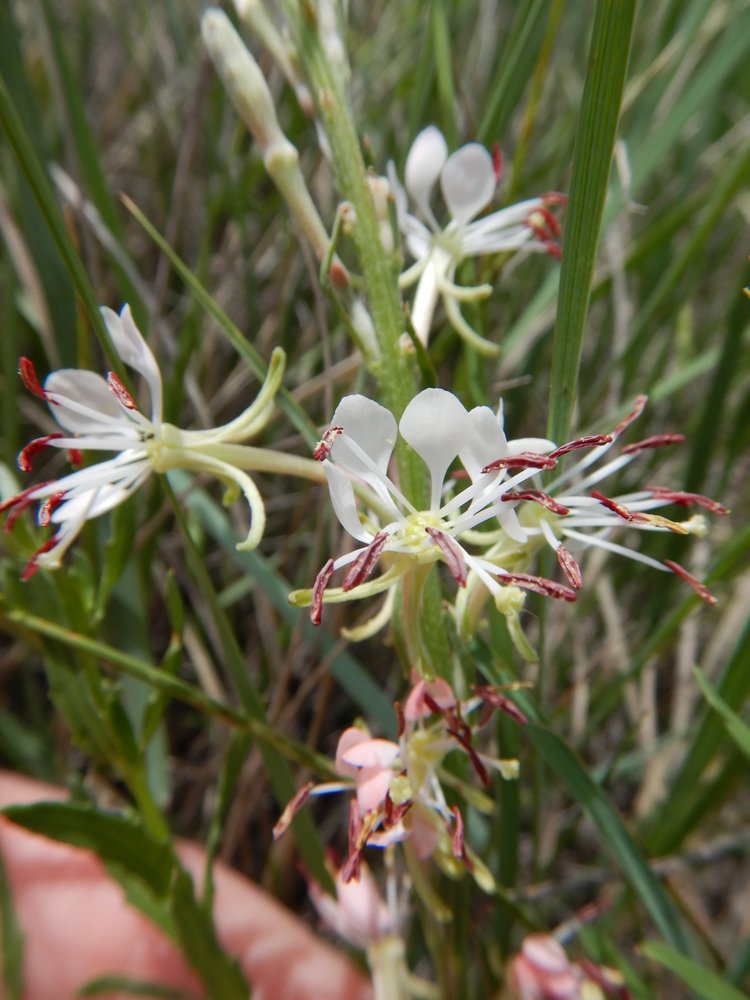
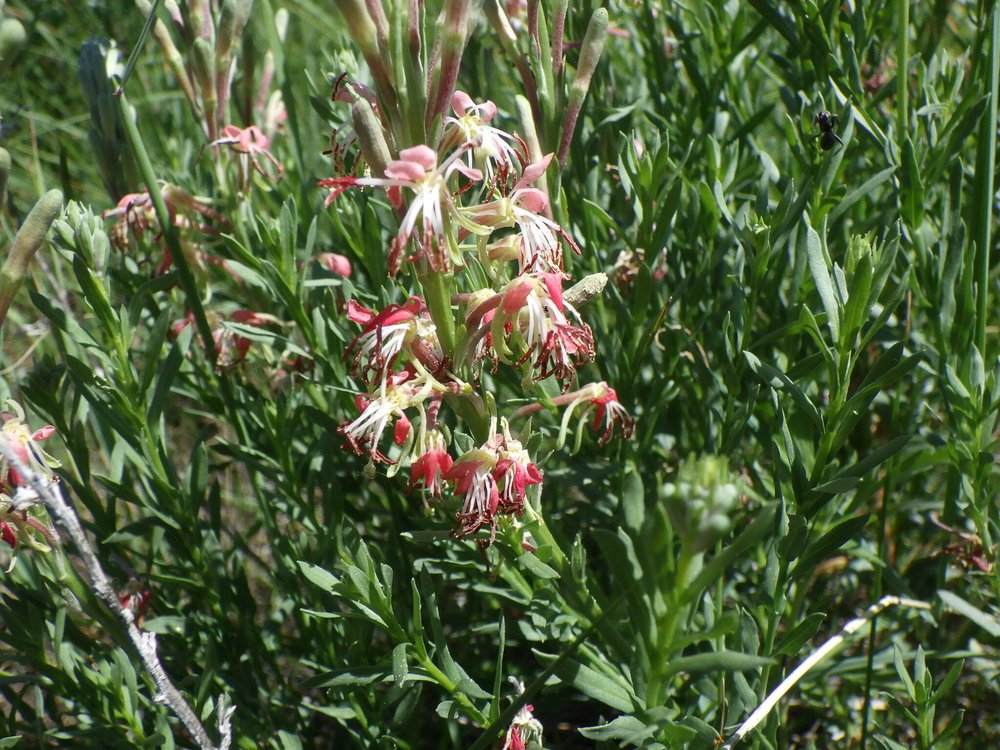
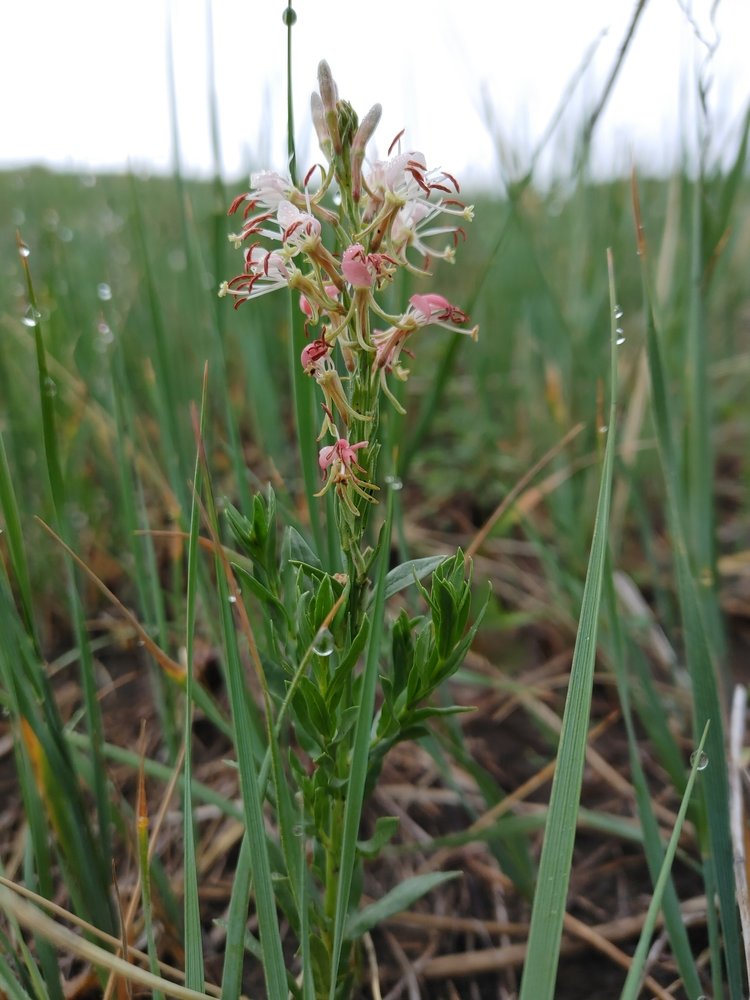
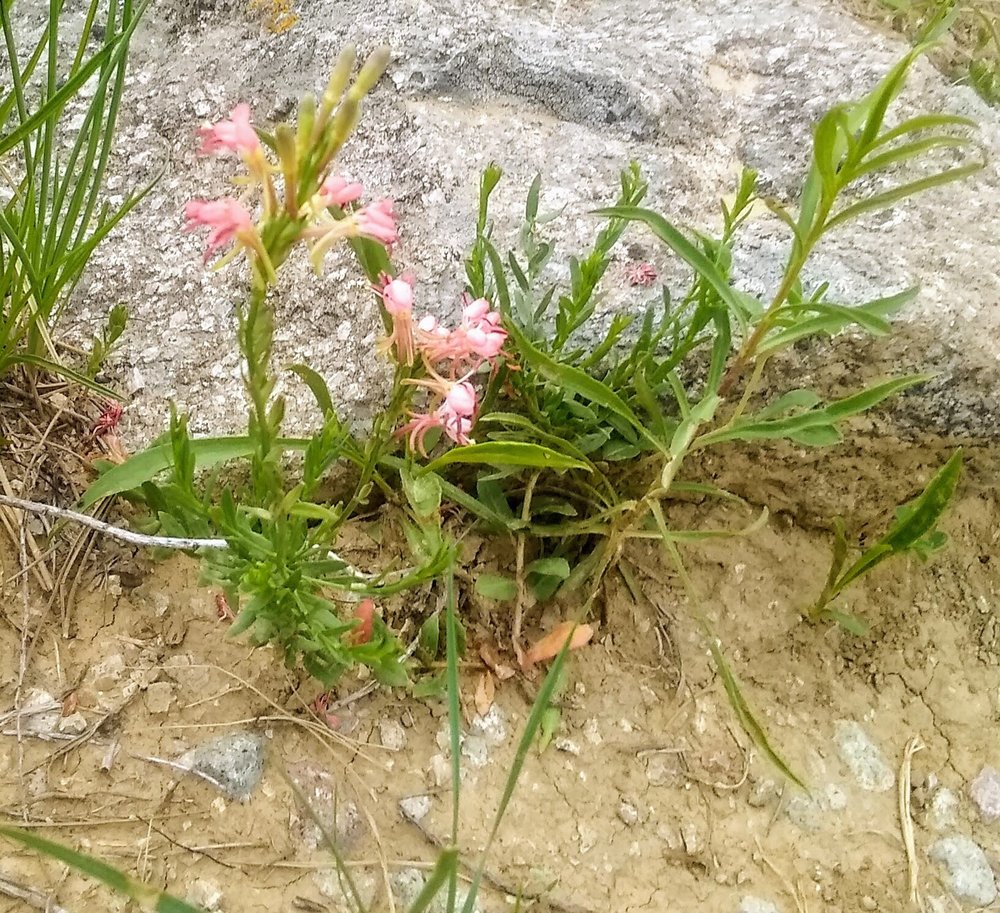
Scarlet Beeblossom (Oenothera suffrutescens), long known as Scarlet Gaura (Gaura coccinea), is a low, gray-green native perennial of dry prairie, foothill slopes and roadsides. Its small, lopsided flowers open white around sunset and fade to pink and then scarlet by the next day, so one spike usually shows both colors. It blooms mostly in June, from May into August, around the drier edges of the Black Hills.
Free photos from other sources
| Family | Onagraceae · Evening Primrose |
|---|---|
| Status | Native perennial |
| Blooms | May into August, mostly June |
| Height | 15–50 cm (6–20 in) |
| Where | Dry, open prairie, grassy and rocky foothill slopes, road and railroad banks |
| Also called | Scarlet Gaura, Scarlet Butterfly Weed, tȟatȟáwabluška tȟačháŋȟloǧaŋ (Lakota), ošúŋk’oyuspapi (Lakota) |
| Synonym | Gaura coccinea, Gaura suffrutescens, Gaura glabra, Gaura odorata, Gaura coccinea var. glabra, Gaura coccinea var. parvifolia, Gaura coccinea var. arizonica, Gaura coccinea var. epilobioides |
| Traditional use | Sitting Bull College's 1998 Culturally Important Plants of the Lakota says the Lakota chewed the plant and rubbed it on their hands to attract and catch horses. |
Roots, seeds & germination
Root: A deep, thick taproot, with branching underground stems that turn sideways and send up new shoots, so one plant slowly becomes a patch. That is why it holds on along road cuts and in grazed prairie.
Seed: A small, hard, nut-like capsule 4–9 mm (¼–⅜ in) long, four-angled, pointed at the top and covered with short white hairs, holding 1–4 light- to reddish-brown seeds. The capsule doesn't split open; it falls whole with the seed inside. The species is self-incompatible, so a single isolated plant may set little seed.
Germination: Seed is dormant when shed. SDSU recommends sowing in fall or giving the seed 60 days of cold, moist stratification before spring sowing. New plants are also easily started by dividing the shoots that come up from the underground stems in spring.
How do you identify Scarlet Beeblossom?
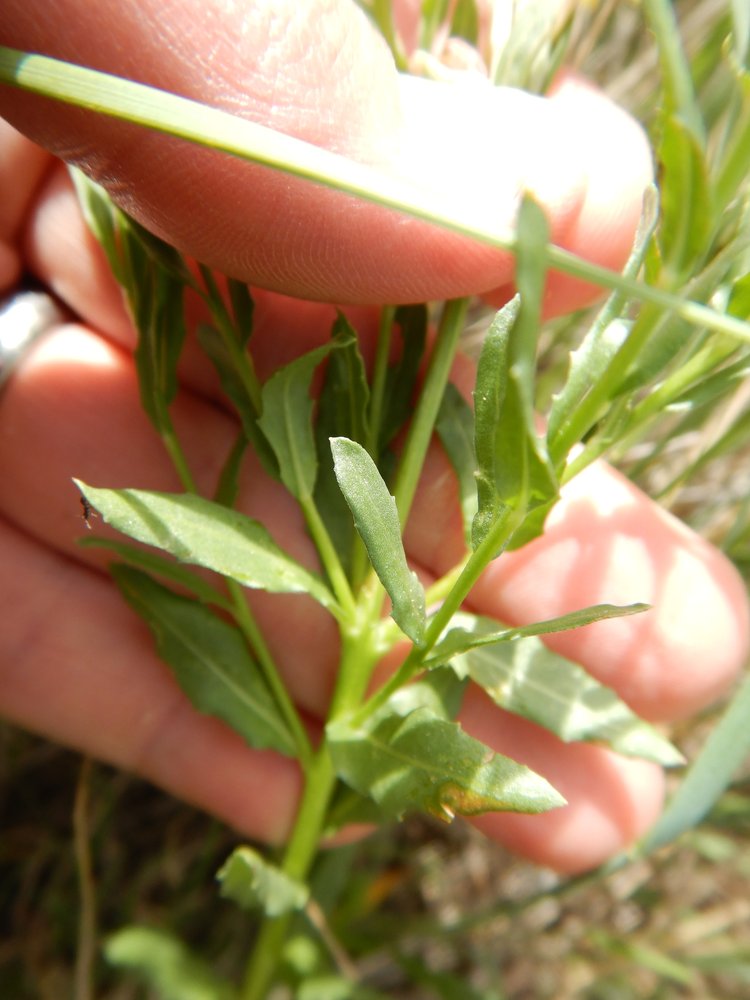
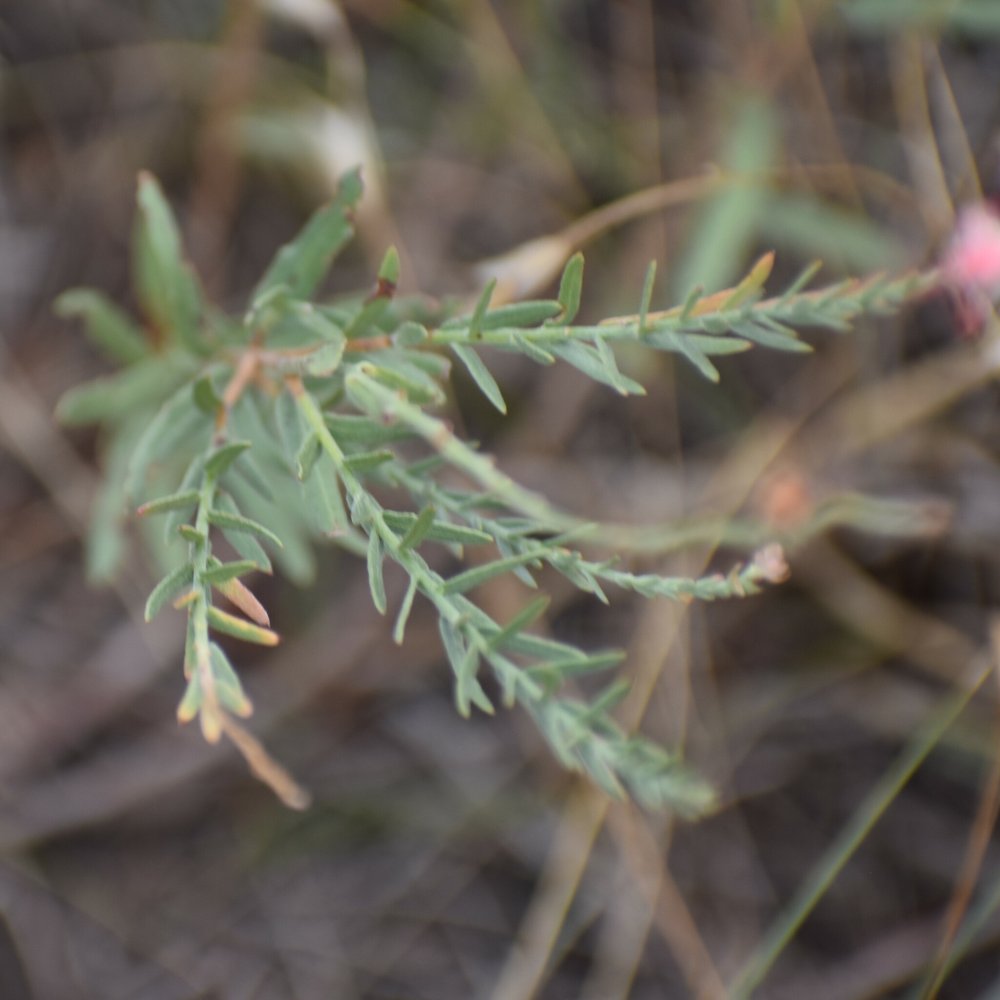
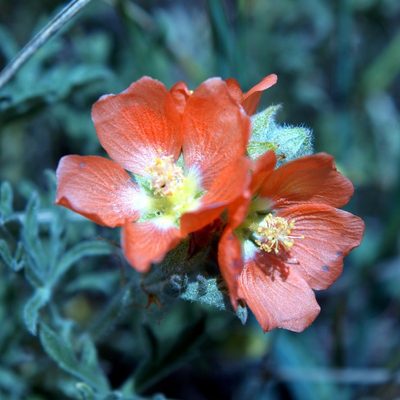
Look for a low, bushy clump of slender, leafy stems, usually knee-high or less and gray-green from fine flat-lying hairs, with small, narrow, stalkless leaves crowded along the stem. The flowers sit in a dense spike at each branch tip, with buds above, one ring of open flowers and hard, cone-shaped fruits below. Each flower is about 1–1.5 cm (½ in) across and lopsided: the four spoon-shaped petals swing up to one side, while the eight stamens and the long style hang down the other. Scarlet Globemallow grows on the same dry ground with orange-red flowers, but it has five broad petals forming a cup and leaves cut into lobes.
When does it bloom?
May into August, mostly June.
Where does it grow?
Dry, open mixed-grass and shortgrass prairie, grassy and rocky hillsides, open ponderosa pine edges, clay banks and disturbed ground such as road shoulders and railroad embankments, in full sun. It is mostly a plant of the lower, drier, open edges of the Hills and the surrounding prairie. The 1986 plant survey of Jewel Cave lists it among the pink flowers, and the National Park Service lists it at Wind Cave and Devils Tower. Herbarium specimens come from Fall River, Pennington, Custer, Lawrence and Meade counties in South Dakota and Crook and Weston counties in Wyoming, including Hell Canyon, Deadwood, Spearfish and Hot Springs.
Other flowers to compare
Sources: Flora of North America, vol. 10: Oenothera suffrutescens; Flora of North America, vol. 10: Oenothera subsect. Stipogaura (pollinators of the gaura group); USDA PLANTS Database: Oenothera suffrutescens (OESU3); ITIS: Oenothera suffrutescens, TSN 836008; Reese, R. N. Onagraceae: Oenothera suffrutescens. South Dakota Native Plant Research, SDSU Open PRAIRIE; Lady Bird Johnson Wildflower Center: Oenothera suffrutescens; Minnesota Wildflowers: Scarlet Gaura; Kansas Wildflowers and Grasses: Oenothera suffrutescens; Native Plant Society of New Mexico: Oenothera suffrutescens; Black Elk, L. & W. Flying By. 1998. Culturally Important Plants of the Lakota (Sitting Bull College), entries 132 and 133; Marriott, H. & R. Hartman. 1986. A Survey of the Vegetation of Jewel Cave National Monument; NPSpecies checklist, Wind Cave National Park vascular plants; NPSpecies checklist, Jewel Cave National Monument vascular plants; NPSpecies checklist, Devils Tower National Monument vascular plants; GBIF occurrence records, Oenothera suffrutescens in South Dakota; GBIF occurrence records, Oenothera suffrutescens in Wyoming; iNaturalist observations of Oenothera suffrutescens in the Black Hills area; Wikipedia: Oenothera curtiflora (Velvetweed), for the lookalike; Weiss, M. R. 1991. Floral colour changes as cues for pollinators. Nature 354: 227–229 (general explanation of color change).