Common Evening Primrose Oenothera villosa
Also called Hairy Evening Primrose
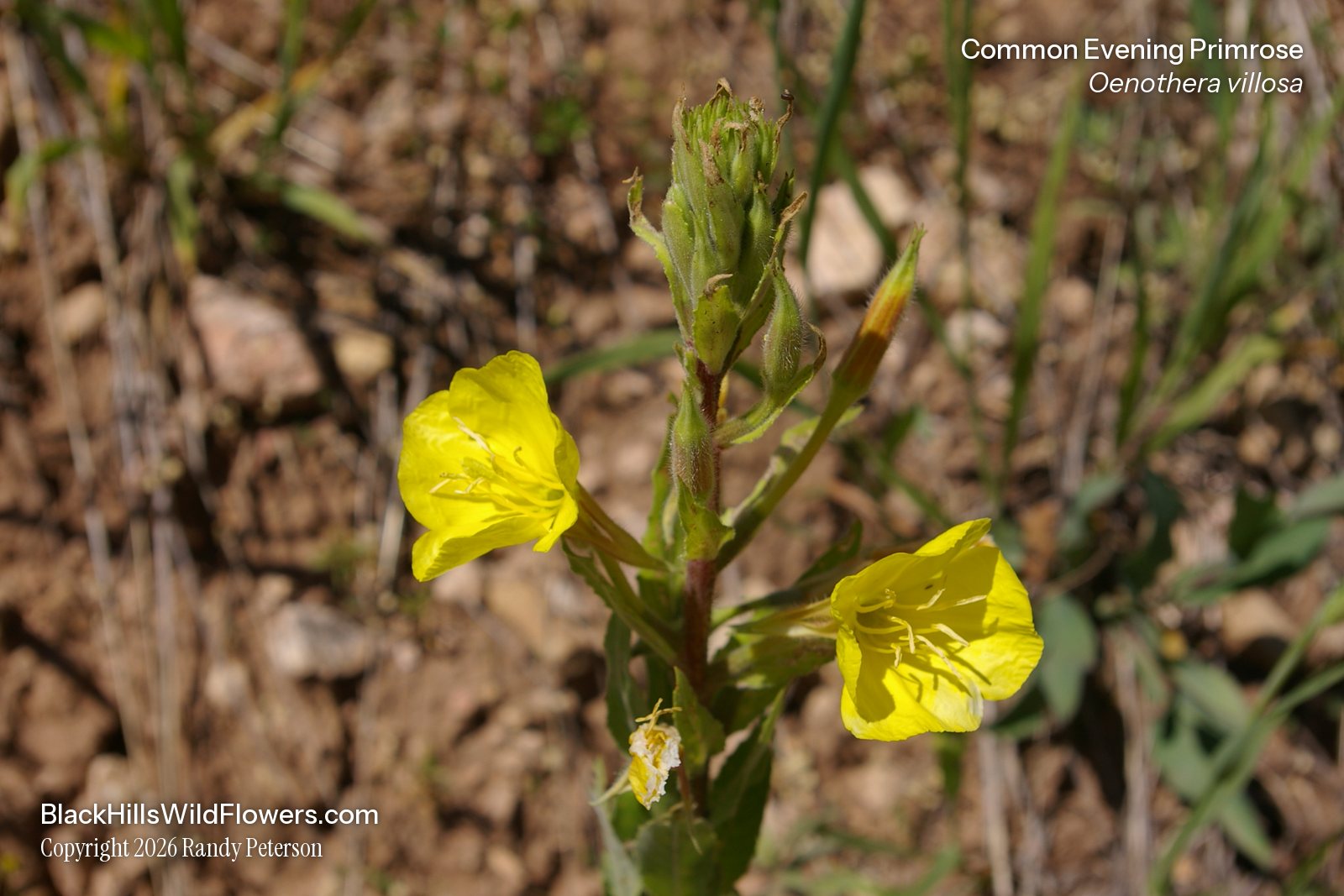
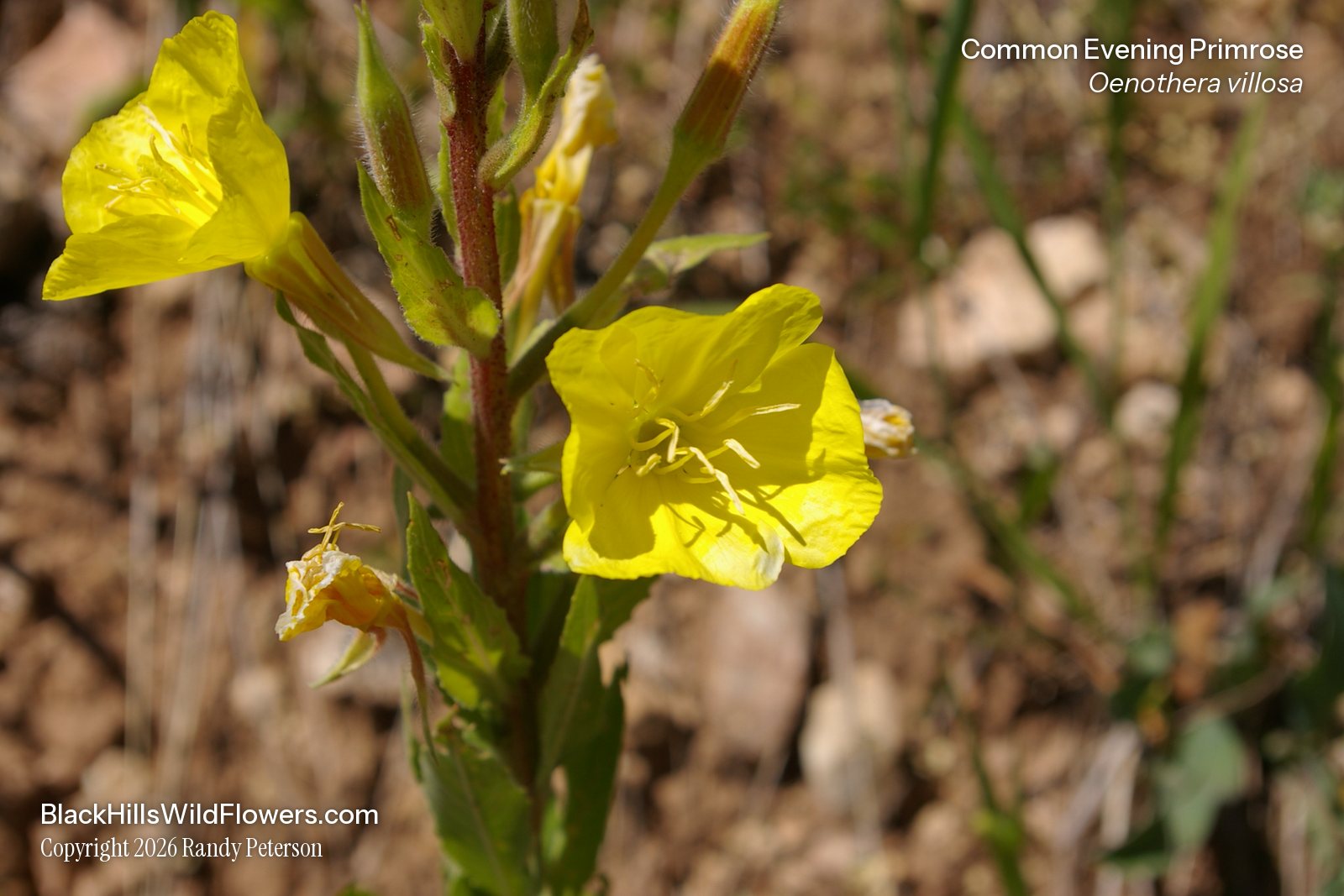
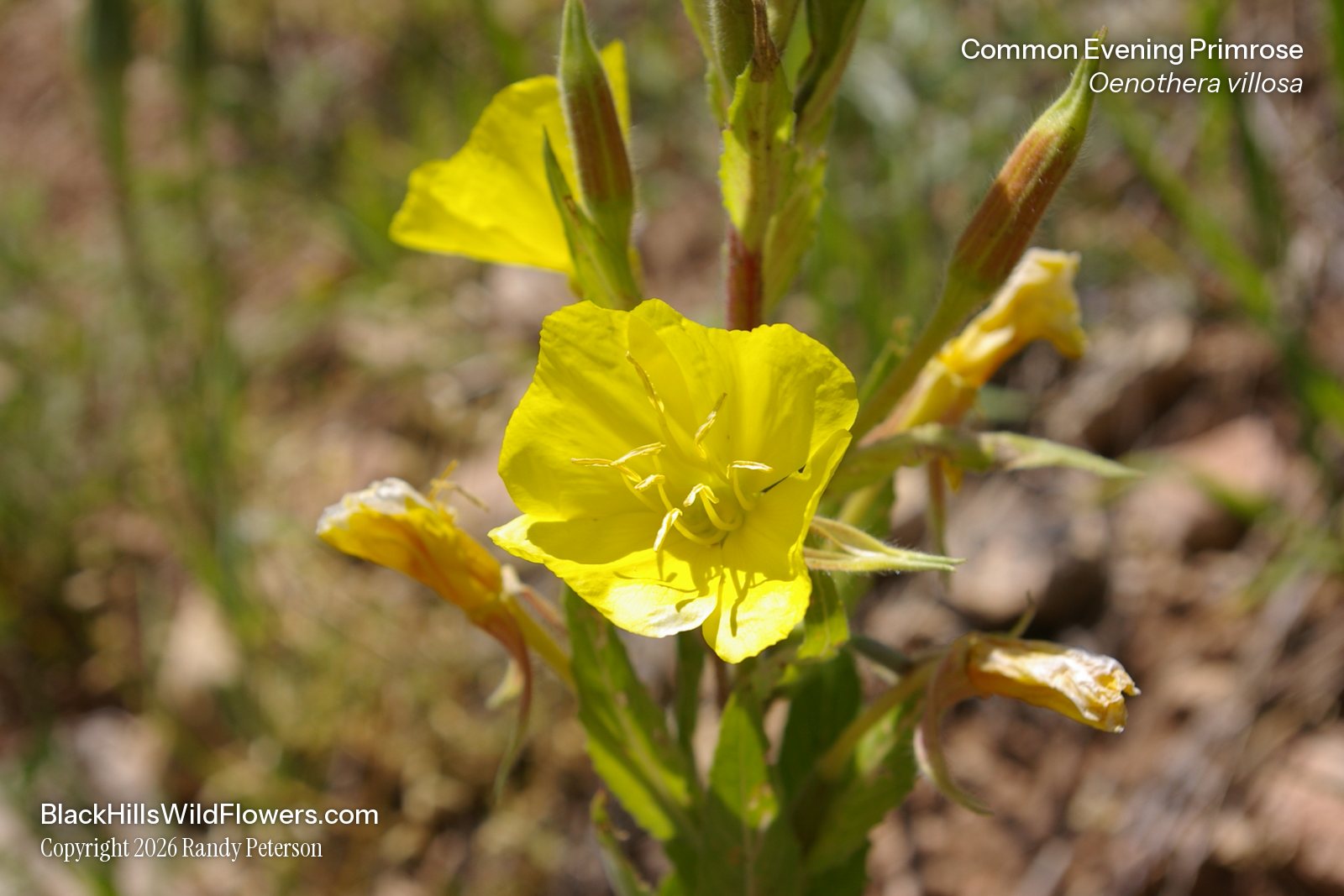
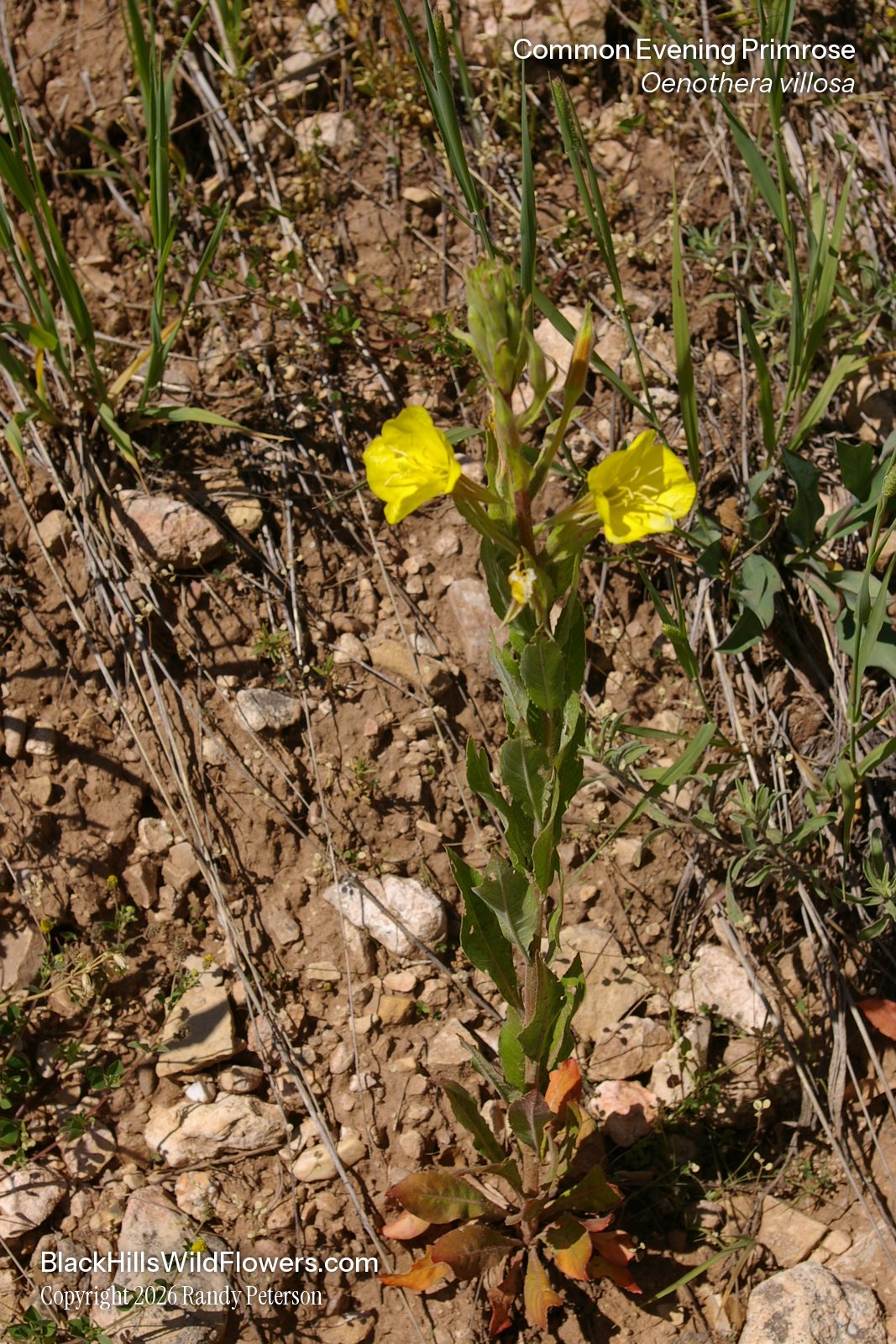
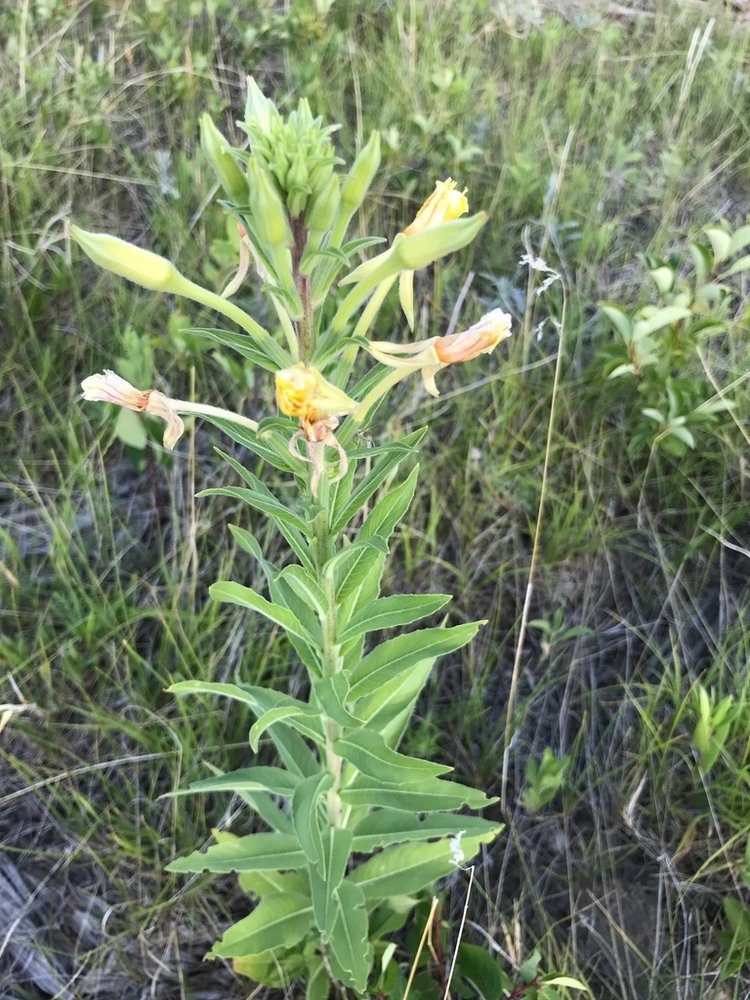
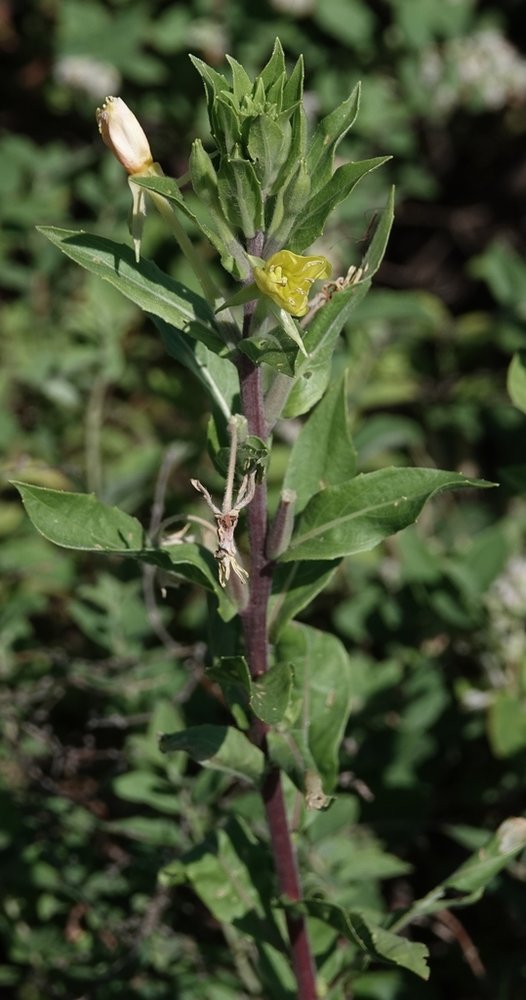
Common Evening Primrose (Oenothera villosa), also called Hairy Evening Primrose, is a native biennial with a stout, leafy, often reddish stem and yellow, four-petaled flowers that open near sunset and fade orange, from June into September. In the Black Hills it grows on roadsides, waste ground, rocky slopes, pond and lake edges and in open pine forest, and the National Park Service lists it at Wind Cave, Jewel Cave, Mount Rushmore and Devils Tower. Photographed in the Black Hills.
Free photos from other sources
| Family | Onagraceae · Evening Primrose |
|---|---|
| Status | Native biennial or short-lived perennial |
| Blooms | June into September |
| Height | 30–200 cm (12–79 in) |
| Where | Roadsides, waste ground, rocky slopes, stream and pond edges and open pine woods |
| Also called | Hairy Evening Primrose |
| Synonym | Oenothera strigosa, Oenothera biennis var. strigosa, Oenothera biennis var. canescens, Oenothera depressa |
| Traditional use | Moerman's database, citing Vestal (1952), records that the Ramah Navajo took a cold infusion of the dried root for what they called "deer infection" and smoked the dried leaves with tobacco for good luck in hunting; both uses were recorded for the subspecies strigosa. |
Traditional use: first drafted by Google AI, then checked against the sources on this page.
Roots, seeds & germination
Root: A taproot. In its first year it is a rosette of leaves at ground level; it flowers on a tall stem in a later year.
Seed: The upright capsule, 2–4.3 cm (¾–1¾ in) long and hairy, holds small seeds 1–2 mm long, dark brown to black and often purple-spotted.
How do you identify Common Evening Primrose?
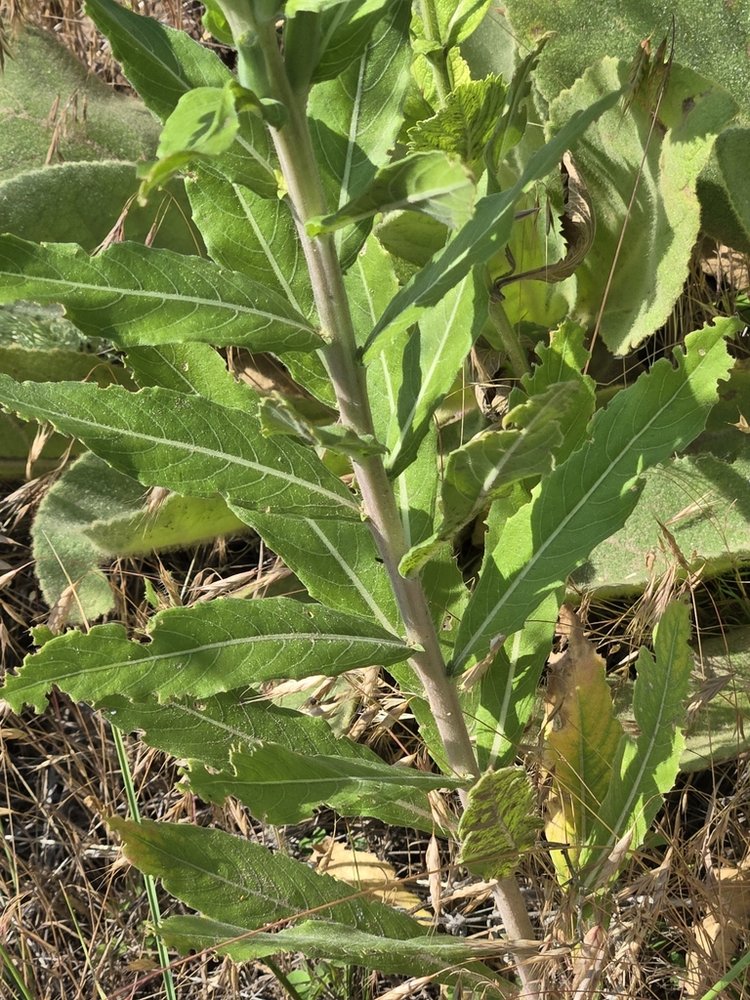
Look for an upright stem, usually reddish at least near the base, with lance-shaped leaves 5–20 cm (2–8 in) long whose edges are smooth to finely toothed, and a leafy spike of yellow flowers at the top. Each flower is about 2–4 cm (¾–1½ in) across, with 4 heart-shaped petals, 8 stamens and a cross-shaped stigma, and sits on a slender floral tube 2.3–4.4 cm (about 1–1¾ in) long that looks like a flower stalk. The 4 sepals bend back as the flower opens and are often striped or tinged red. The stem has stiff, flat-lying hairs mixed with longer spreading ones, some with a red or green pimple-like base. The fruit is an upright, hairy capsule 2–4.3 cm (¾–1¾ in) long. The very similar Oenothera biennis, the plant Minnesota Wildflowers calls Common Evening Primrose, also has Black Hills records: Minnesota Wildflowers says it is less densely hairy and green to pale green, its sepals are rarely if ever tinged red, and its pimple-based hairs are green, not red; Flora of North America adds that its petals fade whitish rather than orange, though Minnesota Wildflowers isn't convinced that difference holds. Subspecies strigosa, the form of the Rocky Mountains, has red-striped sepals, red-based hairs and short glandular hairs on the upper stem. Flora of North America notes that some western O. biennis plants also have dark red stems and sepals, so red color alone doesn't settle which species a plant is.
When does it bloom?
June into September.
Where does it grow?
Roadsides, waste places and other disturbed ground, rocky slopes, stream banks, pond and lake edges, and open ponderosa pine, aspen and birch woods. Black Hills herbarium specimens collected from 1913 to 2018 come from Lawrence, Pennington and Custer counties in South Dakota and Crook and Weston counties in Wyoming. The National Park Service lists it at Wind Cave, Jewel Cave, Mount Rushmore and Devils Tower, and the 1986 plant survey of Jewel Cave records it.
Other evening primroses in this guide
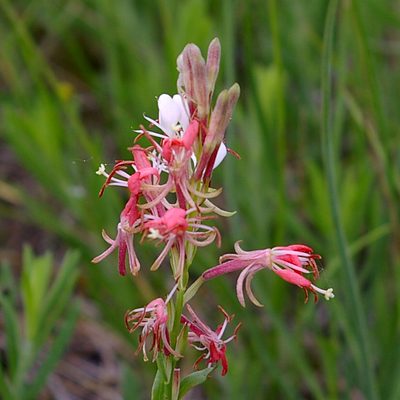
Evening Primrose family (Onagraceae): 6 other plants in this guide
Sources: Flora of North America Vol. 10: Oenothera villosa (W. L. Wagner et al.), eFloras; Flora of North America Vol. 10: Oenothera villosa subsp. strigosa, eFloras; Flora of North America Vol. 10: Oenothera villosa subsp. villosa, eFloras; Flora of North America Vol. 10: Oenothera biennis, eFloras; Flora of North America Vol. 10: Oenothera subsect. Oenothera (key to species), eFloras; Minnesota Wildflowers: Oenothera villosa (Hairy Evening Primrose); Kansas Wildflowers & Grasses: Hairy evening primrose, Oenothera villosa; Montana Field Guide: Hairy Evening-primrose, Oenothera villosa (Montana Natural Heritage Program); USDA PLANTS Database: Oenothera villosa, hairy evening primrose (OEVI); ITIS: Oenothera villosa (TSN 27421); NPSpecies checklist, Wind Cave National Park vascular plants; NPSpecies checklist, Jewel Cave National Monument vascular plants; NPSpecies checklist, Mount Rushmore National Memorial vascular plants; NPSpecies checklist, Devils Tower National Monument vascular plants; Marriott and Hartman 1986, A Survey of the Vegetation of Jewel Cave National Monument; GBIF occurrence search: Oenothera villosa, South Dakota and Wyoming herbarium specimens; GBIF occurrence search: Oenothera biennis, South Dakota and Wyoming herbarium specimens; South Dakota Game, Fish and Parks: Rare Plants of South Dakota (checked; not listed); Black Hills National Forest Revised Forest Assessment: At-Risk Species, October 2023 (checked; not listed); Culturally Important Plants of the Lakota (Black Elk and Flying By, 1998), filed with the South Dakota PUC (checked; the entry is Oenothera biennis, not this species); Moerman, Native American Ethnobotany Database (BRIT): Oenothera villosa.