Wild plums and cherries of the Black Hills
All 3 wild plums and cherries in this guide, side by side, A to Z. Compare the photos, bloom time, height and where each grows, then open the one that fits for more photos and the full ID notes. Each plant's page lists its sources.
| Plant | Color | Blooms | Height | Where | How to tell it apart |
|---|---|---|---|---|---|
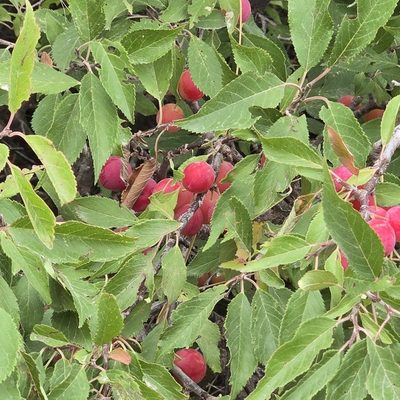 American PlumPrunus americana | – | April and May, before or with the leaves; the plums ripen in August and September | 2–6 m (6–20 ft) | Thickets in draws, ravines and canyon bottoms, creek banks, woodland edges, pastures, fence rows and roadsides | Start with the thorns and the flower clusters. The branches carry stiff thorns, because older side twigs harden into spines up to 7 cm (2¾ in) long, and the plant suckers from its roots into dense thickets. The leaves are alternate, elliptic to obovate (widest above the middle), 5–11 cm (2–4⅓ in) long, with coarse double teeth along the edge and a tip drawn out abruptly to a point. In April and May, before or as the leaves open, the flowers come 2 to 5 together in small umbrella-like clusters, each flower on its own stalk: white, five-petaled, about 2.5 cm (1 in) across, sweet-scented, with 20 to 30 stamens and sepals bent back. The fruit is a plum 2–3 cm (¾–1¼ in) long, red, orange or yellow with a waxy bloom, around a flattened oval stone. Chokecherry is the plant to rule out. Flora of North America's key splits them at its first step, by the flower clusters: Chokecherry's flowers are packed in long racemes of 18 to 64 flowers, 4–11 cm long, while American Plum's come 2 to 5 to a cluster. Its species accounts add that Chokecherry blooms after the leaves open, has no thorns, and has cherries only 6–14 mm across around a stone that isn't flattened, while American Plum blooms before or with the leaves, is thorny, and has plums 15–30 mm long around a flattened stone. |
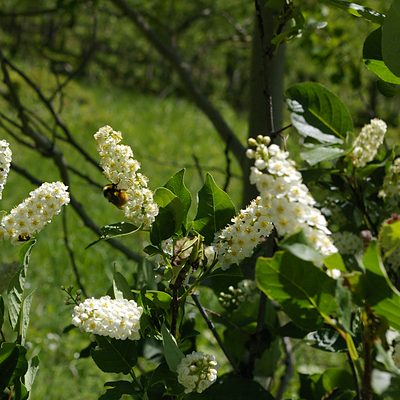 ChokecherryPrunus virginiana | White | May and June in the Black Hills; April and May across South Dakota | 1–6 m (3–20 ft) | Wooded draws, stream banks, canyon bottoms and forest edges | Look for a many-stemmed shrub, often in a dense patch, with broadly oval leaves 2.5–10 cm (1–4 in) long that end in a short, abrupt point and are edged with very fine, sharp teeth. In May and June the white, five-petaled flowers come packed in long, cylindrical spikes 7–15 cm (3–6 in) long, with a strong, sweet smell. The cherries ripen from red to dark purple-black in long hanging clusters, and they make your mouth pucker. Pin Cherry has small, flat-topped bunches of flowers and bright red cherries, narrow, long-pointed leaves and shiny reddish bark that may peel in strips. |
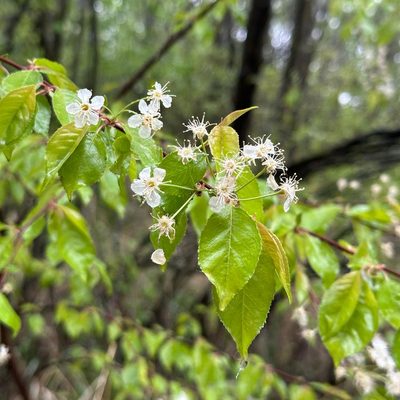 PincherryPrunus pensylvanica | White | May into June, as the leaves open | 0.3–6 m (1–20 ft) on Black Hills specimen labels | Moist woods and ravines, creek bottoms, rocky slopes, roadsides and clearings in pine, aspen and birch forest | Start with the bark and twigs: shiny reddish-brown to gray bark marked with conspicuous horizontal lines of pores (lenticels) that peels in horizontal strips, and smooth, red to reddish-brown twigs. The leaves are simple and alternate, 5–9 cm (2–3½ in) long, shiny dark green, tapering to a point, with shallow, rounded, blunt teeth and a pair of glands on the leaf stalk near the blade. Flora of North America says plants on the northwestern Great Plains are shrubby, with smaller leaves, under 6 cm (2⅛ in) long. In May and June the flowers sit in small flat-topped clusters of 3 to 7, each flower about 12 mm (½ in) across, with 5 white petals. The fruit is a shiny, bright red cherry 6–10 mm (¼–⅜ in) across with one hard stone. Chokecherry, also in this guide, is described by Minnesota Wildflowers with nodding, cylindrical clusters of 20 to 50 flowers, reddish-purple to nearly black fruit and brownish-gray bark. American Plum, also in this guide, has only 1 to 4 flowers in each cluster and gray, peeling bark on mature trees, says Minnesota Wildflowers. |
Other look-alike groups: 38 groups
- Anemones (4)
- Asters (4)
- Beardtongues (5)
- Buttercups (3)
- Cacti (4)
- Cinquefoils (7)
- Clovers (6)
- Coneflowers (4)
- Currants and gooseberries (5)
- Daisies (5)
- Dandelions (3)
- Docks and buckwheats (4)
- Evening primroses (4)
- Ferns (4)
- Gentians (4)
- Grasses (11)
- Groundsels and ragworts (3)
- Lilies (5)
- Mayflowers and false Solomon's seals (3)
- Milkvetches and locoweeds (12)
- Milkweeds (6)
- Mints (8)
- Mustards (11)
- Orchids (8)
- Paintbrushes (3)
- Pines (3)
- Raspberries and thimbleberries (3)
- Sagebrushes and sageworts (3)
- Sedges (3)
- Speedwells and kittentails (3)
- Sunflowers (4)
- Thistles (6)
- Vervains (3)
- Vetches (4)
- Violets (7)
- Wild lettuces (3)
- Wild onions (3)
- Willows (3)