Bull Thistle Cirsium vulgare
Also called Common Thistle, Spear Thistle
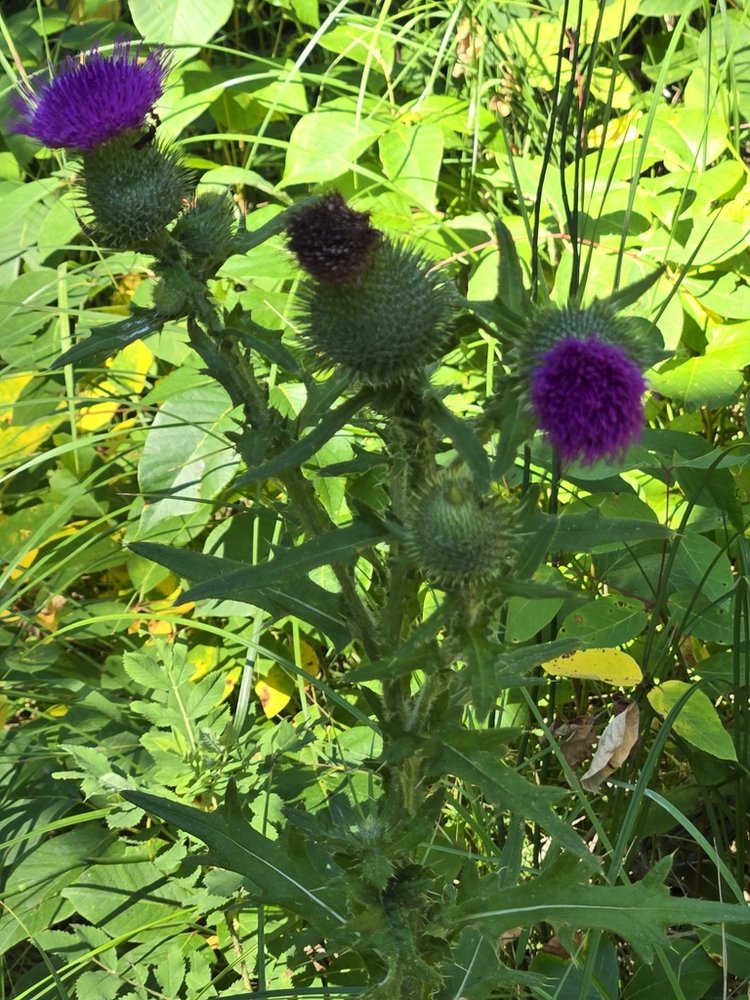
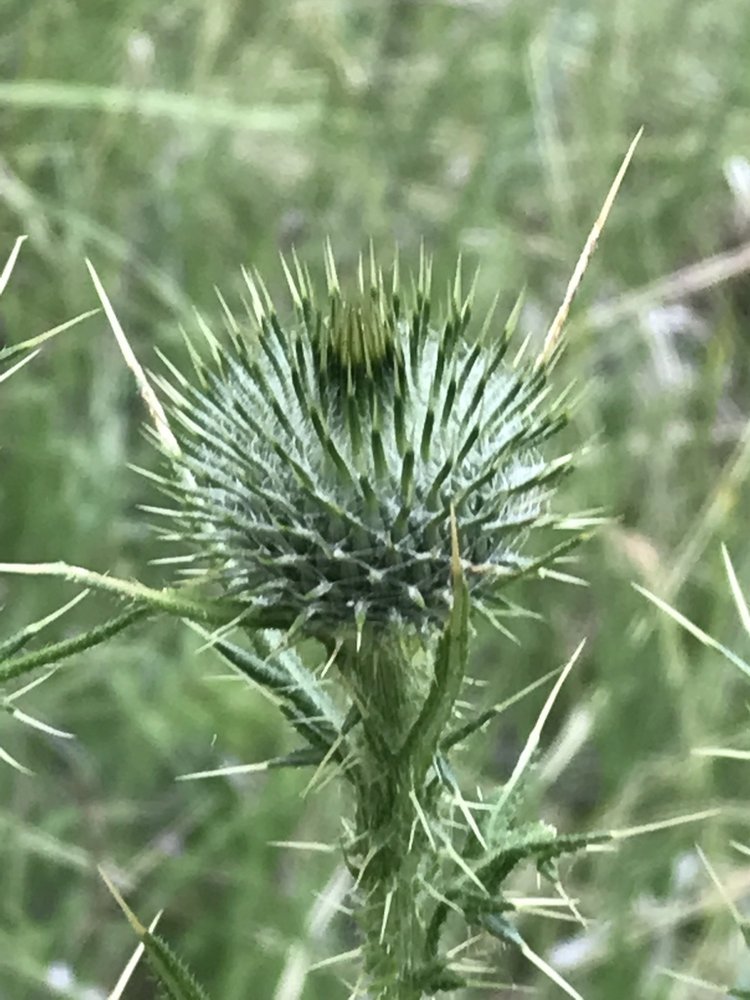
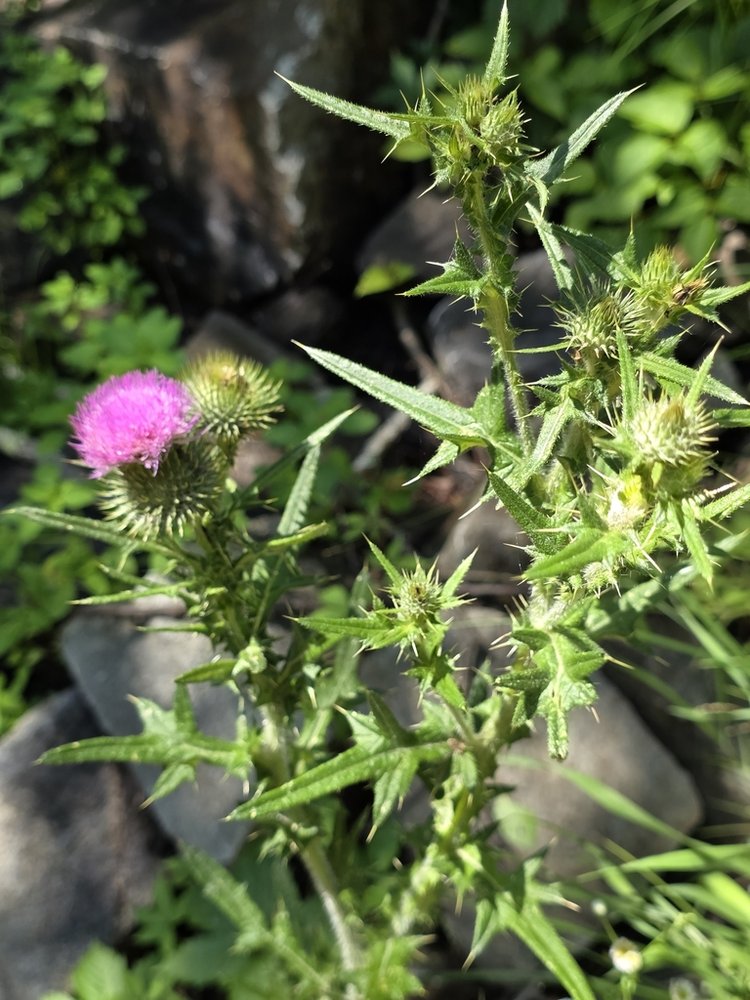
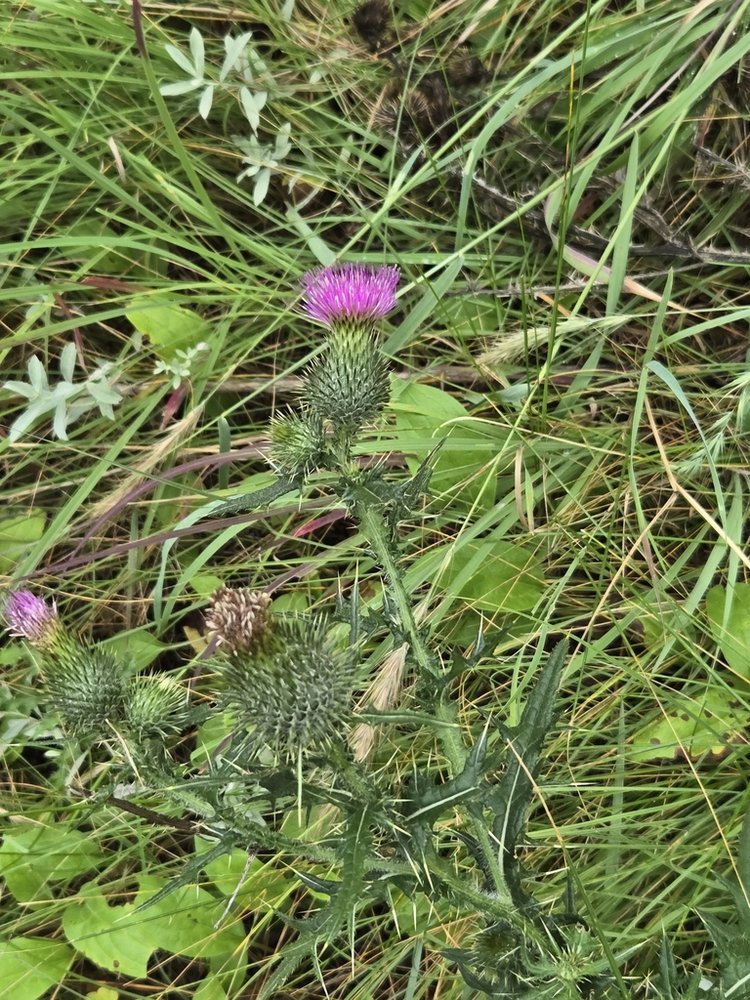
Bull Thistle (Cirsium vulgare) is an introduced biennial weed and one of the spiniest thistles: each leaf lobe ends in a long yellow spine, and the upper face of the leaf is covered with short bristle-like spines, a mark no other North American thistle has. Its reddish-purple heads, 4–5 cm (1½–2 in) across, sit in a cup of many narrow, spine-tipped bracts, and it blooms from July into September on roadsides, in pastures and in forest openings. In the Black Hills it is a listed weed in Lawrence and Fall River counties and grows in all four national park sites.
Free photos from other sources
| Family | Asteraceae · Aster |
|---|---|
| Status | Introduced biennial |
| Blooms | July into September |
| Height | 30–200 cm (12–79 in) |
| Where | Roadsides, pastures, meadows, forest openings, logged forest and other disturbed sites |
| Also called | Common Thistle, Spear Thistle |
| Synonym | Carduus vulgaris, Carduus lanceolatus |
| Listed | Locally noxious in Lawrence (2024–2028) and Fall River (2024–2028) counties, South Dakota; not on South Dakota's state noxious weed list. A county-declared weed in Crook County, Wyoming; not on Wyoming's state designated weed list. |
| Note | Native to Europe. |
Roots, seeds & germination
Root: A first-year plant is a single rosette, up to 1 m (3 ft) across, with a taproot up to 70 cm (28 in) long. The taproot does not spread; it grows several smaller side roots.
Seed: Each head holds about 100 to 300 or more seeds, and a plant can carry from 1 to over 400 heads. The fruits are 3–4.5 mm long, light brown with darker streaks, with a tuft of feathery bristles 20–30 mm (¾–1¼ in) long that comes loose easily, so about 91 percent of seeds land within one and a half plant-heights of the parent. Seed is shed in late summer and early autumn; seed near the surface does not last long in the soil, but seed buried 15 cm (6 in) or deeper can stay more than half viable for three years.
Germination: Most seed is viable, 60 to 90 percent. Reviews disagree on dormancy: some find little, others find most seed dormant at maturity with up to 90 percent sprouting within a year. Seeds sprout in spring or fall when the soil is moist. The plant makes a small spiny rosette and a fleshy taproot its first year, then bolts and flowers the second year from midsummer until frost.
How do you identify Bull Thistle?
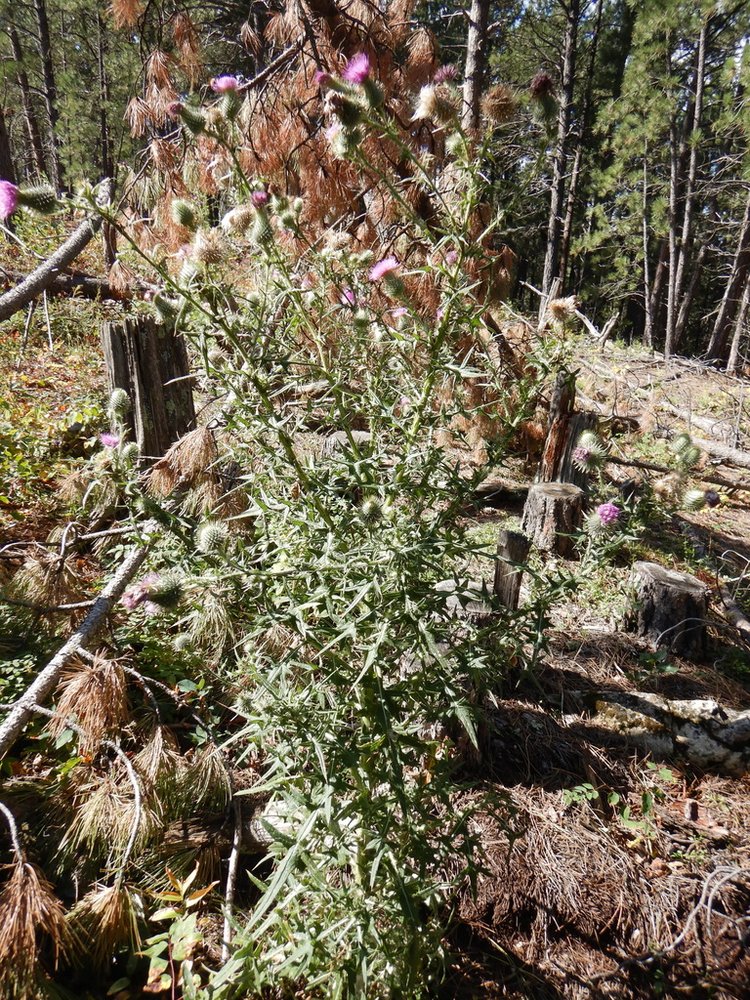
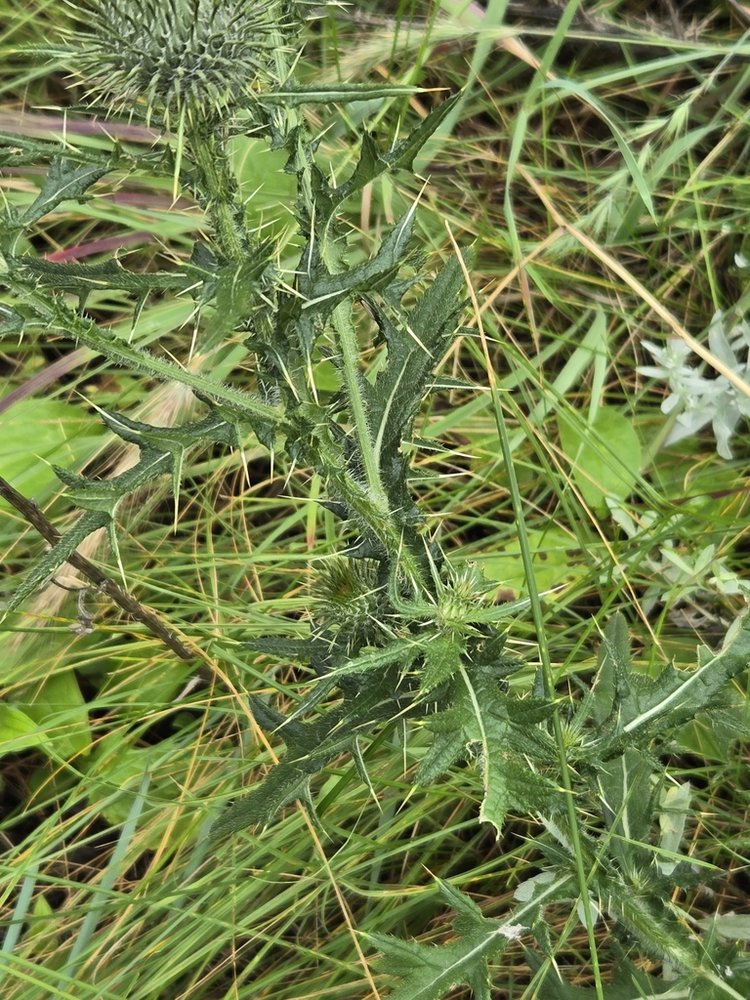
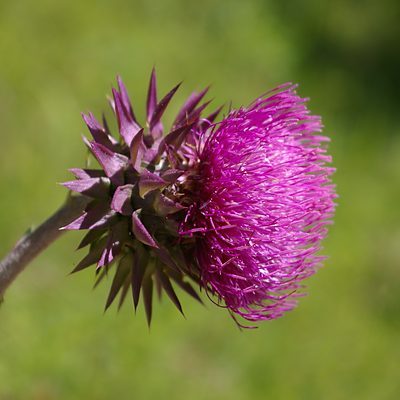
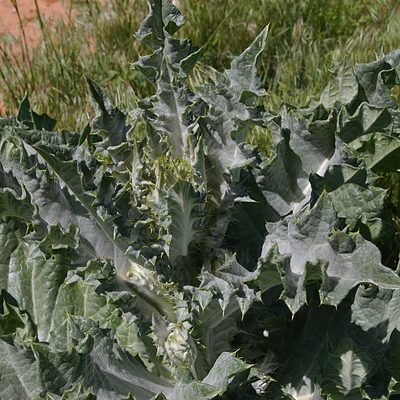
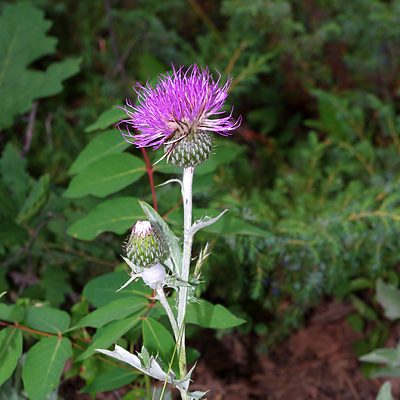
The top of each leaf is prickly, covered with short bristle-like spines that lie flat, and each of the rigid lobes ends in a sharp yellow spine up to 1 cm (⅜ in) long, while the underside is gray and woolly. The leaves are 15–40 cm (6–16 in) long, and the bases of at least the upper leaves run down the stem as long spiny wings. The heads, 4–5 cm (1½–2 in) across and reddish-purple, sit singly or a few together at the branch tips on stalks 1–6 cm (½–2½ in) long, each in a cobwebby cup 3–4 cm (1¼–1½ in) tall made of 10 to 12 rows of narrow bracts whose spine tips point outward. Plants stand 30–200 cm (1–6½ ft) tall and are usually much branched. Minnesota Wildflowers says it resembles Plumeless Thistle, whose heads are usually 2.5 cm (1 in) across or less, whose leaves are mostly hairless on top, and which is even spinier. Musk Thistle carries big 5 cm (2 in) heads singly, nodding on curved stalks, with broad bracts that bend back. Canada Thistle is a creeping perennial with many small heads about 2 cm (¾ in) across and no spiny wings running down the stem. The native Wavyleaf Thistle has densely gray-felted stems and leaf undersides and strongly wavy leaf edges, and native Drummond's Thistle holds its heads on stalks usually no more than 5 cm (2 in) long, crowded and overtopped by the upper leaves.
When does it bloom?
July into September.
Where does it grow?
Roadsides, pastures, meadows, forest openings, logged forest and other disturbed sites; Flora of North America says it can increase in heavily grazed pastures, and the Fire Effects Information System says it often moves in after logging, with or without burning, in western forests. The National Park Service lists it at Wind Cave National Park, Jewel Cave National Monument, Mount Rushmore National Memorial and Devils Tower National Monument, where it is one of three thistles controlled with herbicides. The 1986 Jewel Cave plant survey records it as an exotic, and the Black Hills National Forest puts it on its Class C list of established invasive plants. Herbarium specimens from 1910 to 2013 come from Lawrence, Pennington and Custer counties in South Dakota and Crook County in Wyoming. Their labels name waste places, roadsides, a clay bank, an open range pasture, a sedge wetland beside a creek, white spruce forest and riparian and roadside meadows. iNaturalist has 117 research-grade records within 100 km of the central Hills.
Other thistles in this guide
Aster family (Asteraceae): 62 other plants in this guide
- Aromatic Aster
- Arrowleaf Balsamroot
- Arrowleaf Sweet Coltsfoot
- Bachelor's Button
- Balsam Ragwort
- Black-eyed Susan
- Blanket Flower
- Blue Lettuce
- Broom Snakeweed
- Canada Hawkweed
- Canada Lettuce
- Canada Thistle
- Chicory
- Common Burdock
- Common Dandelion
- Common Sunflower
- Common Tansy
- Common Yarrow
- Curlycup Gumweed
- Cutleaf Coneflower
- Dotted Gayfeather
- Drummond's Thistle
- Easter Daisy
- False Boneset
- Fetid Marigold
- Field Pussytoes
- Fringed Sagewort
- Hairy Golden Aster
- Heart-leaved Arnica
- Hooker's Townsend Daisy
- Horseweed
- Jerusalem Artichoke
- Lambstongue Groundsel
- Maximilian Sunflower
- Missouri Goldenrod
- Mountain Dandelion
- Musk Thistle
- Oxeye Daisy
- Pearly Everlasting
- Pineapple Weed
- Prairie Coneflower
- Prairie False Dandelion
- Purple Coneflower
- Rocky Mountain Blazing Star
- Rosy Pussytoes
- Rubber Rabbitbrush
- Rush Skeletonplant
- Scotch Thistle
- Silver Sagebrush
- Smooth Blue Aster
- Spotted Joe-Pye Weed
- Stemless Four-nerve Daisy
- Stiff Goldenrod
- Stiff Sunflower
- Threenerve Fleabane
- Wavyleaf Thistle
- Western Ragweed
- White Hawkweed
- White Prairie Aster
- White Sagebrush
- Woolly Groundsel
- Yellow Salsify
Sources: Flora of North America Vol. 19: Cirsium vulgare (D. J. Keil), eFloras; Flora of North America Vol. 19: Carduus nutans, eFloras; Flora of North America Vol. 19: Cirsium arvense, eFloras; Flora of North America Vol. 19: Cirsium undulatum, eFloras; Flora of North America Vol. 19: Cirsium drummondii, eFloras; USDA Forest Service Fire Effects Information System: Cirsium vulgare (Zouhar 2002); USDA PLANTS Database: Cirsium vulgare (CIVU); SDSU Extension, Noxious Weeds of South Dakota, Extension Special Series 34 (revised 2010); SDSU Extension, 2026 Weed Control: Noxious Weeds (P-00144-2026); South Dakota DANR: Locally Noxious Weed Pest List (updated 2024); University of Wyoming CAPS: Bull Thistle, Cirsium vulgare (county declared weed); Wyoming Weed and Pest Council: State Designated Weed List; Black Hills National Forest: Invasive plant species accounts and BHIPP priority list; NPS Devils Tower National Monument: Nonnative Species; Minnesota Wildflowers: Cirsium vulgare (Bull Thistle); Kansas Wildflowers and Grasses: Cirsium vulgare; NPSpecies checklist, Wind Cave National Park vascular plants; NPSpecies checklist, Jewel Cave National Monument vascular plants; NPSpecies checklist, Mount Rushmore National Memorial vascular plants; NPSpecies checklist, Devils Tower National Monument vascular plants; Marriott and Hartman 1986, A Survey of the Vegetation of Jewel Cave National Monument; GBIF occurrence search: Cirsium vulgare herbarium specimens, South Dakota and Wyoming; GBIF specimen 1265794459: Black Hills National Forest, Lawrence County, 1910; GBIF specimen 2512331402: Lawrence County, 1913, waste place, in fruit; GBIF specimen 2512287794: Pennington County, 1913, roadside, in flower and fruit; GBIF specimen 2512329200: Pennington County, 1924, clay bank, in flower and fruit; GBIF specimen 2512330203: Lawrence County, 1930, budding July 15; GBIF specimen 2890632681: Lawrence County, 1930, open range pasture hillside, in flower and fruit July 31; GBIF specimen 2890632665: Custer County, 1985, ponderosa pine forest by a cattail stand, budding July 27; GBIF specimen 2512332382: Lawrence County, 2006, sedge wetland beside a creek, flowering August 21; GBIF specimen 3034738759: Pennington County, 2007, white spruce forest; GBIF specimen 2512288387: Black Hills National Forest, Pennington County, 2010, riparian meadow, flowering September 6; GBIF specimen 2512286990: Crook County, Wyoming, 2009, open disturbed riparian ground under pine and paper birch, flowering September 15; GBIF specimen 5159167971: Lawrence County, 1981, disturbed roadside in spruce forest, in flower and fruit September 26; GBIF specimen 2512284759: Lawrence County, 2013, ditch meadow, in flower and fruit; iNaturalist: research-grade Cirsium vulgare observations within 100 km of the Black Hills.