Bush Morning-glory Ipomoea leptophylla
Also called Bigroot Morning-glory, Man Root, Man-of-the-earth, Bush Moonflower, pȟežúta niǧé tȟáŋka pȟetáǧa (Lakota)
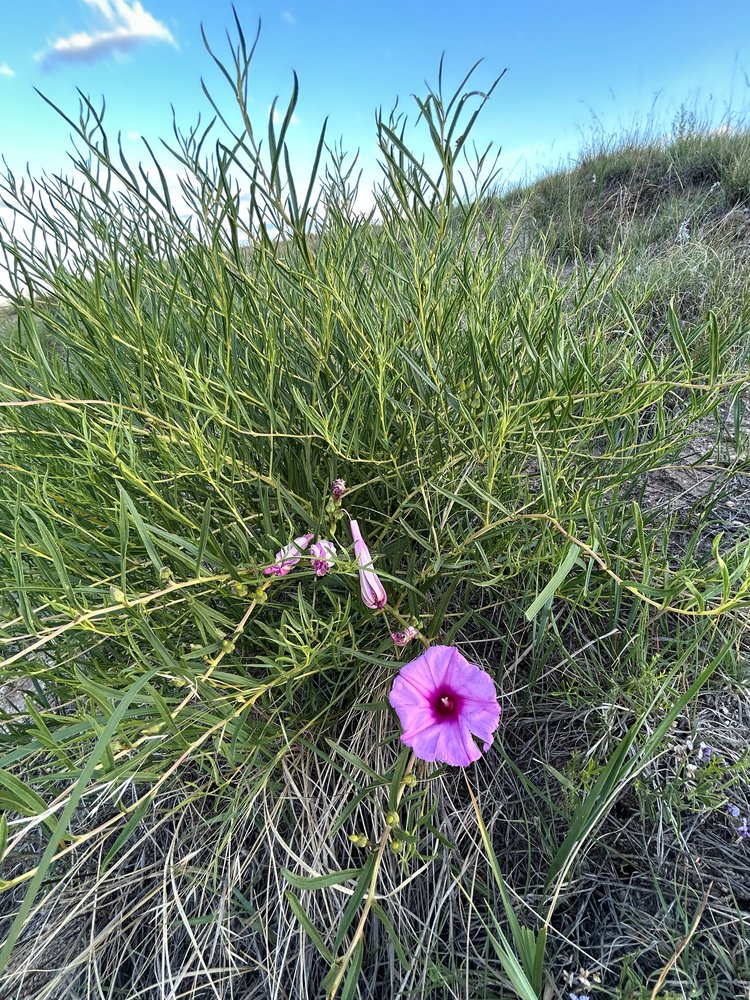
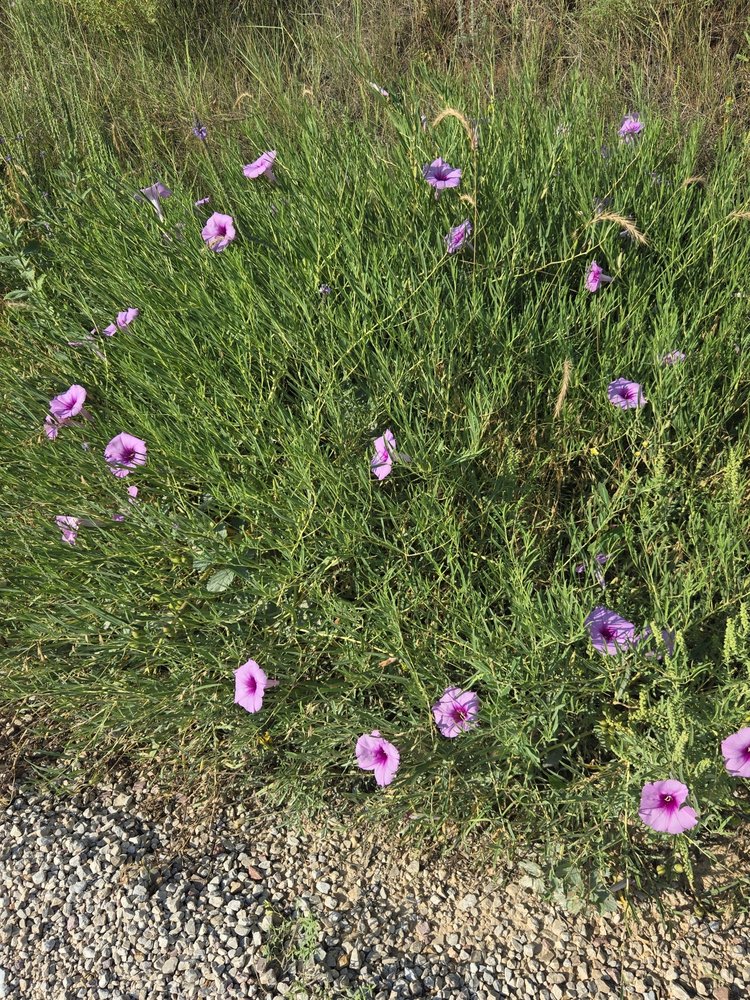
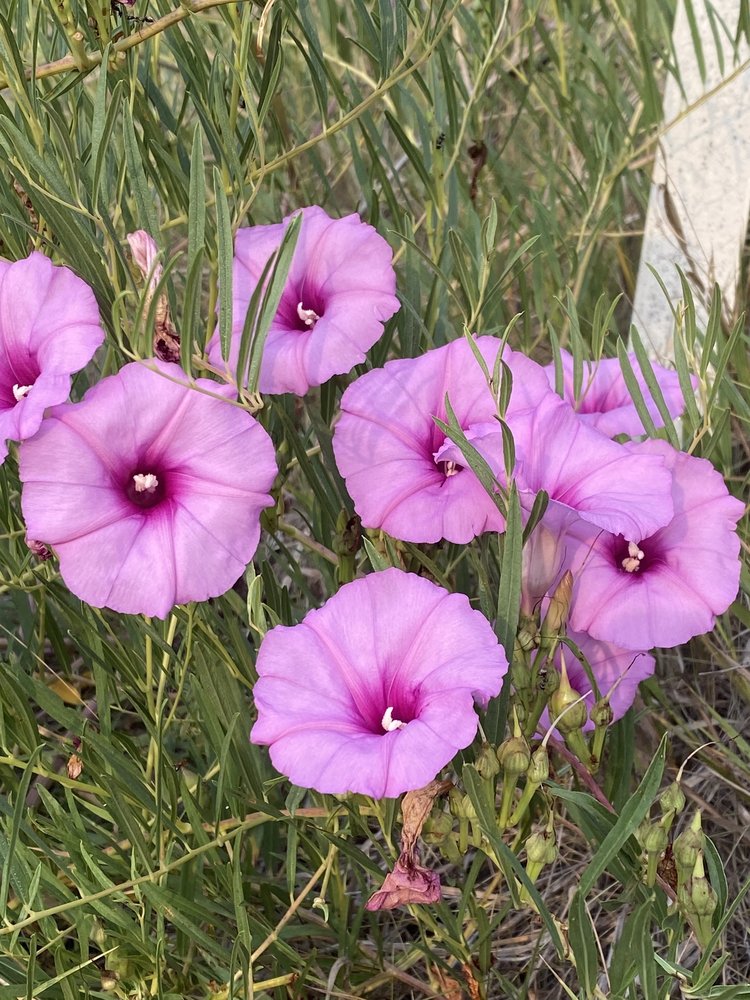
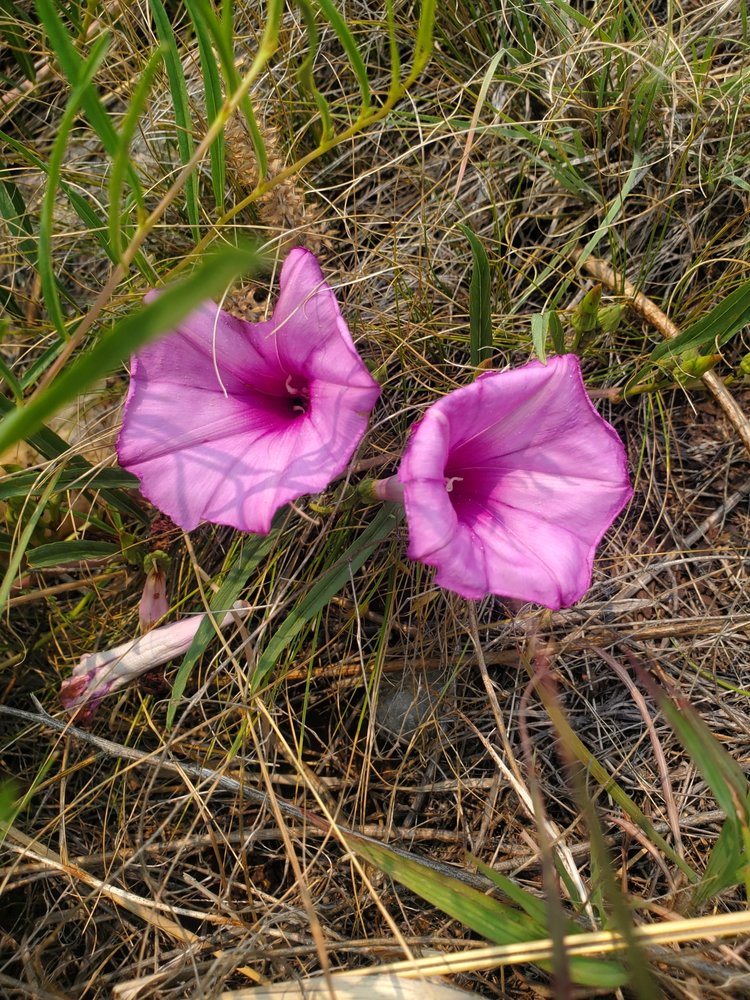
Bush Morning-glory (Ipomoea leptophylla) is a native, long-lived perennial of sandy and gravelly prairie that grows as a rounded bush of arching stems and narrow leaves, 30–120 cm (12–48 in) tall, with big pink to purple funnel flowers 5–9 cm (2–3½ in) long and a darker throat from June into August. It is not a vine, and it grows from a huge root. In the Black Hills the records are from the southern edge: the National Park Service lists it at Wind Cave, and herbarium specimens come from Fall River and Custer counties.
Free photos from other sources
| Family | Convolvulaceae · Morning-glory |
|---|---|
| Status | Native perennial |
| Blooms | June into August; SDSU gives May to September for South Dakota, and Black Hills herbarium specimens were in flower from late July to late August |
| Height | 30–120 cm (12–48 in) |
| Where | Sandy or gravelly prairie, plains, roadsides and disturbed ground |
| Also called | Bigroot Morning-glory, Man Root, Man-of-the-earth, Bush Moonflower, pȟežúta niǧé tȟáŋka pȟetáǧa (Lakota) |
| Traditional use | Black Elk and Flying By record that the Lakota ate the peelings of the root for stomach disorders and that, before matches, they stored a fire inside the root and hung it in a tree, where it kept burning for months. Gilmore recorded in 1919 that the Pawnee dusted the powdered root on the body for pain and burned it for nervousness and bad dreams. The USDA plant guide says the root was listed in the U.S. Pharmacopoeia from 1820 to 1863. Moerman's database also lists Rogers (1980) as recording that the Lakota scraped the root and ate it raw for stomach trouble, and Blankinship (1905) as recording that the Arapaho, Cheyenne and Kiowa roasted the root for food when hungry. |
Traditional use: first drafted by Google AI, then checked against the sources on this page.
Roots, seeds & germination
Root: A single huge, spindle-shaped tuber, the man root of its common names, which SDSU says can reach more than 2 m (6½ ft) down and weigh up to 45 kg (100 lb). The USDA plant guide cites a 1968 study that found a taproot 15–60 cm (6–24 in) thick, narrowing to 2.5–5 cm (1–2 in) at 1.2 m (4 ft) or more and then breaking into cord-like roots traced to 3 m (10 ft) or more, with side roots spreading 4.5–7.5 m (15–25 ft) out in the top 1.2 m (4 ft) of soil. The root stores food and water, and established plants may live 50 years or more. Every green part dies at the first fall frost, and new shoots come up well after the last spring frost.
Seed: An egg-shaped, long-pointed capsule 1–1.5 cm long holds one to four large brown seeds about 10 mm long, covered in short brown down. SDSU says to collect the seed from July into September, when it is dark brown. At the end of the season the stems carrying open capsules break off and tumble in the wind, scattering the seed. Seeds stored cool and dry have stayed alive for 25 years or more.
Germination: The seed coat is waterproof, so nick it with a knife point and soak the seed overnight; sprouts can show in 3 to 5 days, but the seeds come up over weeks and months, and some wait until the next spring. Sow about 6 mm (¼ in) deep after the last frost, in full sun and sandy, well-drained soil, where the plant will stay, because the big root makes moving it hard; dormant tubers can be transplanted.
How do you identify Bush Morning-glory?
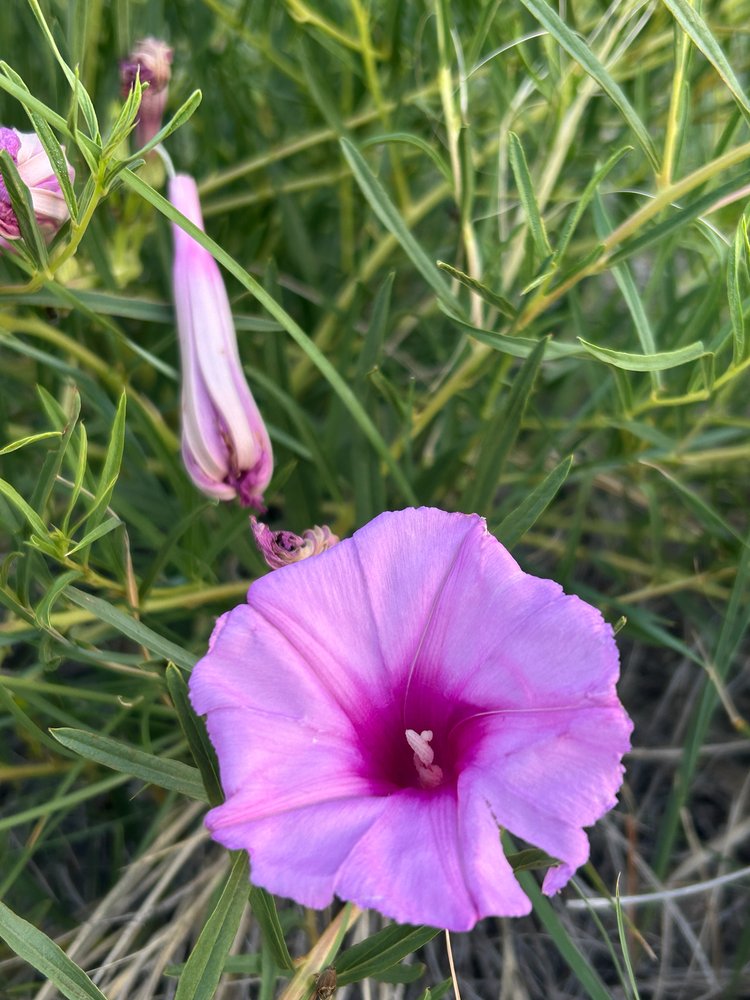
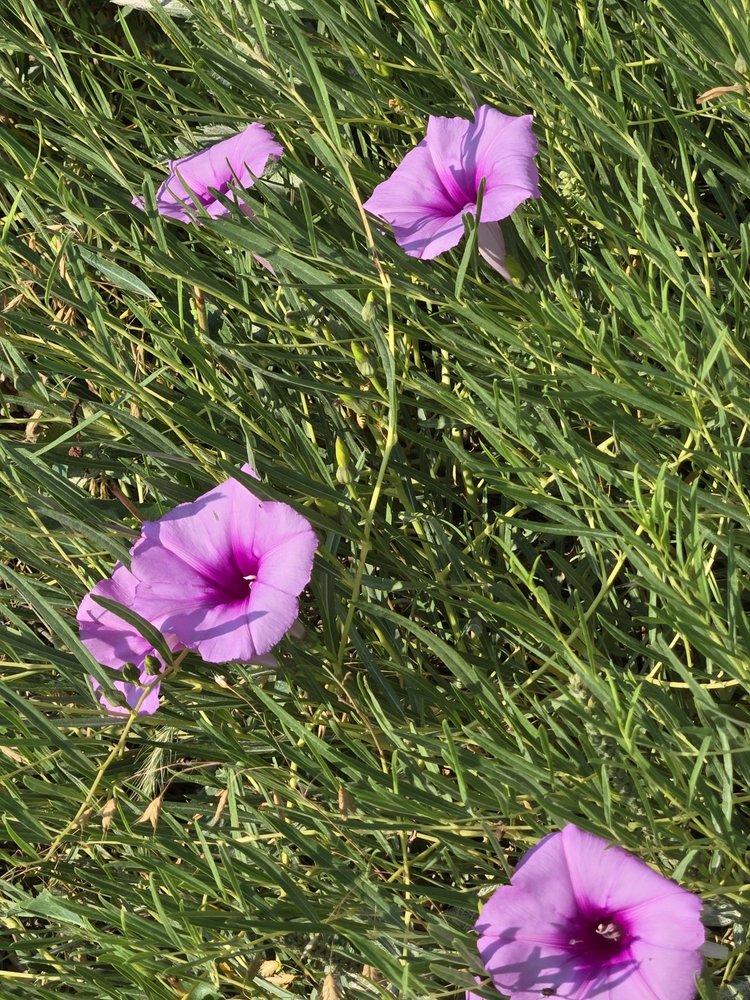
Look for a rounded, shrub-like bush of several smooth stems rising or arching from one root, 30–120 cm tall and up to 1.5 m (5 ft) across; it does not climb or twine like a garden morning glory. The leaves are alternate, narrow and linear, 3–15 cm (1–6 in) long and only 2–10 mm wide, hairless and pointed. The flowers are funnel-shaped, 5–9 cm (2–3½ in) long, lavender-pink to purple-red with a darker throat, and sit one to three together on stalks 7–10 cm (3–4 in) long from the leaf axils; the stamens stay inside the funnel. The sepals are unequal, 5–10 mm, the inner ones longer. The fruit is an egg-shaped, long-pointed capsule 1–1.5 cm long with one to four large brown, downy seeds.
When does it bloom?
June into August; SDSU gives May to September for South Dakota, and Black Hills herbarium specimens were in flower from late July to late August.
Where does it grow?
Sandy or gravelly prairie, plains and roadsides, from the plains up to about 2,200 m (7,200 ft); SDSU puts it on the sandy plains and prairies of southwestern South Dakota, and the USDA plant guide says it is restricted to the Great Plains and can dominate overgrazed range because the latex in its leaves keeps cattle from grazing it. In the Black Hills the National Park Service lists it at Wind Cave National Park, and herbarium specimens from 1892 to 2002 come from Fall River and Custer counties, including Wind Cave National Park; their labels describe a waste field, a railroad embankment, a roadside hilltop, open grassland and dry, gravelly, grassy hillsides, and two give elevations of 975 and 1,150 m (3,200 and 3,770 ft). iNaturalist has 54 research-grade Black Hills records, June to August, most of them in Custer and Fall River counties, including Wind Cave National Park and Custer State Park.
Sources: Flora of North America Vol. 14: Ipomoea leptophylla — eFloras; Convolvulaceae: Ipomoea leptophylla (R. Neil Reese) — SDSU Open PRAIRIE; Plant Guide: Bush Morningglory, Ipomoea leptophylla (Row, 2014) — USDA NRCS Manhattan Plant Materials Center; Ipomoea leptophylla, Bush morning-glory — Kansas Wildflowers and Grasses; Ipomoea leptophylla — Lady Bird Johnson Wildflower Center; NPSpecies checklist, Wind Cave National Park vascular plants — National Park Service; NPSpecies checklist, Jewel Cave National Monument vascular plants (not listed) — National Park Service; NPSpecies checklist, Mount Rushmore National Memorial vascular plants (not listed) — National Park Service; NPSpecies checklist, Devils Tower National Monument vascular plants (not listed) — National Park Service; Occurrence search: Ipomoea leptophylla herbarium specimens in the Black Hills — GBIF; Research-grade Ipomoea leptophylla observations in the Black Hills — iNaturalist; Ipomoea leptophylla — Native American Ethnobotany Database (BRIT); Culturally Important Plants of the Lakota (Black Elk and Flying By, 1998), entry 152 — South Dakota PUC docket HP14-001.