White Sagebrush
Artemisia ludoviciana
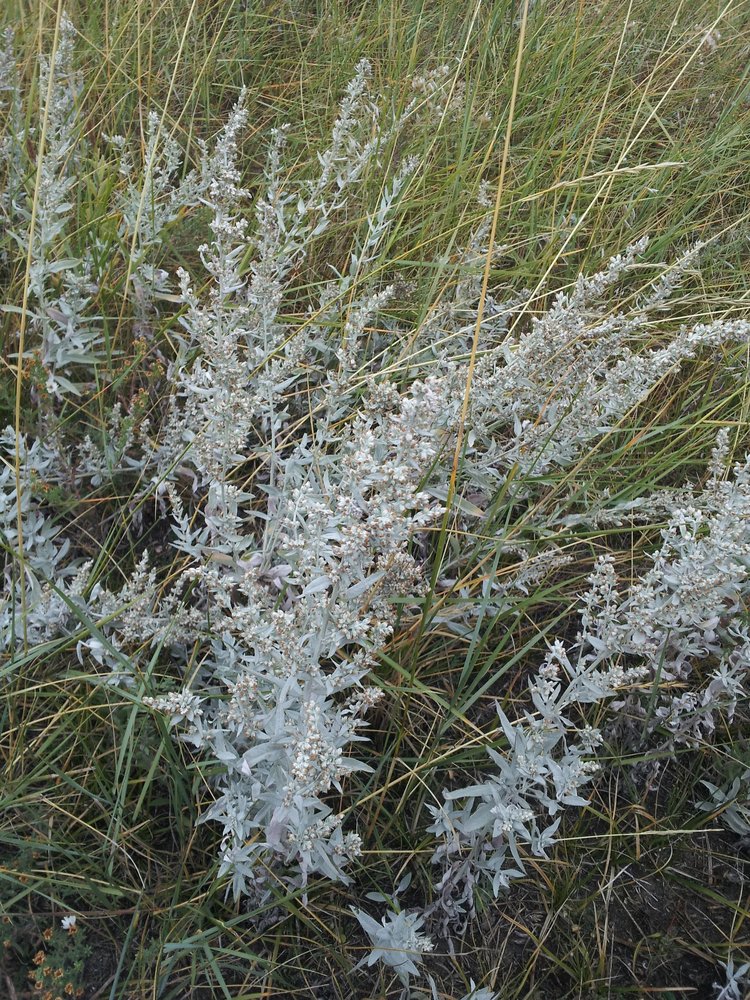
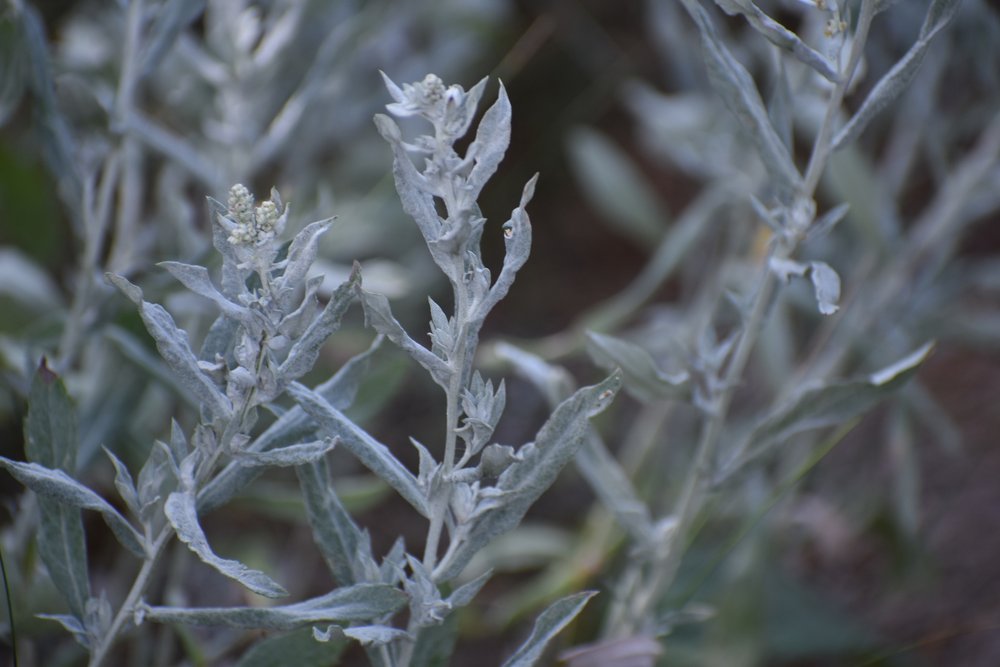
White Sagebrush (Artemisia ludoviciana) is a native perennial of the sunflower family, a silvery-white, woolly, strongly scented plant that spreads by underground runners into loose patches. Its tiny greenish-yellow flower heads open from August into September on prairies, roadsides and open pine woods, and it is listed at Jewel Cave, Wind Cave, Mount Rushmore and Devils Tower in the Black Hills.
Free photos from other sources
| Family | Asteraceae · Aster |
|---|---|
| Status | Native perennial |
| Blooms | August into September, with heads lingering into October |
| Height | 30–100 cm (12–39 in) |
| Where | Prairies, meadows, roadsides, open pine woods and rocky slopes, foothills to high ridges |
| Also called | Prairie Sage, White Sage, Cudweed Sagewort, Louisiana Sagewort, Silver Wormwood, Western Mugwort, Man Sage, pȟeží hóta wápe blaskáska (Lakota) |
| Synonym | Artemisia gnaphalodes, Artemisia purshiana, Artemisia ludoviciana var. gnaphalodes, Artemisia ludoviciana var. latifolia |
| Toxicity | The USDA plant guide says it contains thujone, which is toxic in large doses. |
| Traditional use | Sitting Bull College’s 1998 Culturally Important Plants of the Lakota says the leaves and stems were burned for smudging, to purify oneself; the plant was made into wreaths and bracelets for Sun Dancers; and a tea was taken for stomach trouble, colds and sore throat. The USDA plant guide adds that it was perhaps the most important ceremonial plant of the Cheyenne. |
| Note | This is the sage burned for smudging. It isn’t kitchen sage or California White Sage, which are both Salvia, in the mint family. |
Roots, seeds & germination
Root: Creeping rhizomes, mostly in the top 2.5–14 cm (1–5½ in) of soil, with coarse roots reaching about 70 cm (27 in). The rhizomes let one plant form a clump 2–3 m (6½–10 ft) across.
Seed: A tiny, smooth, dry achene with no fluffy parachute. Seed ripens and turns brown from early October into early November and is shed by wind, gravity and water through early winter.
Germination: Sources differ: SDSU and a University of Washington protocol call for fall sowing or 60–90 days of cold, moist stratification, while Prairie Moon gives about 30 days. The very small seed is sown on the surface, and plants are also easily started by dividing the rhizomes.
How do you identify White Sagebrush?
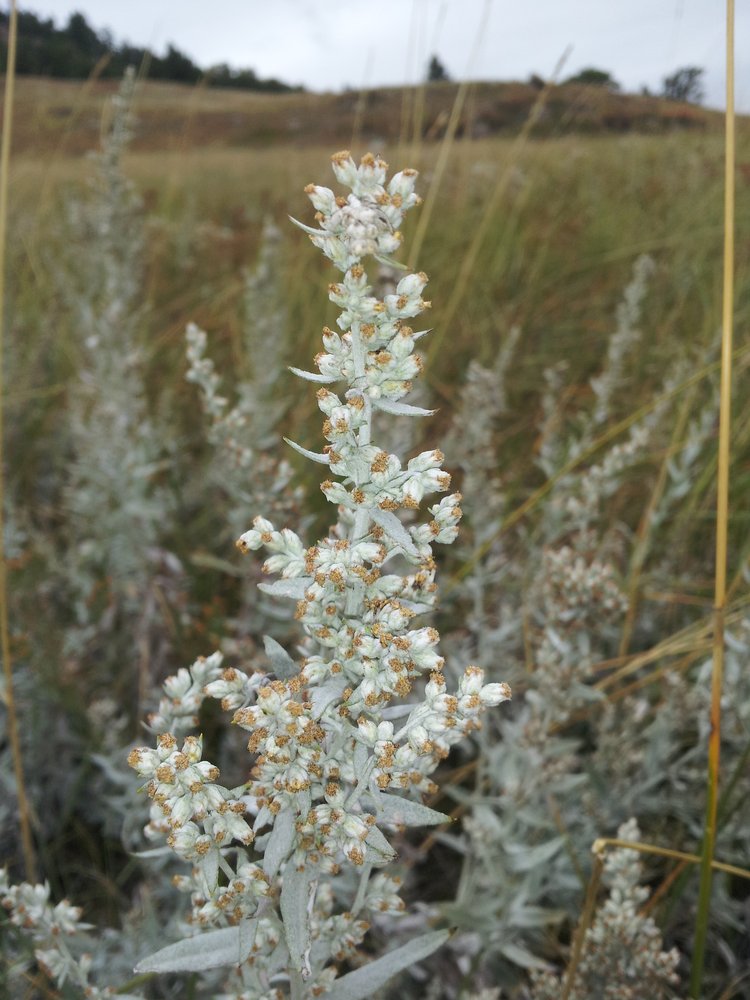
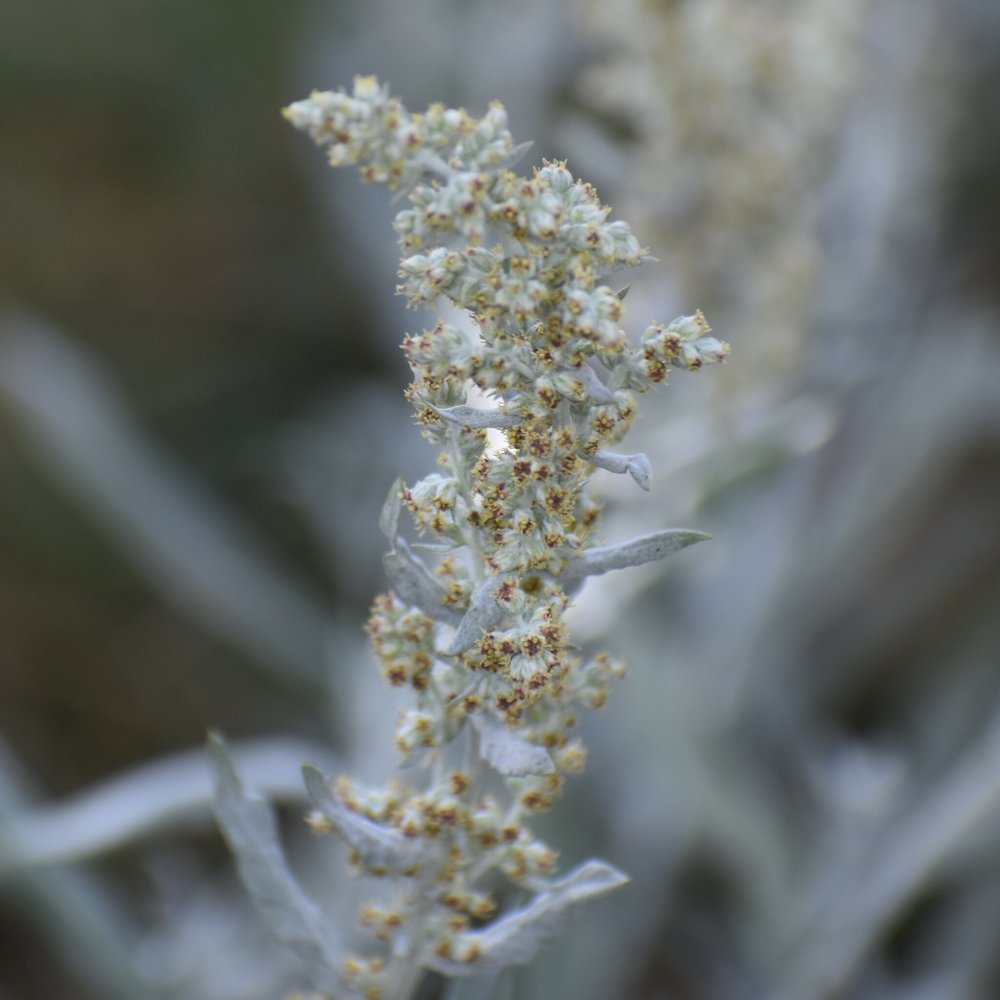
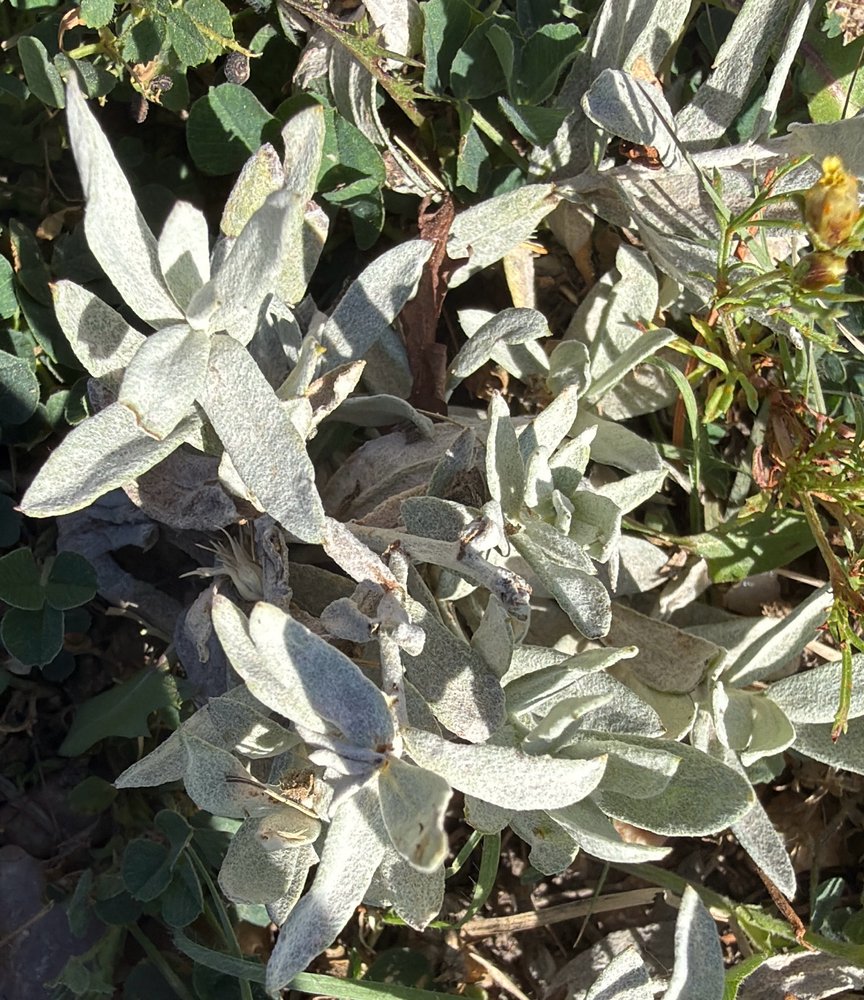
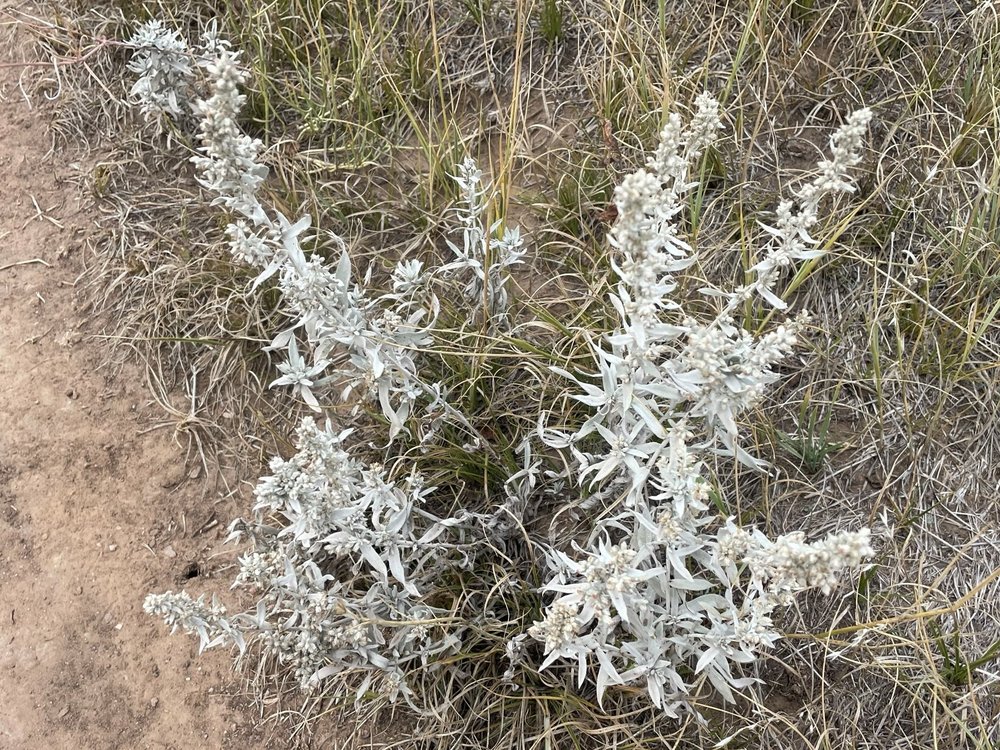
The whole plant, stems and both sides of the leaves, is silvery white to gray-green with a dense felt of matted hairs, and a crushed leaf smells strongly of sagebrush. Upright stems rise in loose patches from creeping rhizomes, not from a woody base. The leaves alternate up the stem and are narrow, lance-shaped, 3–11 cm (1¼–4½ in) long, mostly smooth-edged, with the lower ones sometimes toothed or with a few lobes near the tip. Tiny nodding, button-like heads without petals crowd a narrow, spike-like cluster at the top. Fringed Sage is just as silvery and fragrant but low, 10–40 cm, growing in tufted mats from a woody base, with small leaves finely cut into thread-like segments.
When does it bloom?
August into September, with heads lingering into October.
Where does it grow?
Dry to moderately moist, sunny ground: mixed-grass prairie, meadows, roadsides and other disturbed ground, open ponderosa pine woods, rocky slopes and stream terraces, on sand, loam, clay or gravel. In the Black Hills it runs from the foothills up to the high ridges. About 170 herbarium specimens since 1892 come from all seven Black Hills counties, including Custer State Park and Devils Tower, the 1986 Jewel Cave survey lists it, and the species lists for Wind Cave, Jewel Cave, Mount Rushmore and Devils Tower include it.
Sources: South Dakota Native Plant Research: Artemisia ludoviciana (SDSU Open PRAIRIE); Black Elk, L. and W. Flying By. 1998. Culturally Important Plants of the Lakota. Sitting Bull College (filed as SD PUC docket HP14-001 testimony exhibit), entry 34; Gilmore, M.R. 1919. Uses of Plants by the Indians of the Missouri River Region. 33rd Annual Report of the Bureau of American Ethnology (Internet Archive scan): Artemisia gnaphalodes, A. frigida; USDA NRCS Plant Guide: White Sage, Artemisia ludoviciana (Stevens & Roberts; archived copy); USDA Forest Service Fire Effects Information System: Artemisia ludoviciana; USDA PLANTS Database: Artemisia ludoviciana (ARLU); ITIS: Artemisia ludoviciana Nutt., TSN 35474; National Park Service, Devils Tower: Native Plants; NPSpecies checklist, Wind Cave National Park (vascular plants); NPSpecies checklist, Jewel Cave National Monument (vascular plants); NPSpecies checklist, Mount Rushmore National Memorial (vascular plants); NPSpecies checklist, Devils Tower National Monument (vascular plants); Marriott, H. and R. Hartman. 1986. A Survey of the Vegetation of Jewel Cave National Monument; GBIF occurrence search: Artemisia ludoviciana (herbarium specimens, filtered to Black Hills counties); GBIF occurrence search: Artemisia tridentata (Big Sagebrush) for lookalike range; Minnesota Wildflowers: White Sage (Artemisia ludoviciana); Prairie Moon Nursery: Artemisia ludoviciana, Prairie Sage; Koehn, D.G. 2008. Plant Propagation Protocol for Artemisia ludoviciana. University of Washington ESRM 412; iNaturalist: Artemisia ludoviciana observations near the Black Hills.