Missouri Goldenrod Solidago missouriensis
Also called Prairie Goldenrod, čhaŋnúŋǧa hú pteptéčela (Lakota)
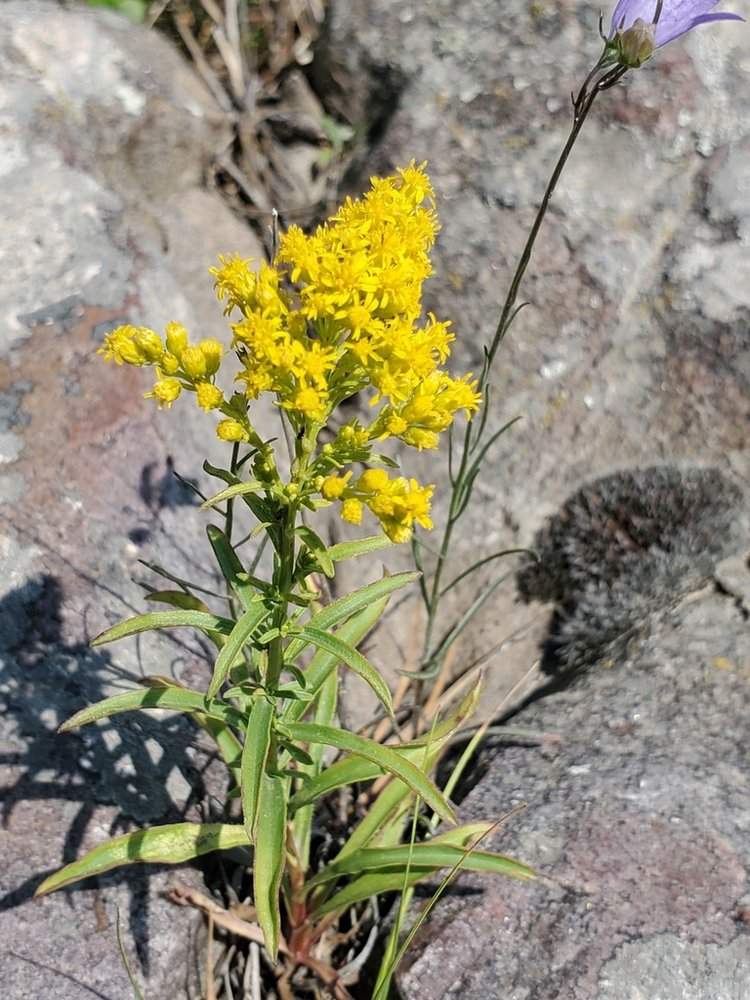
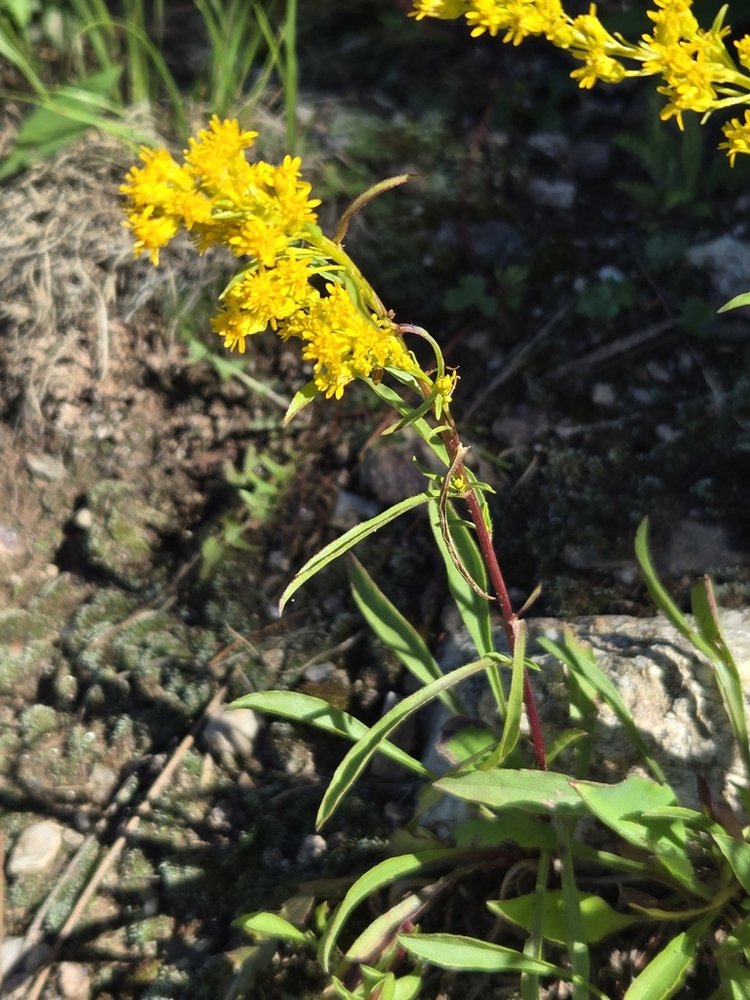
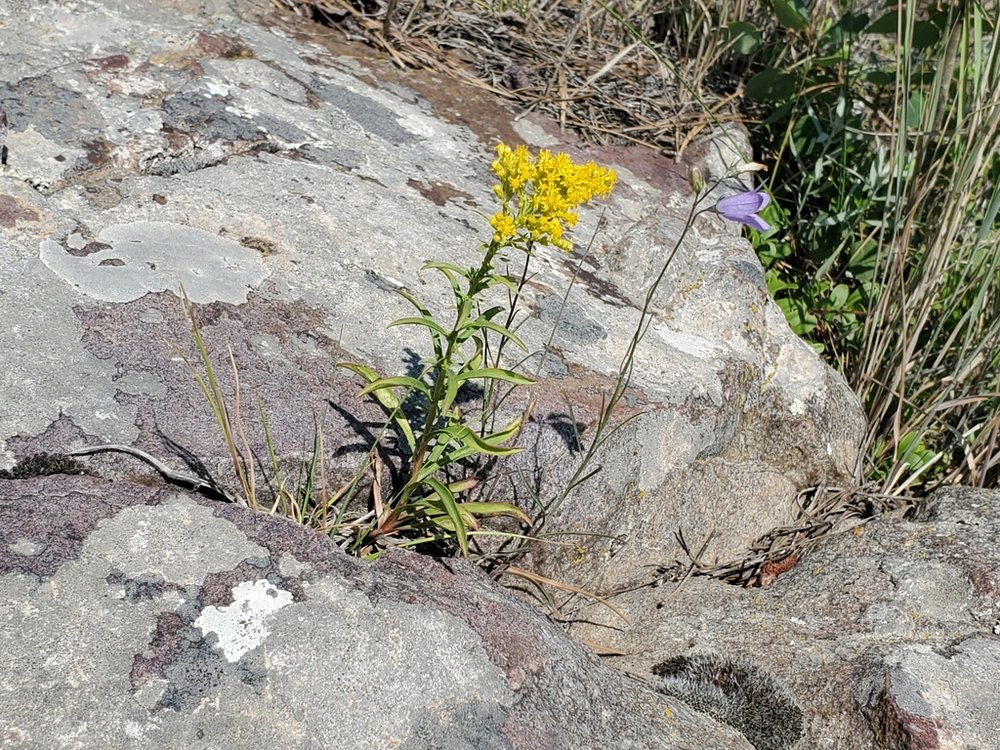
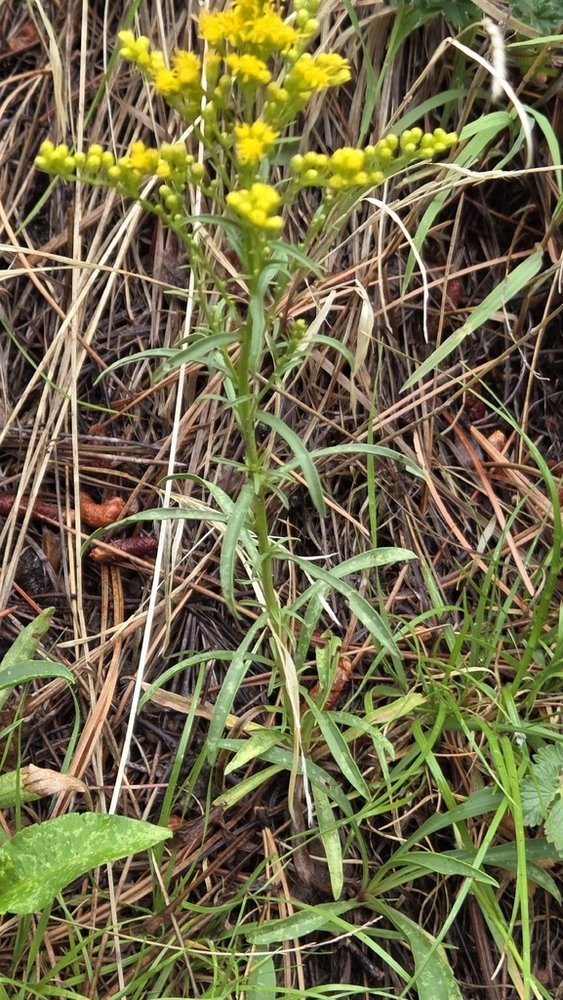
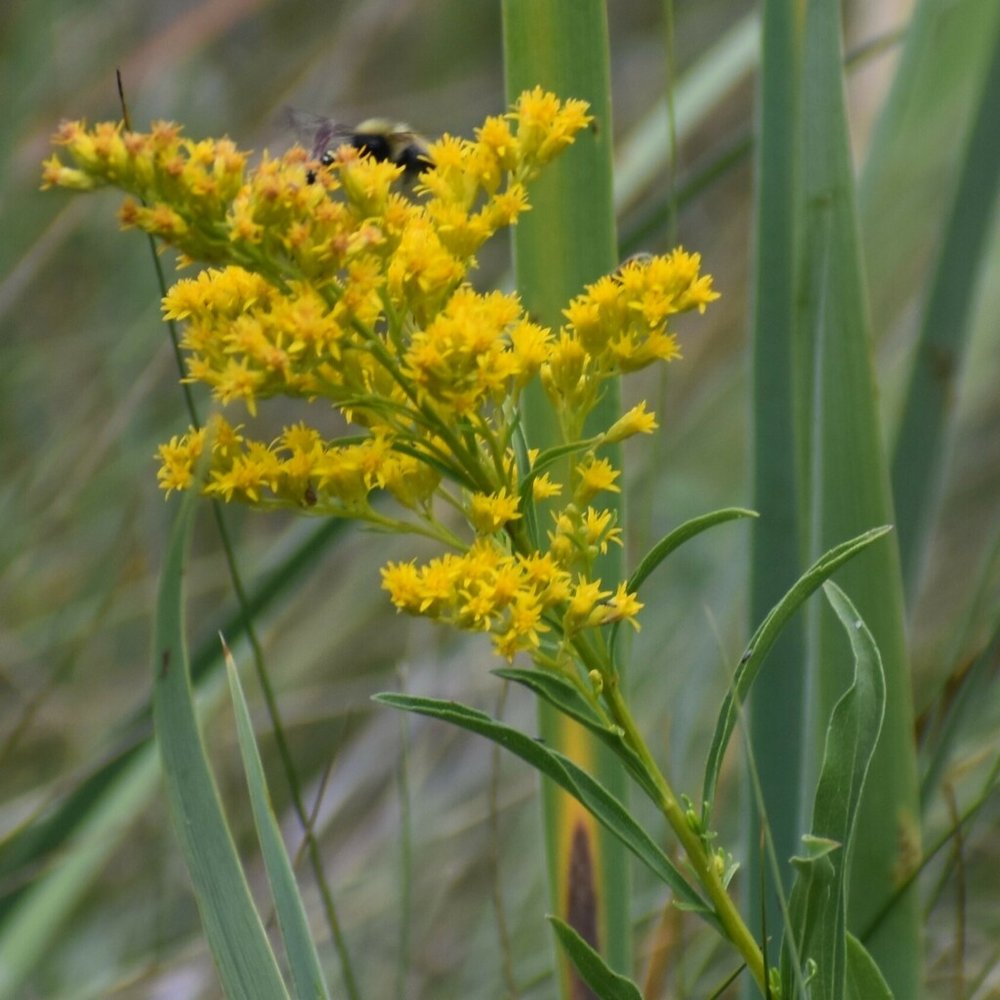
Missouri Goldenrod (Solidago missouriensis) is a native perennial 30–90 cm (12–36 in) tall with smooth, often reddish stems, narrow three-veined leaves and a pyramid-shaped plume of tiny yellow heads, most of them on the upper side of each arching branch. It is one of the earliest goldenrods to bloom, from July into September, and in the Black Hills it grows on dry prairie, open hillsides and in open ponderosa pine woods, where the National Park Service lists it at Wind Cave, Jewel Cave, Mount Rushmore and Devils Tower.
Free photos from other sources
| Family | Asteraceae · Aster |
|---|---|
| Status | Native perennial |
| Blooms | July into September |
| Height | 30–90 cm (12–36 in) |
| Where | Dry prairie, open hillsides, roadsides and open pine woods on sandy or rocky soil, in full sun |
| Also called | Prairie Goldenrod, čhaŋnúŋǧa hú pteptéčela (Lakota) |
| Synonym | Solidago glaberrima, Solidago missouriensis var. fasciculata, Solidago missouriensis var. glaberrima, Solidago concinna, Solidago tolmieana |
| Toxicity | The USDA plant guide says it may be toxic to sheep. |
| Traditional use | Black Elk and Flying By (1998) record the Lakota name čhaŋnúŋǧa hú pteptéčela and say an infusion of the dried leaves, flowers and stems was used for stomachaches, flu, urinary infections and sore throats, a tea was made from the dried flowers, and a decoction of the whole plant was used to pass kidney stones. |
Roots, seeds & germination
Root: It spreads by tough, woody rhizomes (underground stems) 1–8 cm (½–3 in) deep and up to 43 cm (17 in) long, so one plant becomes a colony of shoots. Most roots are fine and shallow, densest in the top 10–30 cm (4–12 in) of soil, but some larger roots reach 2–3.4 m (7–11 ft) deep, and a clone can live for several hundred years.
Seed: Each head makes dry, one-seeded fruits 1–2 mm long, brown, smooth or sparsely hairy, each with a tuft of white to pale brown bristles 2.5–3 mm long that carries it on the wind. Seed ripens about six weeks after flowering, and the seed doesn't seem to build a lasting seed bank in the soil.
Germination: Sources disagree on a cold period. The USDA plant guide says the seed needs no cold, moist treatment, sprouts in about 7 to 14 days under a light covering of soil, and does best sown 3–6 mm (⅛–¼ in) deep in fall. SDSU says a 60-day cold, moist treatment can improve germination, or sow in fall. The Fire Effects Information System reports that germination is generally low and best on bare, moist, disturbed soil, and that most spread is by rhizome rather than seed.
How do you identify Missouri Goldenrod?
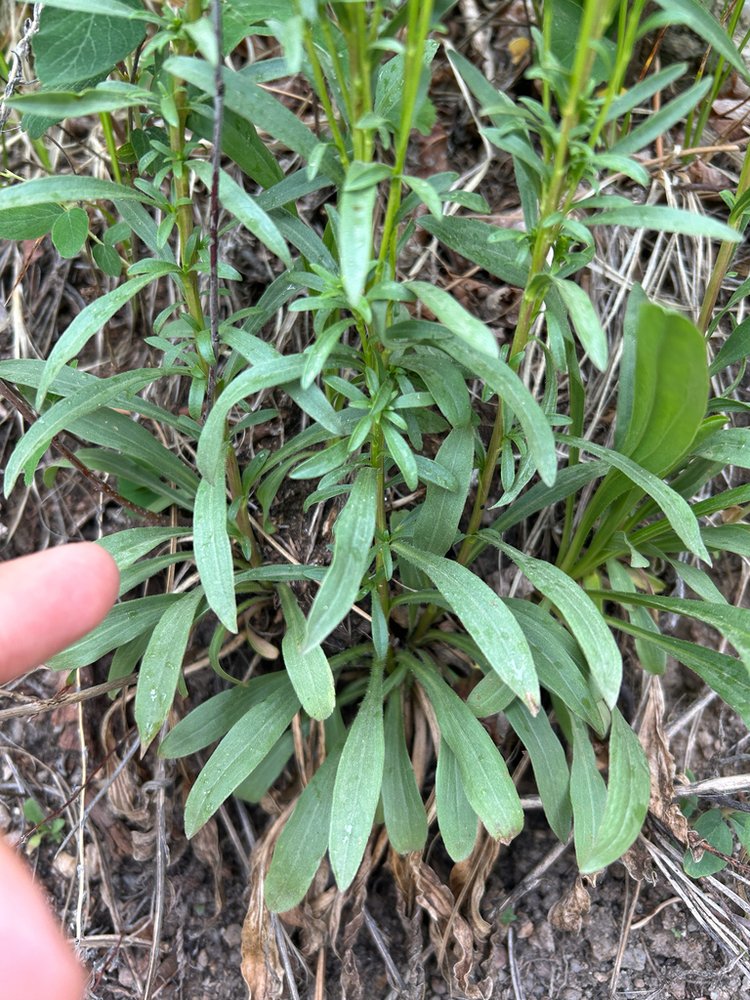
Look for a slender, smooth stem, often red near the base, topped by a dense plume 3–12 cm (1–5 in) long, shaped like a pyramid or a diamond, with up to about 210 tiny heads that on most plants sit along the upper side of spreading, arching branches. Each head is about 3 mm across, with 5–14 short yellow rays, and the bracts around it are hairless and yellow-green. The leaves are narrow and lance-shaped, hairless except for a fringe of fine hairs along the edge, and have three main veins: a midvein and two side veins running parallel to it. The lower leaves taper to a winged stalk, the upper ones are much smaller and stalkless, and tufts of tiny leaves often sit where they meet the stem. It is one of the earliest goldenrods to flower. Stiff Goldenrod carries its heads in a flat-topped cluster 5–13 cm (2–5 in) across over gray-green leaves that are rough with short bristly hairs, and blooms from August. Gray Goldenrod, in all four Black Hills park units, is short with gray-hairy stems and leaves and a leaning or nodding cluster, and blooms from August. Giant Goldenrod, at Wind Cave and Mount Rushmore, looks like Missouri Goldenrod in form and hairlessness, but it is taller than 90 cm (3 ft), has no basal leaves, its upper stem leaves are not much smaller than the middle ones, and it doesn't bloom until August.
When does it bloom?
July into September.
Where does it grow?
Dry, open ground in full sun: prairie, open hillsides, roadsides and sandy or rocky soil, and openings in ponderosa pine forest, from about 1,000 to 2,000 m (3,300–6,500 ft). The National Park Service lists it at Wind Cave, Jewel Cave, Mount Rushmore and Devils Tower, the 1986 plant survey of Jewel Cave lists it, and herbarium specimens come from Lawrence, Pennington, Custer, Fall River and Meade counties in South Dakota and Crook and Weston counties in Wyoming, including Custer State Park, with labels from open pine forest on rocky soil, pine and bur oak slopes, meadows, roadsides and prairie. The Forest Service's Fire Effects review also reports it in bur oak and sumac scrub and in clearcut ponderosa pine stands in the Black Hills.
Other goldenrods in this guide
Aster family (Asteraceae): 62 other plants in this guide
- Aromatic Aster
- Arrowleaf Balsamroot
- Arrowleaf Sweet Coltsfoot
- Bachelor's Button
- Balsam Ragwort
- Black-eyed Susan
- Blanket Flower
- Blue Lettuce
- Broom Snakeweed
- Bull Thistle
- Canada Hawkweed
- Canada Lettuce
- Canada Thistle
- Chicory
- Common Burdock
- Common Dandelion
- Common Sunflower
- Common Tansy
- Common Yarrow
- Curlycup Gumweed
- Cutleaf Coneflower
- Dotted Gayfeather
- Drummond's Thistle
- Easter Daisy
- False Boneset
- Fetid Marigold
- Field Pussytoes
- Fringed Sagewort
- Hairy Golden Aster
- Heart-leaved Arnica
- Hooker's Townsend Daisy
- Horseweed
- Jerusalem Artichoke
- Lambstongue Groundsel
- Maximilian Sunflower
- Mountain Dandelion
- Musk Thistle
- Oxeye Daisy
- Pearly Everlasting
- Pineapple Weed
- Prairie Coneflower
- Prairie False Dandelion
- Purple Coneflower
- Rocky Mountain Blazing Star
- Rosy Pussytoes
- Rubber Rabbitbrush
- Rush Skeletonplant
- Scotch Thistle
- Silver Sagebrush
- Smooth Blue Aster
- Spotted Joe-Pye Weed
- Stemless Four-nerve Daisy
- Stiff Goldenrod
- Stiff Sunflower
- Threenerve Fleabane
- Wavyleaf Thistle
- Western Ragweed
- White Hawkweed
- White Prairie Aster
- White Sagebrush
- Woolly Groundsel
- Yellow Salsify
Sources: Flora of North America Vol. 20: Solidago missouriensis (Semple & Cook 2006), eFloras; Reese, R.N. Asteraceae: Solidago missouriensis. South Dakota Native Plant Research, SDSU Open PRAIRIE; Minnesota Wildflowers: Solidago missouriensis (Missouri Goldenrod); Kansas Wildflowers and Grasses: Solidago missouriensis; Illinois Wildflowers: Missouri Goldenrod; USDA NRCS Plant Guide: Missouri Goldenrod, Solidago missouriensis; Zouhar & Masin 2020. Solidago missouriensis. Fire Effects Information System, USDA Forest Service; Semple, Astereae Lab, University of Waterloo: Solidago missouriensis; ITIS: Solidago missouriensis (TSN 36277); Minnesota Wildflowers: Solidago rigida (Stiff Goldenrod); Minnesota Wildflowers: Solidago nemoralis (Gray Goldenrod); NPSpecies checklist, Wind Cave National Park vascular plants; NPSpecies checklist, Jewel Cave National Monument vascular plants; NPSpecies checklist, Mount Rushmore National Memorial vascular plants; NPSpecies checklist, Devils Tower National Monument vascular plants; Marriott & Hartman 1986. A Survey of the Vegetation of Jewel Cave National Monument; GBIF occurrence search: Solidago missouriensis, South Dakota and Wyoming herbarium specimens; Black Elk, L.S. & Flying By, W.D. 1998. Culturally Important Plants of the Lakota (Sitting Bull College), entry 289.