Spotted Joe-Pye Weed
Eutrochium maculatum var. bruneri
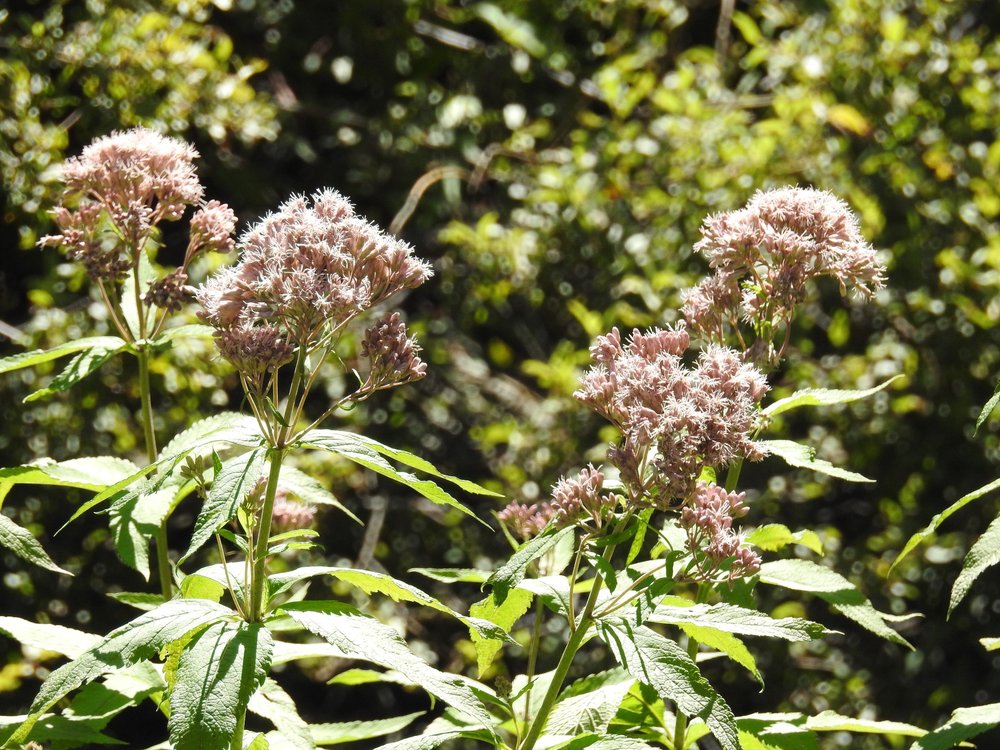
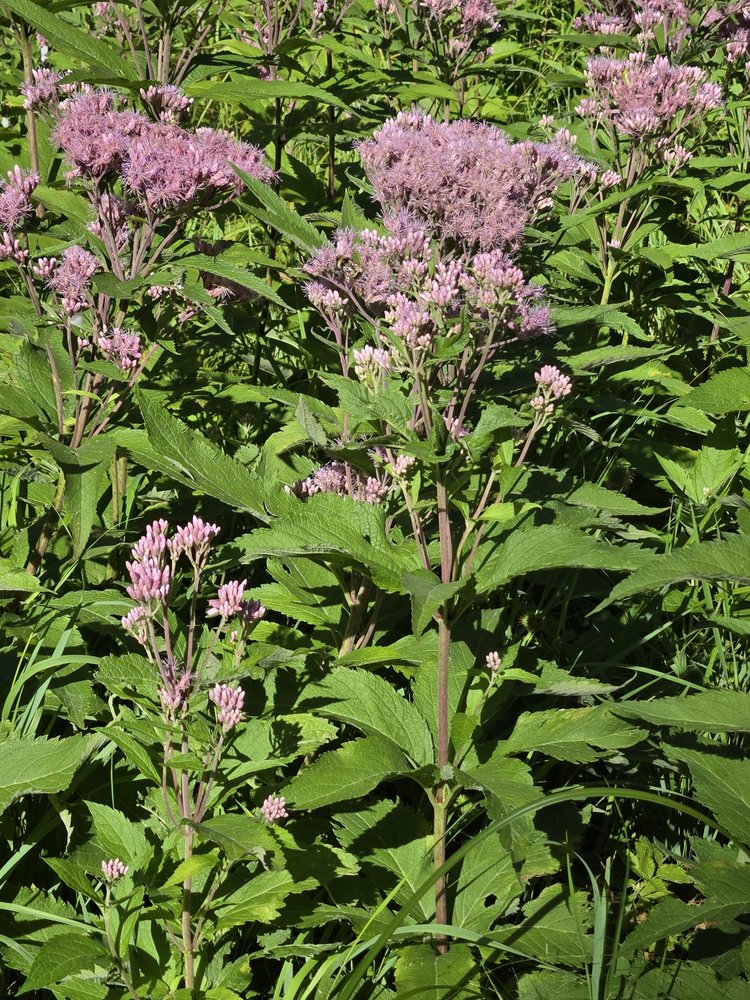
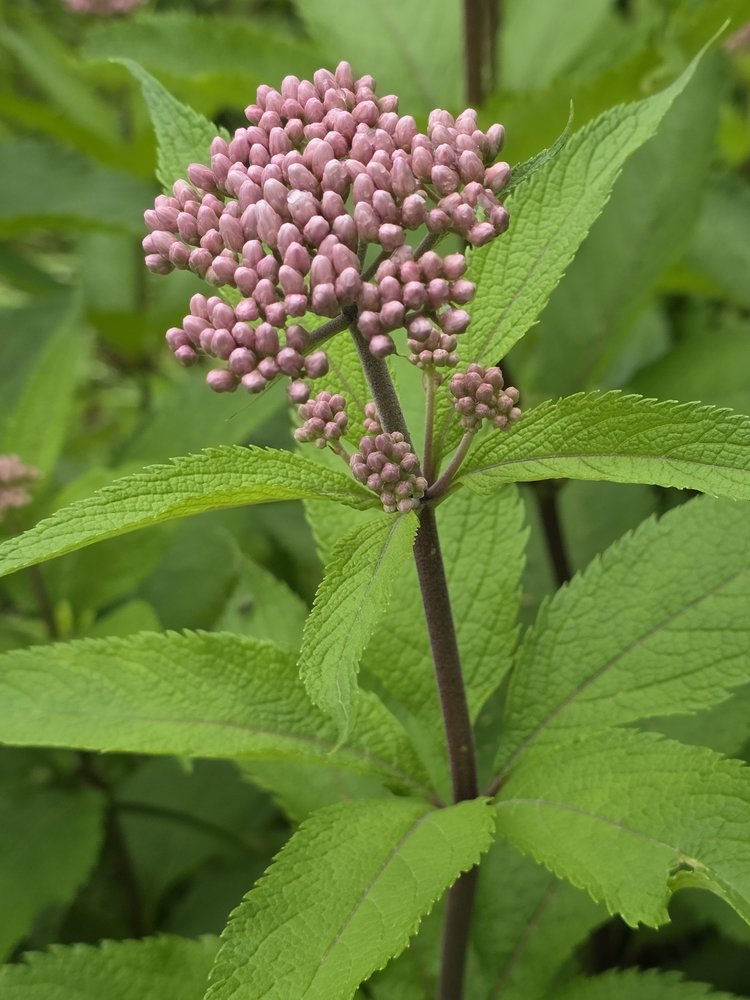
Spotted Joe-Pye Weed (Eutrochium maculatum var. bruneri) is a tall native perennial of wet ground, topped in late summer by broad, flat-topped clusters of pink to purplish flower heads on purple or purple-spotted stems. It blooms from July into September along creeks, springs and seeps in the Black Hills, and the National Park Service lists it at Wind Cave and Mount Rushmore.
Free photos from other sources
| Family | Asteraceae · Aster |
|---|---|
| Status | Native perennial |
| Blooms | July into September, most in August |
| Height | 60–200 cm (24–79 in) |
| Where | Streambanks, springs, seeps, wet meadows and creek-side thickets |
| Also called | Joe-Pye Weed, Spotted Joepyeweed, Bruner's Spotted Joe-Pye Weed, Western Spotted Gravel-root, Purple Boneset, waȟčá pȟepȟéla (Lakota) |
| Synonym | Eupatorium maculatum, Eupatorium maculatum var. bruneri, Eupatorium bruneri, Eupatoriadelphus maculatus |
| Listed | NatureServe ranks it S3 (vulnerable) in Wyoming; South Dakota does not rank it. |
| Traditional use | Sitting Bull College's 1998 Culturally Important Plants of the Lakota says the Lakota drank a tea of the whole plant as a diuretic for kidney and urinary complaints and rheumatism, and a root decoction for fevers, colds and kidney infections. |
Roots, seeds & germination
Root: A fibrous root system, sometimes with rhizomes, and plants often form small clonal colonies.
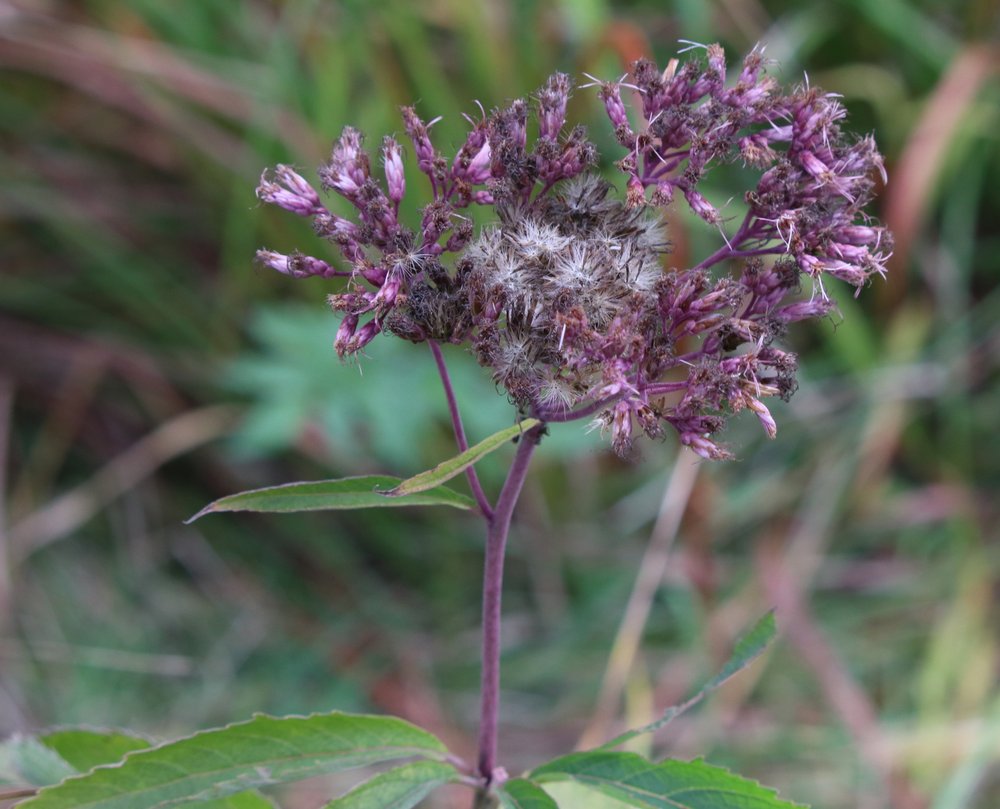
Seed: Each tiny flower becomes a slender, five-angled seed 3–4 mm long, with a tuft of light brown hairs that carries it on the wind. In late summer or early fall the clusters turn into a mass of brown seed.
Germination: The seed has some dormancy: sow it outdoors in fall, or give it a 30-day cold treatment before spring sowing. Clumps can also be divided, or stem cuttings taken, in spring.
How do you identify Spotted Joe-Pye Weed?
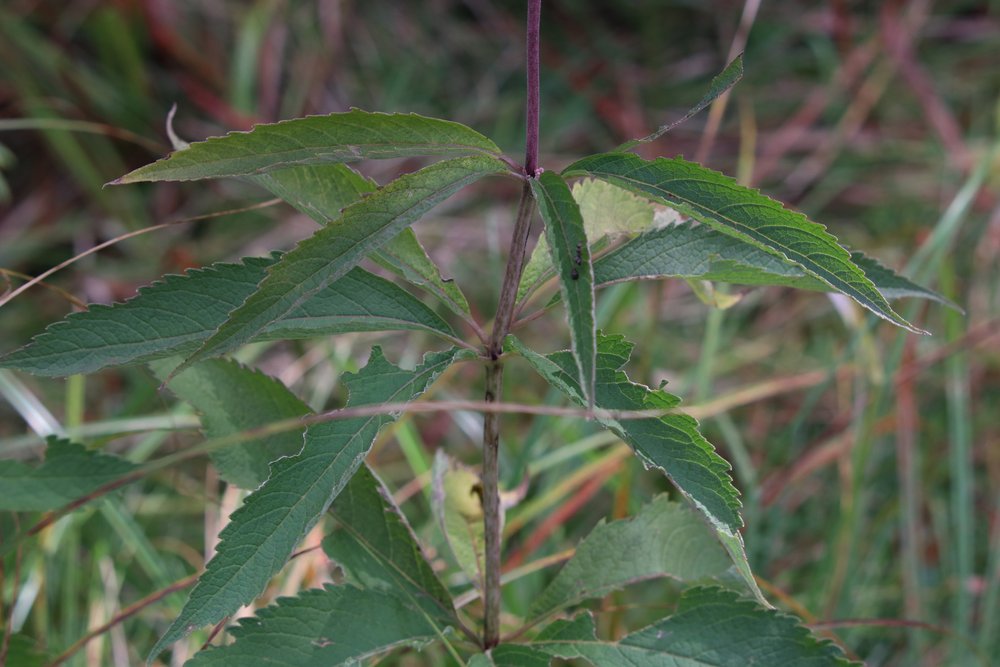
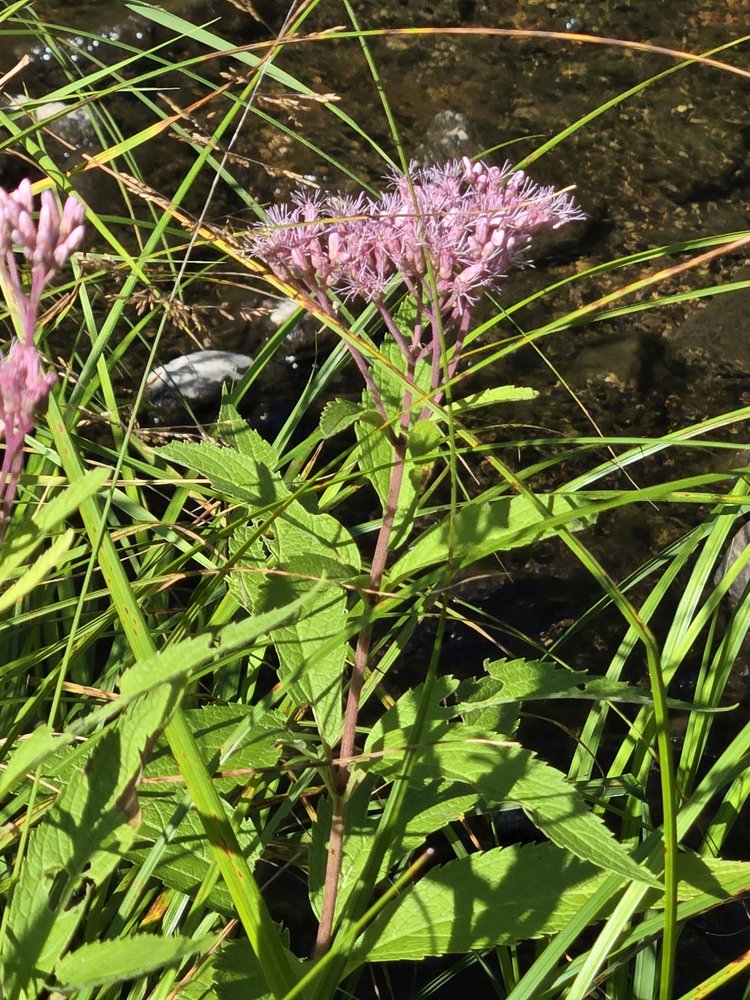
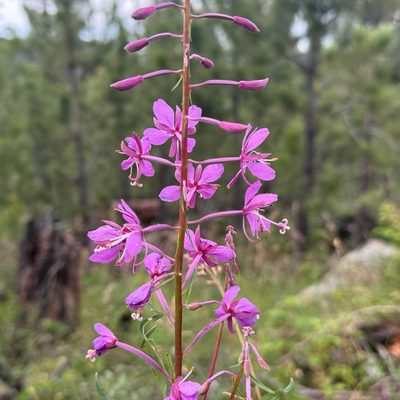
Look for a big, upright, mostly unbranched plant, usually waist to head high, with leaves in whorls of 4 or 5 at each joint on a stout stem spotted with purple, or purple all over. In var. bruneri, the Black Hills variety, the stem is finely hairy from the base up to the flowers. The leaves are lance-shaped, 6–15 cm (2½–6 in) long and toothed. The flat or nearly flat cluster on top, 8–15 cm (3–6 in) across, is made of many small heads of pink to purplish florets with no petals, each floret with long, thread-like styles sticking out. Fireweed, also pink in summer, has flowers with four obvious petals in a tall spike, and alternate, mostly untoothed leaves.
When does it bloom?
July into September, most in August.
Where does it grow?
Wet ground in sun or part shade beside water: creek banks, springs, seeps, lake shores and wet meadows, and moist thickets of willow, birch, aspen and spruce. About 80 herbarium specimens from 1891 to 2011 are filed under Lawrence, Pennington, Custer, Butte and Fall River counties in South Dakota and Crook County in Wyoming, many from Spearfish Canyon, and others from Custer State Park, the Black Elk Wilderness and the Bear Lodge Mountains. The National Park Service lists it at Wind Cave and Mount Rushmore.
Other flowers to compare
Sources: GBIF occurrence search: Eutrochium maculatum in South Dakota; GBIF occurrence search: Eutrochium maculatum in Wyoming; GBIF species page: Eutrochium maculatum var. bruneri; NPSpecies checklist: Wind Cave National Park, vascular plants; NPSpecies checklist: Mount Rushmore National Memorial, vascular plants; USDA PLANTS: Eutrochium maculatum var. bruneri (EUMAB4); Reese, R.N. Asteraceae: Eutrochium maculatum. SDSU Open PRAIRIE, South Dakota Native Plant Research; Black Elk, L. & W. Flying By. 1998. Culturally Important Plants of the Lakota (entry 120); Minnesota Wildflowers: Spotted Joe-pye Weed; Minnesota Seasons: Bruner's spotted Joe Pye weed; Illinois Wildflowers: Spotted Joe-Pye Weed; Colorado Wildbuds: Eutrochium maculatum var. bruneri; Pearce, R.B. & J.S. Pringle. 2017. Joe Pye, Joe Pye's Law, and Joe-Pye-Weed: the history and eponymy of the common name Joe-Pye-weed for Eutrochium species (Asteraceae). The Great Lakes Botanist 56: 177–200; Hitchcock Center: Who was Joe Pye?; Pearce & Pringle 2017, full volume 56 scan (archive.org); NatureServe Explorer: Eutrochium maculatum var. bruneri (state ranks); ITIS: Eutrochium maculatum var. bruneri (TSN 780903), synonyms; Minnesota Wildflowers: Fireweed (Chamaenerion angustifolium).