False Boneset Brickellia eupatorioides also listed as Brickellia suaveolens
Also called waȟpé pȟá (Lakota)
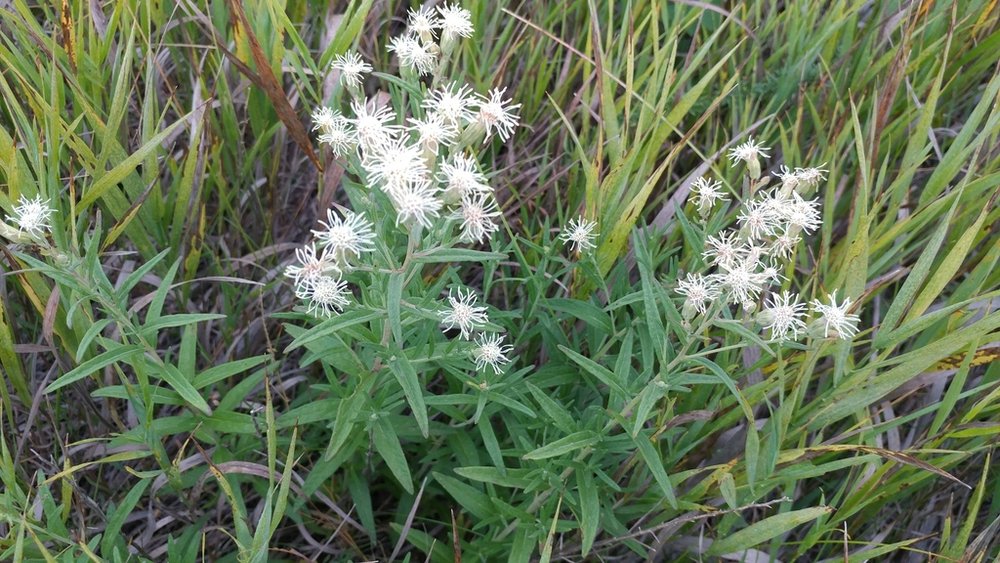
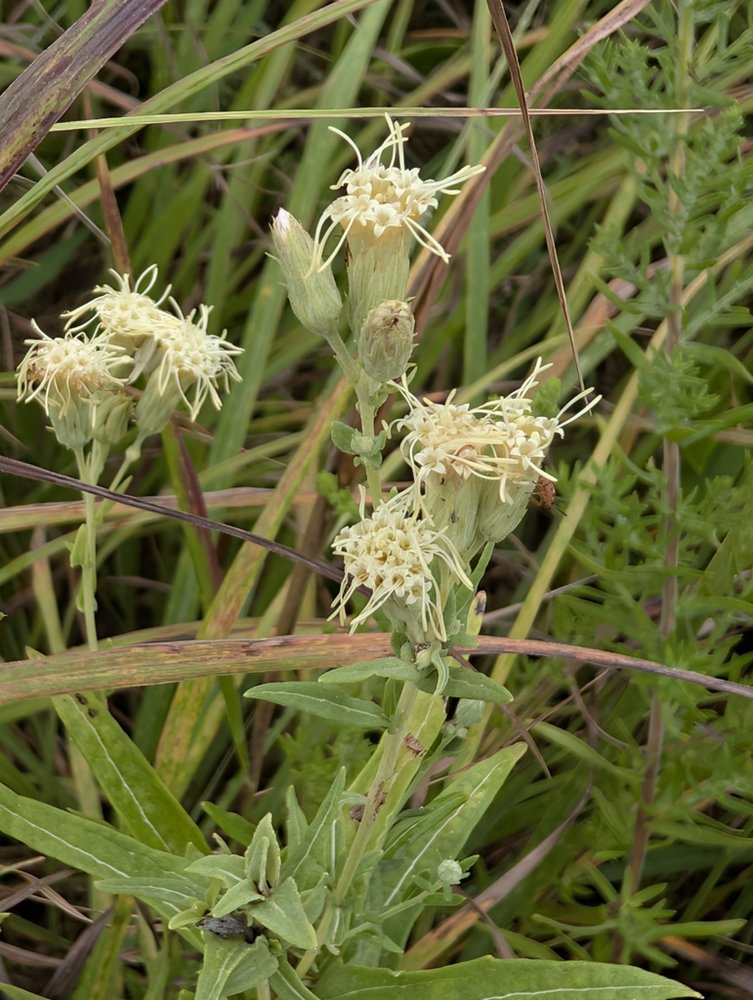
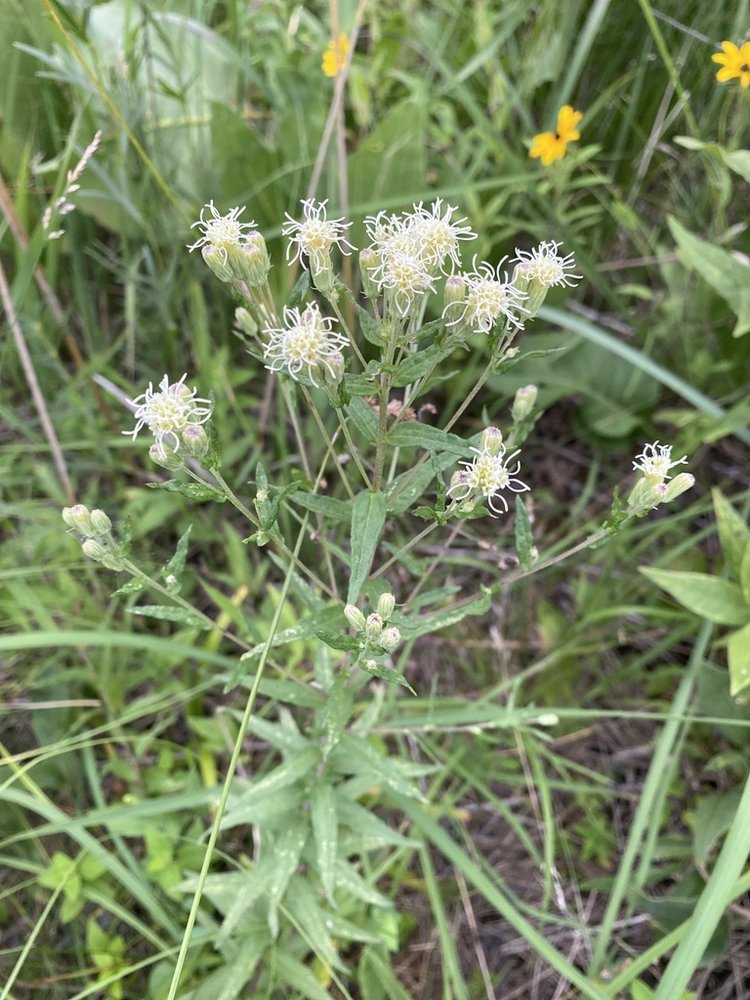
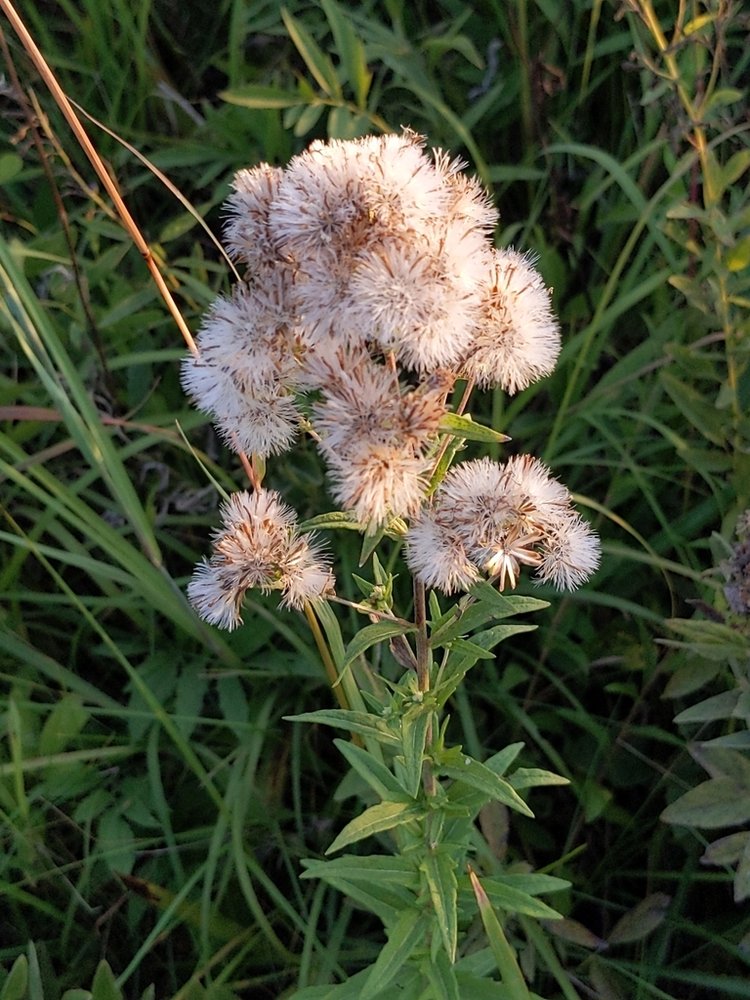
False Boneset (Brickellia eupatorioides) is a native perennial with loose clusters of rayless, creamy-white to pale-yellow flower heads, each with long, thread-like styles sticking out, blooming from August into September. It grows on dry prairie, slopes and open woods, and the plant lists of Wind Cave National Park, Jewel Cave National Monument and Devils Tower National Monument record it as present.
Free photos from other sources
| Family | Asteraceae · Aster |
|---|---|
| Status | Native perennial |
| Blooms | August into September |
| Height | 30–120 cm (12–48 in) |
| Where | Dry prairies, slopes, open woods and roadsides, in sun |
| Also called | waȟpé pȟá (Lakota) |
| Synonym | Kuhnia eupatorioides |
| Traditional use | Black Elk and Flying By 1998 (entry 56) say the Lakota use the whole plant in a poultice for swellings, and Moerman's ethnobotany database (BRIT) records, under the variety eupatorioides, that the Ramah Navajo took a decoction of the root for an old injury and cough (Vestal 1952). |
Roots, seeds & germination
Root: A very long taproot that can reach 5 m (16 ft) deep (Minnesota Wildflowers; Kansas Wildflowers); Missouri Plants says the roots are often thickened.
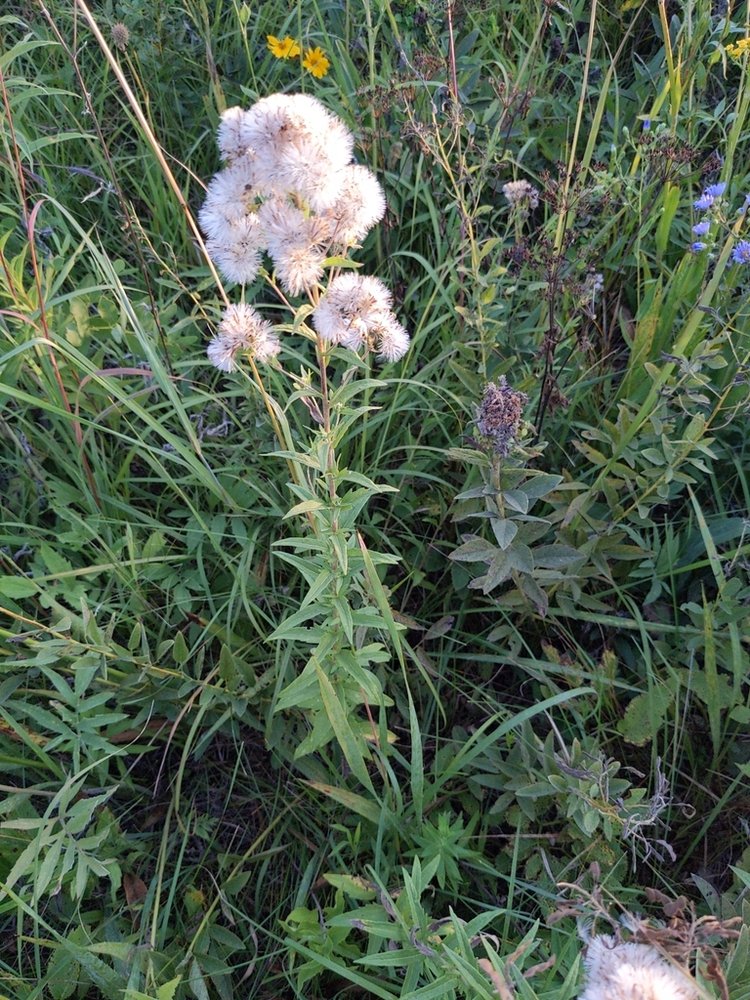
Seed: Each fruit is a ribbed, brown seed (achene) 3–5 mm (⅛–¼ in) long, tipped with 20 to 25 feathery bristles (Missouri Plants; Kansas Wildflowers), which carry it off in the wind (Minnesota Wildflowers).
How do you identify False Boneset?
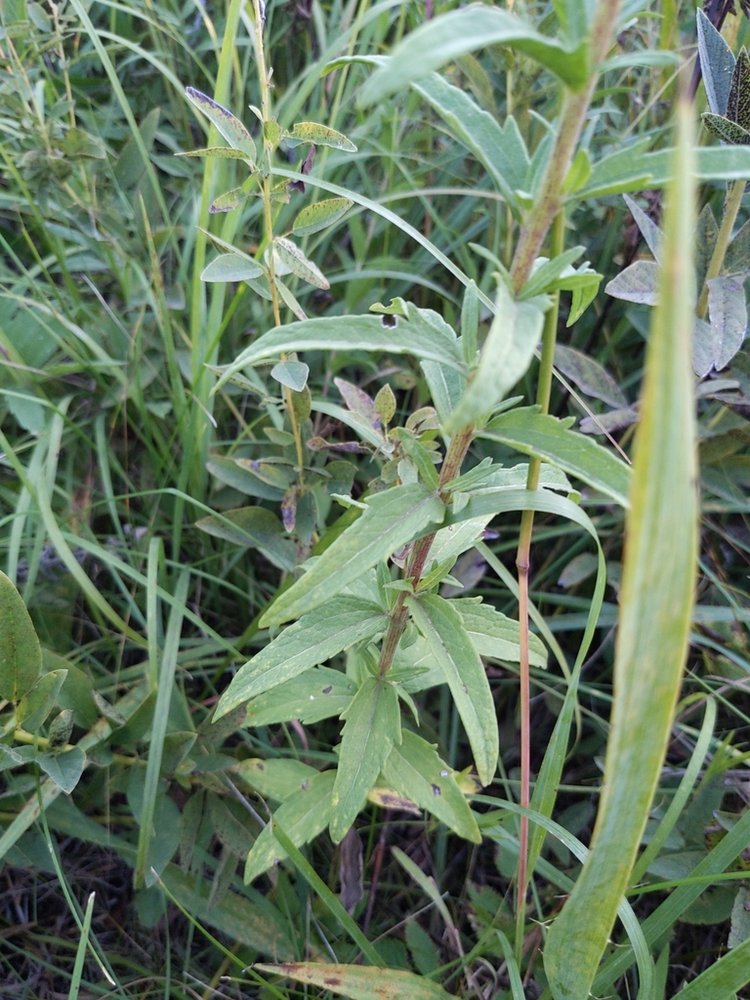
Look for a perennial 30–120 cm (1–4 ft) tall, with one or several stems from the base that are covered in short, fine hairs and woody at the bottom. The leaves are alternate, 2.5–10 cm (1–4 in) long and up to 2.5 cm (1 in) wide, narrow and pointed, toothless or with a few coarse teeth, and dotted with glands underneath. They can be so crowded that some look opposite. The flower heads have no ray flowers (petals). Each head has 15 to 30 tiny disk flowers with 5 lobes, a creamy-white to pale-yellow forked style sticking out of the center, and a cylinder of very narrow bracts about 12 mm (½ in) long around its base (Minnesota Wildflowers). The fruit is a dry, ribbed seed topped with about 20 feathery, off-white to tan bristles (Kansas Wildflowers), and a head in fruit looks like a fuzzy ball about 2 cm (¾ in) across. Minnesota Wildflowers says the flowers vaguely resemble those of Eupatorium plants, but their leaves tell them apart: Common Boneset (Eupatorium perfoliatum) has broader leaves in opposite pairs that join around the stem, and Tall Boneset (Eupatorium altissimum) has leaves toothed over the outer half and 3 distinct parallel veins. Kansas Wildflowers adds that False Boneset has alternate leaves where Tall Boneset has opposite ones, and Missouri Plants says Tall Boneset usually has wider leaves, denser flower clusters and white disk flowers.
When does it bloom?
August into September.
Where does it grow?
Prairies, open woods, railroads and bluffs, in sun and dry to average soil (Minnesota Wildflowers); Kansas Wildflowers adds dry slopes and waste ground, most abundant in sandy soil. The plant lists of Wind Cave National Park, Jewel Cave National Monument and Devils Tower National Monument record it as Brickellia eupatorioides var. corymbulosa (the 1986 survey of Jewel Cave's vegetation lists it as Kuhnia eupatorioides var. corymbulosa, with the common name false boneset), and Minnesota Wildflowers says that variety is the one in Minnesota and most of middle America. GBIF holds 21 preserved specimens from the Black Hills counties: Lawrence 8, Pennington 5, Custer 2, Fall River 1 and Butte 1 in South Dakota, and Crook 4 in Wyoming, though some come from the prairie and Badlands parts of those counties. The oldest, collected in 1910 in Crook County, was labeled “Black Hills,” limestone slopes, and other labels give hillsides, open range pasture, a roadside bank, dry open prairie and south-facing limestone cliffs among ponderosa pine. It isn't on South Dakota's state noxious weed list or its locally noxious (county) list, or on Wyoming's state designated weed list or weed-seed lists.
Aster family (Asteraceae): 62 other plants in this guide
- Aromatic Aster
- Arrowleaf Balsamroot
- Arrowleaf Sweet Coltsfoot
- Bachelor's Button
- Balsam Ragwort
- Black-eyed Susan
- Blanket Flower
- Blue Lettuce
- Broom Snakeweed
- Bull Thistle
- Canada Hawkweed
- Canada Lettuce
- Canada Thistle
- Chicory
- Common Burdock
- Common Dandelion
- Common Sunflower
- Common Tansy
- Common Yarrow
- Curlycup Gumweed
- Cutleaf Coneflower
- Dotted Gayfeather
- Drummond's Thistle
- Easter Daisy
- Fetid Marigold
- Field Pussytoes
- Fringed Sagewort
- Hairy Golden Aster
- Heart-leaved Arnica
- Hooker's Townsend Daisy
- Horseweed
- Jerusalem Artichoke
- Lambstongue Groundsel
- Maximilian Sunflower
- Missouri Goldenrod
- Mountain Dandelion
- Musk Thistle
- Oxeye Daisy
- Pearly Everlasting
- Pineapple Weed
- Prairie Coneflower
- Prairie False Dandelion
- Purple Coneflower
- Rocky Mountain Blazing Star
- Rosy Pussytoes
- Rubber Rabbitbrush
- Rush Skeletonplant
- Scotch Thistle
- Silver Sagebrush
- Smooth Blue Aster
- Spotted Joe-Pye Weed
- Stemless Four-nerve Daisy
- Stiff Goldenrod
- Stiff Sunflower
- Threenerve Fleabane
- Wavyleaf Thistle
- Western Ragweed
- White Hawkweed
- White Prairie Aster
- White Sagebrush
- Woolly Groundsel
- Yellow Salsify
Sources: Minnesota Wildflowers: Brickellia eupatorioides (False Boneset); Kansas Wildflowers and Grasses: False boneset (Brickellia eupatorioides); Missouri Plants: Brickellia eupatorioides (False Boneset); Lady Bird Johnson Wildflower Center: Brickellia eupatorioides (False Boneset); USDA PLANTS Database: Brickellia eupatorioides (BREU), native in the lower 48 states; Native American Ethnobotany Database (BRIT): Brickellia eupatorioides; Culturally Important Plants of the Lakota (Black Elk and Flying By, Sitting Bull College, 1998), entry 56; NPSpecies checklist, Wind Cave National Park (vascular plants); NPSpecies checklist, Jewel Cave National Monument (vascular plants); NPSpecies checklist, Devils Tower National Monument (vascular plants); A Survey of the Vegetation of Jewel Cave National Monument (Marriott and Hartman, University of Wyoming, 1986); GBIF occurrence search: Brickellia eupatorioides, preserved specimens, South Dakota (35) and Wyoming (11); South Dakota DANR: State Noxious Weed and Pest List; South Dakota DANR: Locally Noxious Weed and Pest List (county designations, PDF); Wyoming Weed and Pest Council: Identify Weeds (state designated weeds); Wyoming rule 010-63 Wyo. Code R. 63-3: Prohibited Noxious Weeds (weed-seed list); Wyoming rule 010-63 Wyo. Code R. 63-4: Restricted Noxious Weeds (weed-seed list).