Big Bluestem Andropogon gerardii also listed as Andropogon gerardi
Also called Turkeyfoot, Turkey-foot, Tall bluestem, Bluejoint beardgrass, pȟeží šašá ókhihe tȟaŋkíŋkiŋyaŋ (Lakota)
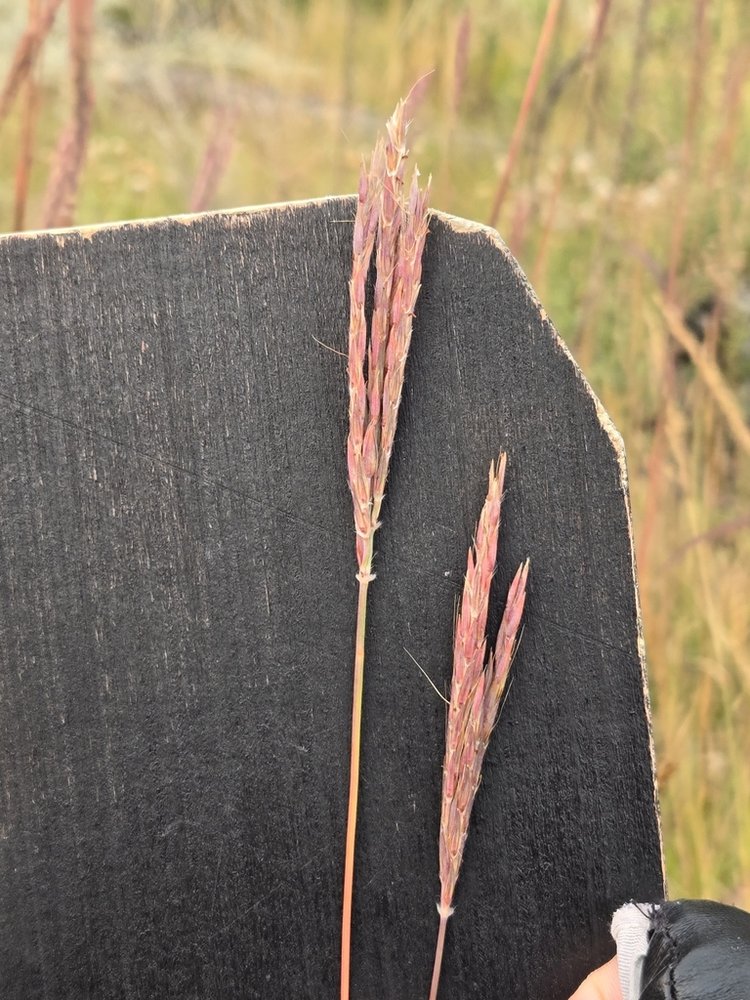
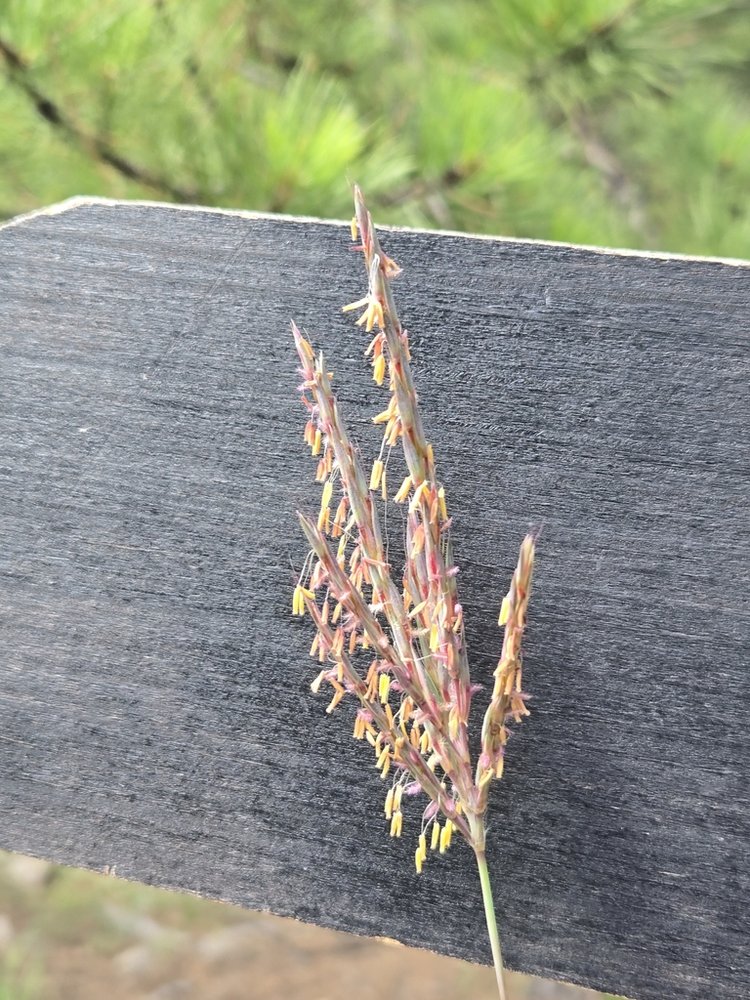
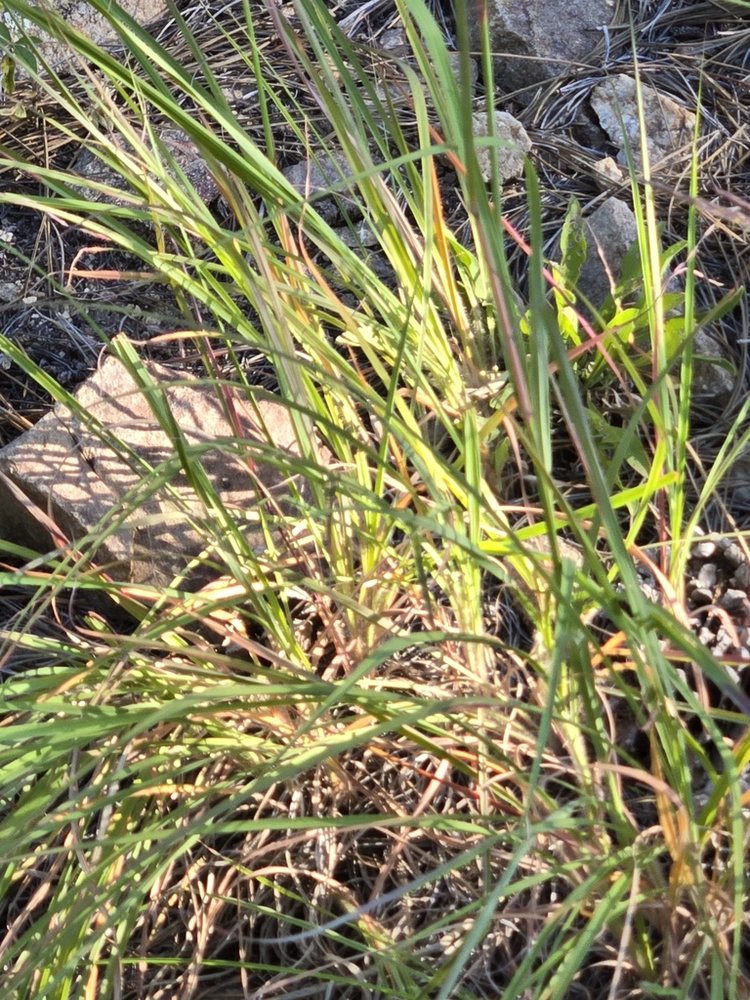
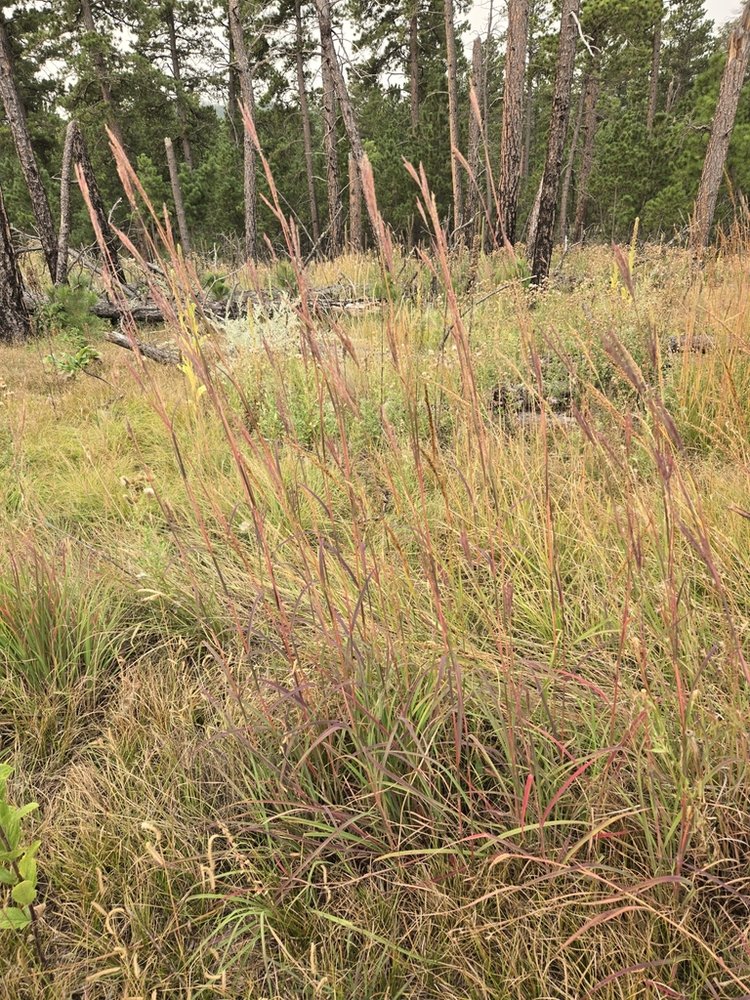
Big Bluestem (Andropogon gerardii) is a tall native perennial grass, 1–2 m (3–7 ft), whose purplish seed head usually splits into three fingers like a turkey's foot. It flowers July into September, its stems are bluish at the base under a waxy coating, and the plant turns rusty red in fall. In the Black Hills it grows in meadows, draws and grassy openings, and the National Park Service lists it at Wind Cave, Jewel Cave, Mount Rushmore and Devils Tower.
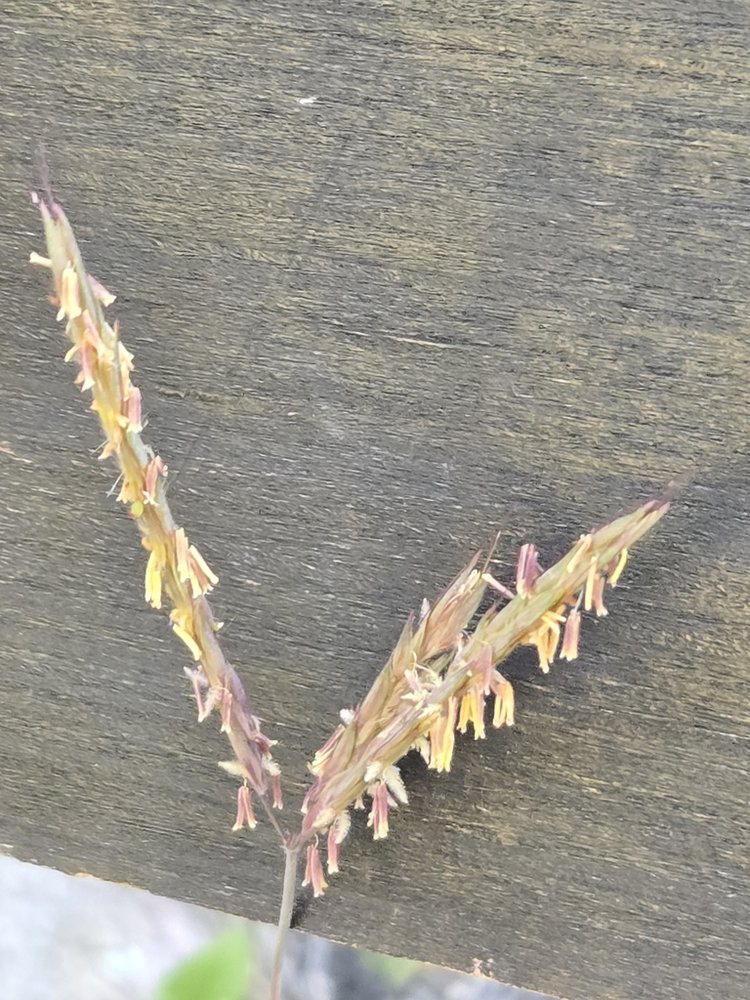
Free photos from other sources
| Family | Poaceae · Grass |
|---|---|
| Status | Native perennial grass |
| Blooms | July into September; the dead stalks stand through winter |
| Height | 1–2 m (3–7 ft) |
| Where | Grassland, meadows, draws, floodplains and openings in pine and oak woods; also sandy slopes and roadsides |
| Also called | Turkeyfoot, Turkey-foot, Tall bluestem, Bluejoint beardgrass, pȟeží šašá ókhihe tȟaŋkíŋkiŋyaŋ (Lakota) |
| Synonym | Andropogon furcatus, Andropogon provincialis |
| Traditional use | Black Elk and Flying By (1998) record that Lakota boys used the stems as arrows in mock war games, and call the grass excellent forage for bison. Johnson and Larson add that the Omaha and Ponca used its stems to support earthen roofs. The BRIT ethnobotany database, citing Gilmore (1919), records that the Omaha used a decoction of the blades as a wash for fevers, and it lists a Chippewa root decoction taken for stomach pain (Densmore 1928). |
Traditional use: first drafted by Google AI, then checked against the sources on this page.
Roots, seeds & germination
Root: Coarse rhizomes (underground stems) 3–6 mm thick run 2.5–5 cm (1–2 in) below the surface, sometimes to 10 cm (4 in), and send up new shoots, so the plant forms sod on good ground and looks like a bunchgrass on dry ground. The main roots reach 2–3 m (6–10 ft) deep, with most of the root mass in the top 18–50 cm (7–20 in) of soil.
Seed: The seed is golden brown, narrowly elliptical and nearly as long as its spikelet, which drops whole with its hairs and awn. The USDA plant guide says to gather seed when the heads no longer have a creamy center, usually in September and October; for the South Dakota cultivar Bonilla, the first seed ripened on September 11 and half of it by September 29. Seed is only a small part of how the plant spreads, since it regenerates mainly from its rhizomes, and the Fire Effects Information System reports almost no viable seed stored in the soil of an undisturbed prairie stand.
Germination: The USDA plant guide says seed sown outdoors from late winter to early spring comes up in about 4 weeks with watering, that a cold treatment (stratification) at 4 °C (40 °F) can make sprouting more even, and that first-season growth is slow, with the rhizomes speeding growth in later years. In the greenhouse the guide raises it at alternating day and night temperatures of about 24 and 18 °C (75 and 65 °F).
How do you identify Big Bluestem?
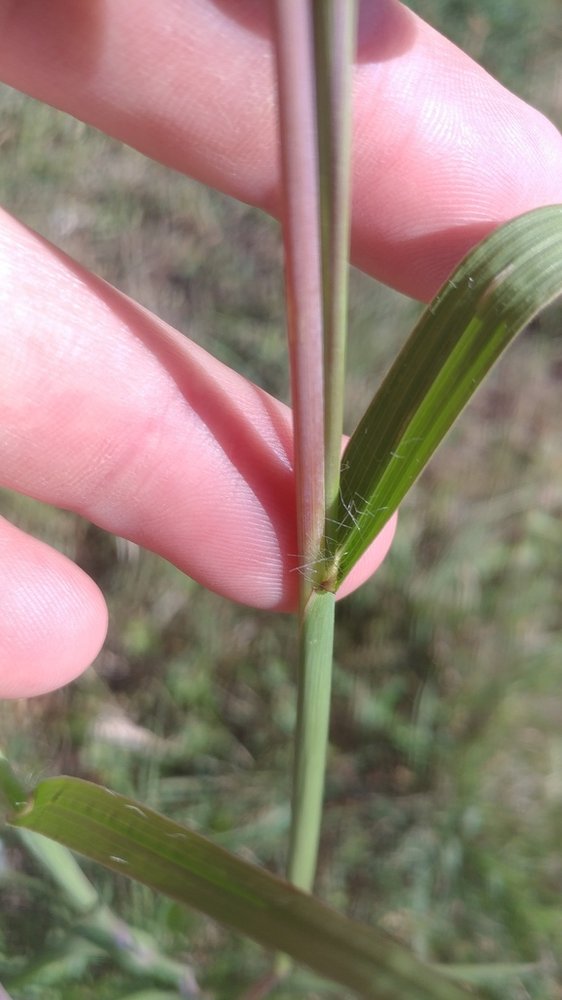
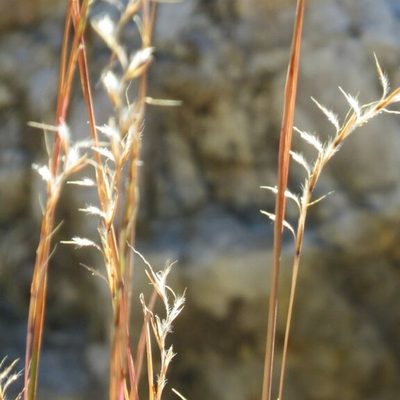
The seed head settles it: at the top of a tall, stout stalk, 2 to 6 (usually 3) finger-like spikes 5–10 cm (2–4 in) long spread from one point like a turkey's foot, purplish to yellowish brown. Each spike carries spikelets in pairs, one stalkless and fertile with a twisted, bent awn 1–2 cm (½–¾ in) long, the other on a short hairy stalk. Below the seed head the stem is round, solid and hairless, often bluish to purple under a waxy coating, with purplish joints. The leaves are flat, 6–13 mm (1/4–1/2 in) wide and up to 60 cm (2 ft) long, rough on top and usually with long white hairs near the base of the blade where it meets the sheath; the sheaths are slightly flattened and usually hairy, and the ligule (the flap at the base of the blade) is a short fringed membrane 1–2.5 mm long. Clumps grow from short, scaly rhizomes (underground stems), and the dead stalks stay standing through winter. Little Bluestem is the lookalike on this site: it is shorter, each of its stems ends in a single fuzzy spike, and Johnson and Larson and SDSU Extension both point out that its lower stems and sheaths are flatter and hairless. Sand Bluestem, a close relative of sandy ground, has dense yellow hairs on its seed heads and straw-colored stems.
When does it bloom?
July into September; the dead stalks stand through winter.
Where does it grow?
Grassland, meadows and openings in pine and oak woods, often where the soil holds more water. SDSU Extension and Johnson and Larson say that in western South Dakota it grows in small protected areas with enough soil moisture, and the Fire Effects Information System reports Black Hills burn studies in which its basal cover held after an October fire and rose slightly after spring fires. The 1986 Jewel Cave vegetation survey lists it, and the National Park Service lists it at Wind Cave National Park, Jewel Cave National Monument, Mount Rushmore National Memorial and Devils Tower National Monument. Herbarium specimens from 1892 to 2017 come from Lawrence, Custer, Pennington, Fall River and Meade counties in South Dakota and Crook and Weston counties in Wyoming, including Wind Cave, Devils Tower and Bear Butte State Park, at about 910–1,690 m (3,000–5,550 ft). Their labels describe meadows, floodplains and marsh edges, a prairie draw, openings in ponderosa pine and pine and bur oak woods, open and sandy slopes, and roadsides.
Other grasses in this guide
Compare all 11 grasses side by side
Blue Grama
Bouteloua gracilis
Buffalo Grass
Bouteloua dactyloides
Cheatgrass
Bromus tectorum
Foxtail Barley
Hordeum jubatum
Idaho Fescue
Festuca idahoensis
Little Bluestem
Schizachyrium scoparium
Needle-and-thread
Hesperostipa comata
Prairie Junegrass
Koeleria macrantha
Smooth Brome
Bromus inermis
Timothy
Phleum pratense
Sources: USDA PLANTS Database: Andropogon gerardii (ANGE), plant profile service; USDA NRCS Plant Guide: Big bluestem, Andropogon gerardii (Wennerberg 2004); USDA Forest Service Fire Effects Information System: Andropogon gerardii (Uchytil 1988); SDSU Extension P-00232: Warm-Season Grasses of South Dakota (Ehlert and Bachler 2022); Johnson and Larson 1999, Grassland Plants of South Dakota and the Northern Great Plains (SDSU bulletin 566), Open PRAIRIE; Kansas Wildflowers and Grasses: Andropogon gerardii (Big bluestem); Minnesota Wildflowers: Andropogon gerardii (Big Bluestem); Montana Field Guide: Big Bluestem, Andropogon gerardii; Marriott and Hartman 1986, A Survey of the Vegetation of Jewel Cave National Monument; NPSpecies checklist, Wind Cave National Park vascular plants; NPSpecies checklist, Jewel Cave National Monument vascular plants; NPSpecies checklist, Mount Rushmore National Memorial vascular plants; NPSpecies checklist, Devils Tower National Monument vascular plants; GBIF occurrence search: Andropogon gerardi, South Dakota and Wyoming herbarium specimens; Black Elk and Flying By 1998, Culturally Important Plants of the Lakota (entry 17), filed with the South Dakota PUC; BRIT Native American Ethnobotany Database: Andropogon gerardii; Gilmore 1919, Uses of Plants by the Indians of the Missouri River Region.