Needle-and-thread Hesperostipa comata
Also called Needleandthread, Needle and thread grass, Speargrass
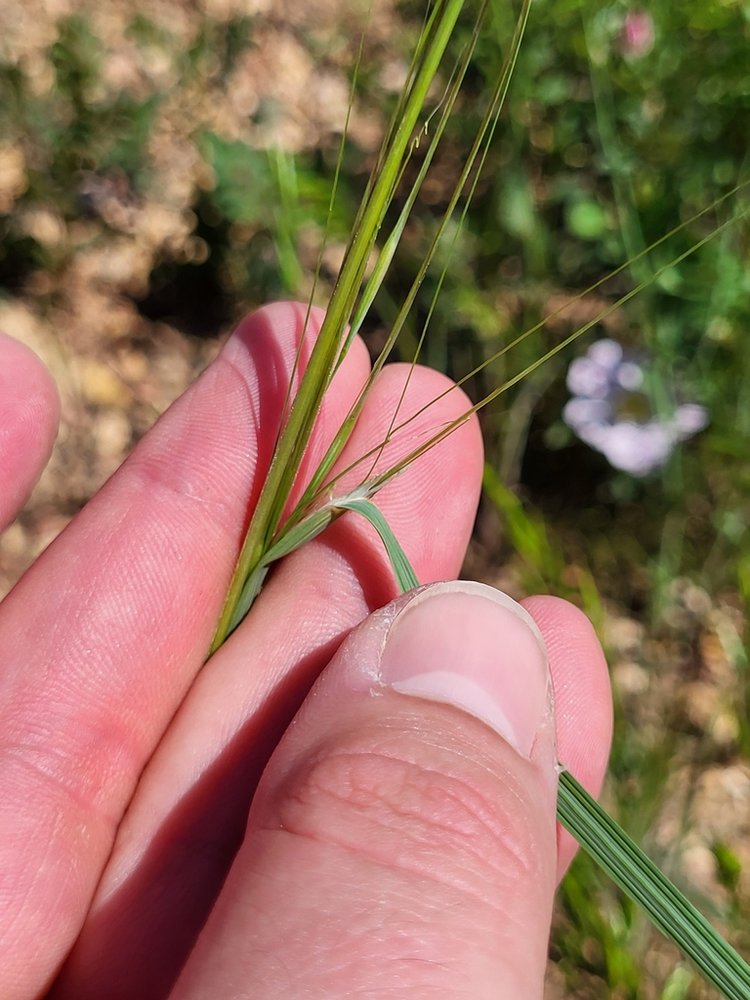
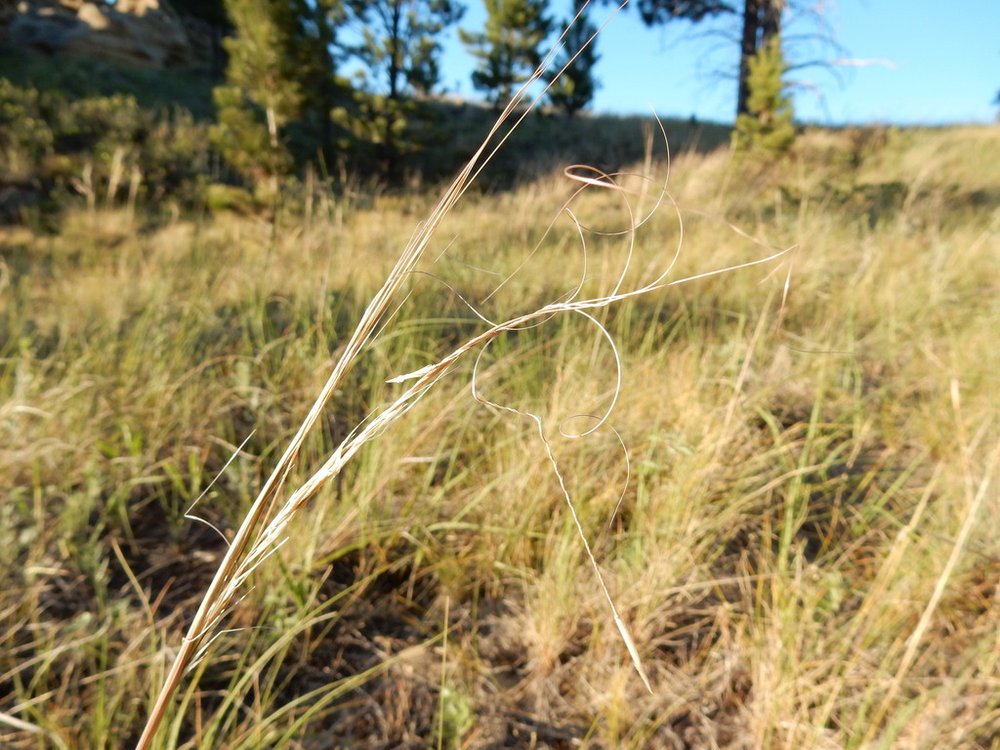
Needle-and-thread (Hesperostipa comata) is a native cool-season bunchgrass, 30–100 cm (12–40 in) tall, named for its seed: a sharp-pointed needle with a twisted, thread-like awn 10–20 cm (4–8 in) long that catches in cloth and wool. It flowers in June and sheds its seed in July. In the Black Hills it grows on dry prairie, foothill grassland and open pine ground, and the National Park Service lists it at Wind Cave, Jewel Cave, Mount Rushmore and Devils Tower.
Free photos from other sources
| Family | Poaceae · Grass |
|---|---|
| Status | Native perennial grass |
| Blooms | Flowers in June; the long twisted awns show in June and July, and the seeds drop in July |
| Height | 30–100 cm (12–40 in) |
| Where | Dry prairie, foothill grassland and open ponderosa pine on sandy, gravelly and silty ground |
| Also called | Needleandthread, Needle and thread grass, Speargrass |
| Synonym | Stipa comata |
| Traditional use | Kansas Wildflowers reports that the Blackfoot judged the best time to hunt bison by the look of this grass. |
| Note | The sharp seeds catch in cotton cloth and in sheep's wool, and the USDA plant guide and SDSU Extension say they can injure the eyes, mouths and skin of grazing animals. SDSU suggests moving livestock off for 2 to 3 weeks until the seeds fall. |
Roots, seeds & germination
Root: Shallow to medium-deep and fibrous, with many fine roots about 1 mm thick or less. They spread more than 36 cm (14 in) sideways in the top 15 cm (6 in) of soil and reach 0.9–1.5 m (3–5 ft) down, but more than half of the root mass is in the top 20 cm (8 in). The plant also spreads by tillers (new shoots at the base).
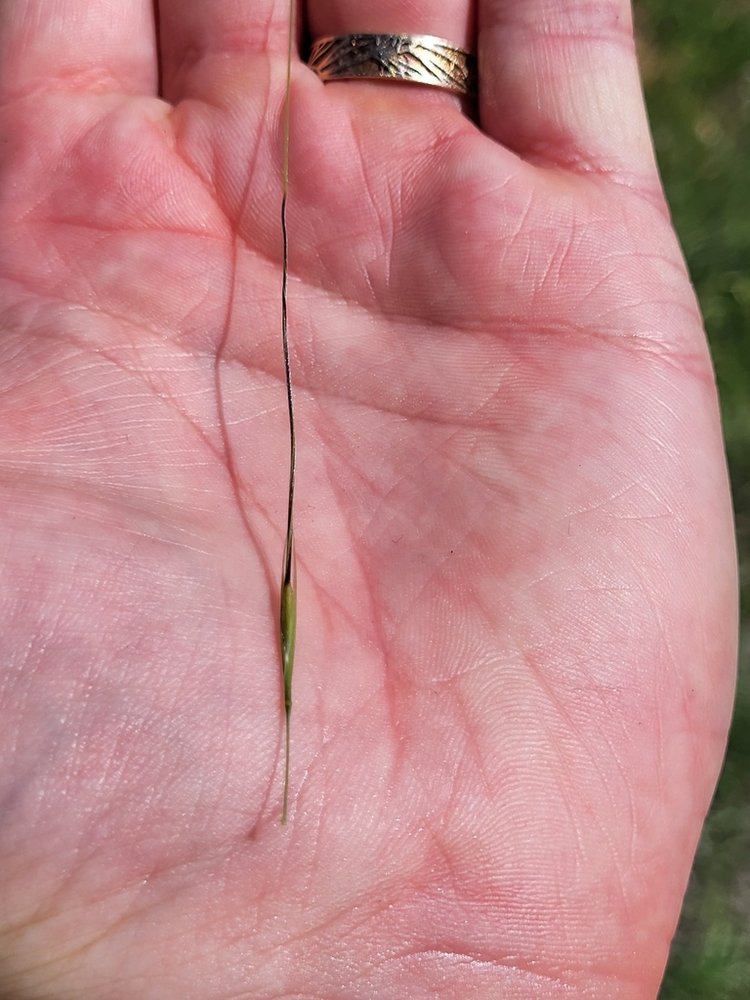
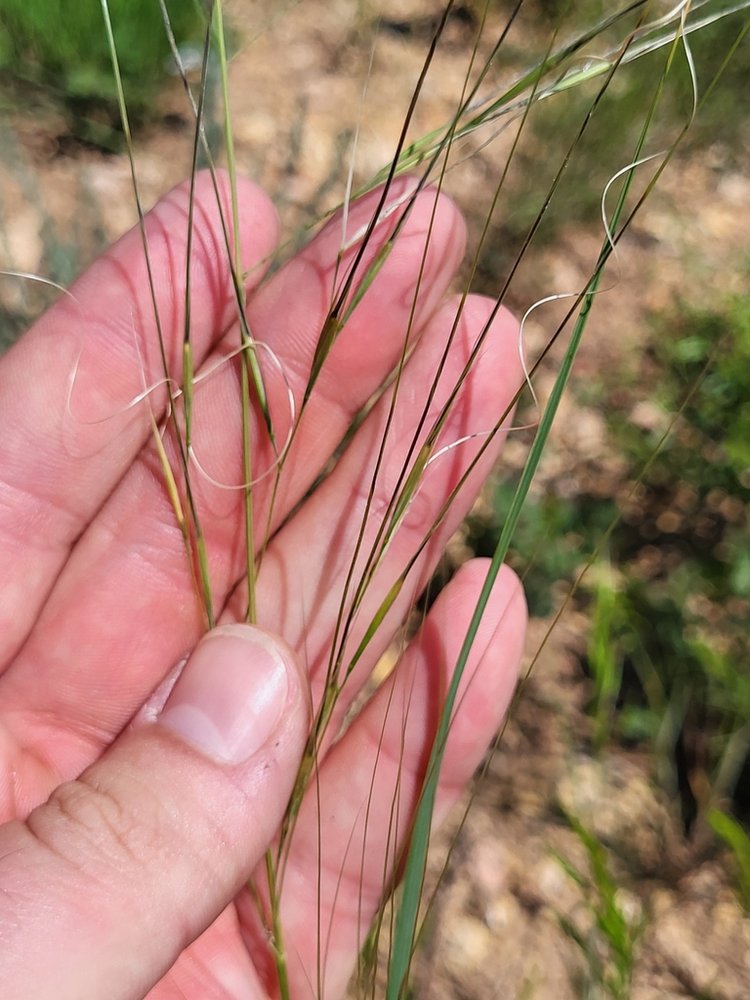
Seed: One seed per spikelet, narrow and sharp-pointed with a tuft of stiff hairs at the base and an awn 10–20 cm (4–8 in) long, twisted at the base. The awn twists and untwists as the air dries and dampens, which can work the seed into the soil. Seed is shed in July, runs about 115,000 per pound (about 250,000 per kilogram), and lives a long time: 63 percent still sprouted after 9 years in open storage in Utah.
Germination: The USDA plant guide says the seed carries fairly heavy dormancy. Seed less than two years old should be sown in late fall so winter breaks the dormancy, and older seed can be sown in early spring. It goes about 2 cm (3/4 in) deep on loam, 1.3 cm (1/2 in) on clay and up to 2.5 cm (1 in) on sand. A short cold treatment backfires: 30 to 60 days of prechilling cut germination to 37 and 68 percent, while seed with no prechill or 120 days of it sprouted readily. Seedlings are slow to establish, and the Fire Effects Information System says most seeds sprout in fall.
How do you identify Needle-and-thread?
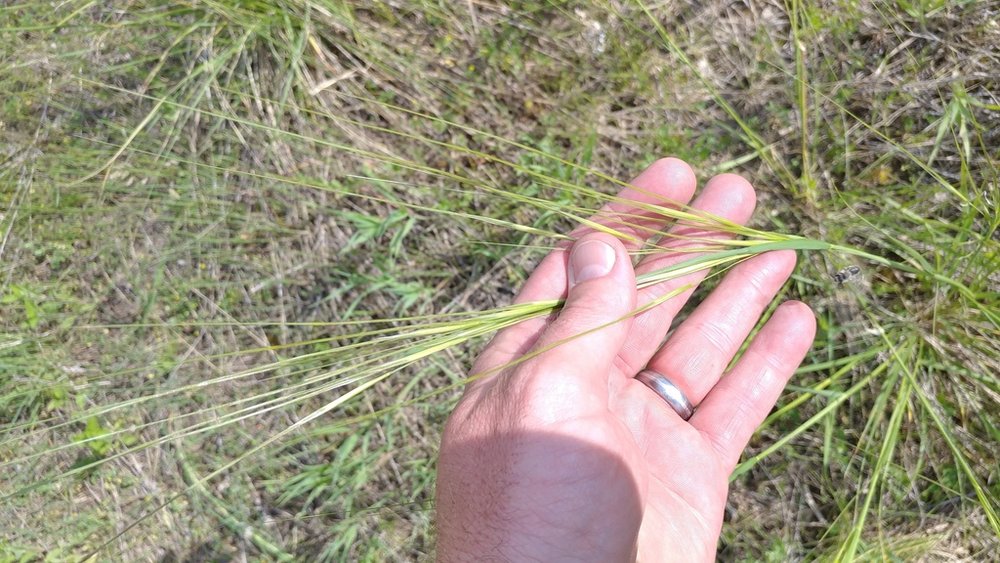
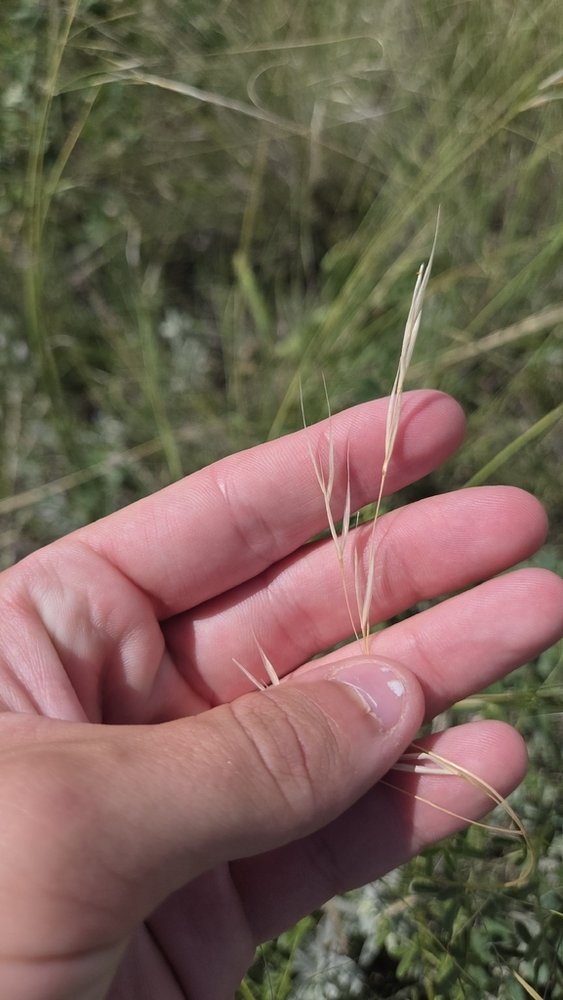
Look at the seed head in June: a narrow, loose cluster whose lower part stays wrapped in the top leaf sheath, with each spikelet holding one seed tipped by an awn (a long bristle) 10–20 cm (4–8 in) long that is tightly twisted near its base and loosely coiled or kinked toward the end, so it looks like a needle trailing a thread. The seed itself is narrow, about 8 mm (5/16 in) long, with a sharp, hairy point at the base; when it falls, the awn twists and untwists with changes in humidity and screws the seed into the ground, and the awns curl as they dry. The leaves are dull green, 20–30 cm (8–12 in) long and narrow, flat or rolled, rough on the upper side, with the tips often dying back, and the plant grows as a dense tuft. Without a seed head, look at the ligule, the pale membrane at the base of the leaf blade, which the USDA plant guide calls an identifying mark: it is tall, 3–6 mm, and split or frayed unevenly, which SDSU Extension describes as the slot you would thread a needle through. Porcupine Grass is the close relative that Johnson and Larson and SDSU Extension compare with it. Porcupine Grass can be taller, its seed heads stand fully out of the sheath and lean under the weight of the heavy spikelets, and its glumes (the papery scales of the spikelet) are 3–4 cm (1¼–1⅝ in) long, against 1.3–2.2 cm (½–⅞ in) on Needle-and-thread. Its seeds taper gradually into longer awns, where Needle-and-thread's have a shoulder at the base of the awn, and its ligule is cut evenly rather than split.
When does it bloom?
Flowers in June; the long twisted awns show in June and July, and the seeds drop in July.
Where does it grow?
Dry prairie, foothill grassland and open ponderosa pine on sandy, gravelly and silty ground. SDSU Extension calls it common on sandy and silty sites in central and western South Dakota, and the Fire Effects Information System reports burn studies on it at Wind Cave National Park, where it grows in ponderosa pine and mixed-grass prairie with green needlegrass, and in the southern Black Hills. The 1986 Jewel Cave vegetation survey lists it, and the National Park Service lists it at Wind Cave National Park, Jewel Cave National Monument, Mount Rushmore National Memorial and Devils Tower National Monument. Herbarium specimens from 1892 to 2018 come from Pennington, Fall River, Lawrence, Custer and Meade counties in South Dakota and Crook and Weston counties in Wyoming, some of them from the plains beyond the Hills. Labels from the Hills include Wind Cave and Devils Tower and describe open meadows and grassy openings in ponderosa pine, rocky south-facing slopes, limestone rims and grassland, up to about 1,710 m (5,600 ft).
Other grasses in this guide
Sources: USDA PLANTS Database: Hesperostipa comata (HECO26), plant profile service; USDA NRCS Plant Guide: Needle-and-thread, Hesperostipa comata (Idaho State Office); USDA Forest Service Fire Effects Information System: Hesperostipa comata (Zlatnik 1999); SDSU Extension P-00231: Cool-Season Grasses of South Dakota (Ehlert and Bachler 2022); Johnson and Larson 1999, Grassland Plants of South Dakota and the Northern Great Plains (SDSU bulletin 566), Open PRAIRIE; Kansas Wildflowers and Grasses: Hesperostipa comata (Needle-and-thread); Montana Field Guide: Needle-and-Thread, Stipa comata; Marriott and Hartman 1986, A Survey of the Vegetation of Jewel Cave National Monument; NPSpecies checklist, Wind Cave National Park vascular plants; NPSpecies checklist, Jewel Cave National Monument vascular plants; NPSpecies checklist, Mount Rushmore National Memorial vascular plants; NPSpecies checklist, Devils Tower National Monument vascular plants; GBIF occurrence search: Hesperostipa comata, South Dakota and Wyoming herbarium specimens.