Lesser Roundleaved Orchid Platanthera orbiculata also listed as Habenaria orbiculata
Also called Round-leaved Orchid, Roundleaf Orchid, Large Round-leaved Orchid
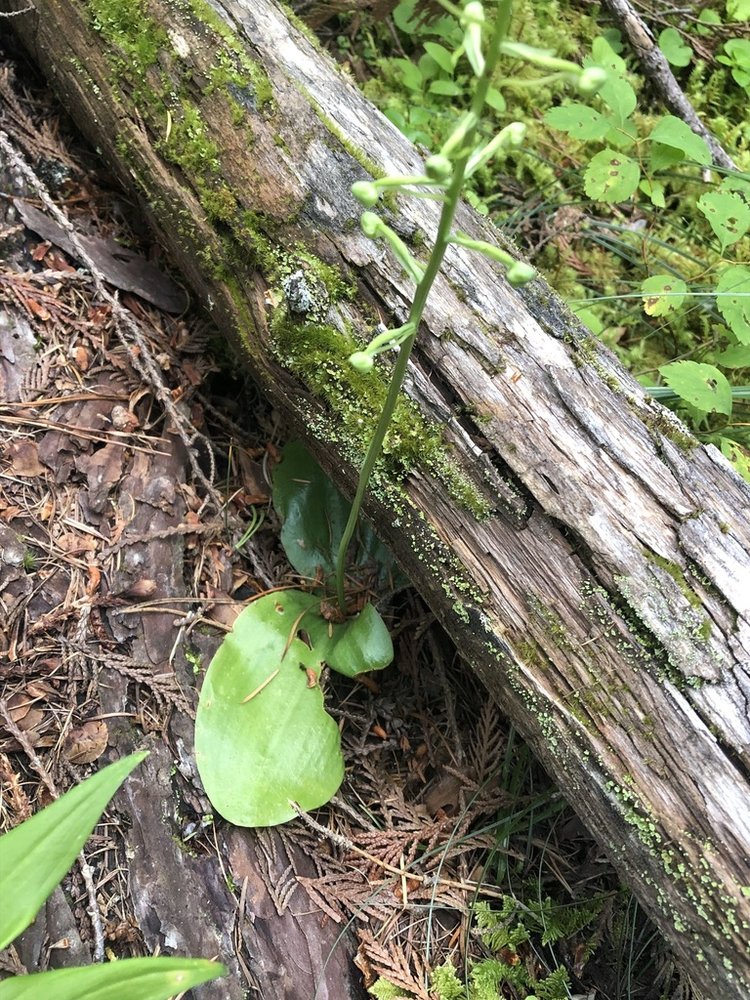
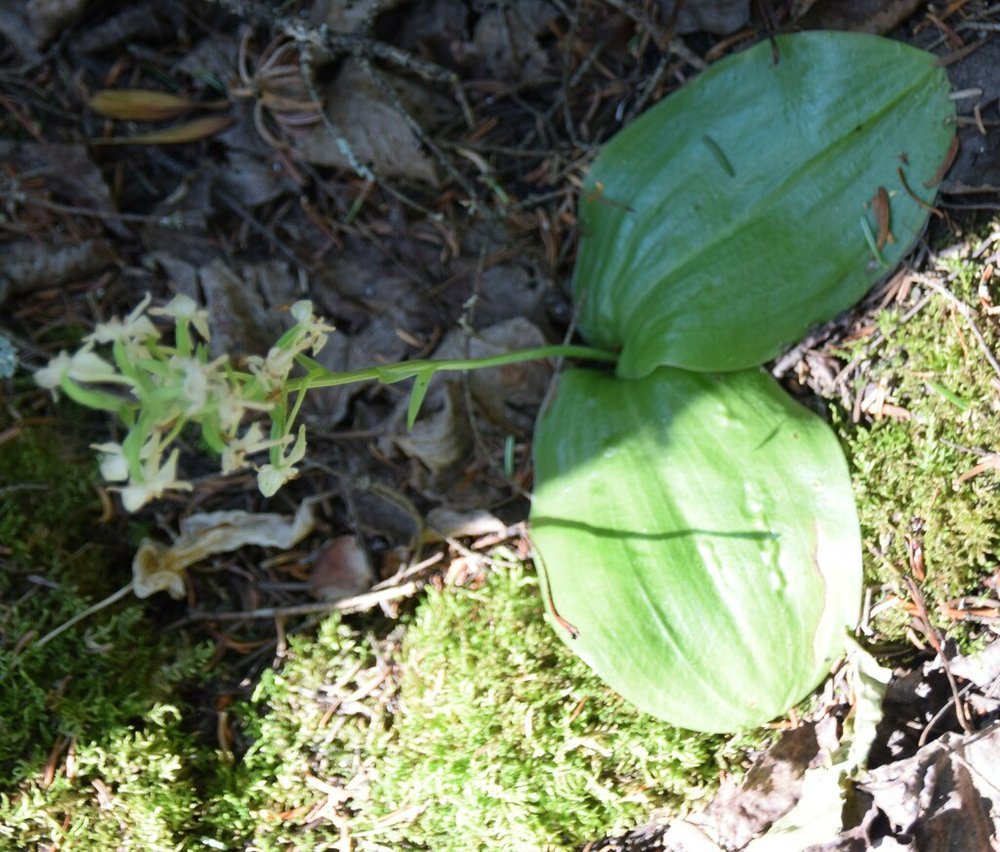
Lesser Roundleaved Orchid (Platanthera orbiculata) is a native orchid with two large, round, glossy leaves lying flat on the forest floor and one tall stalk of greenish-white flowers, each with a long narrow lip and a slender spur. It blooms in July and August in moist, shady conifer forest in the Black Hills, where it is rare.
Free photos from other sources
| Family | Orchidaceae · Orchid |
|---|---|
| Status | Native perennial |
| Blooms | July and August |
| Height | 17–62 cm (7–24 in) |
| Where | Moist, shady conifer forest and mixed spruce and birch woods |
| Also called | Round-leaved Orchid, Roundleaf Orchid, Large Round-leaved Orchid |
| Synonym | Habenaria orbiculata, Orchis orbiculata, Lysias orbiculata, Platanthera orbiculata var. lehorsii |
| Note | The U.S. Forest Service listed it as a sensitive plant for the Black Hills in 2005, and South Dakota's rare plant list ranks it S3, vulnerable. This page gives no locations. |
Roots, seeds & germination
Root: Slender roots and a swollen storage organ underground; the plant is green and makes its own food, and its rhizomes are not coral-like.
Seed: A cylindrical capsule 1–2.5 cm (½–1 in) long that points up or outward.
How do you identify Lesser Roundleaved Orchid?
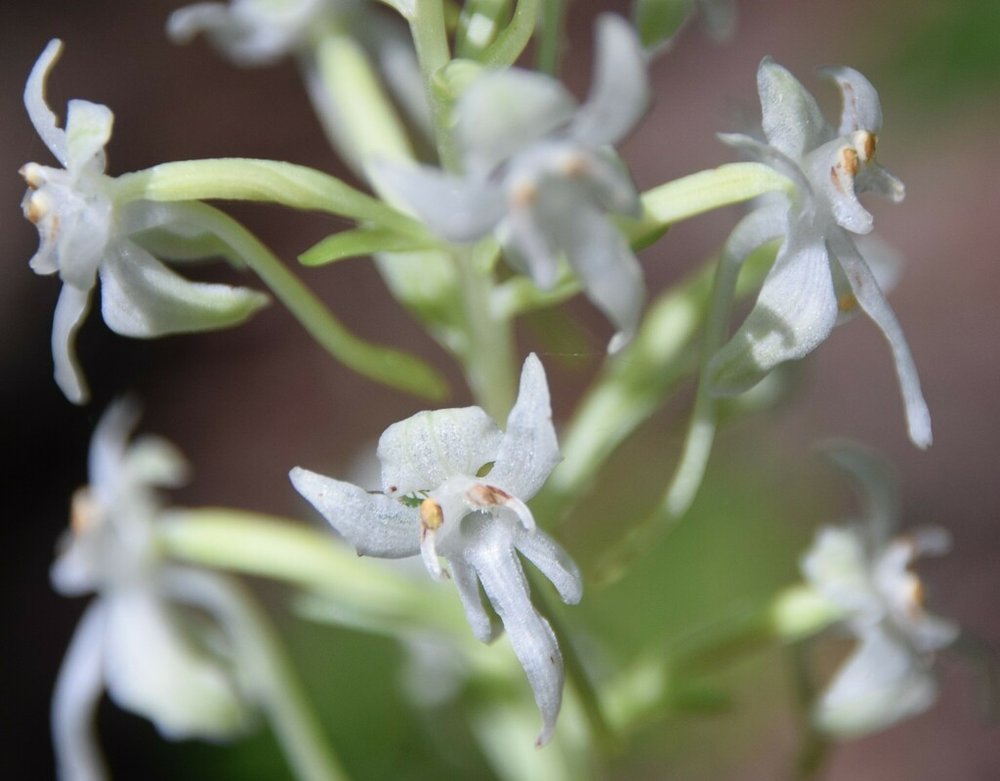
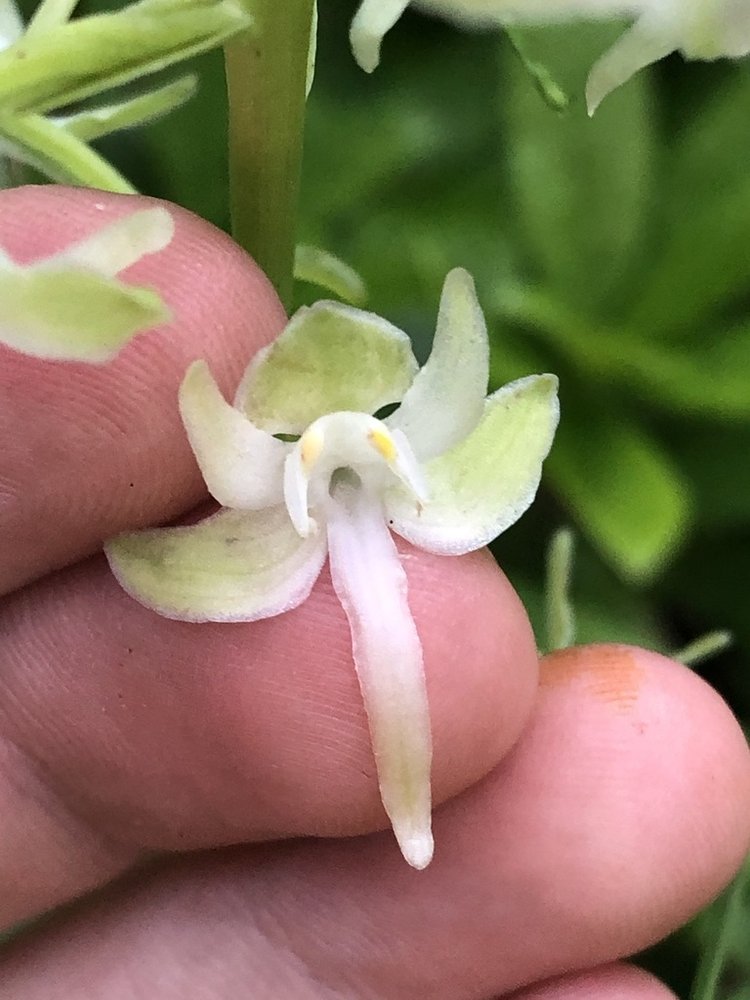
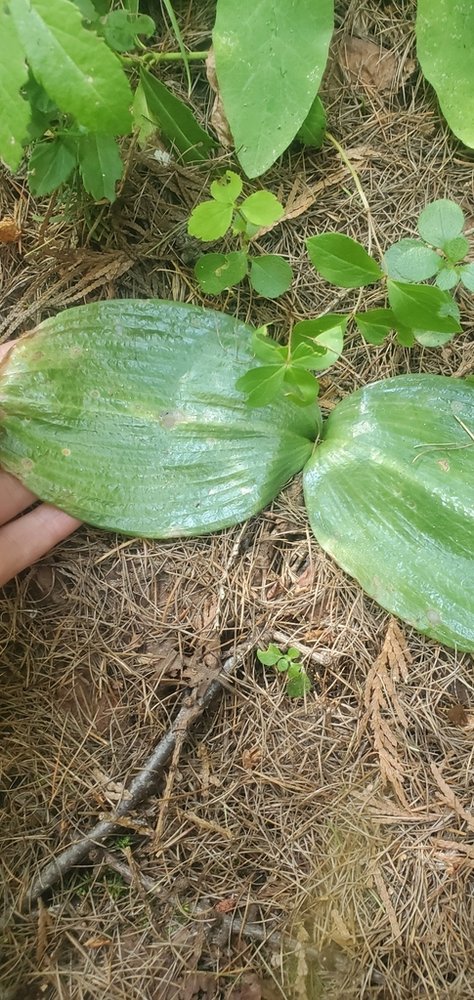
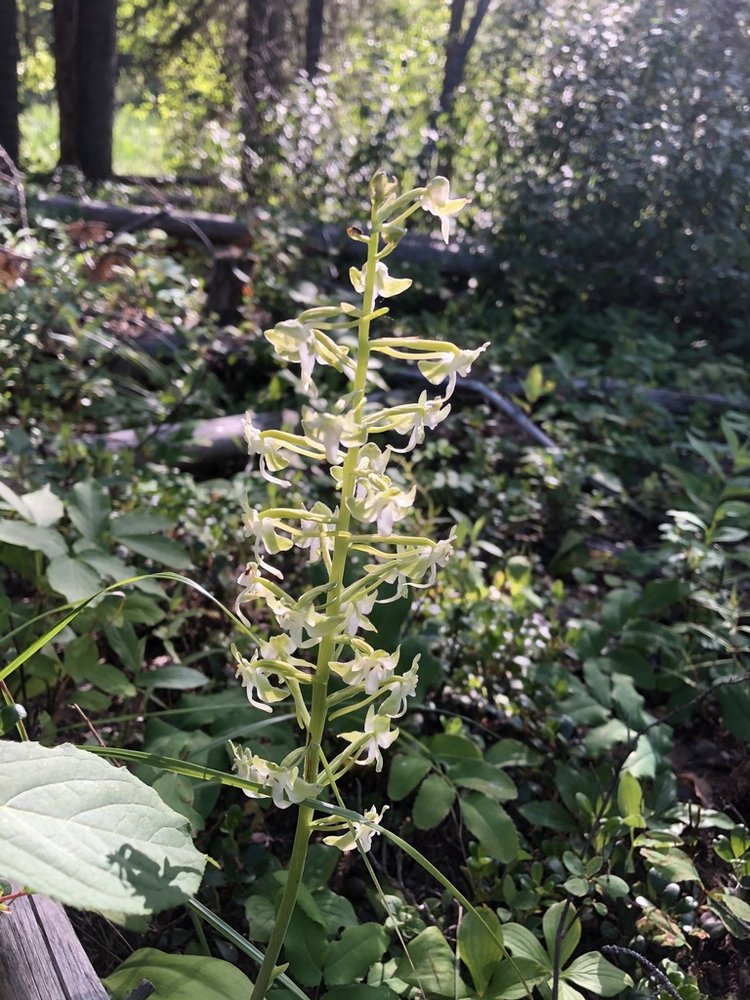
Two broad leaves, 5–21 cm (2–8 in) long and nearly as wide, lie flat on the ground opposite each other, glossy and dark green with fine parallel veins. The flower stalk, 17–62 cm (7–24 in) tall, carries no true leaves, only 1 to 6 small bract-like leaves scattered along it. The open spike holds up to about 30 greenish-white flowers: a squarish upper sepal forms a hood over the two creamy pollen sacs, two side petals spread up and out, two larger side sepals spread sideways, and a long narrow lip 7–17 mm (¼–⅔ in) hangs straight down, with a slender spur 14–27 mm (½–1 in) long behind the flower that is thickest toward its tip. Spotted Coralroot, another forest orchid in this guide, has no green leaves at all, only overlapping sheaths on a pale to brownish-yellow stem, and its flowers have a white lip spotted with purple.
When does it bloom?
July and August.
Where does it grow?
Moist, shady conifer forest and mixed spruce and birch woods, where it grows on the forest floor in partial shade. South Dakota's rare plant list places it in forested habitats of the Black Hills, and the Forest Service names it among the plants at risk where tree harvest opens the white spruce canopy.
Other orchids in this guide
Sources: Phase II Amendment Final Environmental Impact Statement, Chapter 3-3.2 Flora: Region 2 sensitive plants (Lesser roundleaved orchid) (2005) — USDA Forest Service; Revised Forest Assessment: At-Risk Species, draft October 2023 (lesser roundleaved orchid: white spruce risk table; not a species of conservation concern) — USDA Forest Service; Rare Plants of South Dakota (Platanthera orbiculata, Round-leaved Orchid, G5 S3) — South Dakota Natural Heritage Program, SD Game, Fish and Parks (2018); Flora of North America Vol. 26: Platanthera orbiculata (C. J. Sheviak) — eFloras; USDA PLANTS Database: Platanthera orbiculata (Pursh) Lindl., lesser roundleaved orchid (PLOR4); ITIS: Platanthera orbiculata (Pursh) Lindl., TSN 43435 (synonyms); Go Orchids, North American Orchid Conservation Center: Platanthera orbiculata (Round Leaved Orchid); Minnesota Wildflowers: Platanthera orbiculata (Large Round-leaved Orchid); Minnesota Wildflowers: Corallorhiza maculata var. maculata (Spotted Coralroot); Montana Field Guide: Roundleaf Orchid, Platanthera orbiculata — Montana Natural Heritage Program.