Leafy Spurge
Euphorbia virgata
Leafy Spurge (Euphorbia virgata) is a perennial weed from Europe and Asia and a state noxious weed in South Dakota and Wyoming. What look like yellow-green flowers from late May through July are pairs of bracts around tiny true flowers, and every part bleeds a milky sap. In the Black Hills it forms dense patches in prairie, road ditches and pine openings, and the National Park Service lists it at Jewel Cave, Wind Cave and Devils Tower.
Free photos from other sources
| Family | Euphorbiaceae · Spurge |
|---|---|
| Status | Introduced perennial |
| Blooms | Late May through July, with the bracts yellow-green into August |
| Height | 30–90 cm (12–36 in) |
| Where | Prairie, pastures, road ditches, creek banks, springs and pine openings, in dense patches |
| Also called | Wolf’s Milk, Russian Leafy Spurge, šiŋská (Lakota) |
| Synonym | Euphorbia esula, Euphorbia esula var. uralensis |
| Listed | A state noxious weed in South Dakota and a designated noxious weed in Wyoming. |
| Toxicity | The milky sap can irritate the skin and eyes and blister the skin around horses' hooves, and eating the plant causes severe diarrhea and weakness in cattle and horses. |
| Note | South Dakota’s and Wyoming’s weed lists, and most older books, call this plant Euphorbia esula. |
Roots, seeds & germination
Root: Most of the root mass is in the top 30 cm (1 ft), but roots reach 4.5 m (15 ft) or more, and the Black Hills National Forest says they often go deeper than 7.6 m (25 ft). The brown roots carry many pinkish buds that send up new shoots, and a piece of root only 1.3 cm (½ in) long can grow into a new plant.
Seed: A small, three-lobed capsule about 3 mm long holds three smooth, brownish seeds, each with a small fleshy knob that ants carry off. When dry, the capsules burst and throw the seeds up to 4.6 m (15 ft), and NDSU and the South Dakota weed program say seeds stay alive in the soil for at least 8 years.
Germination: Seeds stay dormant until they get warm, moist conditions, with best germination around 26–28 °C (79–82 °F). Most seedlings come up in spring after heavy rain, and a seedling can start making root buds within 7–10 days.
How do you identify Leafy Spurge?
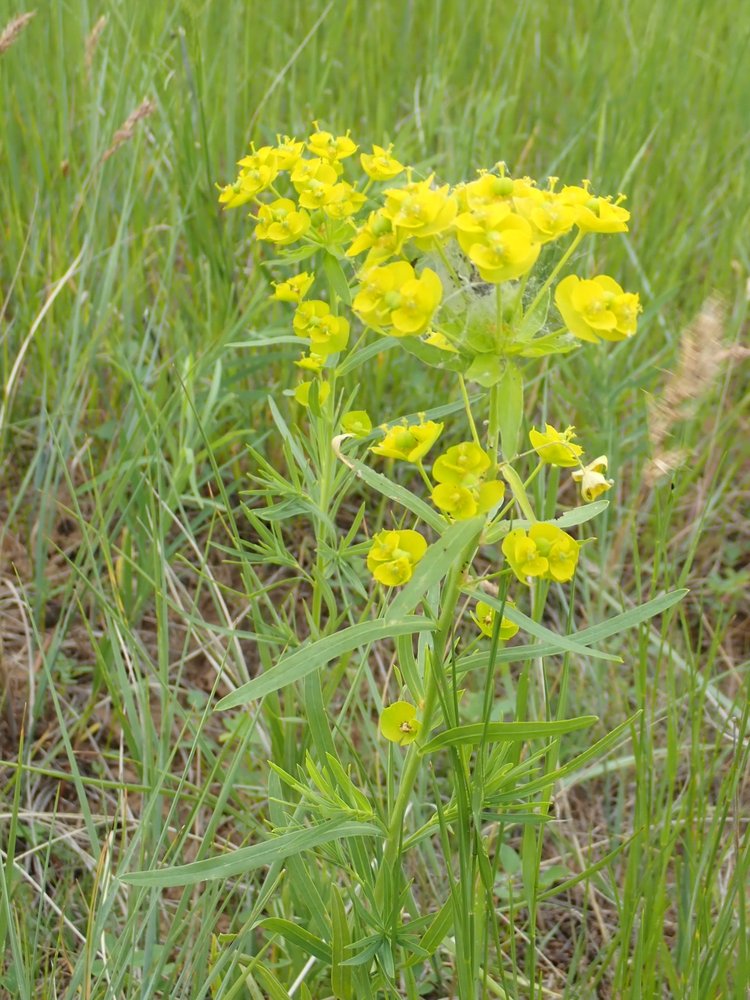
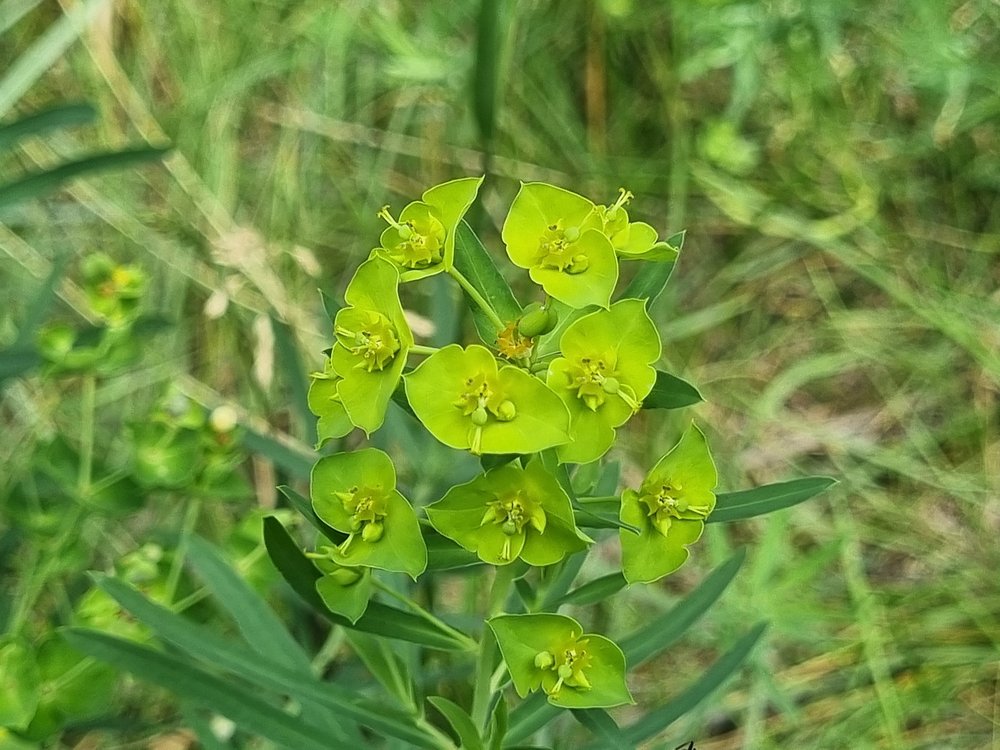
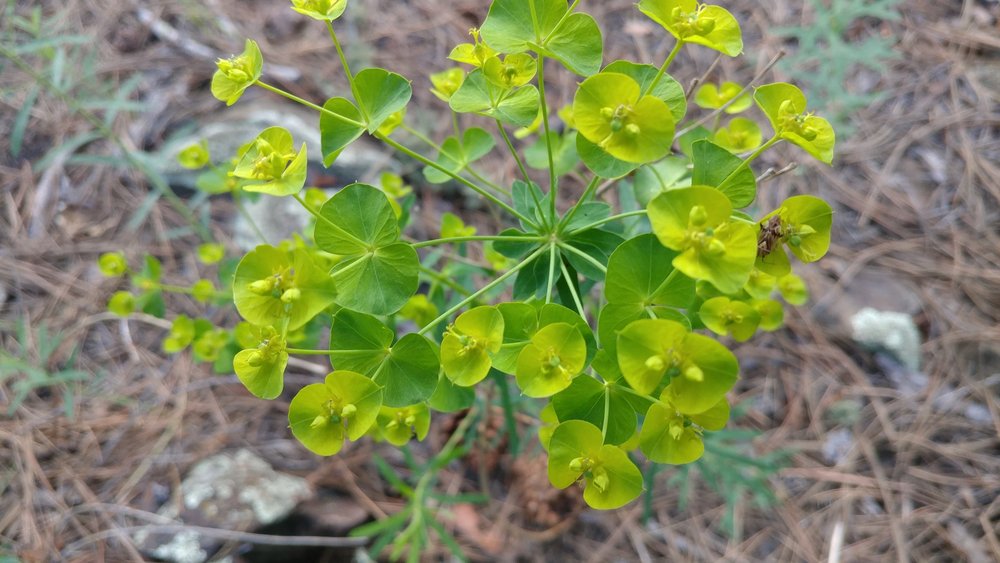
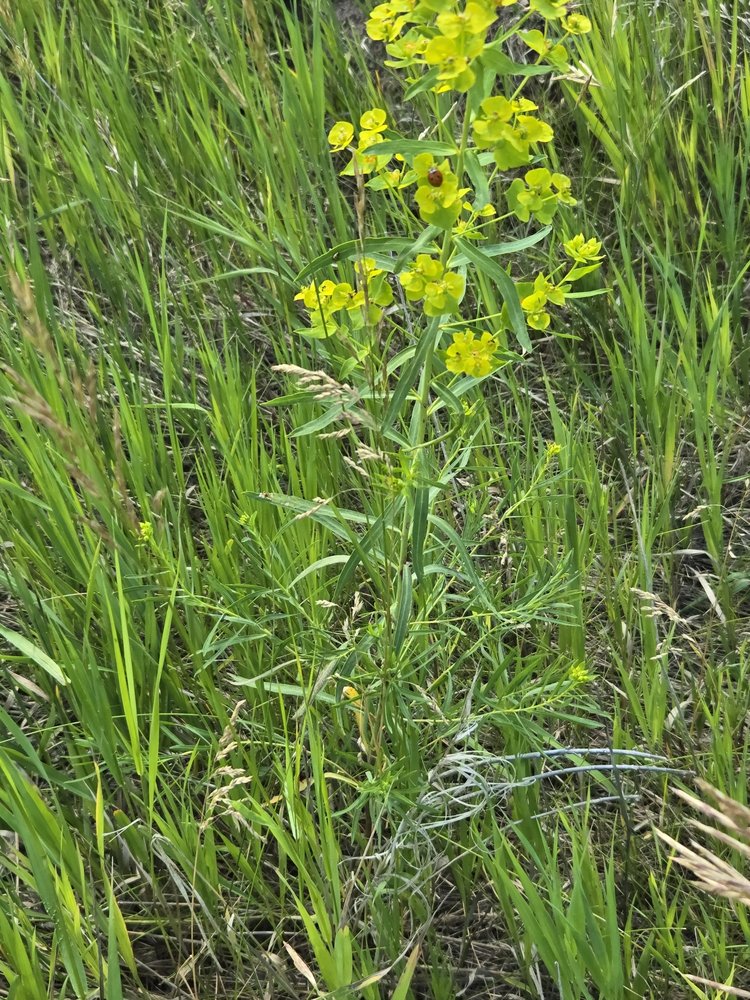
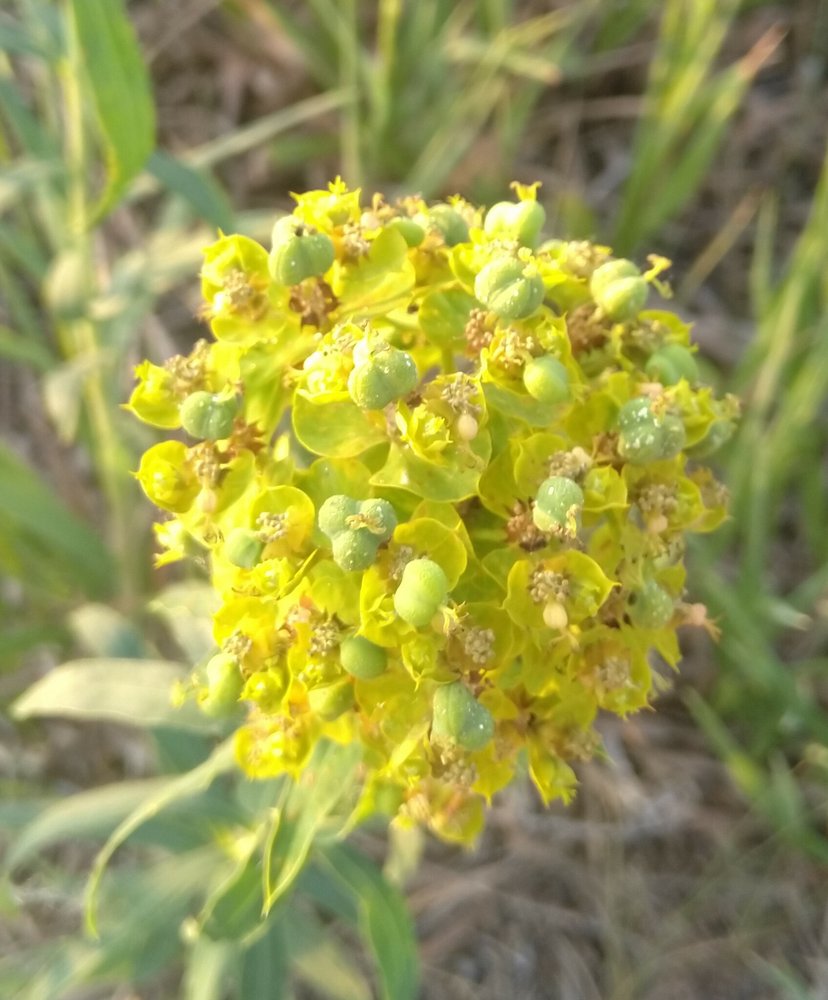
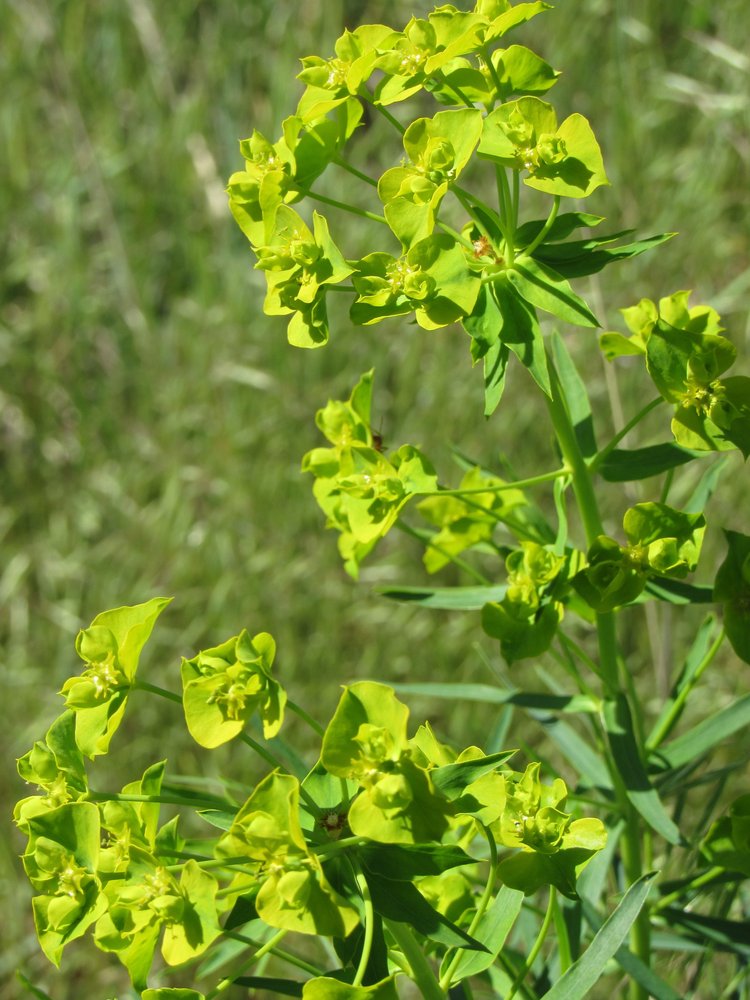
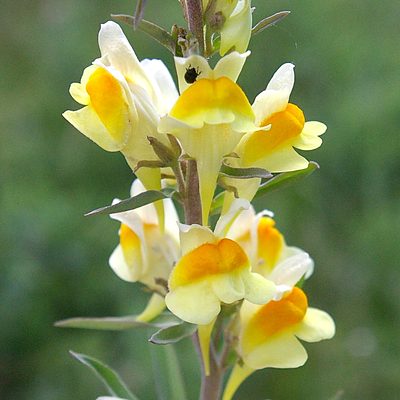
At the top of the stem, a whorl of leaves sits under an umbrella of rays, each ending in a pair of rounded, heart-shaped, yellow-green bracts about 6 mm (¼ in) across that cup a tiny cluster of petal-less true flowers. Break a leaf or stem and white milky sap runs out, the quickest test. The many narrow leaves, 3–9 cm (1¼–3½ in) long and 3–8 mm wide, are smooth, untoothed, stalkless and crowded along smooth, upright stems, and plants grow in dense colonies that look chartreuse from a distance. Butter-and-Eggs fills the same ditches with yellow but has real snapdragon-like flowers, pale yellow with an orange throat and a spur, and no milky sap.
When does it bloom?
Late May through July, with the bracts yellow-green into August.
Where does it grow?
Sunny, open ground: prairie and pasture, hay meadows, road and railroad ditches, creek banks, springs and floodplains, and openings in ponderosa pine forest. It is most aggressive on dry sites where grass is thin. The 1986 Jewel Cave survey named it one of three noxious weeds in the monument, the species lists for Wind Cave, Jewel Cave and Devils Tower include it, and the Black Hills National Forest treats it as a priority invasive plant. Herbarium specimens since 1929 come from Lawrence, Pennington and Custer counties, SD, and Crook and Weston counties, WY, and a 1990 count found far more of it in Crook County than in the South Dakota Hills counties.
Other flowers to compare
Sources: South Dakota DANR: State Noxious Weeds list; South Dakota DANR: Leafy Spurge (Euphorbia esula); University of Wyoming CAPS: Leafy Spurge, Wyoming designated noxious weed; St. John, L. & Tilley, D. (2014) USDA NRCS Plant Guide: Leafy Spurge (Euphorbia esula); Lym, R.G. & Messersmith, C.G. (2006) Leafy Spurge: Identification and Chemical Control, NDSU Extension W-765 (archived); Bangsund, D.A. & Leistritz, F.L. (1991) Economic Impact of Leafy Spurge in Montana, South Dakota, and Wyoming, NDSU Agricultural Economics Report 275; Bangsund, D.A., Leistritz, F.L. & Leitch, J.A. (1997) Predicted Future Economic Impacts of Biological Control of Leafy Spurge in the Upper Midwest, NDSU; Jones, E.A.L. et al. (2025) Current state of noxious weed management in South Dakota, Invasive Plant Science and Management 18:e13; Kirby, D.R. & Carlson, R.B. (1998) Flea Beetles for Leafy Spurge Control, NDSU Dickinson Research Extension Center; USGS Fact Sheet 2009-3066: The Saga of Leafy Spurge in the Northern Great Plains; SDSU Extension (2020): leafy spurge and noxious weed management recommendations; Thunhorst, G. & Swearingen, J.M. (2005) Leafy Spurge fact sheet, Plant Conservation Alliance Alien Plant Working Group / NPS (archived); Black Hills National Forest: Invasive plants on the Black Hills NF (species accounts and BHIPP classes); National Park Service, Devils Tower: Nonnative Species; Marriott, H. & Hartman, R. (1986) Vegetation of Jewel Cave National Monument; NPSpecies checklist, Wind Cave National Park (vascular plants); NPSpecies checklist, Jewel Cave National Monument (vascular plants); NPSpecies checklist, Devils Tower National Monument (vascular plants); GBIF occurrence search: Euphorbia virgata, Black Hills box; GBIF occurrence search: Euphorbia esula, Black Hills box; Plants of the World Online (Kew): Euphorbia virgata Waldst. & Kit.; Flora of North America: Euphorbia virgata (could not be opened in this session; see Confidence notes); Wikipedia: Euphorbia virgata (summarizes the FNA treatment and leaf ratios); Minnesota Wildflowers: Leafy Spurge (Euphorbia virgata); Minnesota Wildflowers: Cypress Spurge (Euphorbia cyparissias); Minnesota Wildflowers: Butter and Eggs (Linaria vulgaris); Minnesota Wildflowers: Yellow Sweet Clover (Melilotus officinalis); Putnam Park Wildflowers (UW-Eau Claire): Euphorbia virgata notes (leaf sizes vs. Cypress Spurge); Black Elk, L. & Flying By, W. (1998) Culturally Important Plants of the Lakota, Sitting Bull College.