Striped Coralroot Corallorhiza striata
Also called Hooded Coralroot, Striped Coral-root
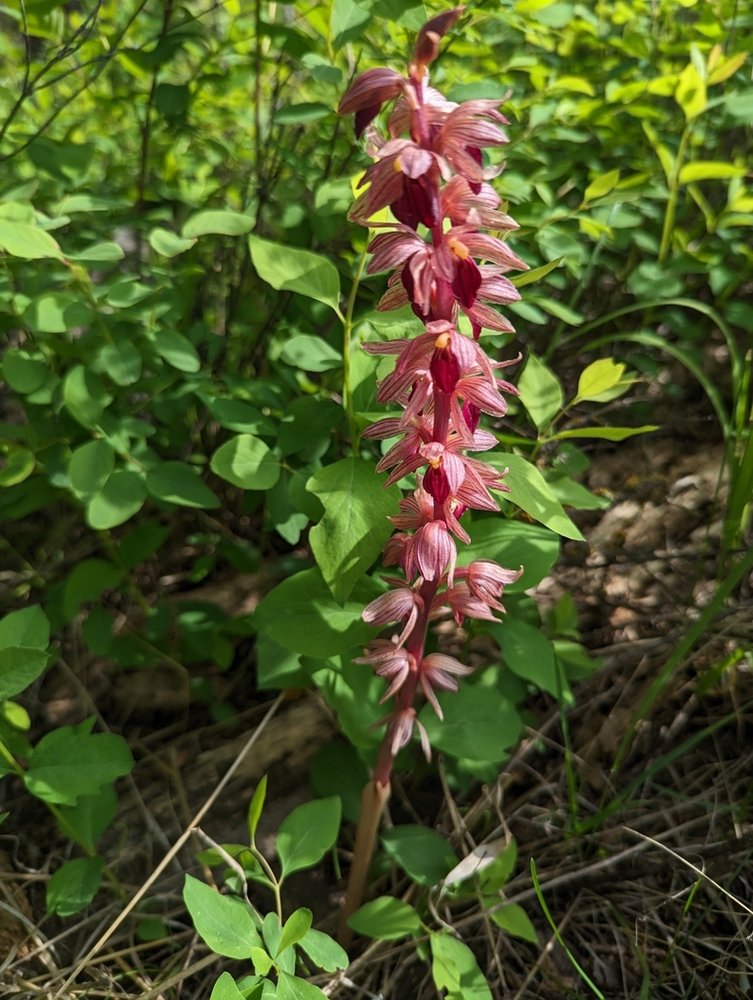
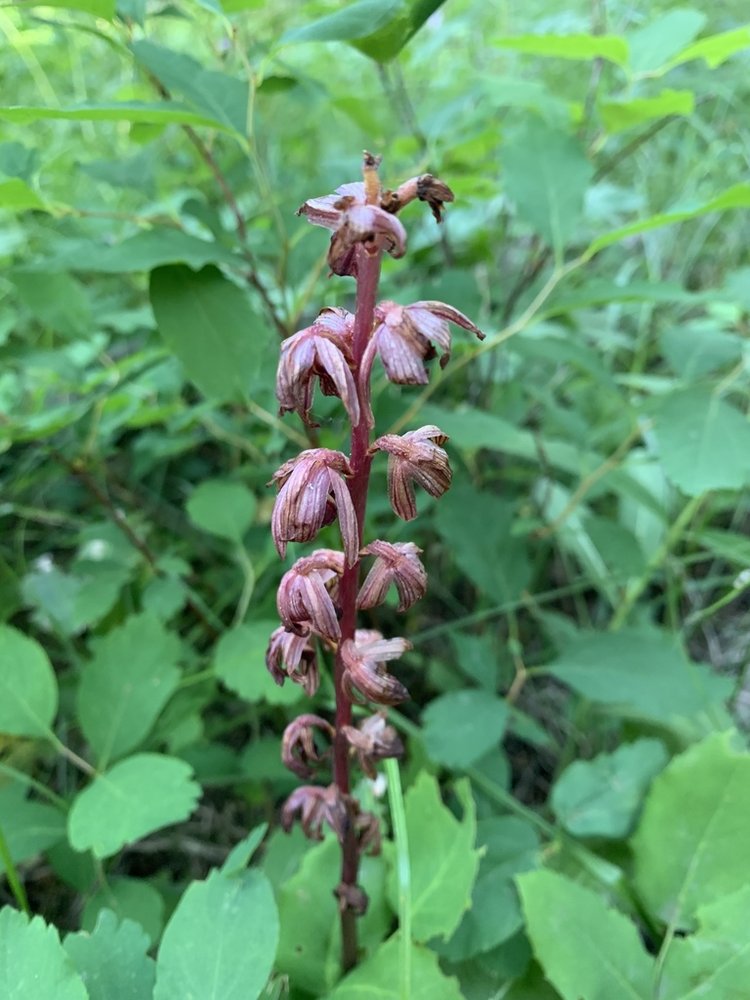
Striped Coralroot (Corallorhiza striata) is a native orchid with a reddish stem, no real leaves, and a spike of 2 to 35 flowers whose sepals and petals are striped with dark red or purple. Black Hills herbarium specimens collected from June into August come from ponderosa pine and spruce forest, aspen groves and birch-and-ironwood stream bottoms.
Free photos from other sources
| Family | Orchidaceae · Orchid |
|---|---|
| Status | Native perennial |
| Blooms | June into August |
| Height | 10–65 cm (4–26 in) |
| Where | Shaded, humus-rich woods of pine, spruce, aspen and birch |
| Also called | Hooded Coralroot, Striped Coral-root |
| Note | Black Hills herbarium sheets of this orchid are filed under both of its varieties, var. striata and var. vreelandii. |
Roots, seeds & germination
Root: The underground stems (rhizomes) look like ocean coral, which gave the plant its name, according to the Forest Service. Flora of North America describes the stem as more or less strongly thickened, without a bulb at its base.
Seed: The fruit is a dangling capsule up to 2.5 cm (1 in) long, according to Minnesota Wildflowers.
How do you identify Striped Coralroot?
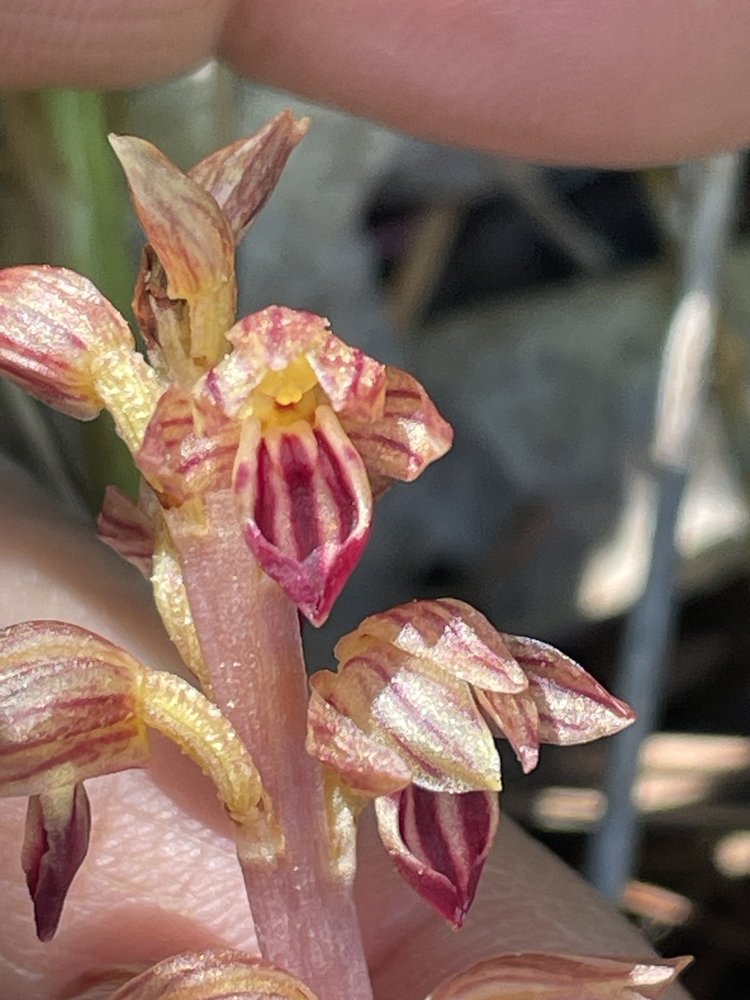
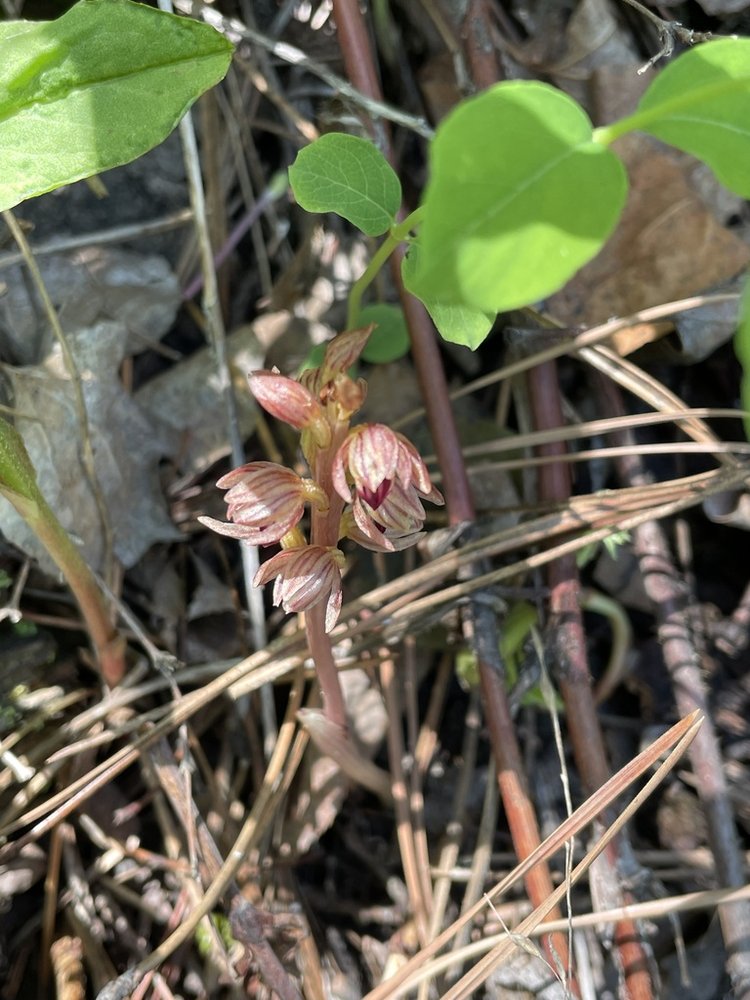
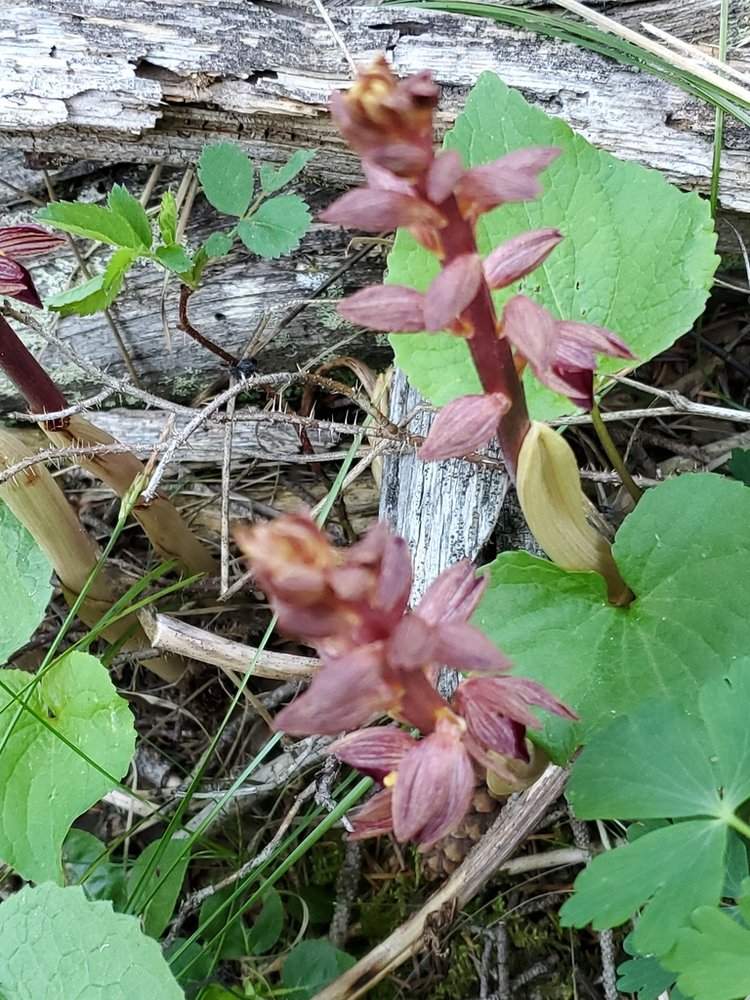
Look for an unbranched red-to-purple stem with no green leaves, only pale sheaths wrapped around it, topped by a spike of drooping flowers. Each flower is about 1.3 cm (½ in) across; the sepals and petals are creamy white to salmon-pink with dark red-purple stripes, and the lip below them is wider and nearly solid reddish purple, around a yellow center column. Wildflowers of the Pacific Northwest says the plant is similar to Spotted Coralroot (Corallorhiza maculata) but has the largest flowers of the coralroots. The Forest Service notes that some plants have creamy yellow flowers, because the red pigment is missing.
When does it bloom?
June into August.
Where does it grow?
Shaded, humus-rich soil in a range of conifer and broadleaf woods; Black Hills herbarium labels give open ponderosa pine forest, ponderosa pine with white spruce on a northwest slope, aspen forest, a stream bottom of paper birch and ironwood, aspen with paper birch, moist shady soil, and moist rocky clay soil under ponderosa pine, spruce and birch. The 35 Black Hills-area specimens on GBIF, collected from 1929 to 2011, come from Lawrence, Pennington, Custer and Meade counties in South Dakota and Crook County, Wyoming; Lawrence County has 26 of them.
Other orchids in this guide
Sources: Flora of North America Vol. 26: Corallorhiza striata (Sheviak), eFloras; Minnesota Wildflowers: Corallorhiza striata (Striped Coralroot); USDA Forest Service Plant of the Week: Striped Coralroot (Stritch); Wildflowers of the Pacific Northwest: Corallorhiza striata (Striped Coralroot); GBIF occurrence search: Corallorhiza striata, South Dakota and Wyoming herbarium specimens (Lawrence, Pennington, Custer, Meade and Crook counties); GBIF specimen 4167752388: Schwartz 2011, Lawrence County (var. vreelandii); GBIF specimen 2512288451: Ecological Solutions Group 2011, Lawrence County, "Under open Pinus ponderosa forest" (var. striata); GBIF specimen 2512331057: 2011, Lawrence County, "under Pinus ponderosa and Picea glauca"; GBIF specimen 2512329371: Elliott 2010, Lawrence County, "Riparian corridor dominated by Betula papyrifera and Ostrya virginiana"; GBIF specimen 3091221322: Kravig 1972, Lawrence County, "Aspen forest"; GBIF specimen 5159175345: Todd 1975, Lawrence County, "Moist rocky clay soil"; GBIF specimen 176918609: Magrath 1972, Pennington County (var. vreelandii); GBIF specimen 176918917: Magrath 1972, Custer County (var. vreelandii); GBIF specimen 176918876: Magrath 1971, Meade County; GBIF specimen 4912233905: Kass 1996, Crook County, Wyoming, "Aspen/Paper Birch comm."; South Dakota Game, Fish and Parks: Rare Plants of South Dakota (Corallorhiza striata not listed); Native American Ethnobotany Database (BRIT): search for Corallorhiza (no uses).