Solomon's Seal Polygonatum biflorum
Also called Smooth Solomon's Seal, King Solomon's Seal, Giant Solomon's Seal, Great Solomon's-seal, Sealwort, zuzéča tȟawóte hú (Lakota), tȟaŋkíŋyaŋ héčha (Lakota)
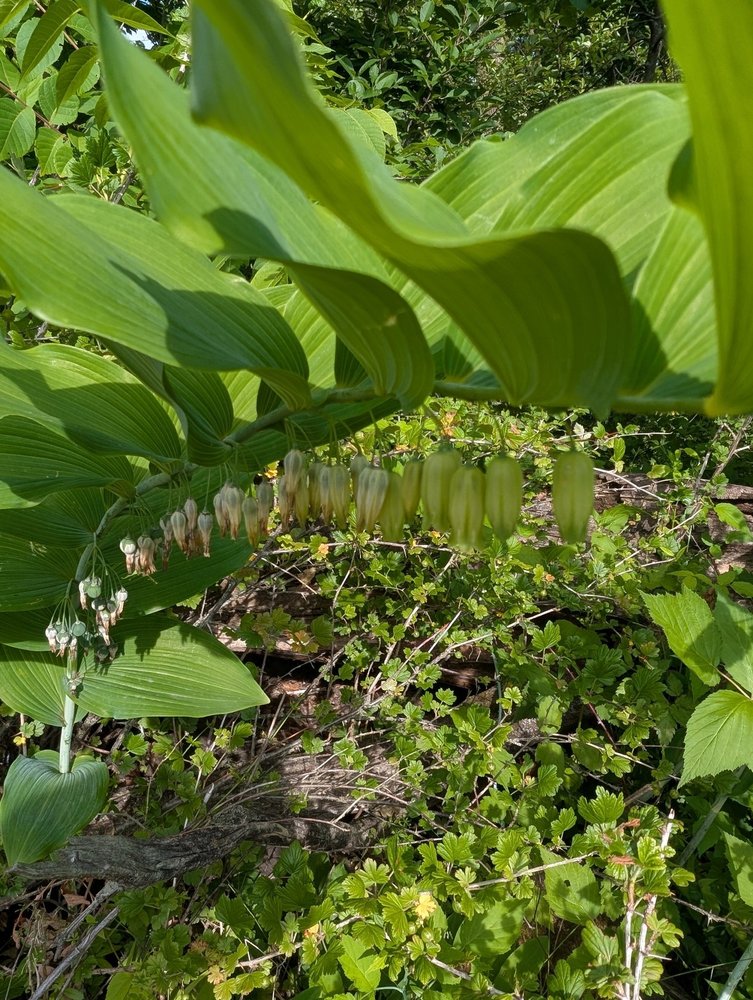
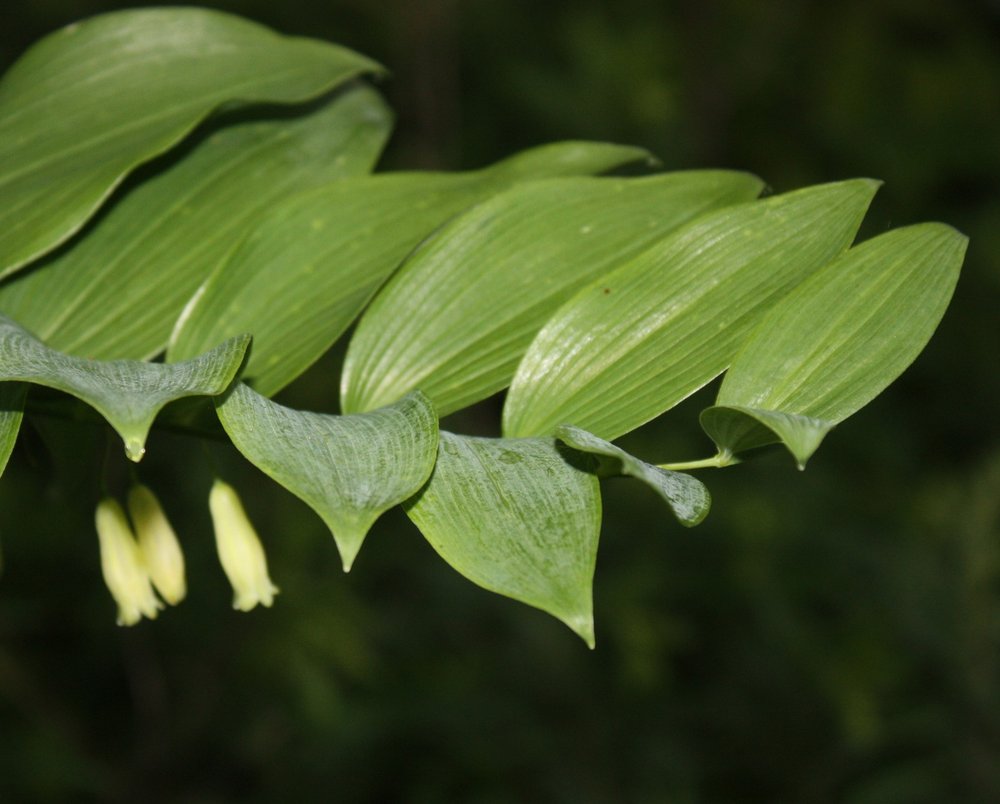
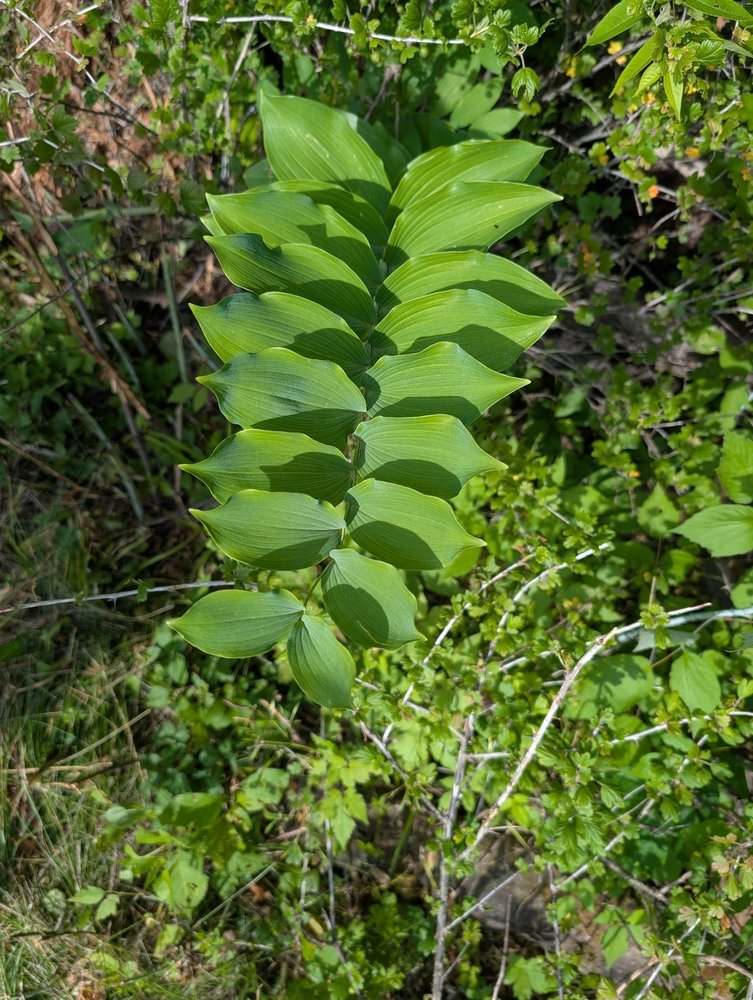
Solomon's Seal (Polygonatum biflorum), also called Smooth Solomon's Seal, is a native perennial with an unbranched, arching stem 30–90 cm (1–3 ft) tall, alternate oval leaves, and pale green bell-shaped flowers that hang in small clusters under the leaves in June and July. Black Hills herbarium specimens come from creek sides, shady damp spots and woodland edges in five counties of South Dakota and Wyoming, and the National Park Service lists it at Wind Cave and Mount Rushmore.
Free photos from other sources
| Family | Asparagaceae · Asparagus |
|---|---|
| Status | Native perennial |
| Blooms | June into July |
| Height | 30–90 cm (1–3 ft) |
| Where | Woods and woodland edges in part shade or shade, often by creeks and in moist, shaded soil |
| Also called | Smooth Solomon's Seal, King Solomon's Seal, Giant Solomon's Seal, Great Solomon's-seal, Sealwort, zuzéča tȟawóte hú (Lakota), tȟaŋkíŋyaŋ héčha (Lakota) |
| Synonym | Polygonatum commutatum |
| Toxicity | The berries have low toxicity; the Lady Bird Johnson Wildflower Center lists vomiting and diarrhea if they are eaten, from anthraquinone. |
| Food use | The Lady Bird Johnson Wildflower Center says First Nations people and colonists used the starchy rhizomes as food, citing Niering. |
| Traditional use | Black Elk and Flying By's 1998 Culturally Important Plants of the Lakota (which spells the name 'Soloman's seal') gives the Lakota names zuzéča tȟawóte hú and tȟaŋkíŋyaŋ héčha and records that the rhizomes were eaten in soups and stews and dried for later use, that the young shoots were eaten raw or cooked, and that the seeds and fruits are considered toxic. |
| Note | Some floras treat the tall form as its own species, Polygonatum commutatum; this guide follows ITIS and the Lady Bird Johnson Wildflower Center, which keep it within Polygonatum biflorum. |
Roots, seeds & germination
Root: The rhizome (underground stem) is jointed, and the plant is rhizomatous but not colonizing (Lady Bird Johnson Wildflower Center).
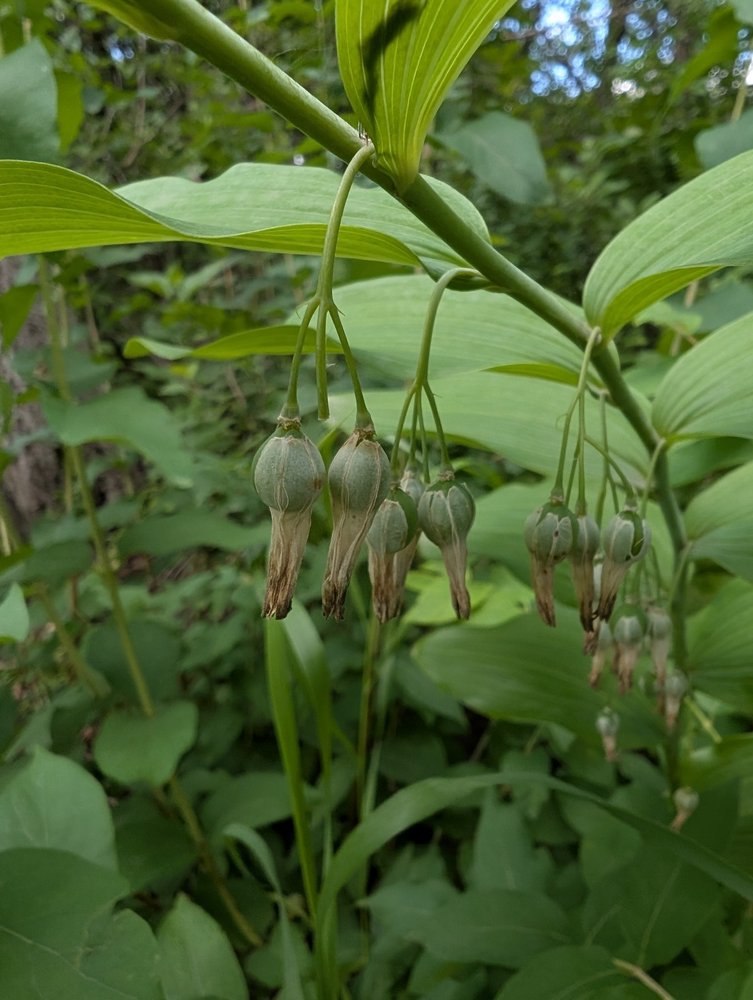
Seed: The fruit is a round berry about 6 mm (¼ in) across that ripens from green to blue-black in late summer (Minnesota Wildflowers).
How do you identify Solomon's Seal?
Look for an unbranched, hairless stem that stands up at the base and arches over, zig-zagging a little between the alternate leaves. The leaves are oval and toothless, 5–15 cm (2–6 in) long and up to 7.5 cm (3 in) wide, with a pointed tip, several prominent parallel veins and a base that clasps the stem. In most leaf axils (the angle where a leaf meets the stem) hang 2 to 10 stalked, bell-shaped flowers, each 1.3–2.5 cm (½–1 in) long and pale yellowish green with 6 short flaring lobes; the stamens and style stay inside the tube, and the flowers are typically hidden under the leaves and may go unseen. The fruit is a round berry about 6 mm (¼ in) across that ripens from green to blue-black in late summer (Minnesota Wildflowers). Minnesota Wildflowers also says the leaves of the false Solomon's seals (Maianthemum) are narrower and their flowers are in a cluster at the tip of the stem, and that Hairy Solomon's Seal (Polygonatum pubescens) has fine, short hairs along the veins under its leaves, where this plant's leaves are hairless. The Lady Bird Johnson Wildflower Center says the rhizome (underground stem) is jointed, and the leaf stalk breaks away from it, leaving a scar said to look like King Solomon's seal.
When does it bloom?
June into July.
Where does it grow?
Woods in part shade or shade (Minnesota Wildflowers). GBIF holds 19 preserved specimens from five Black Hills counties of South Dakota and Wyoming (Pennington 8, Meade 3, Lawrence 3, Crook 3, Custer 2), collected from 1924 to 2018. Their labels give a moist creek, a streamside, riparian cottonwood and birch, shade under chokecherry by a creek, an east-facing dry-mesic to mesic slope, a shady damp spot, moist shaded soil, a forest margin and a wooded floodplain, with plants about 0.8–0.9 m (2½–3 ft) tall; the 4 labels that give an elevation run from 1,100 to 1,300 m (3,600–4,300 ft). The National Park Service lists it as present at Wind Cave and Mount Rushmore, and not at Jewel Cave or Devils Tower. iNaturalist has 3 research-grade records from the Black Hills area, in June, August and September.
Other flowers to compare
Asparagus family (Asparagaceae): 5 other plants in this guide
Sources: Minnesota Wildflowers: Polygonatum biflorum (Smooth Solomon's Seal); Lady Bird Johnson Wildflower Center: Polygonatum biflorum (POBI2), Smooth Solomon's Seal; USDA PLANTS Database: Polygonatum biflorum (POBI2); ITIS: Polygonatum biflorum (TSN 43006), with its synonyms; NPSpecies checklist, Wind Cave National Park (vascular plants); NPSpecies checklist, Mount Rushmore National Memorial (vascular plants); NPSpecies checklist, Jewel Cave National Monument (vascular plants); NPSpecies checklist, Devils Tower National Monument (vascular plants); GBIF occurrence search: Polygonatum biflorum, preserved specimens, South Dakota and Wyoming; iNaturalist: Polygonatum biflorum research-grade observations in the Black Hills; Illinois Wildflowers: Solomon's Seal (Polygonatum commutatum); Culturally Important Plants of the Lakota (Black Elk and Flying By, Sitting Bull College, 1998), entry 233; South Dakota Natural Heritage Program: Rare Plants of South Dakota; Black Hills National Forest Revised Forest Assessment: At-Risk Species (October 2023).