Sulphur Cinquefoil Potentilla recta
Also called Sulfur Cinquefoil, Rough-fruited Cinquefoil, Upright Cinquefoil, Erect Cinquefoil
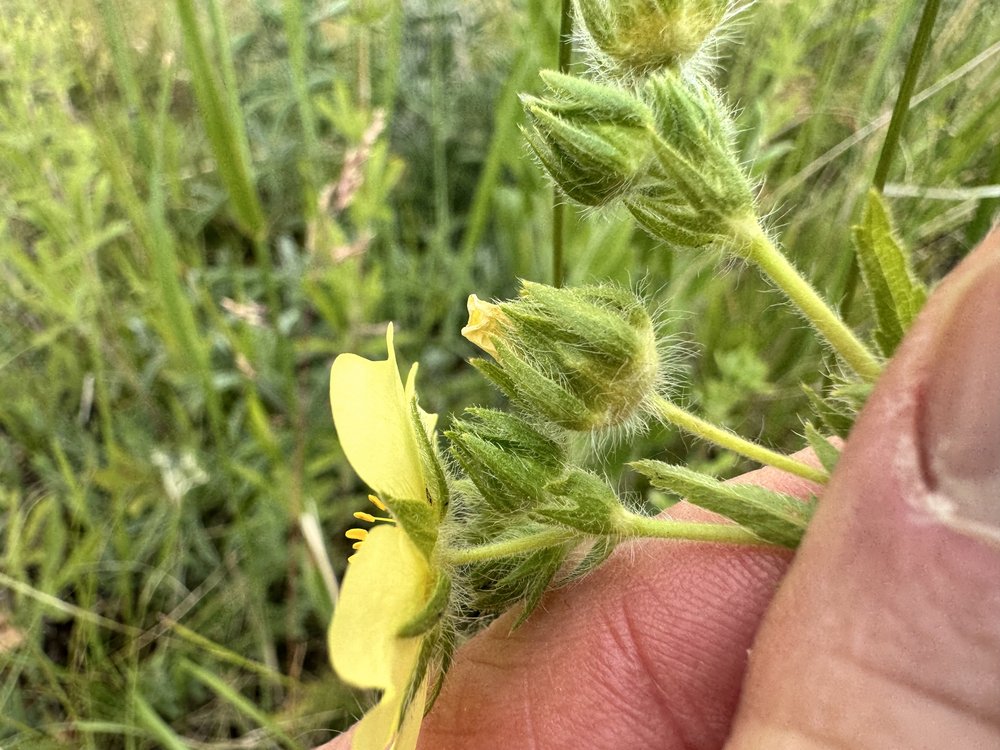
Sulphur Cinquefoil (Potentilla recta) is an introduced perennial weed from Eurasia with pale yellow, five-petaled flowers, each petal notched at the tip, in flat-topped clusters on hairy upright stems 20–80 cm (8–30 in) tall. It blooms from June into August on roadsides, in pastures and in grassland, and in the Black Hills it is on the Wind Cave plant list, in herbarium collections from Lawrence, Pennington and Meade counties and from Crook County, Wyoming, and on the Black Hills National Forest's list of invasive plants.
Free photos from other sources
| Family | Rosaceae · Rose |
|---|---|
| Status | Introduced perennial |
| Blooms | June into August |
| Height | 20–80 cm (8–30 in) |
| Where | Roadsides, pastures, old fields, grassland and open forest |
| Also called | Sulfur Cinquefoil, Rough-fruited Cinquefoil, Upright Cinquefoil, Erect Cinquefoil |
| Synonym | Potentilla sulphurea, Potentilla recta var. sulphurea, Potentilla recta subsp. obscura, Potentilla recta subsp. pilosa |
| Listed | County declared weed in Crook and Weston counties, Wyoming. Jackson County, SD, listed it as locally noxious from 2021 through 2025. Not on the South Dakota or Wyoming state noxious weed list. |
| Toxicity | No reports of it poisoning animals; grazing animals mostly avoid it, likely because of its high tannin content. |
| Note | An introduced weed. The Black Hills National Forest's invasive plant accounts place it in the Black Hills Invasive Plant Partnership's Class B: established in some areas, less common or absent in others. |
Roots, seeds & germination
Root: A woody taproot with a short crown and no rhizomes (underground stems). New shoots can come up each year from the outer edge of the root mass, so an old plant grows a ring of shoots, and one plant can live as long as 20 years.
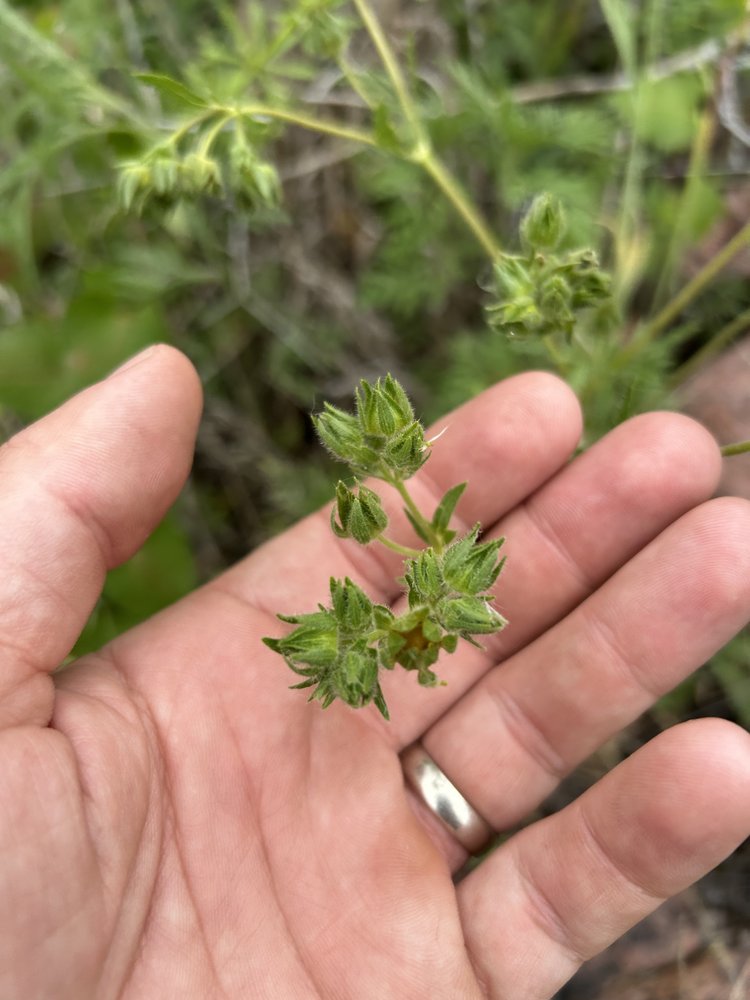
Seed: Each flower leaves a cup of folded sepals holding many small, ribbed, dark brown to reddish-purple seeds 1.2–1.8 mm long. A Michigan study found about 61 seeds per flower and estimated about 1,650 per plant. Most seed drops close to the plant, and in a lab test some seed buried 7 cm (3 in) deep was still alive after 28 months.
Germination: Much of the fresh seed is dormant and ripens over the summer, so that all of it is ready to sprout by fall. In a lab study it sprouted only in light, and it needs no cold period. Seed collected in Montana in August sprouted 55 to 70 percent in October.
How do you identify Sulphur Cinquefoil?
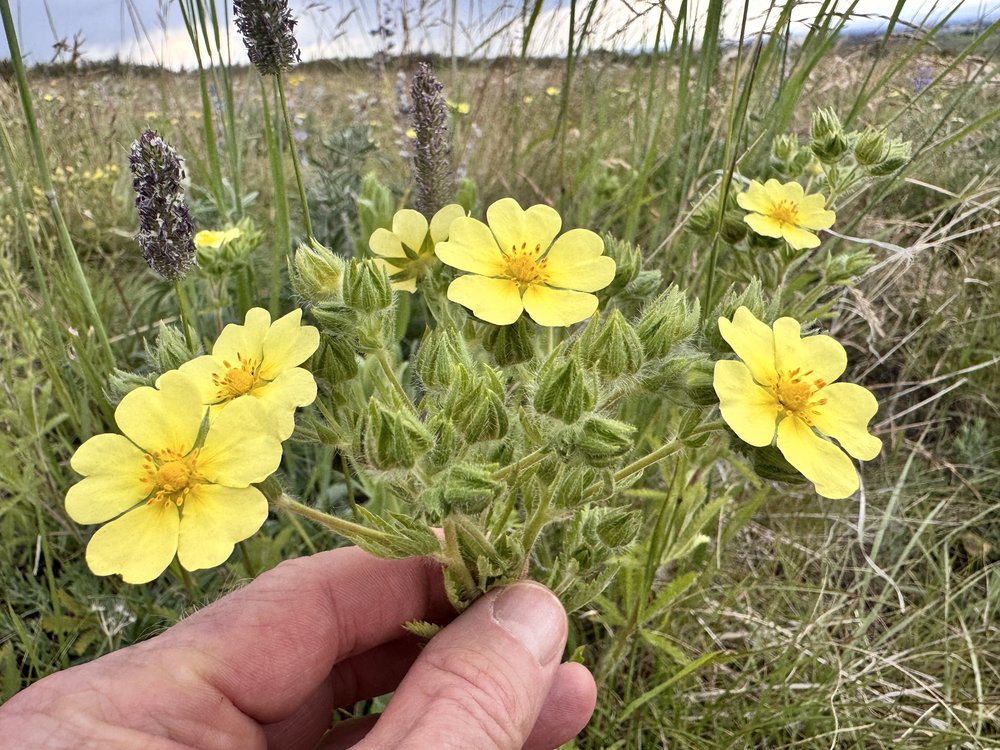
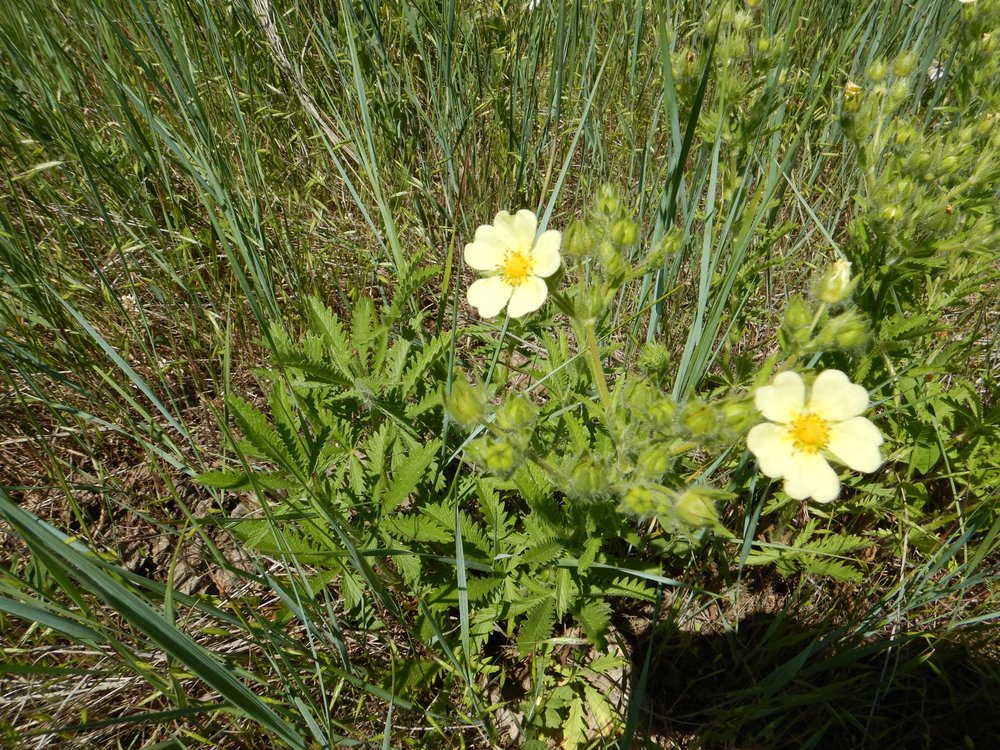
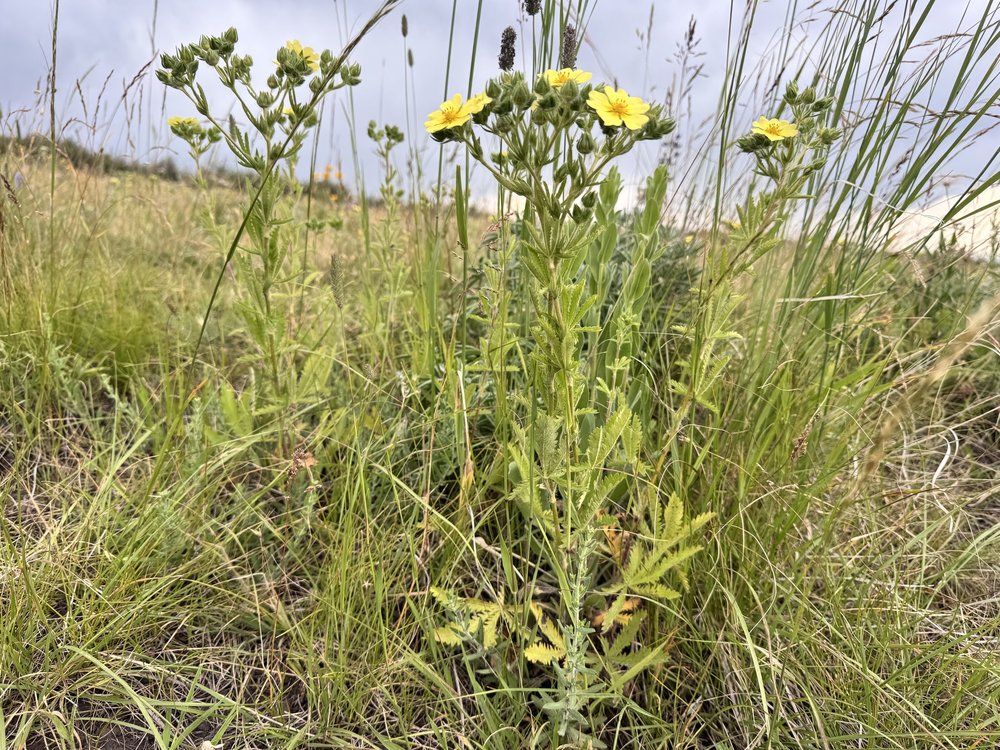
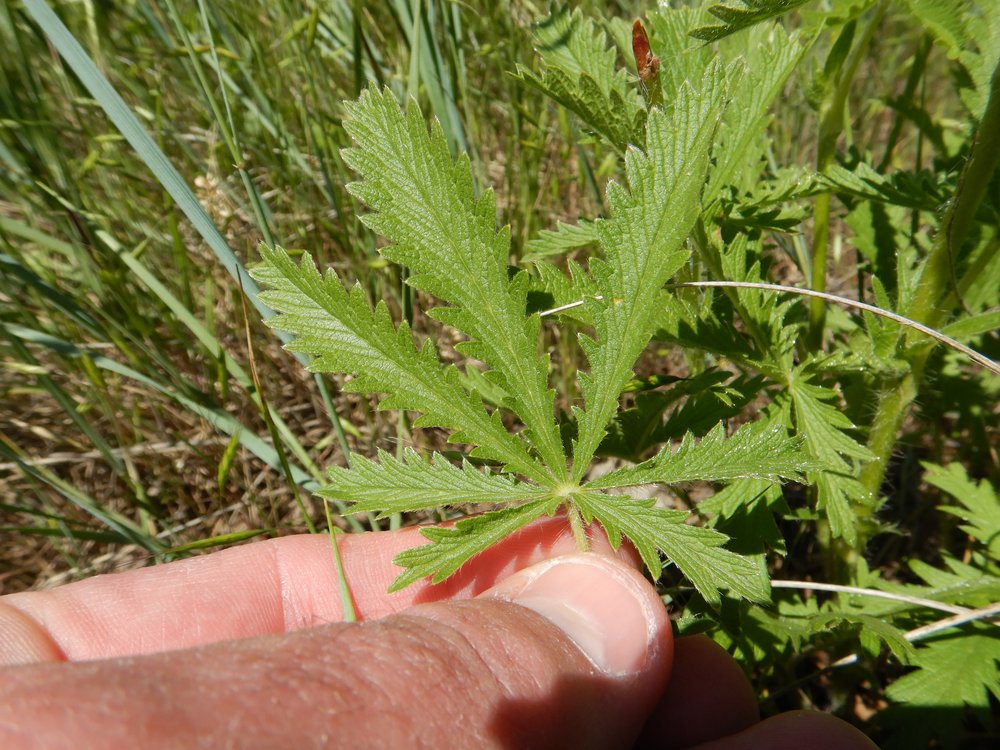
Look for pale, sulphur-yellow flowers 1.5–2.5 cm (½–1 in) across with 5 petals notched at the tip and a brighter yellow patch at the base of each, held in branched, flat-topped clusters at the top of the stem. The stems stand upright, branch only near the top, and are covered in long, stiff, spreading hairs over a layer of short hairs. The leaves are hand-shaped, with 5 to 7 coarsely toothed, hairy leaflets spreading from one point and the middle leaflet longest, and they continue up the stem, while the leaves at the base are short-lived. After the petals fall, the sepals fold up into a cup around the seeds. Slender Cinquefoil, the native plant it is most often confused with, has brighter yellow flowers, mostly basal leaves with few on the stem, and short hairs on the stem and leaf stalks instead of long ones standing straight out. Tall Cinquefoil has white flowers and leaflets set along a central stalk rather than spreading from one point.
When does it bloom?
June into August.
Where does it grow?
Roadsides, pastures, old fields, grassland, shrubland and open forest, from the plains up to about 2,100 m (6,900 ft), where it can take over a site in two or three years. The National Park Service lists it at Wind Cave. Herbarium specimens from 1971 to 2011 come from Lawrence County (dry creek beds, cut-over land beside a road, grassy roadsides up to 1,798 m (5,900 ft), a moist road cut and a meadow in limestone country), from an oak-lined meadow on granitic soil in Pennington County, from rolling prairie in Meade County, and from Crook County, Wyoming, including a dry grassy ridgetop and an open meadow in the Bear Lodge Mountains and a lush meadow by a creek. The Black Hills National Forest lists it among its invasive plants, and iNaturalist has 33 research-grade Black Hills records, June to September.
Other cinquefoils in this guide
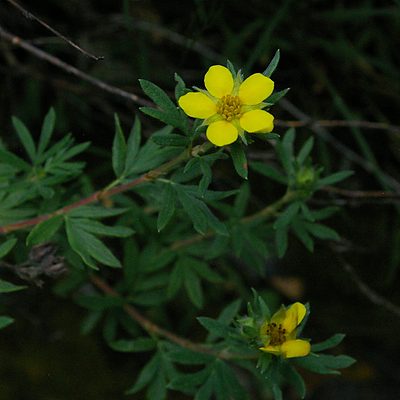
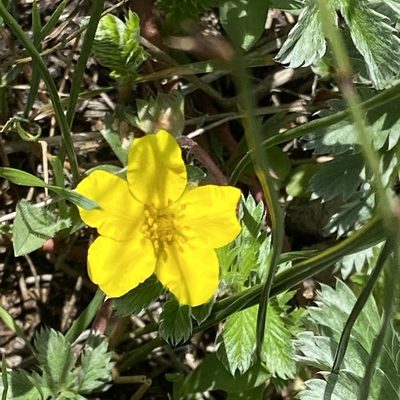
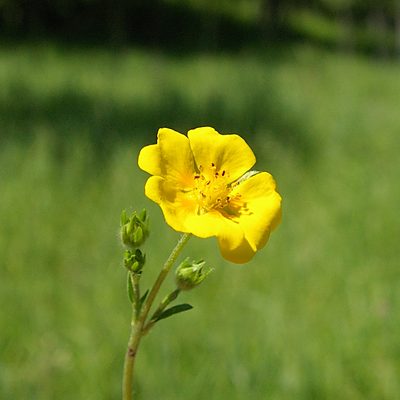
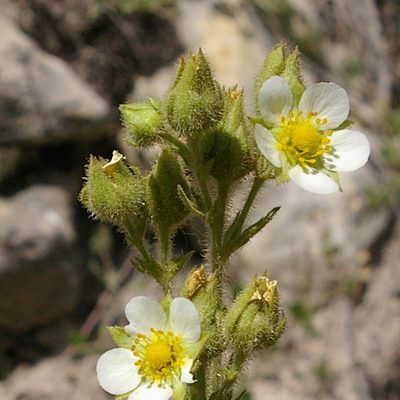
Rose family (Rosaceae): 21 other plants in this guide
- American Plum
- Chokecherry
- Dwarf Raspberry
- Early Cinquefoil
- Leafy Cinquefoil
- Mat Rock Spiraea
- Mountain Mahogany
- Mountain Ninebark
- Pincherry
- Prairie Rose
- Prairie Smoke
- Red Raspberry
- Saskatoon Serviceberry
- Shrubby Cinquefoil
- Silverweed
- Slender Cinquefoil
- Tall Cinquefoil
- Thimbleberry
- White Avens
- White Spirea
- Wild Strawberry
Sources: Flora of North America Vol. 9: Potentilla recta (Ertter, Elven, Reveal and Murray), eFloras; USDA Forest Service Fire Effects Information System: Potentilla recta (Zouhar 2003); Minnesota Wildflowers: Potentilla recta (Sulphur Cinquefoil); Kansas Wildflowers and Grasses: Potentilla recta (sulphur cinquefoil); SDSU Extension Special Series 34, Noxious Weeds of South Dakota, revised 2010, p. 18 (PDF hosted by Fall River County); Black Hills National Forest, Invasive plants species accounts (BHIPP classes); South Dakota DANR, South Dakota Locally Noxious Weed Pest List (PDF, 2026-03-05); South Dakota DANR, State Noxious Weeds; Wyoming Weed and Pest Council, State Designated Weed List; University of Wyoming CAPS, Sulfur Cinquefoil (Potentilla recta): county declared weed list; Montana Department of Agriculture, Sulfur Cinquefoil; USDA PLANTS Database: Potentilla recta (PORE5), profile API; NPSpecies checklist, Wind Cave National Park vascular plants; GBIF occurrence search: Potentilla recta, South Dakota and Wyoming herbarium specimens; iNaturalist: research-grade Potentilla recta observations in the Black Hills.