Saskatoon Serviceberry
Amelanchier alnifolia
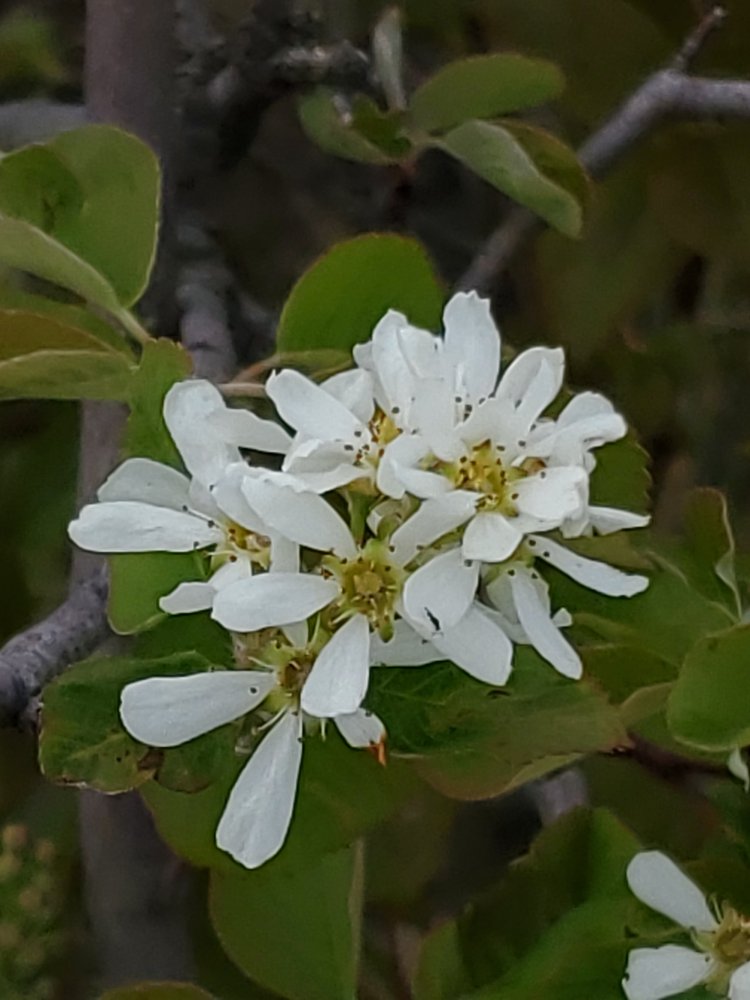
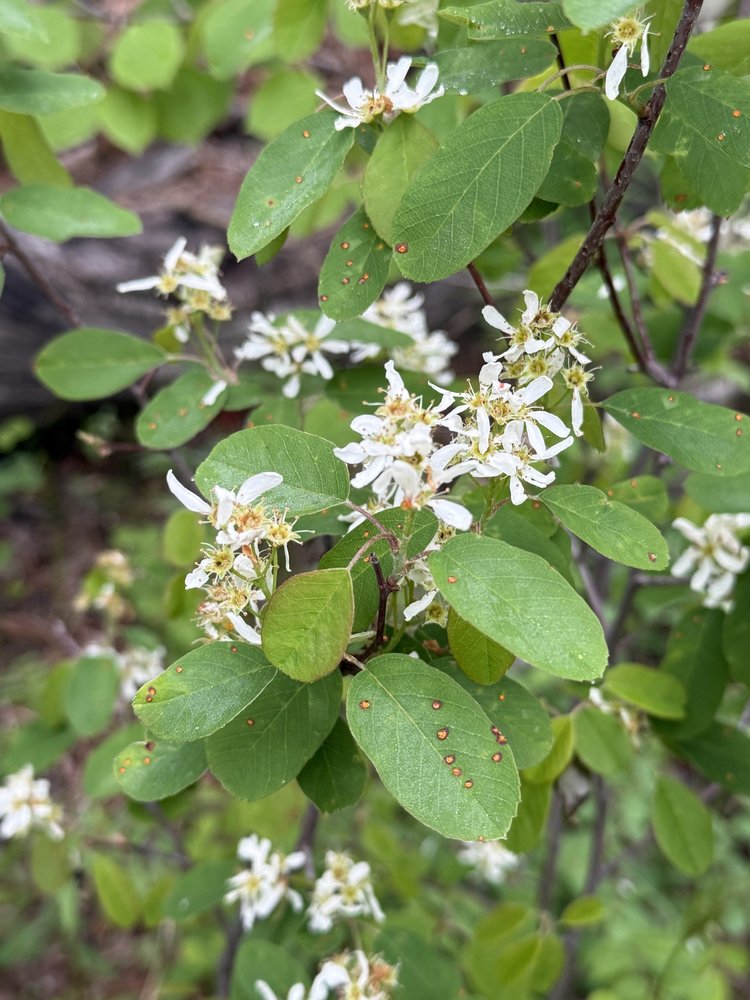
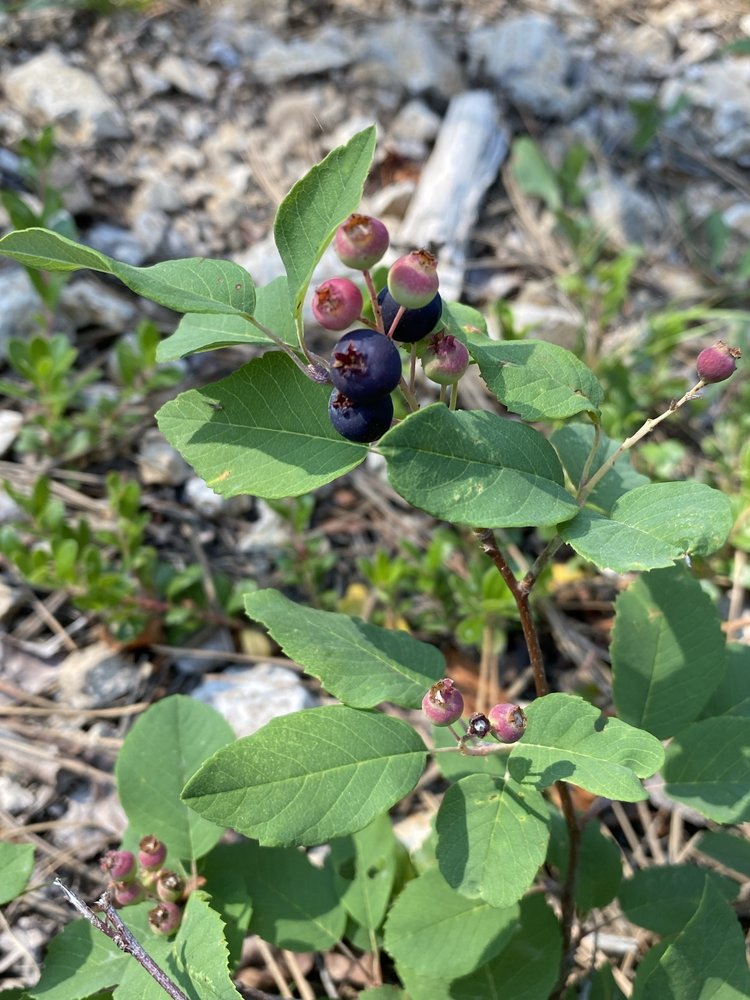
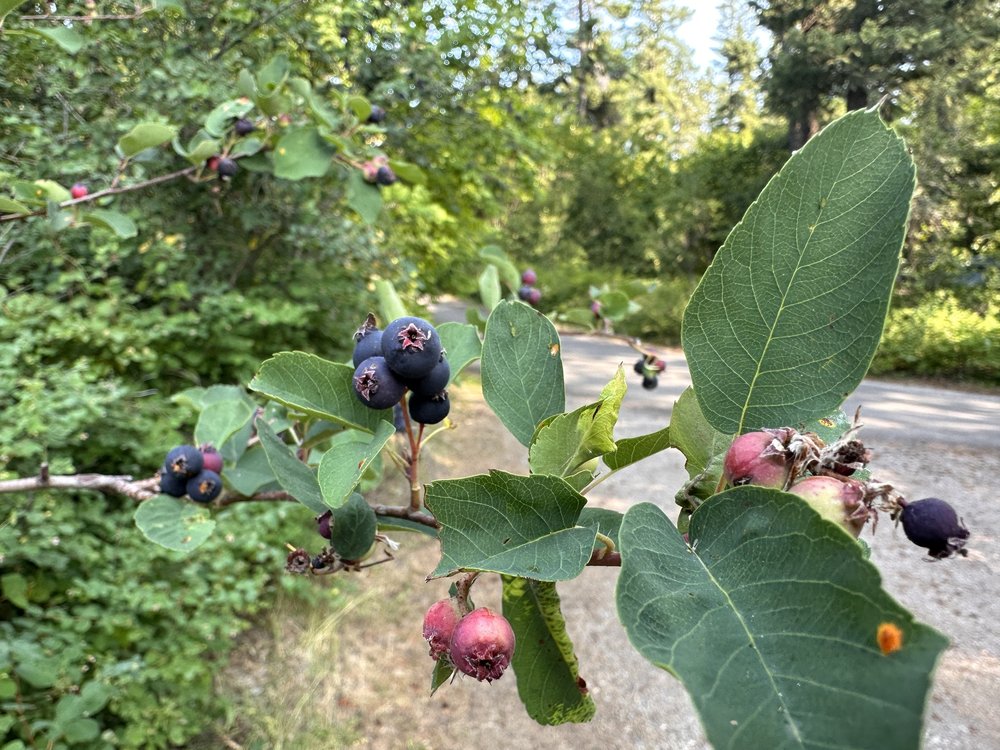
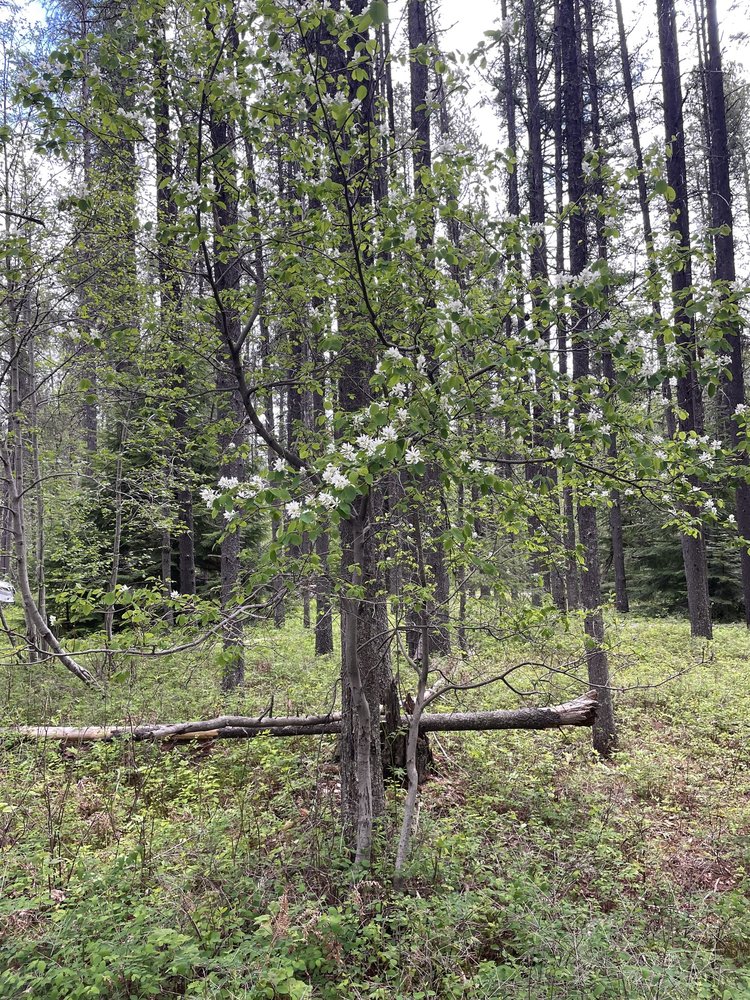
Saskatoon Serviceberry (Amelanchier alnifolia), better known around the Black Hills as juneberry, is a native shrub or small tree and one of the first shrubs to bloom in spring. In May it covers itself in loose clusters of white flowers with long, narrow, strap-like petals, and by July it carries sweet, purple-blue berries in wooded draws, canyon bottoms and rocky slopes.
Free photos from other sources
| Family | Rosaceae · Rose |
|---|---|
| Status | Native shrub |
| Blooms | May, into early June higher up |
| Height | 1–8 m (3–26 ft) |
| Where | Wooded draws, canyon bottoms, creek banks, rocky slopes and forest edges |
| Also called | Juneberry, Serviceberry, Saskatoon, Western Serviceberry, Shadbush, wípazutkȟaŋ (Lakota) |
| Synonym | Aronia alnifolia, Amelanchier cuneata |
| Toxicity | The leaves and especially the young twigs contain cyanogenic glycosides, and deer fed only serviceberry twigs died within a week. |
| Traditional use | Sitting Bull College's 1998 Culturally Important Plants of the Lakota says the berries were eaten fresh or dried for later use and were added to dried meat and fat to make wasna, or pemmican, the leaves were boiled for tea, and the stems were made into hoops for a game of skill and sometimes used for arrow shafts. |
Roots, seeds & germination
Root: A massive woody root crown with rhizomes running sideways and straight down, plus a wide-spreading root system. Most new stems sprout from the crown or rhizomes, which is how one plant becomes a clump or thicket, and it resprouts after fire.
Seed: Each berry holds 4–10 small seeds with a leathery coat, some of them empty. Birds and mammals eat the fruit and spread the seed. It flowers almost every year, but drought, late frost or rust mean a good seed crop only every 3–5 years.
Germination: The seed is dormant and needs a long, cold, moist winter. Remove the pulp, then sow outdoors in fall, or keep it moist at 1–6°C (34–43°F) for about 3–6 months and sow in spring about 6 mm (¼ in) deep. Many seeds wait until the second spring.
How do you identify Saskatoon Serviceberry?
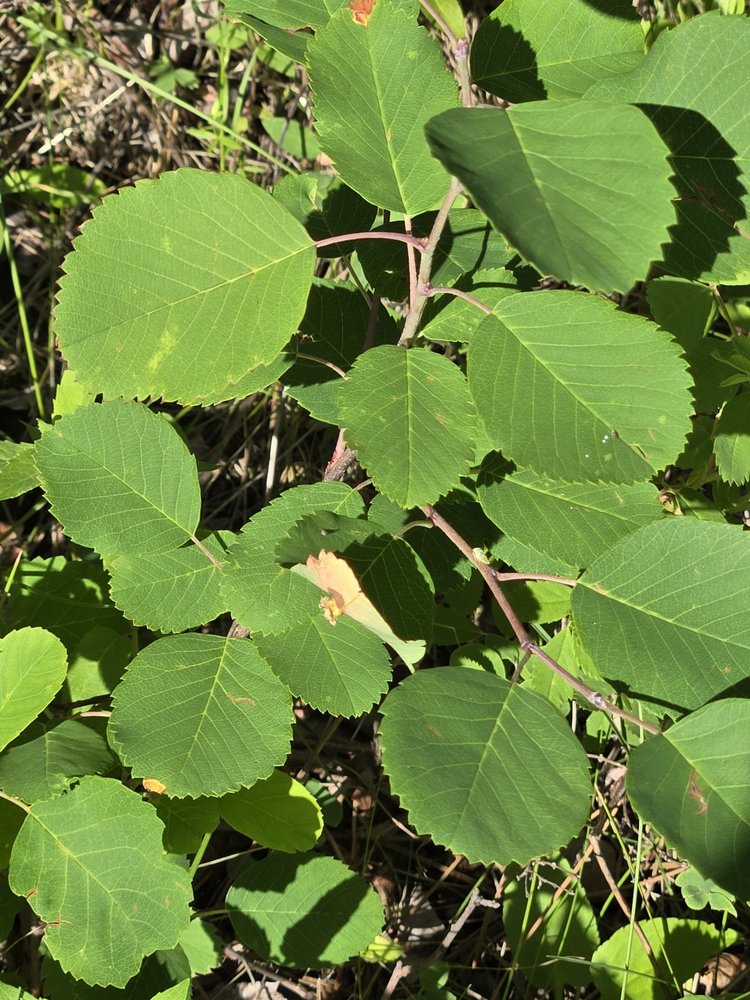
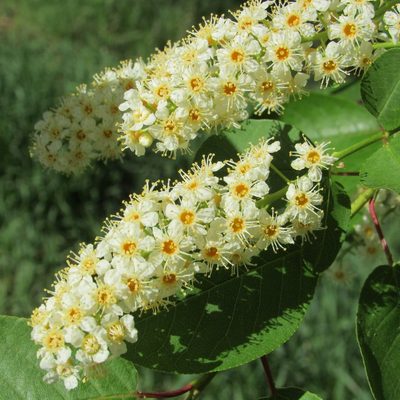
The leaves are the best clue all summer: oval to almost round, 2.5–5 cm (1–2 in) long, blunt or squared off at the tip, and toothed only on the upper half, with straight side veins. In May the flowers come in short, loose, upright clusters of about 6–11, each with five long, narrow white petals 1–1.5 cm (⅜–⅝ in) long that make it look ragged or star-like. The berries ripen from green to red to dark purple-blue with a waxy bloom and hold several tiny, soft seeds. Chokecherry blooms at the same time in the same draws, but its small, round-petaled flowers are packed into long bottlebrush spikes, its leaves are finely toothed all the way around, and its cherries have one hard stone.
When does it bloom?
May, into early June higher up.
Where does it grow?
Sun or light shade on well-drained soils: wooded draws and canyon bottoms, rocky creek banks, talus and rocky slopes, and the edges of pine, aspen, birch and spruce stands, at about 1,040–1,730 m (3,400–5,680 ft) and up to the summit of Terry Peak. It thins out as the forest closes in and comes back strongly after fire or logging. The 1986 Jewel Cave plant survey lists it, it is on the Wind Cave, Mount Rushmore and Devils Tower species lists, and 93 herbarium specimens come from all seven Black Hills counties.
Other plants to compare
Sources: USDA PLANTS Database: Amelanchier alnifolia (AMAL2), Saskatoon serviceberry; USDA NRCS Plant Guide: Saskatoon, Amelanchier alnifolia (Nesom, National Plant Data Center); USDA NRCS Plant Guide: Pacific Serviceberry, Amelanchier alnifolia var. semiintegrifolia (Corvallis Plant Materials Center), seed and propagation section; Howard, J.L. 1997. Amelanchier alnifolia. USDA Forest Service Fire Effects Information System (FEIS); Flora of North America vol. 9: Amelanchier alnifolia; Flora of North America vol. 9: Amelanchier alnifolia var. alnifolia; Flora of North America vol. 9: Amelanchier humilis (low shadbush); Flora of North America vol. 9: Amelanchier sanguinea (red-twigged shadbush); ITIS: Amelanchier alnifolia (TSN 25109) and var. alnifolia synonyms; USDA NRCS Plant Guide: American Plum, Prunus americana Marsh.; Scianna, J. Propagation protocol for Amelanchier alnifolia, Bridger Plant Materials Center, Montana. Native Plant Network (RNGR); Black Elk, L. & Flying By, W. 1998. Culturally Important Plants of the Lakota (entry 13, Amelanchier alnifolia, wípazutkȟaŋ); Gilmore, M.R. 1919. Uses of Plants by the Indians of the Missouri River Region. 33rd Annual Report of the Bureau of American Ethnology, p. 87 (Internet Archive scan); Riggs, S.R. 1890. A Dakota-English Dictionary (ed. J.O. Dorsey), p. 578 wi-pa'-zu-ka; moon list under "wi" (Internet Archive scan); Akta Lakota Museum & Cultural Center (St. Joseph's Indian School): Lakota seasons and moons; Koontz, J.E. 2006. "Saskatoon berries", Siouan languages mailing list (quotes Buechel and Gilmore spellings); Native American Ethnobotany Database (BRIT): Amelanchier alnifolia uses (Rogers 1980; Kraft 1990; Gilmore 1919); Benfer, A. Serviceberry. Foods Indigenous to the Western Hemisphere, American Indian Health and Diet Project, University of Kansas; Friends of the Eloise Butler Wildflower Garden: Saskatoon Serviceberry; Marriott, H. & Hartman, R.L. 1986. A Survey of the Vegetation of Jewel Cave National Monument; NPSpecies checklist, Wind Cave National Park vascular plants; NPSpecies checklist, Jewel Cave National Monument vascular plants; NPSpecies checklist, Mount Rushmore National Memorial vascular plants; NPSpecies checklist, Devils Tower National Monument vascular plants; GBIF occurrence search: Amelanchier alnifolia, preserved specimens, South Dakota and Wyoming; GBIF occurrence search: Amelanchier humilis, preserved specimens, South Dakota and Wyoming; GBIF occurrence search: Amelanchier sanguinea, preserved specimens, South Dakota; iNaturalist: Amelanchier alnifolia (taxon 75415).