Indian Hemp Apocynum cannabinum
Also called Hemp Dogbane, Prairie Dogbane, Dogbane, napéoilekiyapi (Lakota)
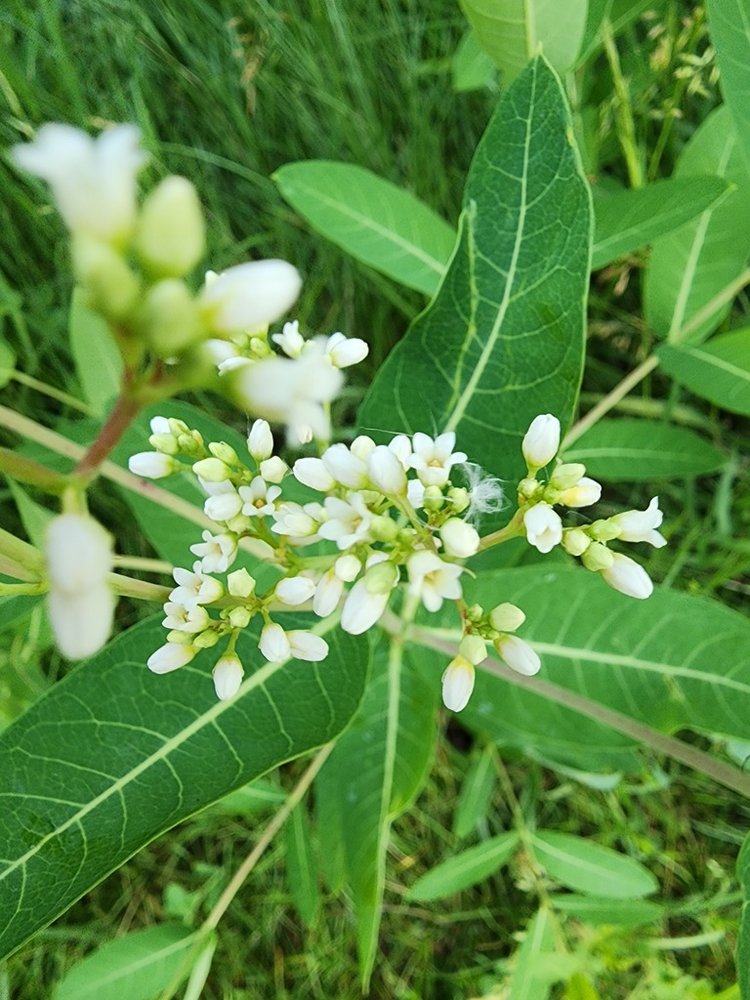
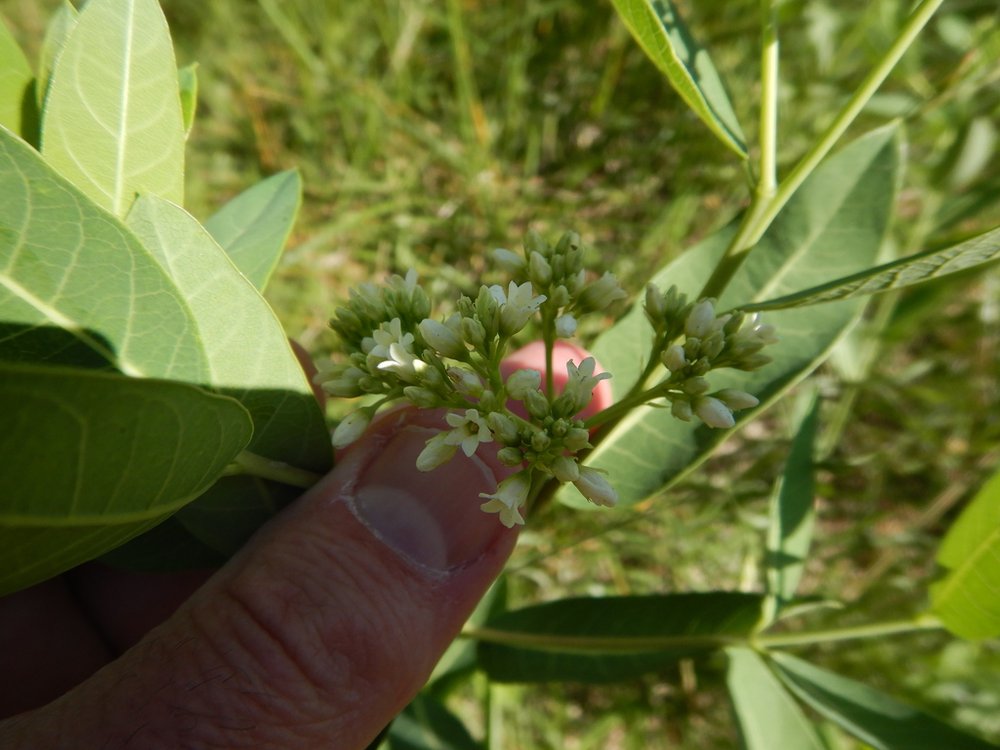
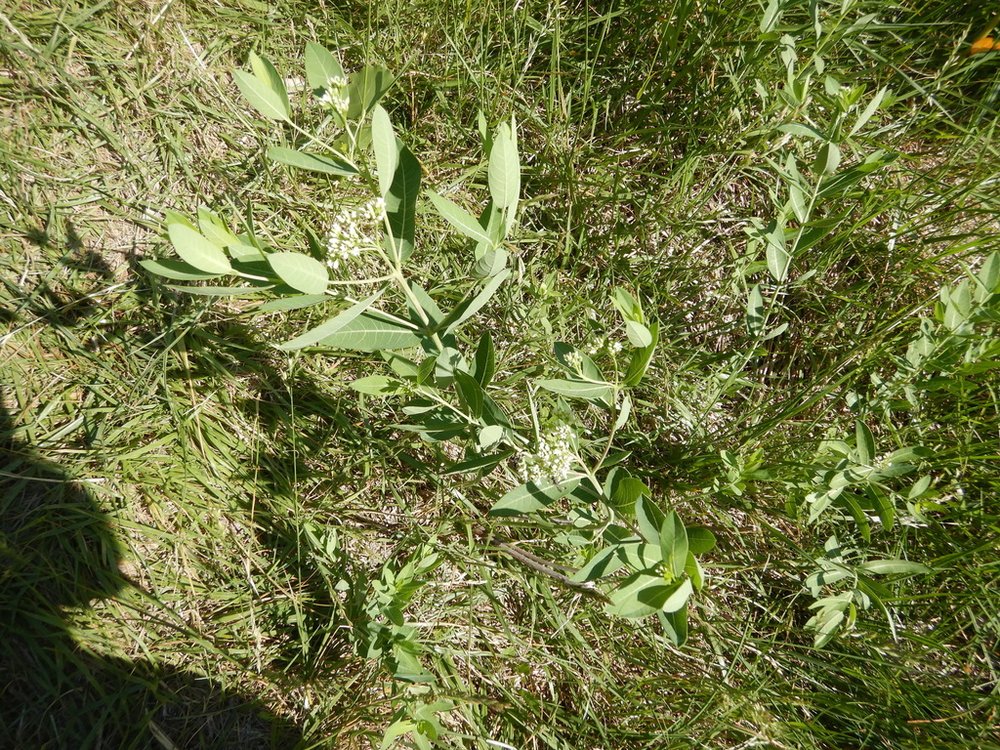
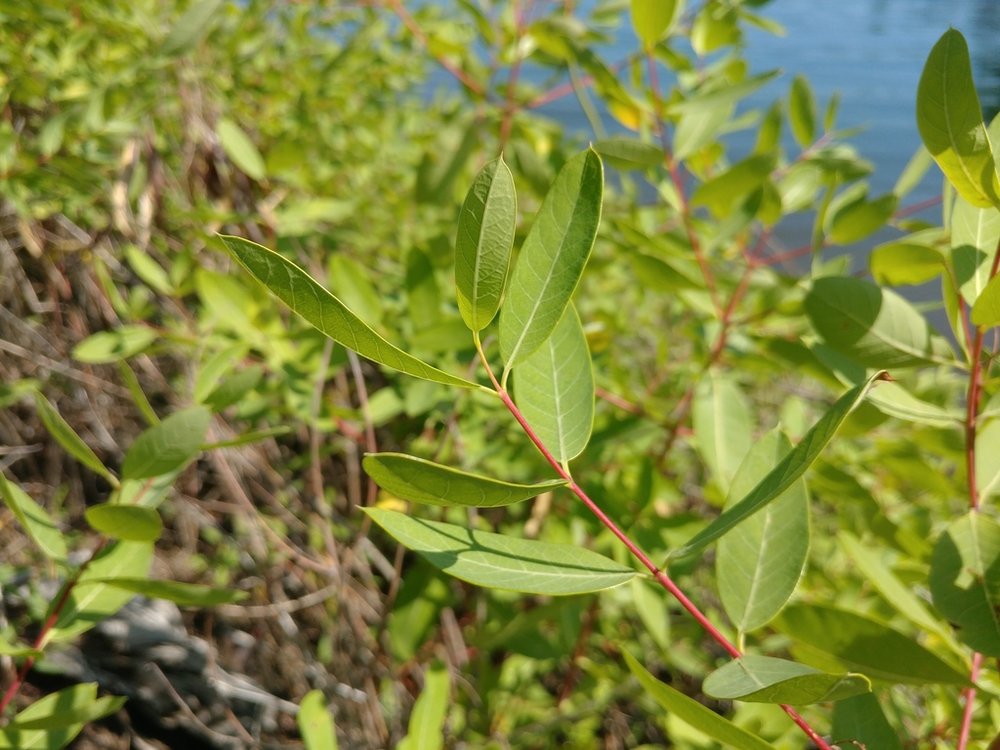
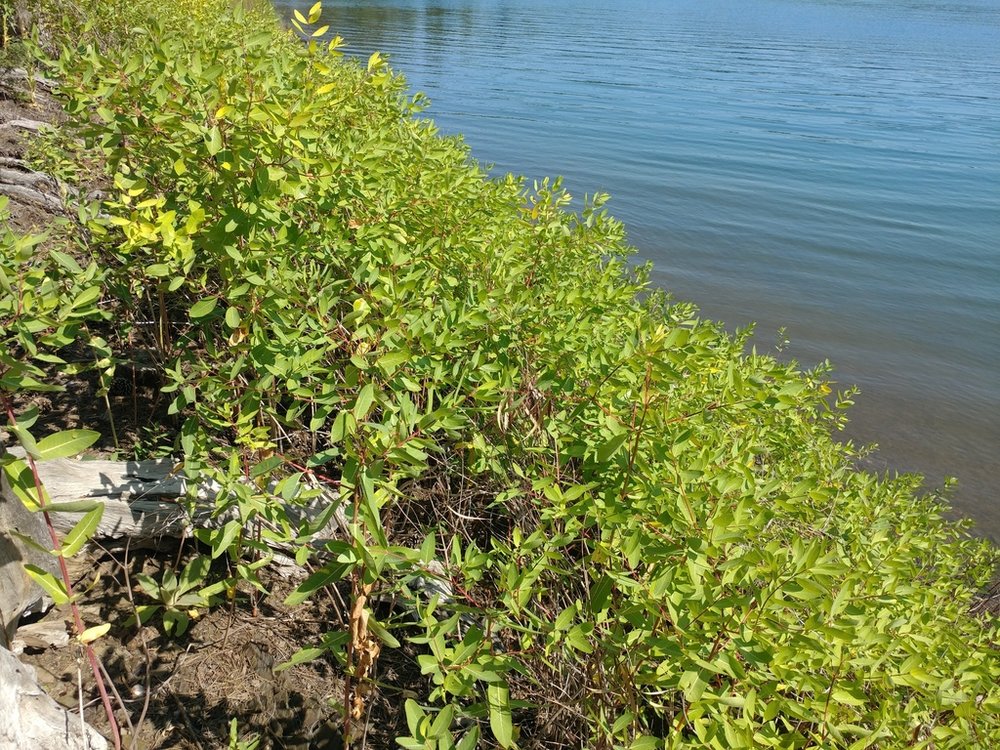
Indian Hemp (Apocynum cannabinum) is a native, bushy perennial with opposite, oval leaves, reddish stems that ooze milky sap when broken, and small clusters of tiny white to greenish-white bells that open from June into August. In the Black Hills it grows along roadsides, meadow and pine-forest edges, creek banks and disturbed ground.
Free photos from other sources
| Family | Apocynaceae · Dogbane |
|---|---|
| Status | Native perennial |
| Blooms | June into August |
| Height | 30–100 cm (12–40 in) |
| Where | Roadsides, meadow and pine-forest edges, creek banks, moist ground and disturbed sites |
| Also called | Hemp Dogbane, Prairie Dogbane, Dogbane, napéoilekiyapi (Lakota) |
| Synonym | Apocynum sibiricum, Apocynum hypericifolium |
| Toxicity | The Lady Bird Johnson Wildflower Center lists all parts as poisonous, with resins and cardiac glycosides. Flora of North America calls the toxicity of Apocynum mild and due to cardiac glycosides, and Black Elk and Flying By (1998) say the Lakota consider the plant toxic. |
| Traditional use | Black Elk and Flying By (1998) record, for the Lakota, that they considered the plant toxic, used its milky sap to remove warts and made nets and twine from the stem fibers. Moerman's ethnobotany database (BRIT) records that the Chippewa considered the fiber the best available for fine cordage (Gilmore 1933), the Meskwaki plaited the outer bast fiber into cord and used it as thread (Smith 1928), and the Kiowa used the milky latex as a chewing gum (Vestal and Schultes 1939). |
| Note | Minnesota Wildflowers treats Clasping Dogbane (Apocynum sibiricum) as a separate, very similar plant, with mostly stalkless, clasping leaves and sometimes yellowish flowers. Flora of North America and USDA PLANTS include it in Indian Hemp. |
Traditional use: first drafted by Google AI, then checked against the sources on this page.
Roots, seeds & germination
Root: The Lady Bird Johnson Wildflower Center lists a taproot for this species.
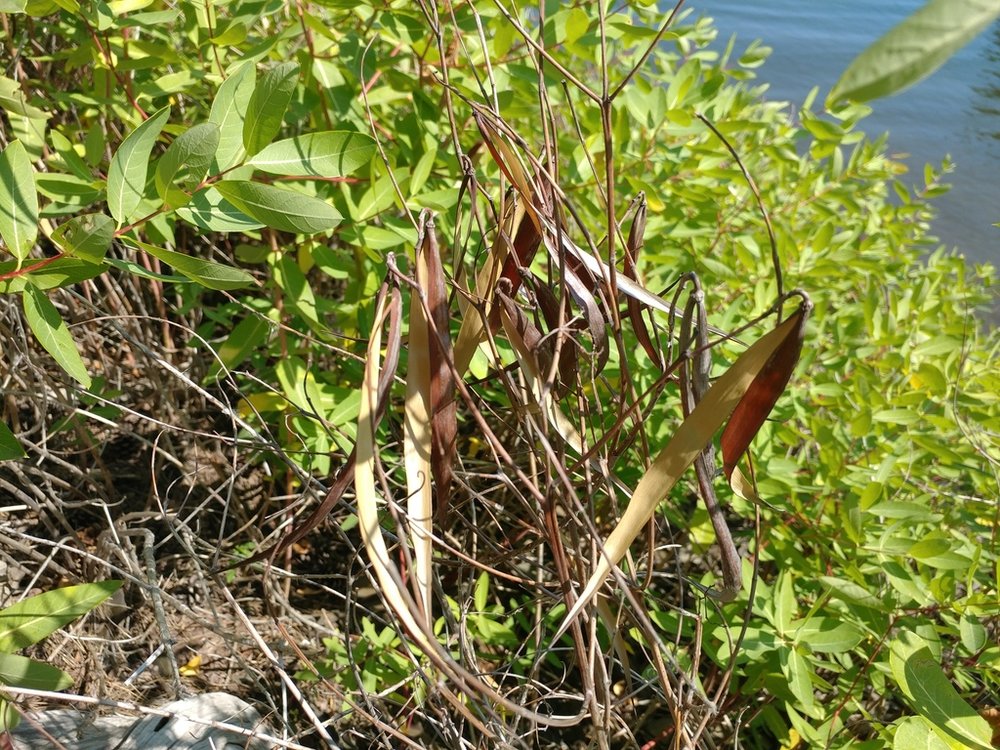
Seed: The fruit is a pair of hanging, slender, slightly curved pods, 10–20 cm (4–8 in) long, with small brown seeds that each carry a tuft of white hair to catch the wind (Minnesota Wildflowers). Flora of North America gives the seeds as 3.5–6 mm long.
How do you identify Indian Hemp?
Look for a bushy plant 30–100 cm (12–40 in) tall whose hairless, reddish-brown stems ooze milky sap when broken. The leaves are opposite, oval to lance-shaped, 3–8 cm (1¼–3 in) long and more than 2½ times as long as wide, with smooth edges, pale veins and a short leaf stalk, and they often point upward. The flowers are tubular to bell-shaped, white to greenish-white and only about 6 mm (¼ in) long or less, in clusters at the top of the plant and at the ends of upper branches, which usually do not rise above the leaves. After bloom, pairs of slender, hanging pods 10–20 cm (4–8 in) long split to release small brown seeds, each with a tuft of white hair. Spreading Dogbane, in this guide, is the other Apocynum here. Flora of North America separates the two: Indian Hemp has white to yellowish-white flowers with a corolla tube 1.5–2.5 mm long, clusters that usually do not rise above the leaves and leaves more than 2½ times as long as wide, while Spreading Dogbane has pink or pink-veined flowers with a tube 4–5 mm long, clusters that usually rise above the leaves and leaves less than twice as long as wide.
When does it bloom?
June into August.
Where does it grow?
Moist soil and open ground in sun or part shade: roadsides, pine-forest and meadow edges, creek banks, riparian woodland, wood-cutting areas and vacant lots, at roughly 1,000–1,650 m (3,300–5,400 ft). Herbarium specimens from 1899 to 2018 come from Meade, Lawrence, Pennington, Custer and Fall River counties in South Dakota and Crook County in Wyoming, and the National Park Service lists it at Devils Tower, and at Wind Cave under the name Apocynum sibiricum.
Other dogbanes in this guide
Dogbane family (Apocynaceae): 7 other plants in this guide
Sources: Minnesota Wildflowers: Apocynum cannabinum (Indian Hemp); Flora of North America Vol. 14: Apocynum cannabinum, eFloras; Flora of North America Vol. 14: genus Apocynum (key), eFloras; Flora of North America Vol. 14: Apocynum androsaemifolium (Spreading Dogbane), eFloras; Lady Bird Johnson Wildflower Center: Apocynum cannabinum (hemp dogbane); USDA PLANTS: Apocynum cannabinum (APCA); USDA PLANTS: Apocynum sibiricum (APSI), which opens the Indianhemp (APCA) profile; NPSpecies checklist, Devils Tower National Monument vascular plants; NPSpecies checklist, Wind Cave National Park vascular plants; GBIF specimen 2859481342: Isaac 2013, edge of pine forest and roadside, 1,205 m, flowering; GBIF specimen 2873276351: 2007, meadow at the edge of ponderosa pine forest and aspen; GBIF specimen 5159174193: Todd 1975, open meadow, white flowers, about 2.5 ft tall; GBIF specimen 5159155744: 1978, riparian woodland below ponderosa pine forest, flowers cream-white, about 3.5 ft; GBIF specimen 2873276372: Nicholas 1990, cool area of a draw, flowering 24 August; GBIF specimen 2512332914: Ecological Solutions Group 2011, disturbed edge of a parking lot, flowering; GBIF specimen 2873276333: Kravig 1968, sunny open bank, 1,067 m, flowering; GBIF specimen 1258022497: Townesmit 2011, forest road, 1,633 m; Native American Ethnobotany Database (BRIT): Apocynum cannabinum; Culturally Important Plants of the Lakota (Black Elk and Flying By, 1998), filed with the South Dakota PUC.