Waxflower Shinleaf Pyrola elliptica
Also called Shinleaf, Wax-flower Wintergreen, Wild Lily-of-the-valley
Waxflower Shinleaf (Pyrola elliptica) is a native perennial with oval, leathery leaves at the base and a raceme (a spike on short stalks) of 3 to 21 nodding white flowers. It flowers from June into August, and in the Black Hills herbarium specimens come from birch, ironwood, aspen, spruce and ponderosa pine woods.
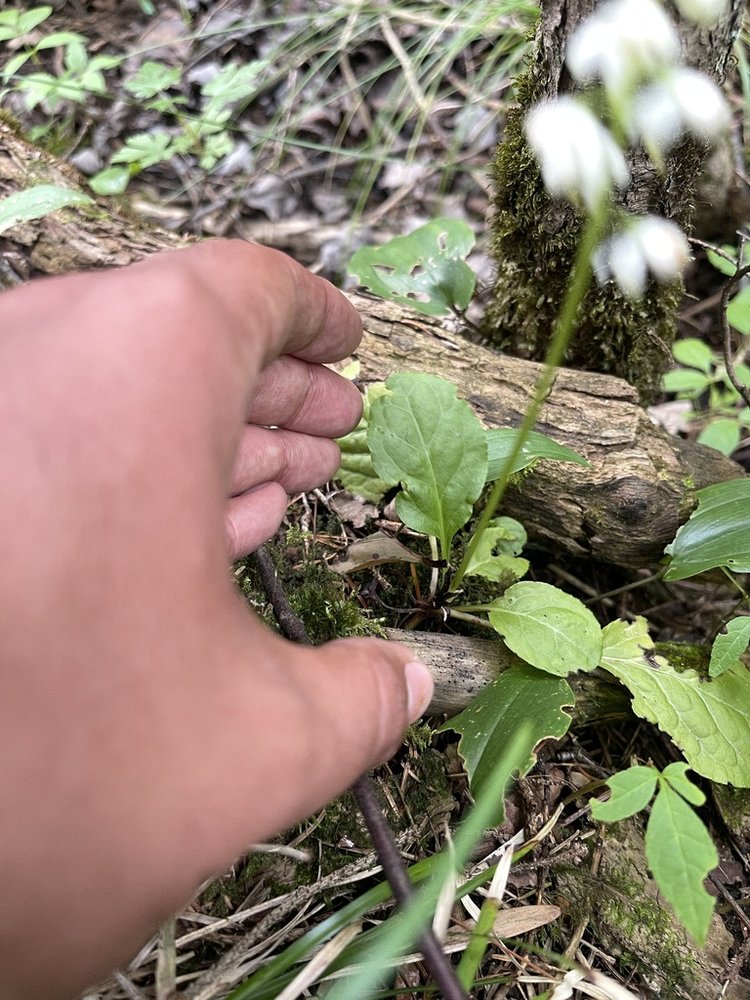
Free photos from other sources
| Family | Ericaceae · Heath |
|---|---|
| Status | Native perennial |
| Blooms | June into August |
| Height | 11–27 cm (4–11 in) |
| Where | Shaded, moist to dry forest |
| Also called | Shinleaf, Wax-flower Wintergreen, Wild Lily-of-the-valley |
| Traditional use | Moerman's database records that the Iroquois gave a decoction of the roots and leaves to babies with fits and used a decoction of the plant as eye drops for sore eyes and sties (Herrick 1977), the Mohegan used an infusion of the leaves as a gargle or wash for mouth sores and sore throat (Tantaquidgeon 1928 and 1972), and the Cherokee stuck the plant on cuts and sores (Hamel and Chiltoskey 1975). |
Traditional use: first drafted by Google AI, then checked against the sources on this page.
Roots, seeds & germination
Root: Flora of North America describes the plants as rhizomatous, meaning they spread by underground stems.
Seed: The fruit is a flattened, round capsule 3–5 mm (⅛–¼ in) long, made of five sections that each hold many seeds, according to Minnesota Wildflowers.
How do you identify Waxflower Shinleaf?
Look for a smooth stalk with a few scale-like leaves, rising from the basal leaves, topped by a raceme of white flowers, each up to about 1.3 cm (½ in) across, with five roundish petals and a pale green style that curves down and out below the lower petals like an elephant's trunk. The leaves are somewhat leathery, 2.5–8 cm (1–3 in) long, longer than wide, and mostly elliptic. Minnesota Wildflowers says they are dull to somewhat shiny and tells this plant from other shinleaves mainly by dull leaves that are nearly always longer than wide, where the others are typically rounder or kidney-shaped; it also says the flowers resemble those of Round-leaved Pyrola (Pyrola americana), which has floral bracts longer than the flower stalk and calyx lobes longer than wide, and those of Green-flowered Pyrola (Pyrola chlorantha), which are more greenish on smaller, rounder leaves.
When does it bloom?
June into August.
Where does it grow?
Shaded woods, from rich, moist ground to dry slopes. Black Hills herbarium labels give open ponderosa pine woodland with granite boulders, birch and ironwood under pine, ironwood forest, white spruce forest with aspen along a creek, rocky mossy ground, shaded slopes in rich forest, aspen understory, deep shady woods and stream bottoms. The 35 specimens on GBIF, collected from 1892 to 2018, come from Lawrence, Custer and Pennington counties in South Dakota and Crook County, Wyoming; the oldest gives an elevation of 5,500 ft (1,680 m). Flora of North America gives dry, upland forests from 10 to 1,700 m (33–5,600 ft) across its range.
Other wintergreens and shinleaves in this guide
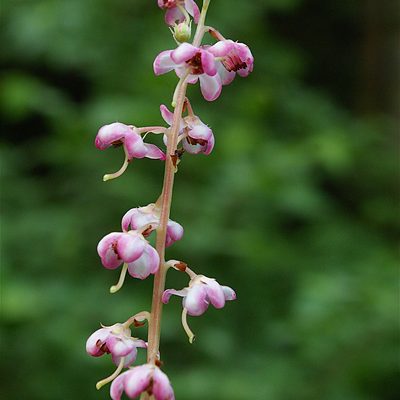
Heath family (Ericaceae): 5 other plants in this guide
Sources: Flora of North America Vol. 8: Pyrola elliptica (Freudenstein), eFloras; Minnesota Wildflowers: Pyrola elliptica (Shinleaf); GBIF occurrence search: Pyrola elliptica, South Dakota and Wyoming herbarium specimens (Black Hills counties); GBIF specimen 4947535667: Basinger 2018, Pennington County, "granite boulders in open ponderosa pine woodland"; GBIF specimen 3454985152: Johnson 1998, Custer County, "Under paper birch, ironwood and large ponderosa pine"; GBIF specimen 2512288914: Elliott 2010, Lawrence County, "Ostrya virginiana forest"; GBIF specimen 2562611531: Mayer 2009, Pennington County, "Picea glauca/Linnaea borealis community ... Flat moist area along creek"; GBIF specimen 2562611532: Mayer 2009, Pennington County, "E-facing, rocky, mossy"; GBIF specimen 3454985260: Larson and Johnson 1991, Custer County, "Base of shaded slope in rich forest"; GBIF specimen 3454991032: Schneeweis 1967, Lawrence County, "An occasional member of aspen understories"; GBIF specimen 2512328689: Over 1924, Lawrence County, "Deep shady woods"; GBIF specimen 5895891538: Rydberg 1892, Custer, "Alt. 5500 feet"; GBIF specimen 5069577695: Ownbey 1938, Crook County, Wyoming, "In shady canyon bottom"; Native American Ethnobotany Database (BRIT): Pyrola elliptica; South Dakota Game, Fish and Parks: Rare Plants of South Dakota (Pyrola elliptica not listed).