Woodland Pinedrops
Pterospora andromedea
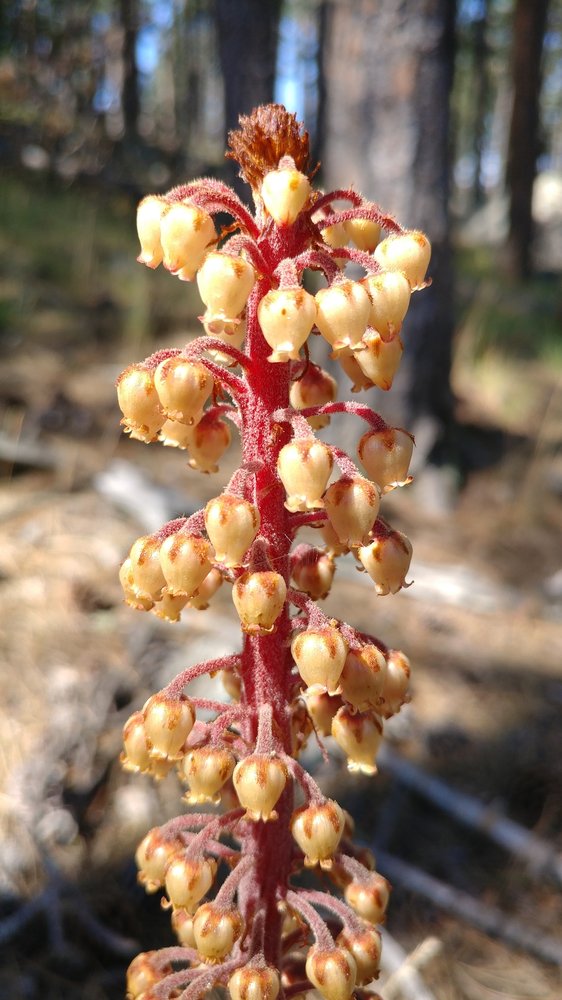
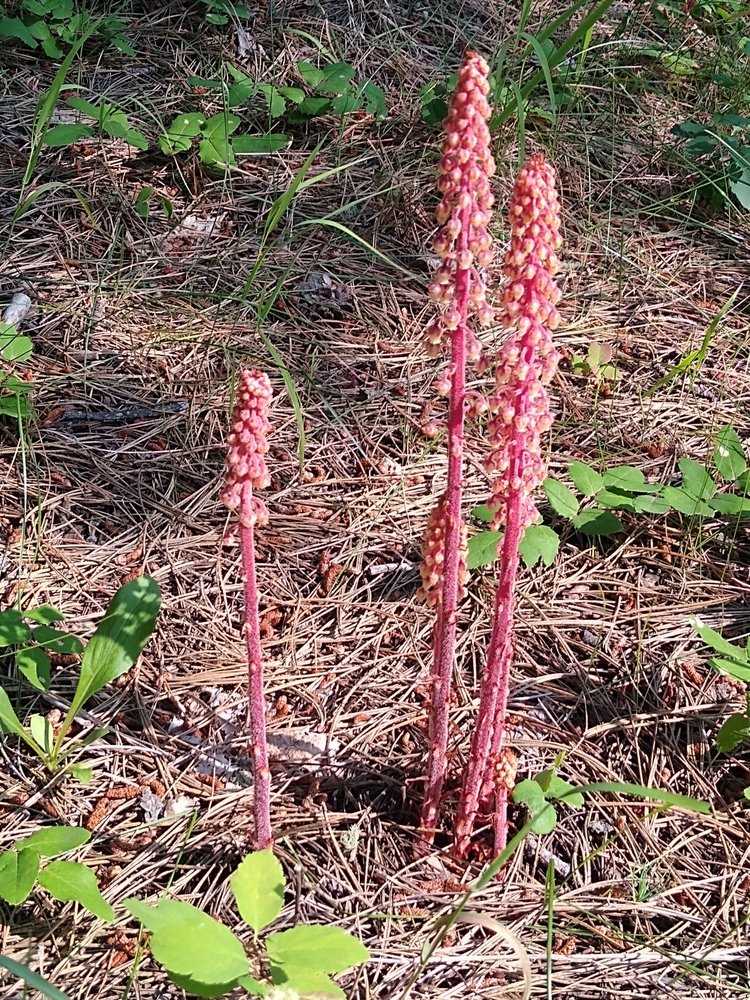
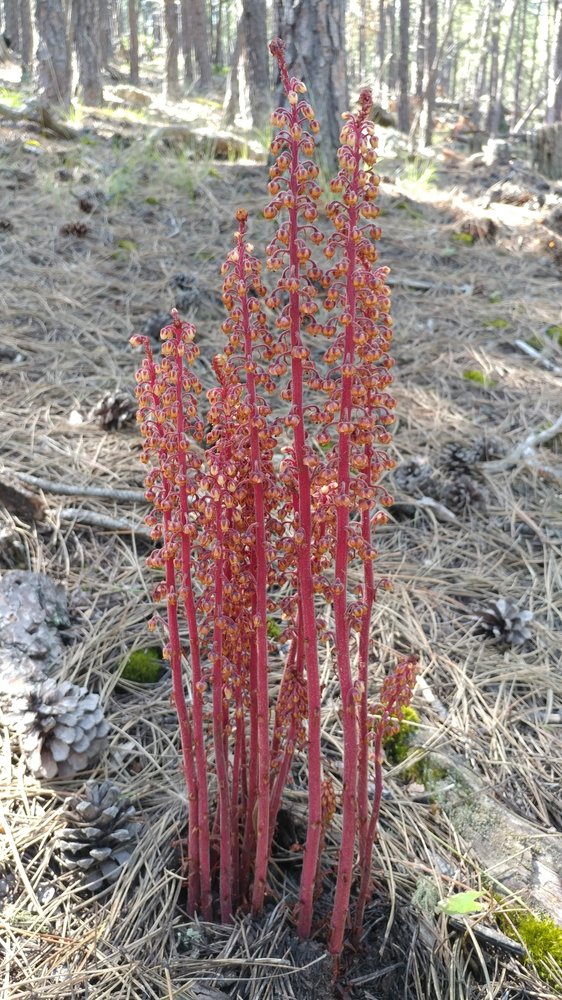
Woodland Pinedrops (Pterospora andromedea) is a native plant with no green in it at all: a sticky red stalk, knee-high or taller, that pushes up through pine needles and hangs out dozens of small cream-colored bells in July and August. It makes no food of its own and lives off a soil fungus that is also linked to pine roots, and the National Park Service lists it at Wind Cave, Mount Rushmore and Devils Tower.
Free photos from other sources
| Family | Ericaceae (subfamily Monotropoideae; older books: Monotropaceae) · Heath |
|---|---|
| Status | Native perennial |
| Blooms | July into August |
| Height | 30–90 cm (12–36 in) |
| Where | Deep pine-needle litter under ponderosa pine, in shade or part sun |
| Also called | Pinedrops, Giant Pinedrops, Giant Bird’s-nest |
| Synonym | Monotropa procera |
| Listed | NatureServe ranks it S3S4 (vulnerable to apparently secure) in Wyoming; South Dakota does not rank it. |
Roots, seeds & germination
Root: A thick, fleshy cluster of roots, often several hundred root tips, each wrapped in a sheath of its fungal partner. The plant is perennial: it sends up one or several stalks in summer, and in some years none.
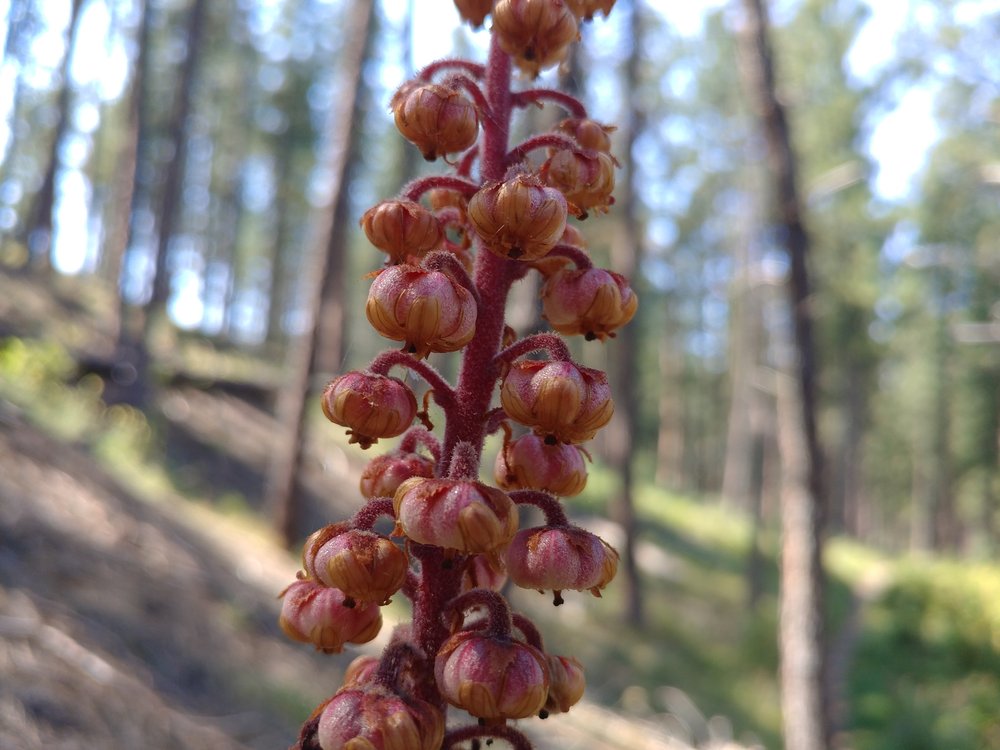
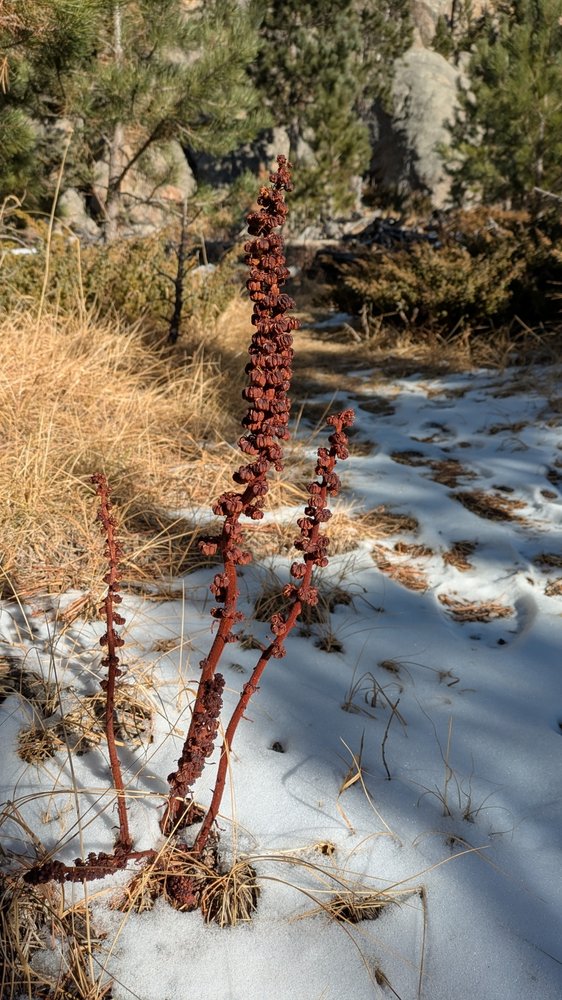
Seed: Each flower becomes a five-celled capsule 5–10 mm long and 7–14 mm (¼–½ in) wide that splits open in August and September. It holds 100 or more tiny seeds, 0.2–0.5 mm long including a broad, see-through papery wing, that blow long distances on the wind.
Germination: The seed will not sprout on its own. In lab tests seeds germinated only next to the Rhizopogon fungus taken from adult plants, and even then only up to 13% sprouted. The Forest Service says it is hard to establish and does not transplant well.
How do you identify Woodland Pinedrops?
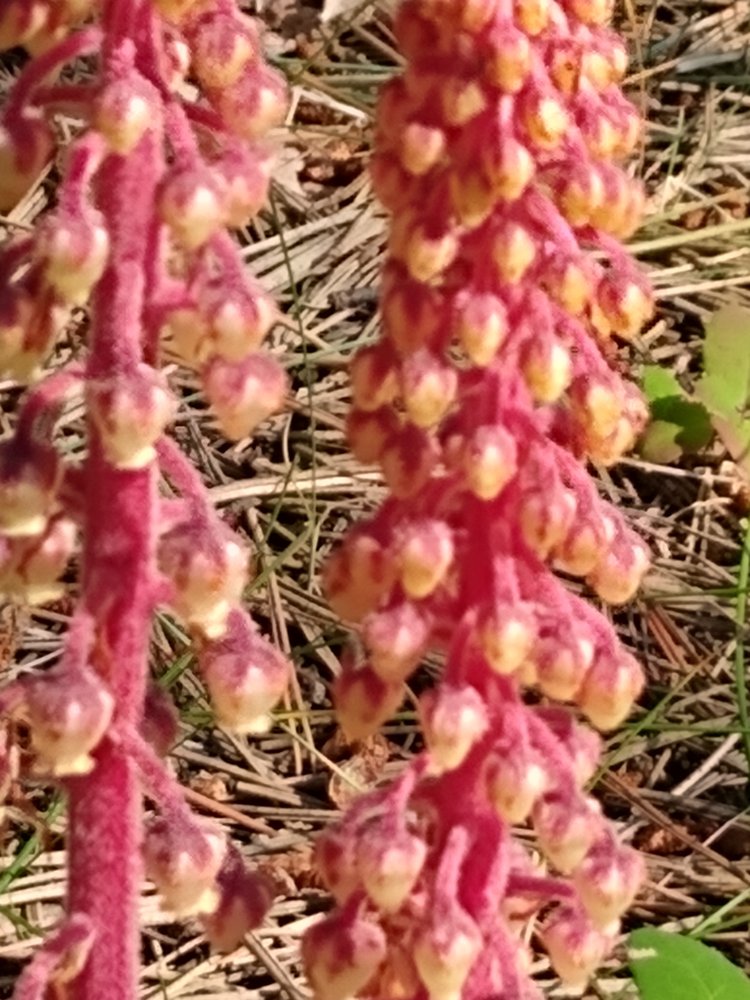
Look in pine-needle litter for a single, unbranched, fleshy stalk 30–90 cm (12–36 in) tall, pink-red to reddish-brown, with no green leaves, only a few narrow purplish scales, mostly near the base. The whole stalk is covered with short, sticky glandular hairs. The upper part carries many nodding, urn-shaped flowers, 6–9 mm (¼ in) long, cream to pale yellow, each on a down-curved stalk. Spotted Coralroot, a leafless orchid that also grows in the Hills, is shorter, 15–55 cm (6–22 in), with a smooth stem and orchid flowers with a white, purple-spotted lip. The stalk turns woody and stiff after flowering, and dried stalks from the year before can still be standing in June.
When does it bloom?
July into August.
Where does it grow?
Shade or part shade of ponderosa pine forest where needle litter lies thick, over granite, limestone and shale; Black Hills labels also mention pine-spruce, lodgepole pine, aspen-birch and pine-bur oak woods. It needs a soil fungus that is linked to living pine roots, so it grows near pines. The species lists for Wind Cave, Mount Rushmore and Devils Tower include it, and herbarium specimens since 1892 come mostly from Lawrence, Pennington and Custer counties, SD, and Crook County, WY, from about 1,100 to 2,000 m (3,500–6,500 ft).
Other flowers to compare
Sources: Woodland Pinedrops, Plant of the Week (USDA Forest Service, Celebrating Wildflowers); Pinedrops, Mycotrophic Wildflowers (USDA Forest Service, Celebrating Wildflowers); Monotropaceae: Pterospora andromedea (R. N. Reese, SDSU Open PRAIRIE, Native Plants); Flora of North America vol. 8: Pterospora (efloras.org); Pterospora andromedea, USDA PLANTS Database (PTAN2); Pterospora andromedea, ITIS TSN 23787; In vitro germination of nonphotosynthetic, myco-heterotrophic plants stimulated by fungi isolated from the adult plants (Bruns & Read 2000, New Phytologist 148:335-342); Pterospora andromedea, Botanical Society of America parasitic plants pages; Botanical Electronic News no. 259 (fungal partner of Pterospora in British Columbia); NPSpecies: Pterospora andromedea, Wind Cave National Park; NPSpecies: Pterospora andromedea, Devils Tower National Monument; NPSpecies checklist, Mount Rushmore National Memorial; GBIF herbarium specimens, South Dakota; GBIF herbarium specimens, Wyoming; Woodland Pinedrops, iNaturalist; Flora of North America vol. 8: Pterospora andromedea (efloras.org); GBIF Backbone Taxonomy: Pterospora andromedea (synonyms); NatureServe Explorer: Pterospora andromedea (state ranks); Minnesota Wildflowers: Spotted Coralroot (Corallorhiza maculata).