Hood's Phlox Phlox hoodii
Also called Spiny Phlox, Carpet Phlox, White Phlox
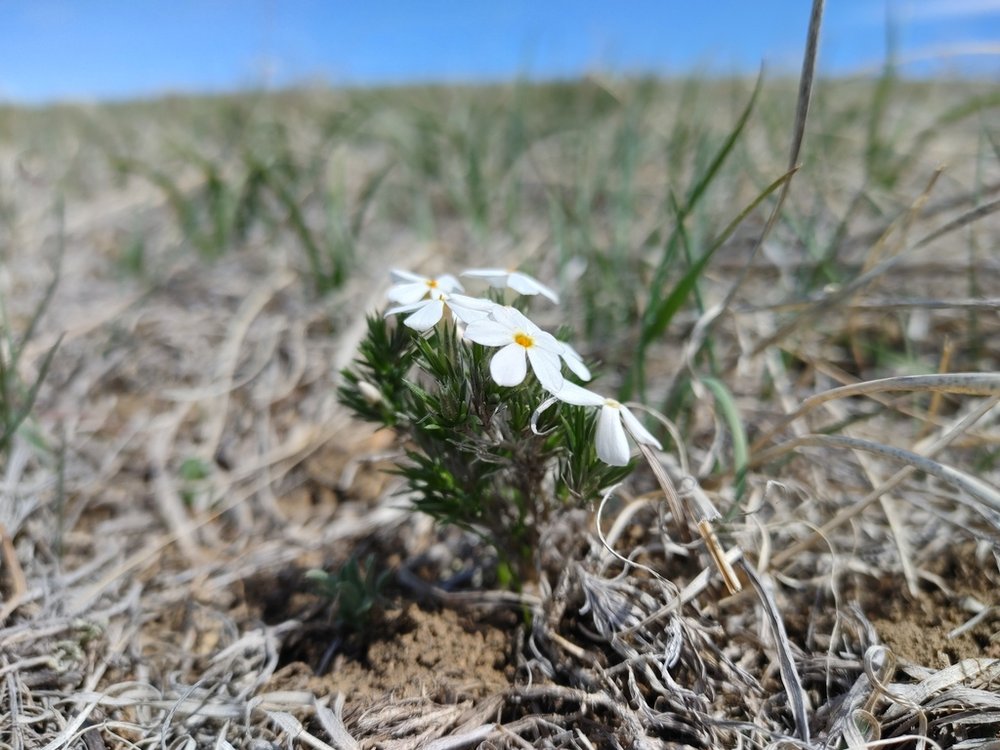
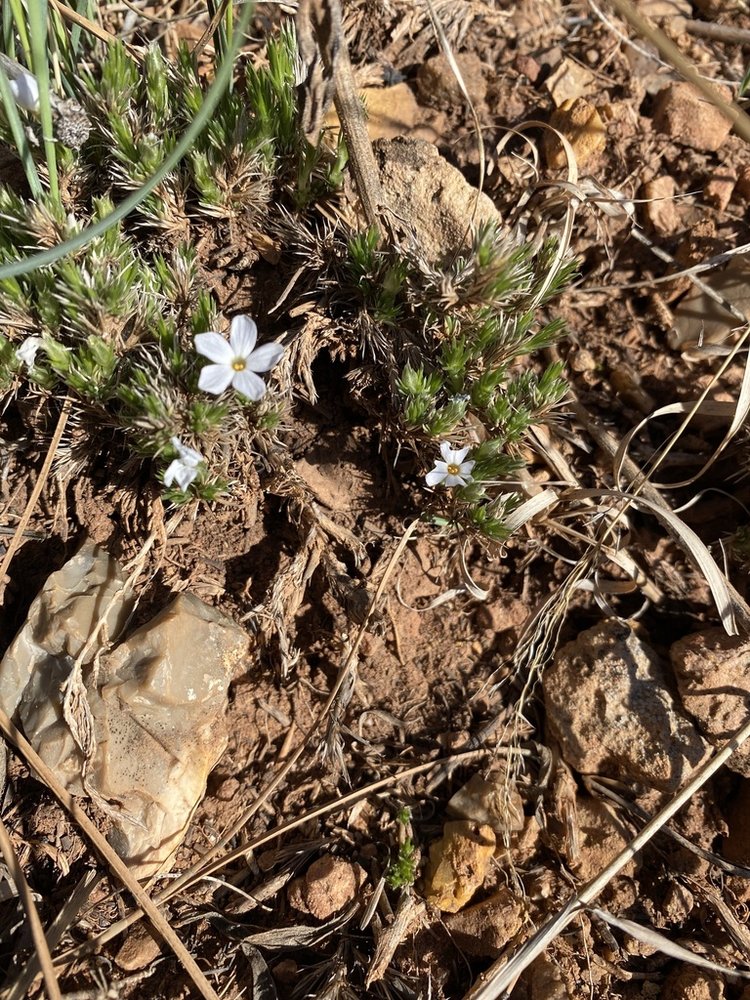
Hood's Phlox (Phlox hoodii) is a low native perennial that grows from a taproot into a dense cushion 2–10 cm (1–4 in) tall, packed with stiff, needle-like leaves, and carries single five-lobed flowers, white to pale blue, pink or lavender, from March into June. It flowers early in spring on dry prairie, rocky outcrops and open pine in and around the Black Hills, where the National Park Service lists it at Wind Cave, Jewel Cave and Devils Tower.
Free photos from other sources
| Family | Polemoniaceae · Phlox |
|---|---|
| Status | Native perennial |
| Blooms | March into June |
| Height | 2–10 cm (1–4 in) |
| Where | Dry prairie, rocky outcrops, sagebrush flats and open pine woodland |
| Also called | Spiny Phlox, Carpet Phlox, White Phlox |
| Synonym | Phlox hoodii subsp. canescens, Phlox hoodii var. canescens, Phlox hoodii subsp. glabrata, Phlox hoodii subsp. muscoides |
| Traditional use | John Hellson's 1974 study of Blackfoot plant use, as indexed by the BRIT ethnobotany database, records that the Blackfoot gave an infusion of the plant to children as a mild laxative, took it for chest pains, and made a yellow dye from it. |
Roots, seeds & germination
Root: A taproot under a base that turns woody with age. South Dakota State University divides mature mats in early spring or late fall.
Seed: A small egg-shaped capsule 3–4 mm (about ⅛ in) long that turns brown and splits open in late spring or early summer, with one seed in each of its three cells. South Dakota State University collects the capsules as they begin to brown and split.
Germination: South Dakota State University sows the seed outdoors in fall, so winter does the chilling, or gives it 30 to 60 days of cold, moist treatment, in well-drained sandy or gravelly soil and full sun; the plant dislikes wet ground.
How do you identify Hood's Phlox?
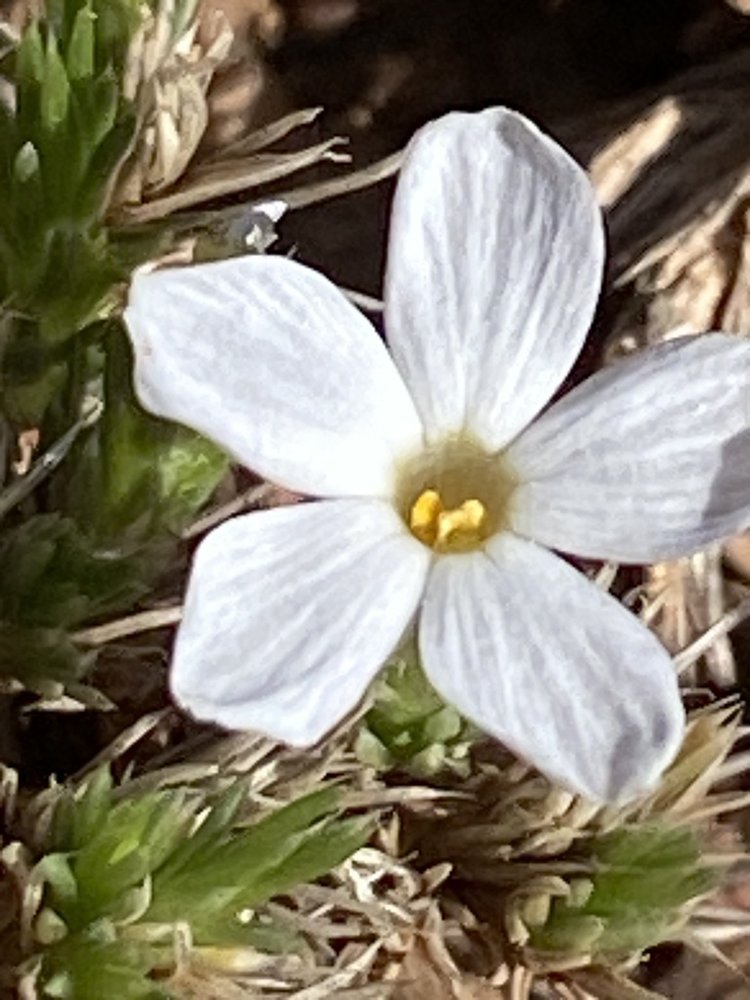
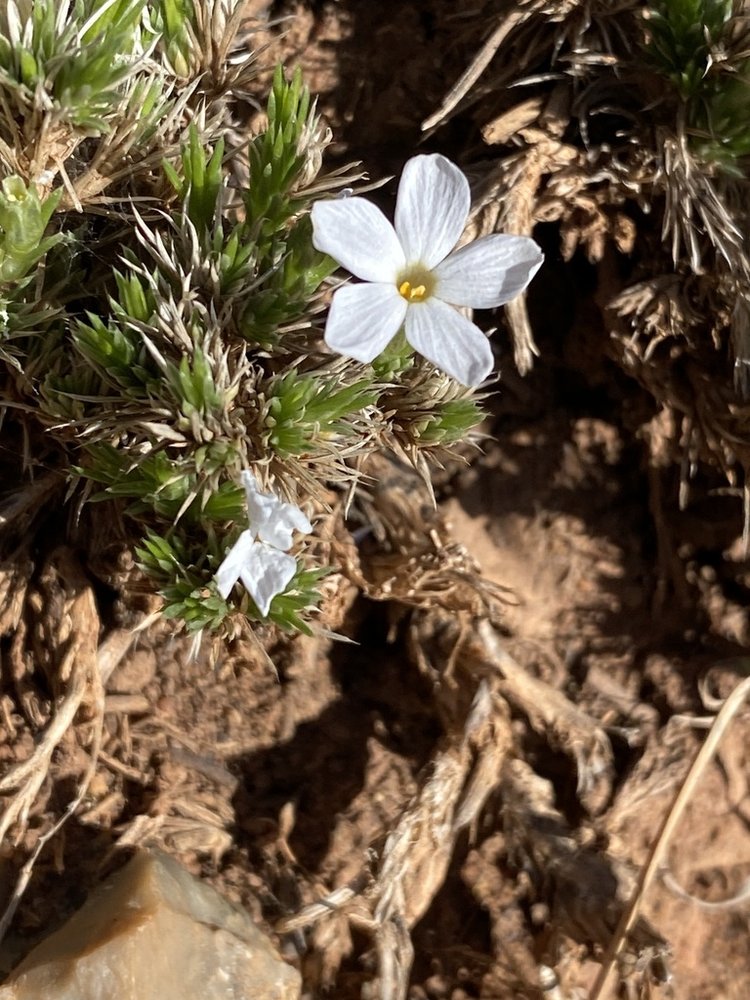
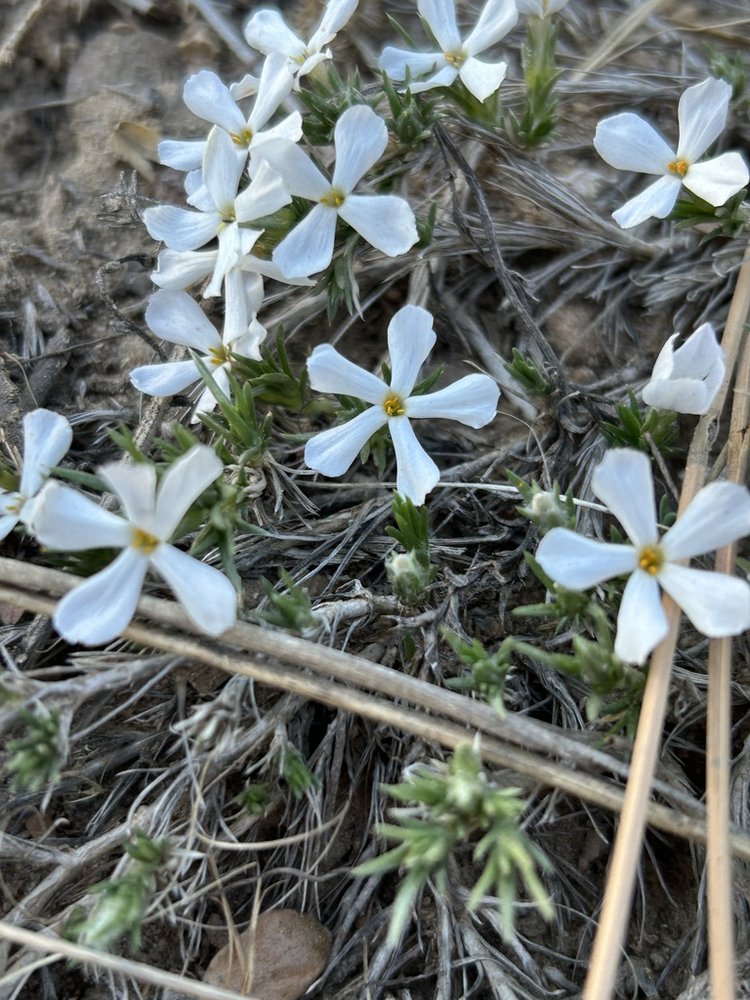
Look for a tight, spiny-looking cushion or mat, usually 2–10 cm (1–4 in) tall, with stiff, sharp-pointed, needle-like leaves only 4–12 mm (⅛–½ in) long that carry tangled woolly hairs at the base and along the thin white edges. The flowers sit single and stalkless at the stem tips: a narrow tube 6–11 mm (¼–⅜ in) long opening into five lobes 3–7 mm (⅛–¼ in) long, white to pale blue, sometimes pink or lavender, with the stamens hidden inside the tube; the calyx behind the flower is woolly. Alyssum-leaf Phlox, also in the Hills, has stems 4–15 cm (1½–6 in) long, firm, narrow to elliptic leaves 9–20 mm (⅜–¾ in) long that are mostly hairless and usually white-edged, one to three flowers per stem, and a flower tube 10–17 mm (⅜–⅔ in) long with lobes 8–12 mm (⅜–½ in).
When does it bloom?
March into June.
Where does it grow?
Dry, open, sunny ground: short grassland, exposed or grazed hillsides, rocky and stony soil, sagebrush grassland, red sandy soil, limestone ridges and open ponderosa pine. Most Black Hills specimens come from the foothills and outer edge of the Hills, with a few from inside them and from Custer State Park. The National Park Service lists it at Wind Cave, Jewel Cave and Devils Tower, the 1986 plant survey of Jewel Cave records it as White Phlox, Devils Tower's wildflower list gives it flowering from March to May, and herbarium specimens from 1888 to 2013 come from all seven Black Hills counties, many of them from the plains just outside the Hills.
Other phloxes in this guide
Phlox family (Polemoniaceae): 3 other plants in this guide
Sources: Polemoniaceae: Phlox hoodii (R. Neil Reese) — SDSU Open PRAIRIE; Phlox hoodii — Burke Herbarium Image Collection, University of Washington; Hood's Phlox, Phlox hoodii — Montana Field Guide; Alyssum-leaf Phlox, Phlox alyssifolia — Montana Field Guide; Native Plants, wildflowers by color — Devils Tower National Monument, National Park Service; Phlox hoodii Richardson (PHHO) — USDA PLANTS Database; Phlox hoodii Richardson, TSN 30948 — ITIS; NPSpecies checklist, Wind Cave National Park vascular plants — National Park Service; NPSpecies checklist, Jewel Cave National Monument vascular plants — National Park Service; NPSpecies checklist, Devils Tower National Monument vascular plants — National Park Service; Marriott and Hartman 1986, A Survey of the Vegetation of Jewel Cave National Monument — NPS History; Phlox hoodii, South Dakota and Wyoming herbarium specimens — GBIF; Phlox hoodii — BRIT ethnobotany database (NAEB).