Ballhead Gilia Ipomopsis congesta
Also called Ballhead Ipomopsis, Ball-head Gilia, Ball-head Standing-cypress, yažókapi hú (Lakota)
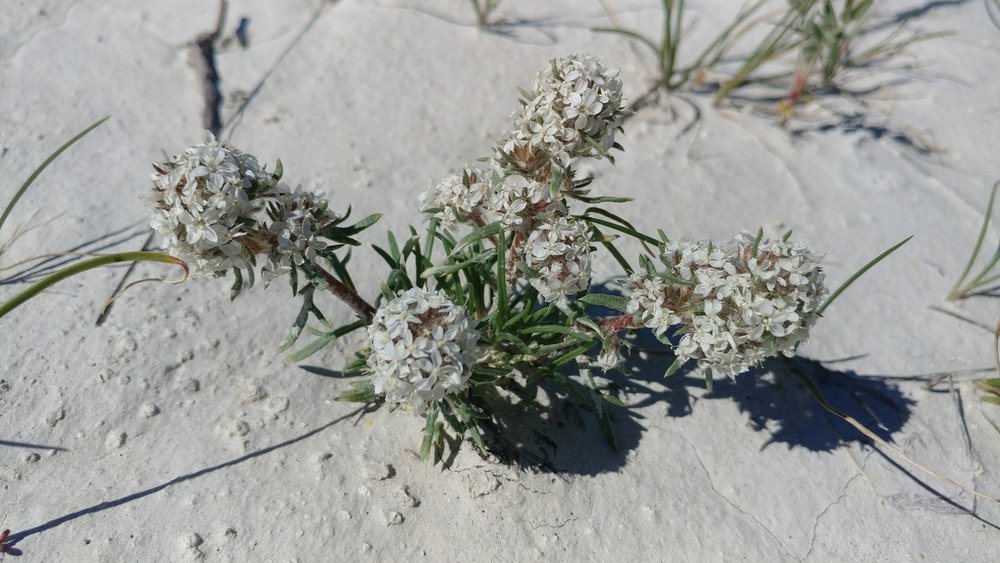
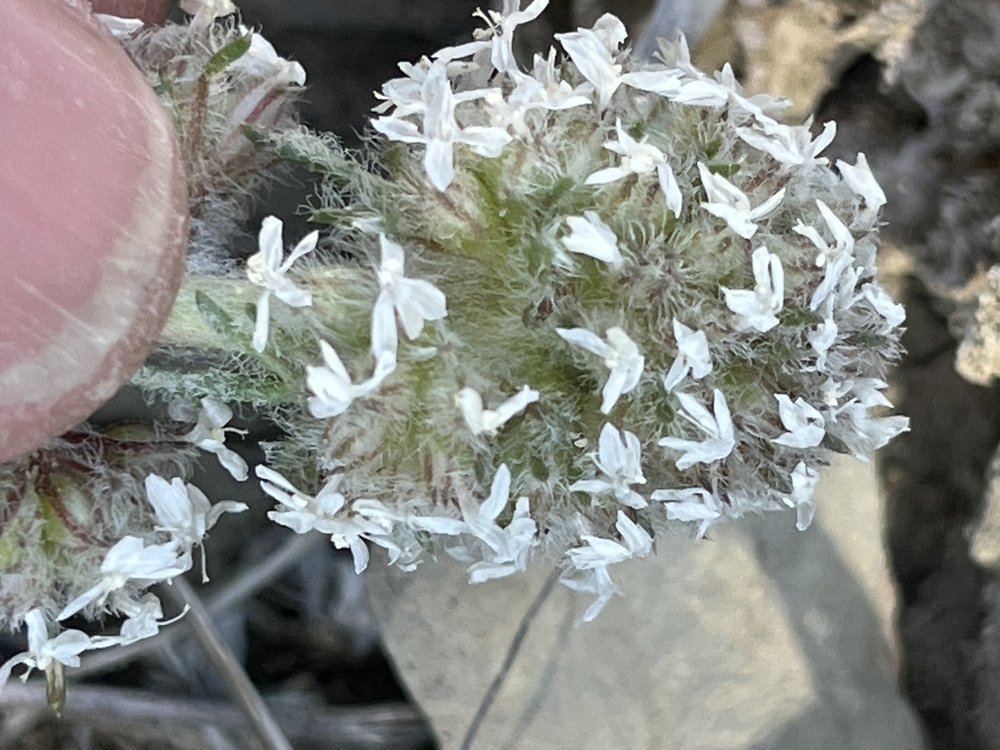
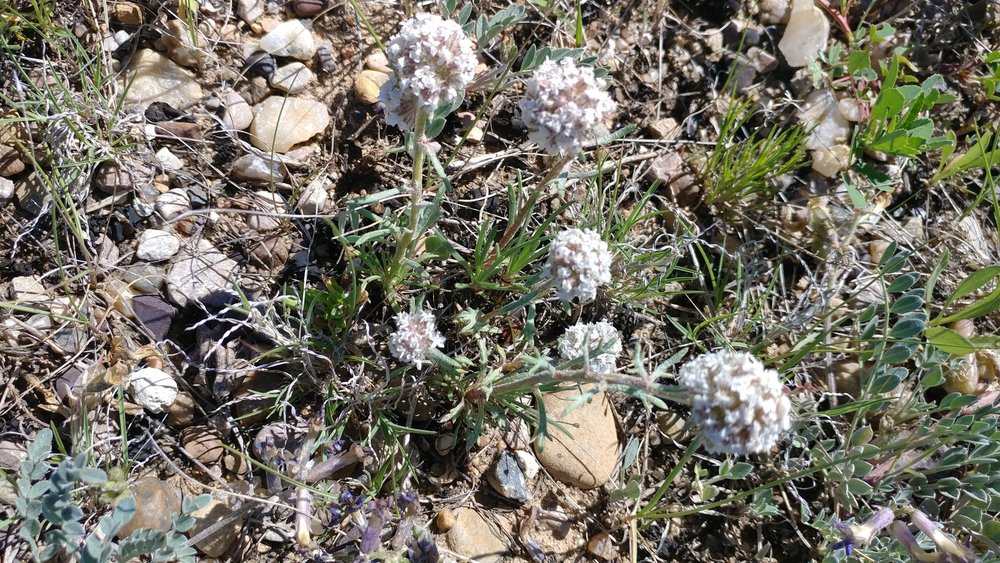
Ballhead Gilia (Ipomopsis congesta) is a low native perennial with tight, round heads of small white flowers at the tips of stems 4–20 cm (1½–8 in) long that stand up or lie along the ground. Herbarium specimens from the Black Hills region were mostly collected in May and June; those from the Hills themselves name hillsides, a ridgeline, red clay and red shale soils, clay banks and a pine slope, and the National Park Service lists it at Wind Cave, Jewel Cave and Devils Tower.
Free photos from other sources
| Family | Polemoniaceae · Phlox |
|---|---|
| Status | Native perennial |
| Blooms | May into June, judging by the dates on flowering herbarium specimens from the Black Hills and nearby plains |
| Height | 4–20 cm (1½–8 in) |
| Where | Grassland, hillsides, badlands and pine woodland, in sandy or clay soil |
| Also called | Ballhead Ipomopsis, Ball-head Gilia, Ball-head Standing-cypress, yažókapi hú (Lakota) |
| Synonym | Gilia congesta |
| Traditional use | Black Elk and Flying By's 1998 Culturally Important Plants of the Lakota gives the Lakota name yažókapi hú for ballhead gilia and records that an infusion of the whole plant was used as a blood tonic. |
| Note | The National Park Service lists the Wind Cave, Jewel Cave and Devils Tower plants as subspecies pseudotypica. |
Roots, seeds & germination
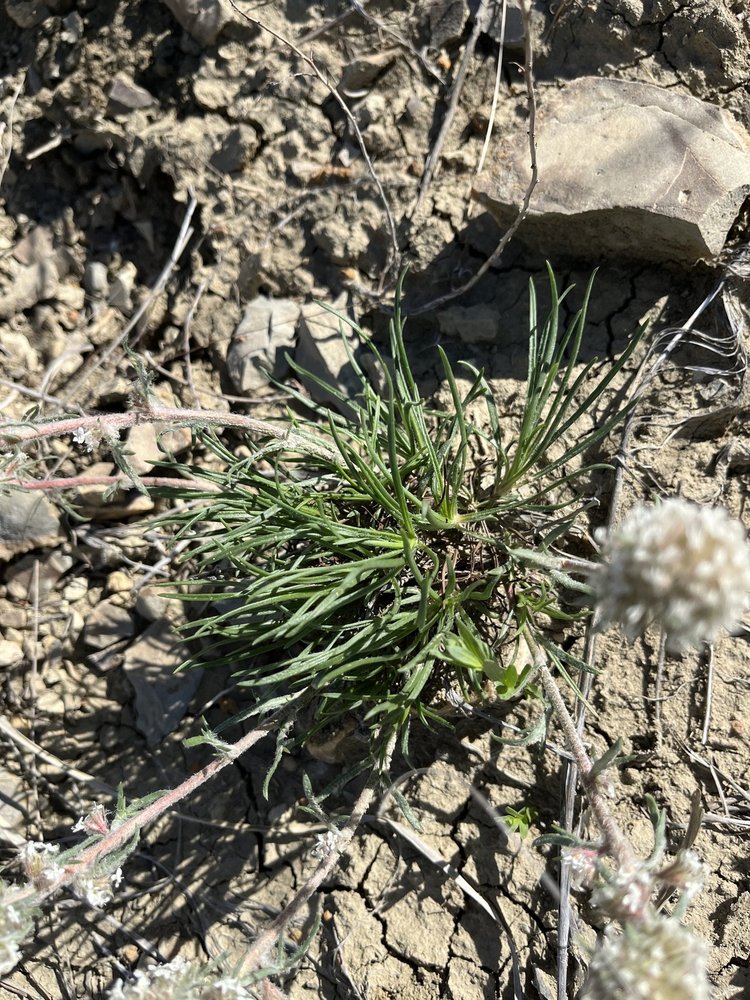
Root: A woody, branched base (caudex) from which the stems rise (Montana Field Guide, after the Manual of Montana Vascular Plants).
Seed: The capsule is 2–4 mm long and holds 1 or 2 seeds in each chamber (Montana Field Guide, after the Manual of Montana Vascular Plants).
How do you identify Ballhead Gilia?
Look for a low perennial with a woody, branched base and stems 4–20 cm (1½–8 in) long that stand up or lie along the ground. The leaves are 5–60 mm (¼–2⅓ in) long, either whole or cut like a feather into narrow lobes, and the plant ranges from woolly to hairless. The flowers crowd into tight, ball-shaped heads at the stem tips and in the leaf axils. Each one is white, with a slender tube 3–5 mm (⅛–¼ in) long that opens into small flat lobes 1–3 mm long, and the stamens stick out past the tube. The seed capsule is 2–4 mm (about ⅛ in) long and holds 1 or 2 seeds in each chamber (Manual of Montana Vascular Plants, through the Montana Field Guide). Labels on Black Hills specimens say the flowers are white, and the 1986 Jewel Cave plant survey lists it among its white-flowered plants.
When does it bloom?
May into June, judging by the dates on flowering herbarium specimens from the Black Hills and nearby plains.
Where does it grow?
Sandy or clay soil in grassland, sagebrush steppe, badlands and pine woodland, from plains to mountains (Montana Field Guide, after the Manual of Montana Vascular Plants). GBIF holds 49 preserved specimens from the seven Black Hills counties of South Dakota and Wyoming (Pennington 12, Weston 10, Crook 10, Lawrence 8, Fall River 5, Custer 3, Meade 1), collected from 1897 to 2018. Those from the Black Hills and their edges name hillsides, a ridgeline, red clay, red shale and red sandy soils, eroded red slopes, steep clay banks, grassland and a pine-forest slope; those from the Badlands and the plains name badlands, gumbo (heavy clay) soil and buttes. The 17 labels that give an elevation run from 838 to 1,646 m (2,750–5,400 ft). The National Park Service lists it as present at Wind Cave, Jewel Cave and Devils Tower, in each case as subspecies pseudotypica, and 41 of the 49 specimens carry that subspecies name. The 1986 Jewel Cave plant survey lists it for the monument. iNaturalist has 7 research-grade records from the Black Hills area, 6 of them in May.
Phlox family (Polemoniaceae): 3 other plants in this guide
Sources: Montana Field Guide: Ballhead Ipomopsis (Ipomopsis congesta), after Lesica et al. 2012, Manual of Montana Vascular Plants; USDA PLANTS Database: Ipomopsis congesta (IPCO5), ballhead ipomopsis; NPSpecies checklist, Wind Cave National Park (vascular plants); NPSpecies checklist, Jewel Cave National Monument (vascular plants); NPSpecies checklist, Devils Tower National Monument (vascular plants); Marriott and Hartman 1986, A Survey of the Vegetation of Jewel Cave National Monument; GBIF occurrence search: Ipomopsis congesta, preserved specimens, South Dakota and Wyoming; iNaturalist: Ipomopsis congesta research-grade observations in the Black Hills; Culturally Important Plants of the Lakota (Black Elk and Flying By, Sitting Bull College, 1998), entry 153; South Dakota Natural Heritage Program: Rare Plants of South Dakota; Black Hills National Forest Revised Forest Assessment: At-Risk Species (October 2023).