Glaucous Honeysuckle Lonicera dioica
Also called Limber Honeysuckle, Wild Honeysuckle, Red Honeysuckle, čhaŋwískuye (Lakota, honeysuckles in general)
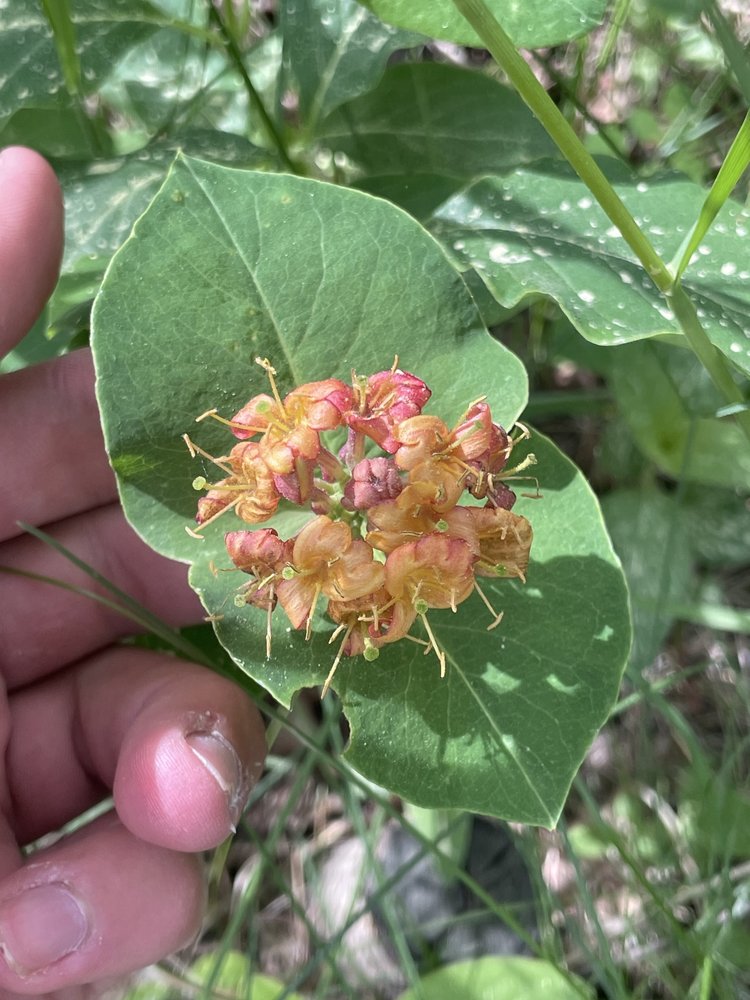
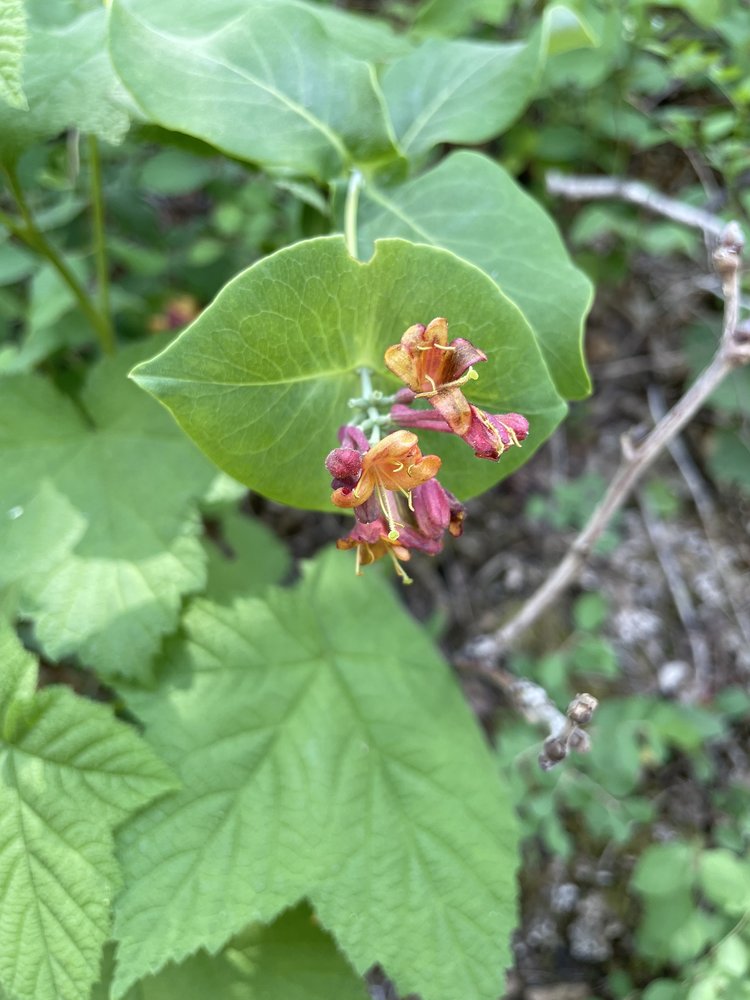
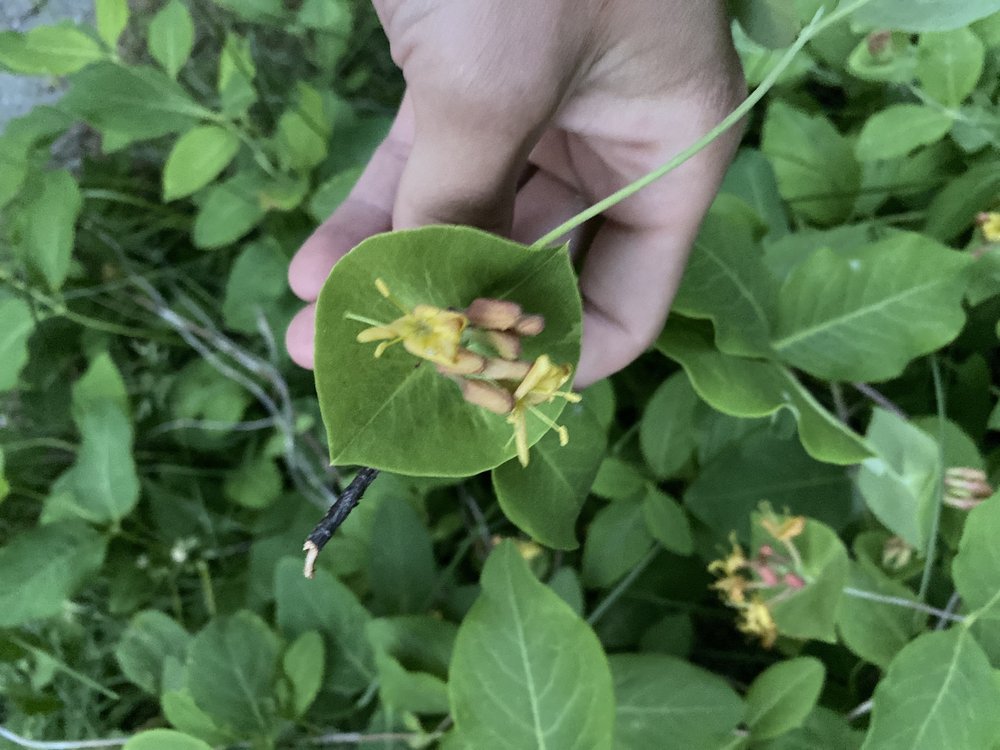
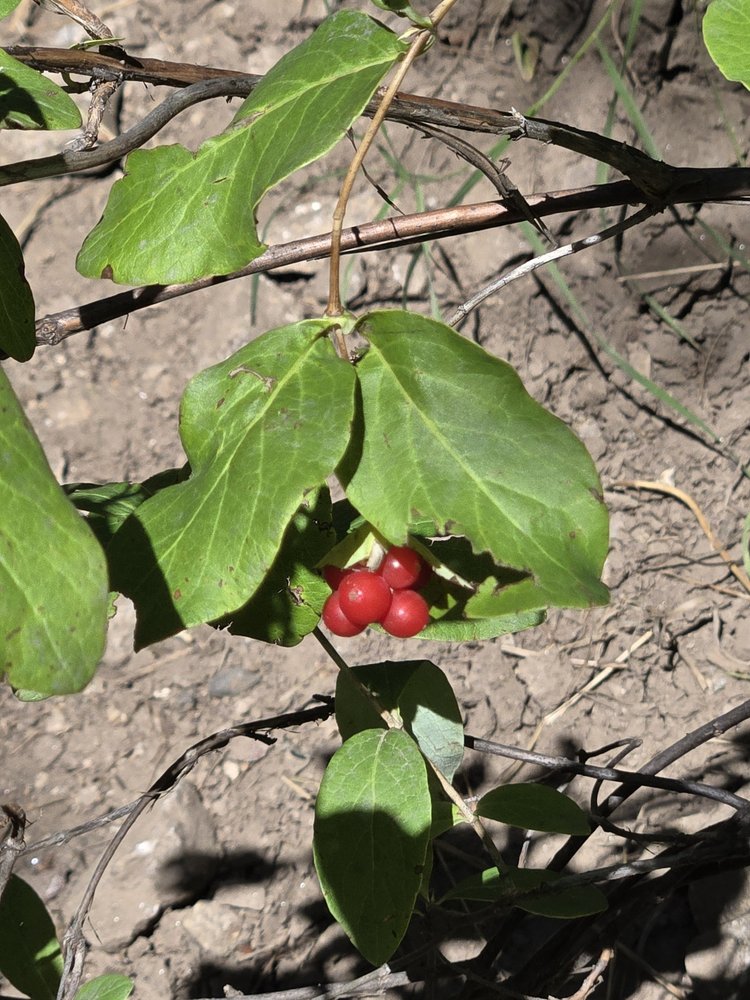
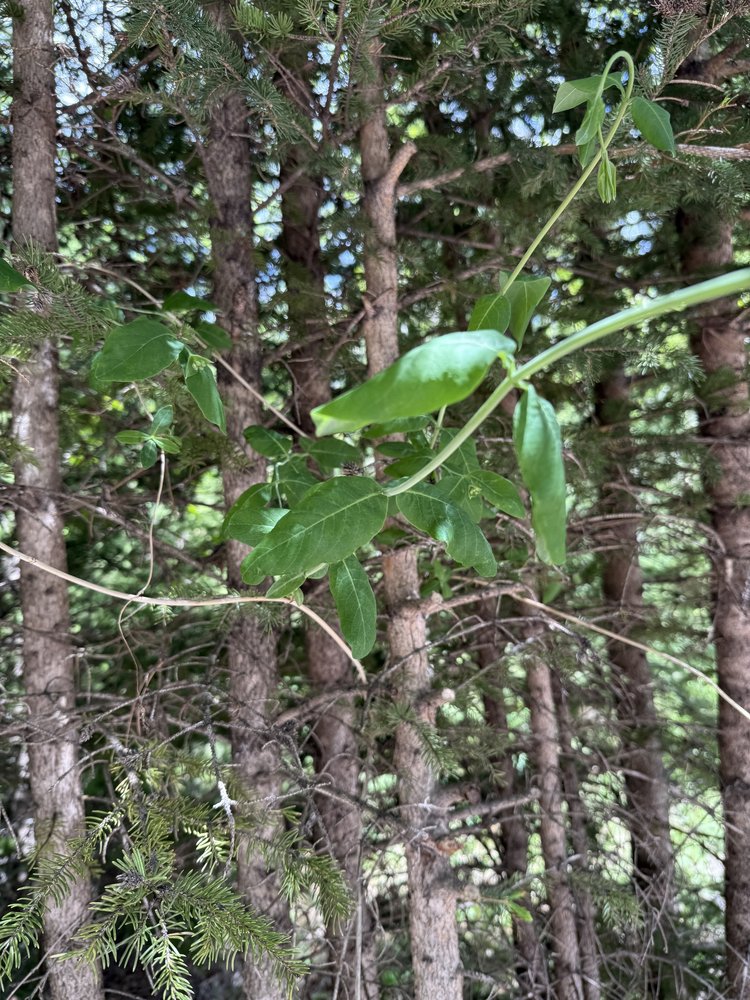
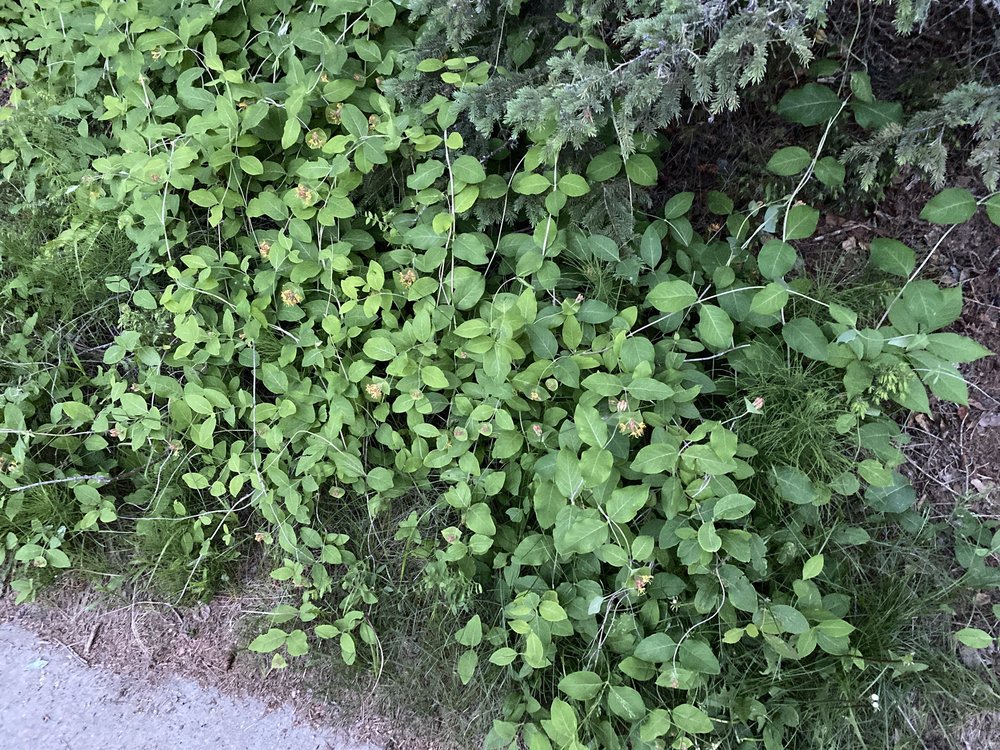
Glaucous Honeysuckle (Lonicera dioica) is a native woody vine, 1–4 m (3–13 ft) long, that twines loosely through shrubs and low branches, with oval leaves that are whitish underneath and a top pair joined into one disk around the stem. In the Black Hills it flowers in June and early July, with a cluster of two-lipped tubular flowers, pale yellow to deep red, sitting in that disk, followed by a bunch of orange-red berries. It grows there in pine, birch and spruce woods and along creeks, and the National Park Service lists it at Jewel Cave and Mount Rushmore.
Free photos from other sources
| Family | Caprifoliaceae · Honeysuckle |
|---|---|
| Status | Native deciduous woody vine |
| Blooms | June into early July; orange-red berries follow |
| Height | Vine 1–4 m (3–13 ft) long |
| Where | Woods, thickets, rocky slopes and creek banks in pine, birch and spruce forest |
| Also called | Limber Honeysuckle, Wild Honeysuckle, Red Honeysuckle, čhaŋwískuye (Lakota, honeysuckles in general) |
| Synonym | Lonicera dioica var. glaucescens, Lonicera glaucescens, Lonicera hirsuta var. glaucescens |
| Toxicity | The berries may cause mild to moderate nausea, vomiting and diarrhea. |
| Traditional use | Black Elk and Flying By (1998) say the Lakota sucked the sweet nectar from honeysuckle flowers (genus Lonicera) as a kind of candy. Moerman's database records that the Chippewa took an infusion of the stems as a diuretic (Gilmore 1933), that the Woods Cree used stem infusions for flu and for urine retention and made pipe stems and children's straws from the hollow stems (Leighton 1985), and that the Iroquois gave children a decoction of the plants for fevers (Herrick 1977). |
Traditional use: first drafted by Google AI, then checked against the sources on this page.
Roots, seeds & germination
Seed: Each orange-red berry, 8–12 mm across, holds 3 to 8 yellow egg-shaped seeds about 3 mm long. Birds and mammals eat the berries in fall.
Germination: The University of Michigan's CLIMBERS page reports that this seems to be one of only two honeysuckles whose seed has no dormancy before it germinates.
How do you identify Glaucous Honeysuckle?
Look for a loosely twining vine, not a bush, with green hairless young twigs and gray-brown peeling bark on the older stems. The leaves are opposite, 4–9 cm (1½–3½ in) long, oval with a rounded tip and toothless, often slightly wavy edges, green above and pale blue-green with a white waxy coat beneath; the pair just below the flowers is fused into a single disk the stem runs through, and the next pair or two are sometimes joined as well. The flowers come in one stalkless cluster at the branch tip, each 1.3–2.5 cm (½–1 in) long, a slender tube with a small pouch near the base and two lips, the upper broad and 4-lobed, the lower narrow, with 5 hairy stamens and a long style poking out; the color runs from yellow to deep red, more often red. Bright orange-red to red berries, 8–12 mm, follow in a cluster on the joined leaves. Hairy Honeysuckle (Lonicera hirsuta), a close relative it is often mistaken for, has broader leaves fringed with hairs and hairy on both sides; GBIF holds no herbarium specimen of it from South Dakota or Wyoming.
When does it bloom?
June into early July; orange-red berries follow.
Where does it grow?
Part shade to shade in dry to moist woods, thickets, rocky slopes and outcrops, and along stream banks. Black Hills herbarium labels since 1891 put it on creek banks and riparian benches under Ponderosa Pine and Paper Birch, on rocky outcrops under open pine, in White Spruce forest, in aspen woods and on moist north-facing road cuts, at about 1,200–1,890 m (3,900–6,200 ft); specimens come from Lawrence, Pennington, Custer and Meade counties and from Crook and Weston counties in Wyoming, including Custer State Park. Labels that note flowers date from June 12 to July 10. The National Park Service lists it at Jewel Cave and Mount Rushmore, and iNaturalist has 120 research-grade Black Hills records.
Honeysuckle family (Caprifoliaceae): 3 other plants in this guide
Sources: Lonicera dioica (Wild Honeysuckle) — Minnesota Wildflowers; Limber Honeysuckle — Missouri Department of Conservation Field Guide; Lonicera dioica (Melymuka, Bradtke and Burnham 2013) — CLIMBERS, University of Michigan; Lonicera dioica (LODI2) — USDA PLANTS Database; NPSpecies checklist, Jewel Cave National Monument vascular plants — National Park Service; NPSpecies checklist, Mount Rushmore National Memorial vascular plants — National Park Service; GBIF occurrence search: Lonicera dioica, South Dakota and Wyoming herbarium specimens — GBIF; GBIF occurrence search: Lonicera hirsuta, South Dakota and Wyoming herbarium specimens — GBIF; Research-grade Glaucous Honeysuckle observations in the Black Hills — iNaturalist; Black Elk & Flying By 1998, Culturally Important Plants of the Lakota (Sitting Bull College); Moerman, Native American Ethnobotany database (BRIT): Lonicera dioica.