White Coralberry Symphoricarpos albus
Also called Common Snowberry, Snowberry, White Snowberry
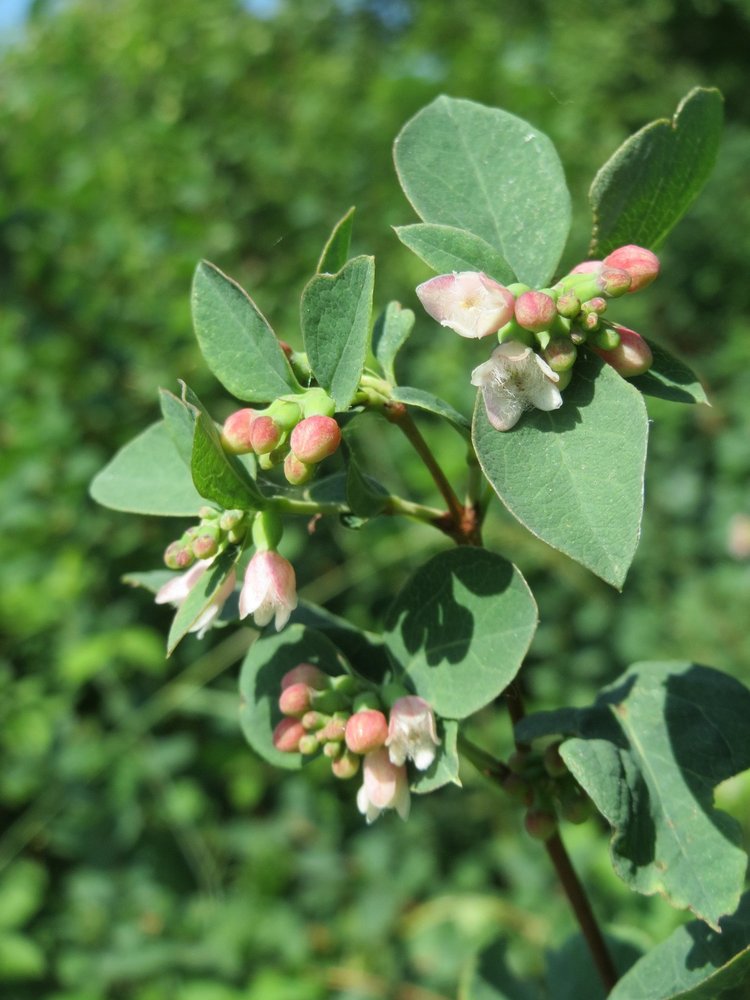
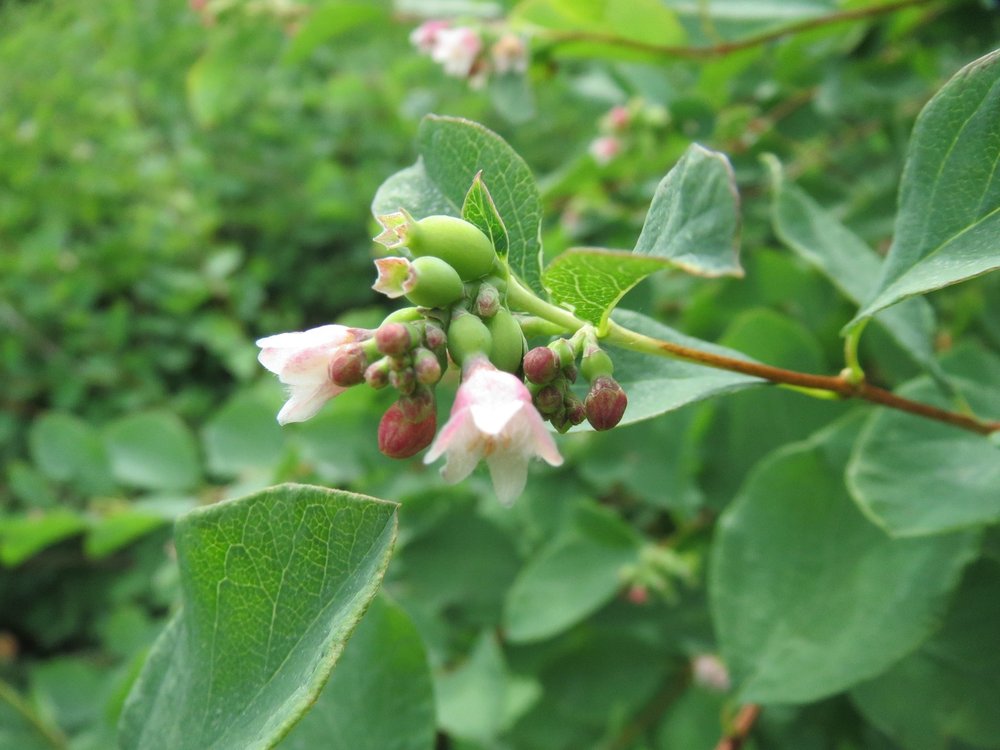
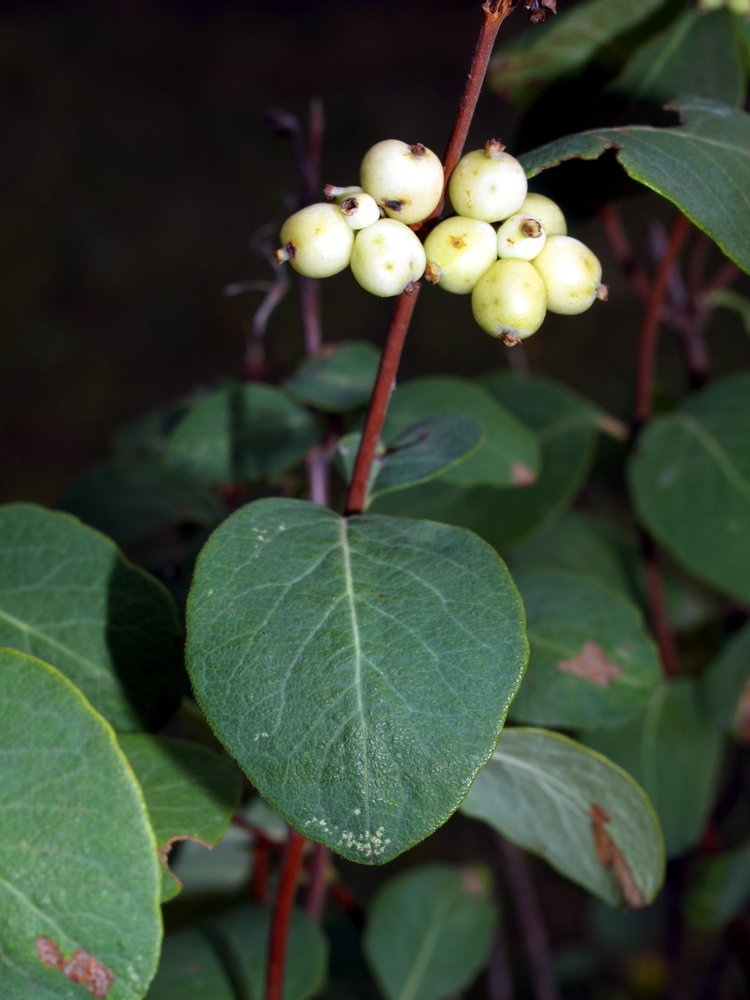
White Coralberry (Symphoricarpos albus), also called Common Snowberry, is a native shrub 0.3–1.5 m (1–5 ft) tall that spreads by underground stems into loose colonies in open forest and along forest edges. Small pink-and-white bell flowers open from June into July, followed by round white berries that may hang on through winter. The National Park Service lists it at Wind Cave, Jewel Cave, Mount Rushmore and Devils Tower.

Free photos from other sources
| Family | Caprifoliaceae · Honeysuckle |
|---|---|
| Status | Native shrub |
| Blooms | June into July |
| Height | 0.3–1.5 m (1–5 ft) |
| Where | Open forest, forest edges, wooded hillsides and rocky, open slopes, in sandy or rocky soil |
| Also called | Common Snowberry, Snowberry, White Snowberry |
| Synonym | Symphoricarpos racemosus, Symphoricarpos rivularis |
| Toxicity | The berries have low toxicity; the Lady Bird Johnson Wildflower Center lists vomiting and diarrhea if they are eaten. |
| Traditional use | The USDA plant guide, citing MacKinnon, Pojar and Coupé 1992 and Pojar and MacKinnon 1994, records that the Gitksan of British Columbia hollowed the twigs to make pipe stems and that the Stl'atl'imx ate one or two berries to settle the stomach after fatty food. |
Roots, seeds & germination
Root: It spreads mainly by rhizomes (underground stems) 5–12.5 cm (2–5 in) deep in the soil, which sprout after fire or other damage to the top of the plant and commonly form dense thickets; usually each rhizome sends up a single stem (Fire Effects Information System).
Seed: Each fruit holds 2 nutlets with 1 seed in each, and birds spread the seeds after eating the fruit. It can grow from seed, but rhizomes are the main way it spreads, and one study found it sprouting from underground parts and not from seed after a fire (Fire Effects Information System).
Germination: The nutlets are very hard to germinate, with a tough, water-tight coat and a partly developed embryo. The Fire Effects Information System reports the best germination, 74 to 87 percent, after 20 to 91 days of warm storage followed by 60 to 300 days of cold storage; the Wildflower Center says seed sown in fall needs 90 to 120 days of warmth at 27 °C (80 °F), and seed sown in spring also needs 4 to 6 months of cold at 5 °C (41 °F).
How do you identify White Coralberry?
Look for a low shrub that spreads into loose colonies, with older bark that is thin and gray and often splits to show a purple-brown layer under it. The leaves are opposite, 1–4 cm (½–1½ in) long, oval to nearly round with blunt tips, dark to blue-green and hairless to sparsely hairy above, paler and hairy below, with edges that are toothless or have a few shallow lobes or large rounded teeth. From June into July the branch tips carry tight clusters of 2 to 10 nodding, short-stalked flowers, pink to nearly white, about 6 mm (¼ in) long. The five lobes don't spread, so the short stamens and the style stay hidden inside the cup-shaped to bell-shaped tube, which is lined with long white hairs. The fruit is a round white berry-like drupe up to 1.3 cm (½ in) across, with 2 nutlets inside, and it may stay on the plant through winter (Minnesota Wildflowers). Western Snowberry (Symphoricarpos occidentalis) is the other snowberry in this guide. Minnesota Wildflowers says it has larger and more numerous stalkless flowers whose lobes spread widely and show the long stamens and style, where White Coralberry's smaller, short-stalked flowers have lobes that hide them, and that White Coralberry's fruit is brighter white and about twice the size. Minnesota Wildflowers also says White Coralberry is more often a plant of forest and forest edges, and Western Snowberry more likely to be found in open grassland. The 1986 Jewel Cave plant survey says the two are told apart by flower form; in the drought year of the survey the snowberry on upland sites there didn't bloom, so it couldn't name it, though it thought Western Snowberry more likely.
When does it bloom?
June into July.
Where does it grow?
Open forest, forest edges, bluffs and sandy or rocky soil (Minnesota Wildflowers); the Lady Bird Johnson Wildflower Center adds wooded hillsides and rocky, open slopes. GBIF holds 87 preserved specimens from the seven Black Hills counties of South Dakota and Wyoming (Lawrence 46, Pennington 17, Crook 9, Custer 6, Meade 4, Weston 3, Fall River 2), collected from 1896 to 2018. Their labels name coniferous and ponderosa pine forest, forest edges and roadsides, creek and riparian zones, and a limestone hilltop, and the 12 labels that give an elevation run from 773 to 1,870 m (2,500–6,100 ft). The Fire Effects Information System gives 1,280–2,040 m (4,200–6,700 ft) for South Dakota, and says Merriam's turkeys in the Black Hills prefer it for cover. The National Park Service lists it as present at Wind Cave, Jewel Cave, Mount Rushmore and Devils Tower; the Devils Tower list calls it white coralberry. The 1986 Jewel Cave survey names snowberry (Symphoricarpos albus) thickets in canyon bottoms there, and lists it with gooseberry as the most frequent shrub in a pine stand on a canyon floor. iNaturalist has 11 research-grade records from the Black Hills area, July to December.
Other snowberries and coralberries in this guide
Honeysuckle family (Caprifoliaceae): 3 other plants in this guide
Sources: Minnesota Wildflowers: Symphoricarpos albus (Snowberry); USDA Forest Service Fire Effects Information System: Symphoricarpos albus (McWilliams 2000); Lady Bird Johnson Wildflower Center: Symphoricarpos albus (SYAL), Common Snowberry; USDA PLANTS Database: Symphoricarpos albus (SYAL); USDA NRCS Plant Guide: Snowberry, Symphoricarpos albus; NPSpecies checklist, Wind Cave National Park (vascular plants); NPSpecies checklist, Jewel Cave National Monument (vascular plants); NPSpecies checklist, Mount Rushmore National Memorial (vascular plants); NPSpecies checklist, Devils Tower National Monument (vascular plants); Marriott and Hartman 1986, A Survey of the Vegetation of Jewel Cave National Monument; GBIF occurrence search: Symphoricarpos albus, preserved specimens, South Dakota and Wyoming; iNaturalist: Symphoricarpos albus research-grade observations in the Black Hills; South Dakota Natural Heritage Program: Rare Plants of South Dakota; Black Hills National Forest Revised Forest Assessment: At-Risk Species (October 2023).