Ironwood Ostrya virginiana
Also called Hop-hornbeam, American hophornbeam, Eastern hophornbeam, Leverwood, Musclewood, išpáŋšpaŋheča (Lakota)
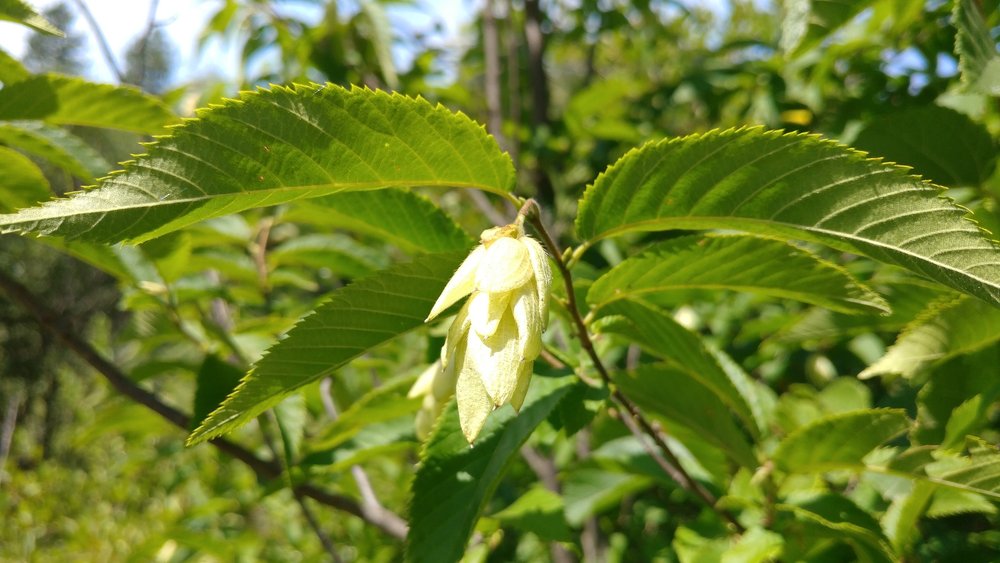
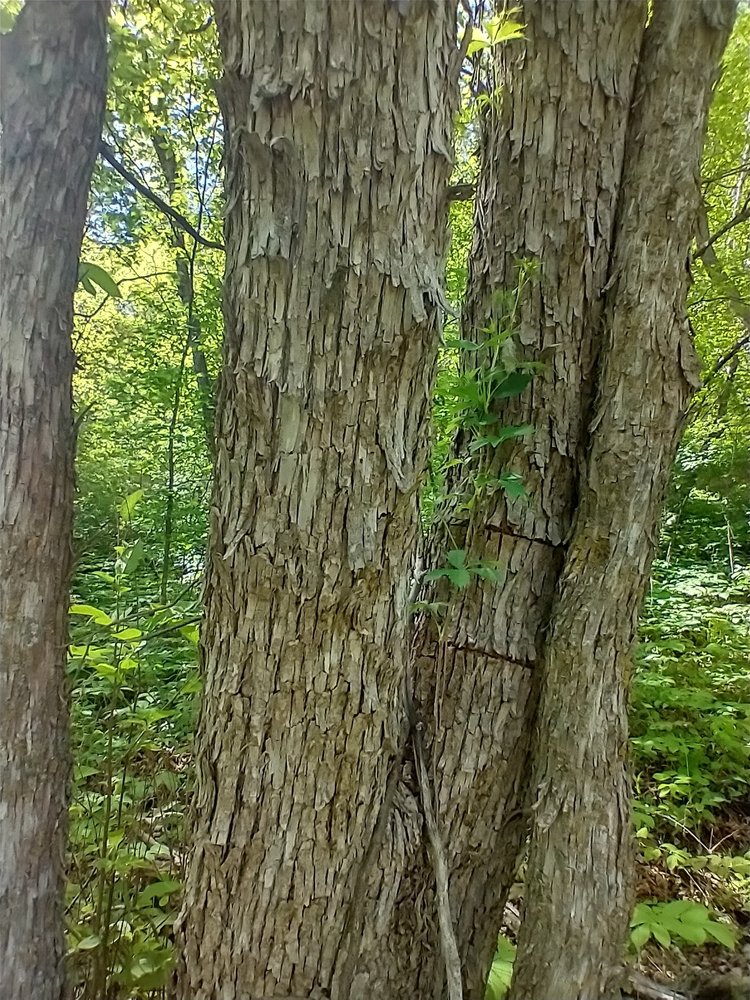
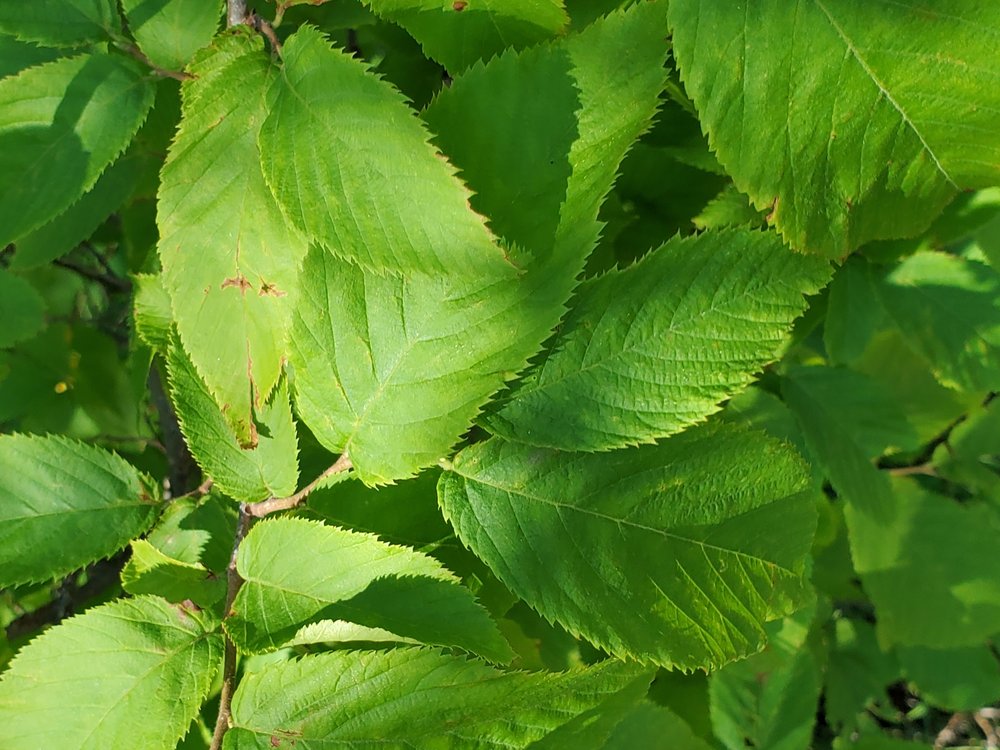
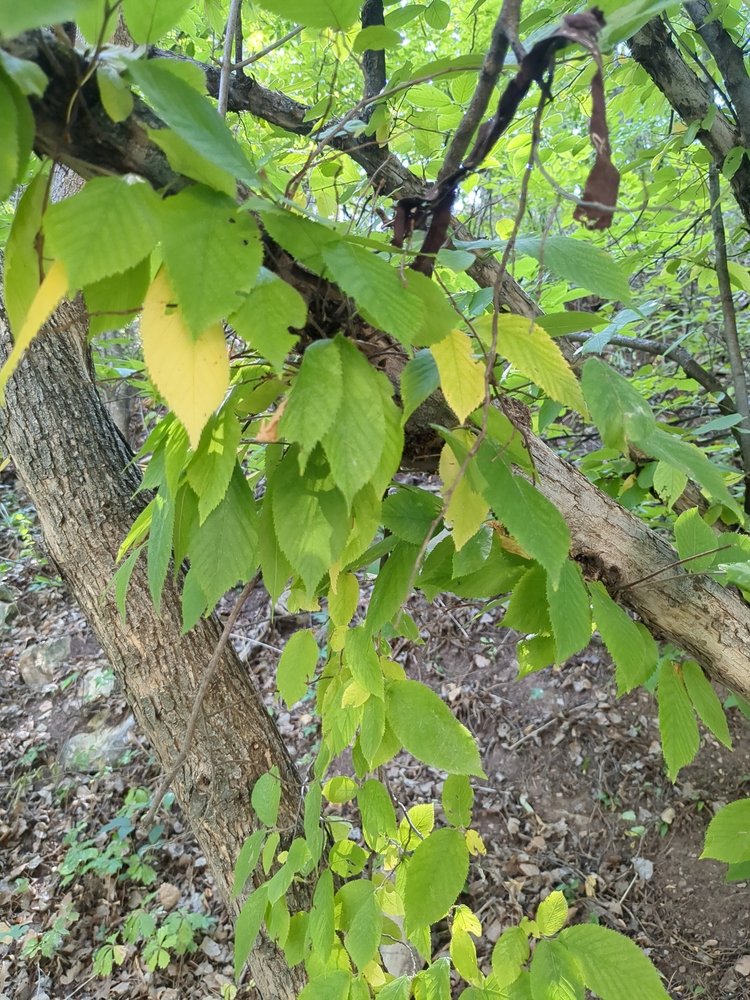
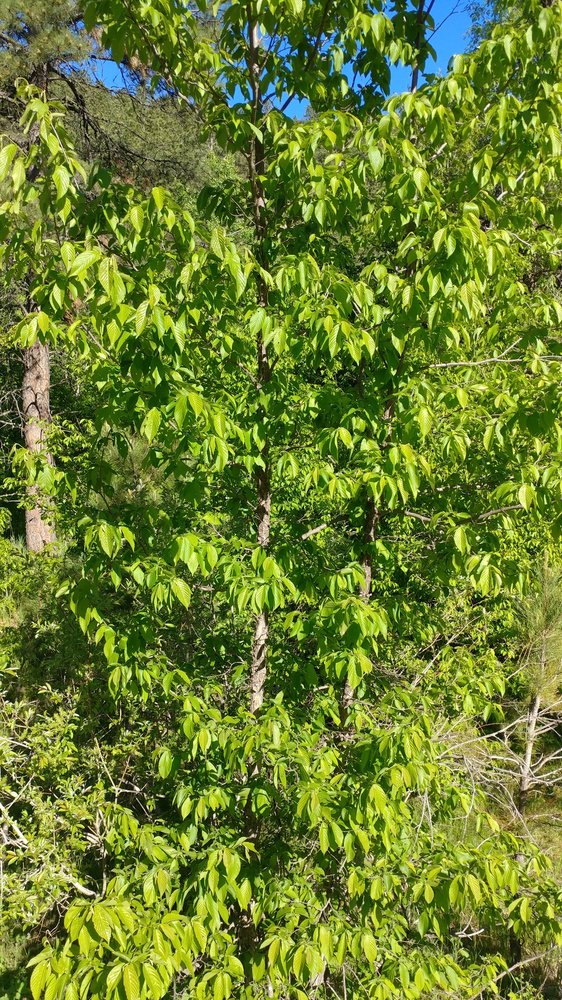
Ironwood (Ostrya virginiana), also called hop-hornbeam, is a small native tree of the birch family with gray-brown bark that shreds into narrow vertical strips, sharp-tipped leaves with double-toothed edges, and hop-like clusters of papery seed sacs that hang from the branches in late summer. Its catkins open in April and May, and in the Black Hills it grows under bur oak and ponderosa pine and in moist draws and canyon bottoms at low elevations, mostly in the northern Hills, where the Forest Service names a bur oak and ironwood habitat type.
Free photos from other sources
| Family | Betulaceae · Birch |
|---|---|
| Status | Native deciduous tree |
| Blooms | Catkins in April and May; the male catkins hang on the twig tips all winter before they open |
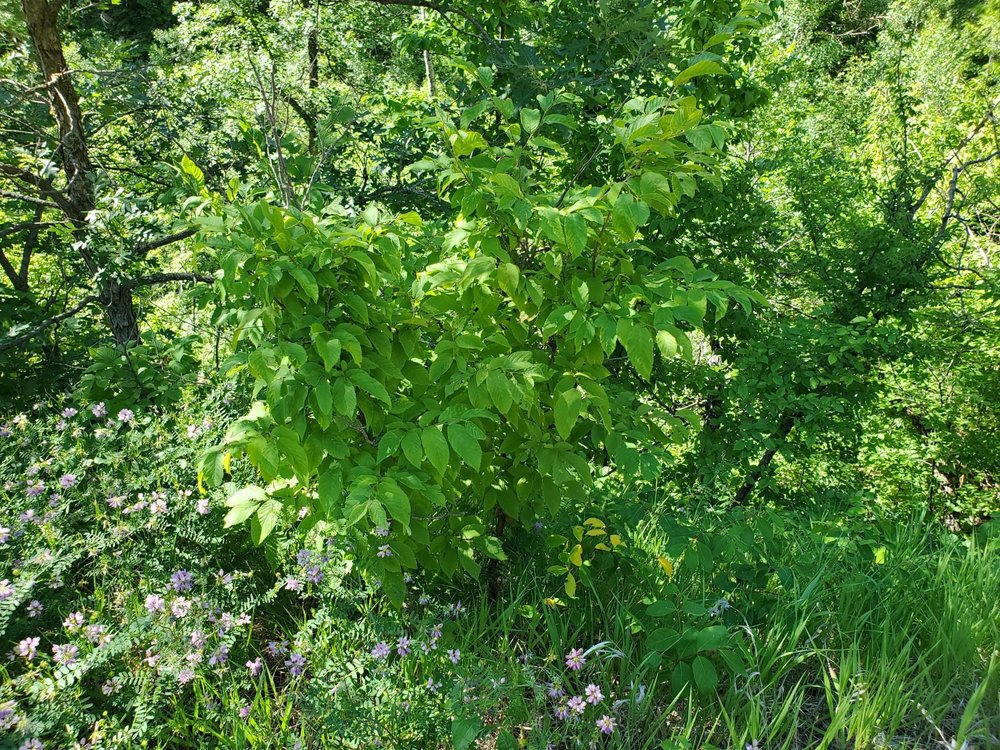
| Height | Usually under 11 m (35 ft), up to 15 m (49 ft); often a shrub 2–3 m (6–10 ft) in the oak stands of the northern Hills |
| Where | Understory of bur oak and ponderosa pine woods, canyon bottoms, moist draws and gulches at low elevations, mostly in the northern Hills |
| Also called | Hop-hornbeam, American hophornbeam, Eastern hophornbeam, Leverwood, Musclewood, išpáŋšpaŋheča (Lakota) |
| Synonym | Carpinus virginiana, Ostrya virginiana var. lasia, Ostrya virginiana var. glandulosa |
| Traditional use | Black Elk and Flying By (1998) record that the Lakota used the very hard wood for bows and utensil handles, and a decoction of the bark to massage sore muscles. |
Roots, seeds & germination
Root: The root spread is less than the tree's height. Cut, burned or injured trees commonly sprout from the stump, and the tree can resprout from the root crown after fire.
Seed: The hanging cluster is usually 2.5–7.5 cm (1–3 in) long and made of papery sacs that each hold one nut about 7 mm long; the sacs turn from green to brown, and in the North the fruit ripens by late August. The clusters fall apart to release the nuts, and the buoyant papery sacs help the wind carry them; birds spread them too, from fall into early winter. Trees don't bear seed heavily until about 25 years old, and the seed can survive at least a year in the soil.
Germination: The seed has a hard coat and an internal dormancy that is hard to break. Three months of warm, moist storage followed by 3 to 5 months of cold gave 81 to 92 percent germination; SDSU calls it a warm-cold-warm treatment and says planting in early fall is the easy way. In an Iowa test, slightly immature seed gathered in August and sown at once came up fully the next spring. Cover the seed with about 6 mm (¼ in) of firmed soil. Seedlings come up in spring with their seed leaves above ground.
How do you identify Ironwood?
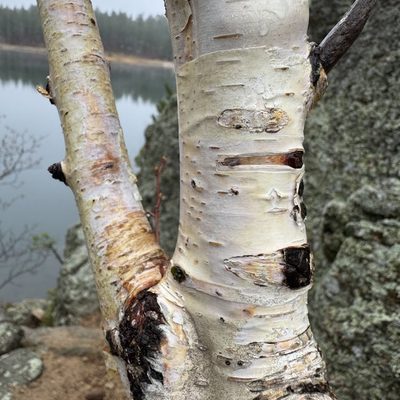
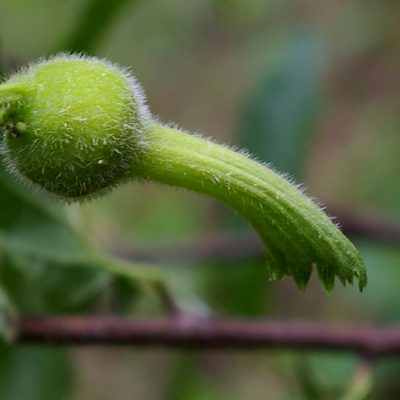
Start with the bark: gray-brown, thin, and shredding into narrow vertical strips that are loose at both ends, so the trunk looks shaggy. Young twigs are smoother and gray with small pale dots. Leaves are alternate, narrowly oval with a tapering tip, 5–13 cm (2–5 in) long, sharply double-toothed (each big tooth carries smaller teeth), hairy underneath along the veins, on stalks usually under 1 cm; they look like elm leaves, and dead brown ones often hang on through winter. There is no bud at the twig tip; the side buds are small, pointed and striped lengthwise. Male catkins 2–5 cm long sit exposed on the twig tips all winter and open in spring. The fruit is a hanging cluster 3.5–6.5 cm (1½–2½ in) long of inflated papery sacs, each holding one nutlet, that looks like the fruit of a hop vine, green at first and brown when ripe. Paper Birch has white, smooth bark that peels in papery sheets on mature trees, and reddish-brown bark on saplings. The Trees of Wisconsin key separates ironwood from the birches this way: ironwood bark splits into close, shaggy vertical strips without conspicuous pores, and its bud scales are often striped lengthwise, while birch bark is papery and peels in sheets, its pores (lenticels) are usually long and run crosswise, and its bud scales are not striped. Early in summer, young ironwood leaves can be mistaken for Beaked Hazelnut, a shrub 4–6 m (13–20 ft) tall with several stems, whose nut sits in a stiff, hairy husk drawn out into a beak two to four times the nut's length.
When does it bloom?
Catkins in April and May; the male catkins hang on the twig tips all winter before they open.
Where does it grow?
Understory of bur oak and ponderosa pine woods, canyon bottoms, moist draws and north-facing gulches at low elevations, about 975–1,415 m (3,200–4,640 ft) on herbarium labels, mostly in the northern Black Hills. SDSU's Open PRAIRIE places it in upland forests of the Black Hills, and the Fire Effects Information System says its range reaches south to the Black Hills of South Dakota. The Forest Service's 1987 habitat-type classification of the Black Hills National Forest names a bur oak and ironwood habitat type at about 1,070–1,250 m (3,500–4,100 ft), sampled mostly along the north fringe of the Hills, where ironwood is a vigorous shrub 2–3 m tall, and it also shows ironwood in the shrub layer of an aspen and beaked hazelnut stand. Herbarium specimens come from Lawrence (about 80), Pennington, Meade and Custer counties in South Dakota and Crook County, Wyoming, from 1891 to 2020. Their labels describe creek banks, canyon floors, moist draws and hillsides, and woods with bur oak, paper birch and aspen, and a 1967 label calls it a common tree at lower elevations in the northern Black Hills.
Other plants to compare
Birch family (Betulaceae): 2 other plants in this guide
Sources: SDSU Open PRAIRIE: Betulaceae: Ostrya virginiana (Hop-hornbeam); USDA Forest Service Fire Effects Information System: Ostrya virginiana (Coladonato 1992); Flora of North America Vol. 3: Ostrya virginiana, eFloras; Hoffman and Alexander 1987, Forest Vegetation of the Black Hills National Forest: A Habitat Type Classification (USDA Forest Service RM-276); USDA PLANTS Database: Ostrya virginiana (OSVI); Leak and Bonner, Ostrya virginiana, Woody Plant Seed Manual (USDA Forest Service); Minnesota Wildflowers: Ostrya virginiana (Ironwood); Minnesota DNR: Ironwood (Ostrya virginiana); NDSU Tree Handbook: Ironwood or American Hop-hornbeam; Trees of Wisconsin (UW-Green Bay herbarium): Ostrya virginiana; Trees of Wisconsin (UW-Green Bay herbarium): Key to the trees, couplet 101 (Ostrya or Betula); South Dakota DANR: South Dakota Tree List; GBIF occurrence search: Ostrya virginiana, South Dakota and Wyoming herbarium specimens; GBIF specimen 3454987243: Schneeweis 1967, "A common tree at lower elevations in the northern Black Hills"; Black Elk and Flying By 1998, Culturally Important Plants of the Lakota (entry 209), filed with the South Dakota PUC; USDA Forest Service Fire Effects Information System: Betula papyrifera (paper birch bark); USDA Forest Service Fire Effects Information System: Corylus cornuta (beaked hazelnut form and husk).