Silver Buffaloberry Shepherdia argentea
Also called Buffaloberry, Thorny buffaloberry, Bull berry, Silverleaf buffaloberry, maštíŋčaphuté (Lakota)
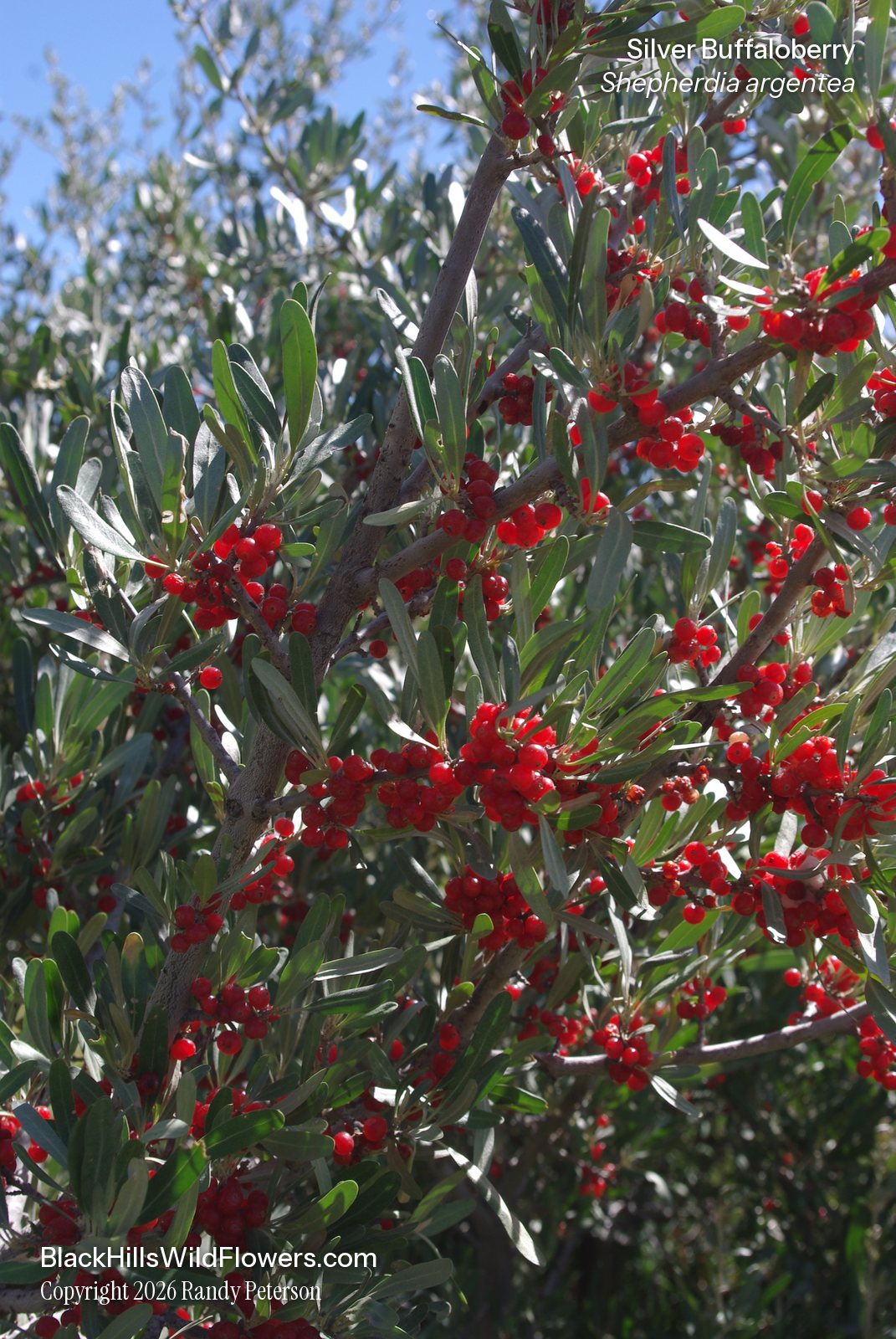
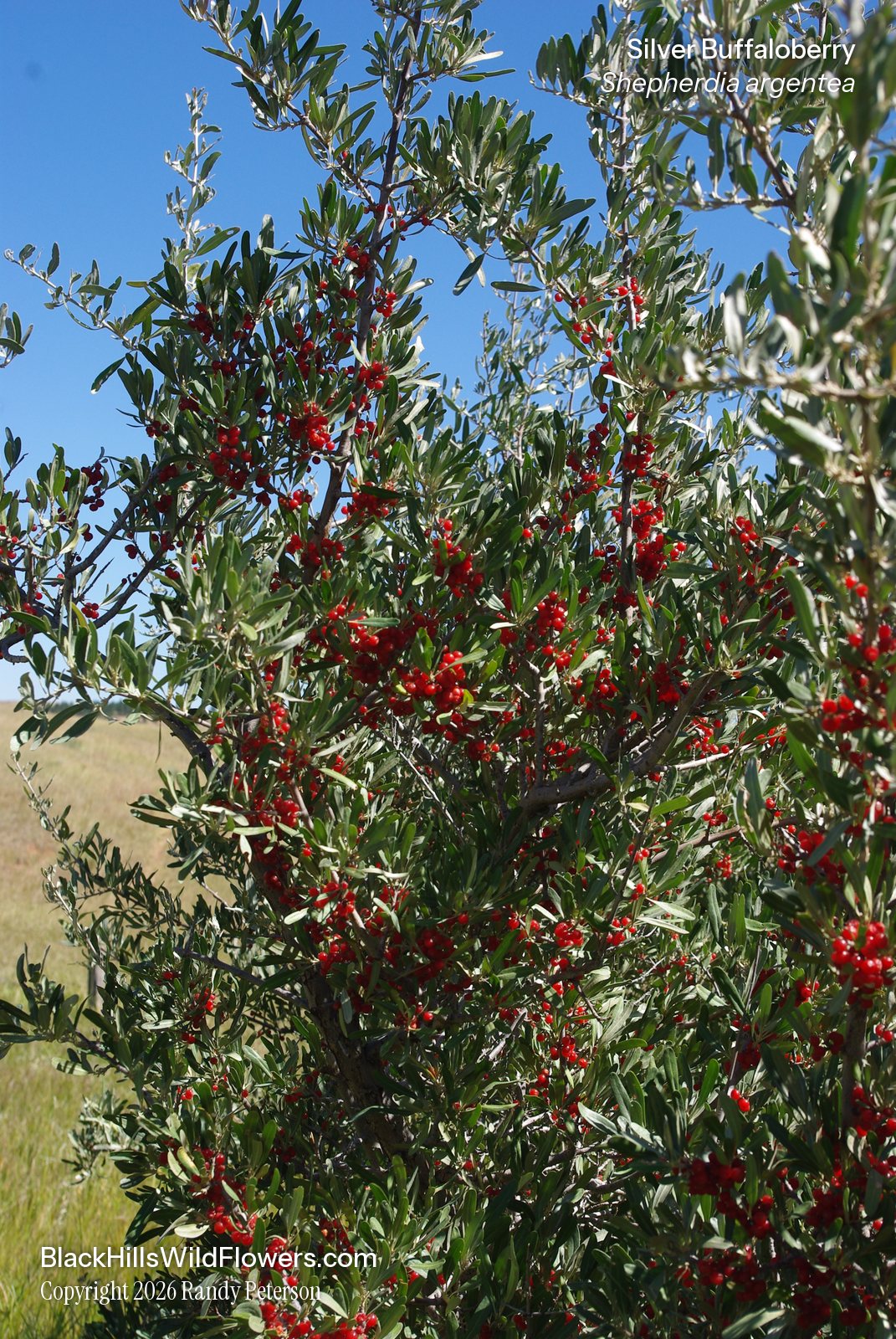
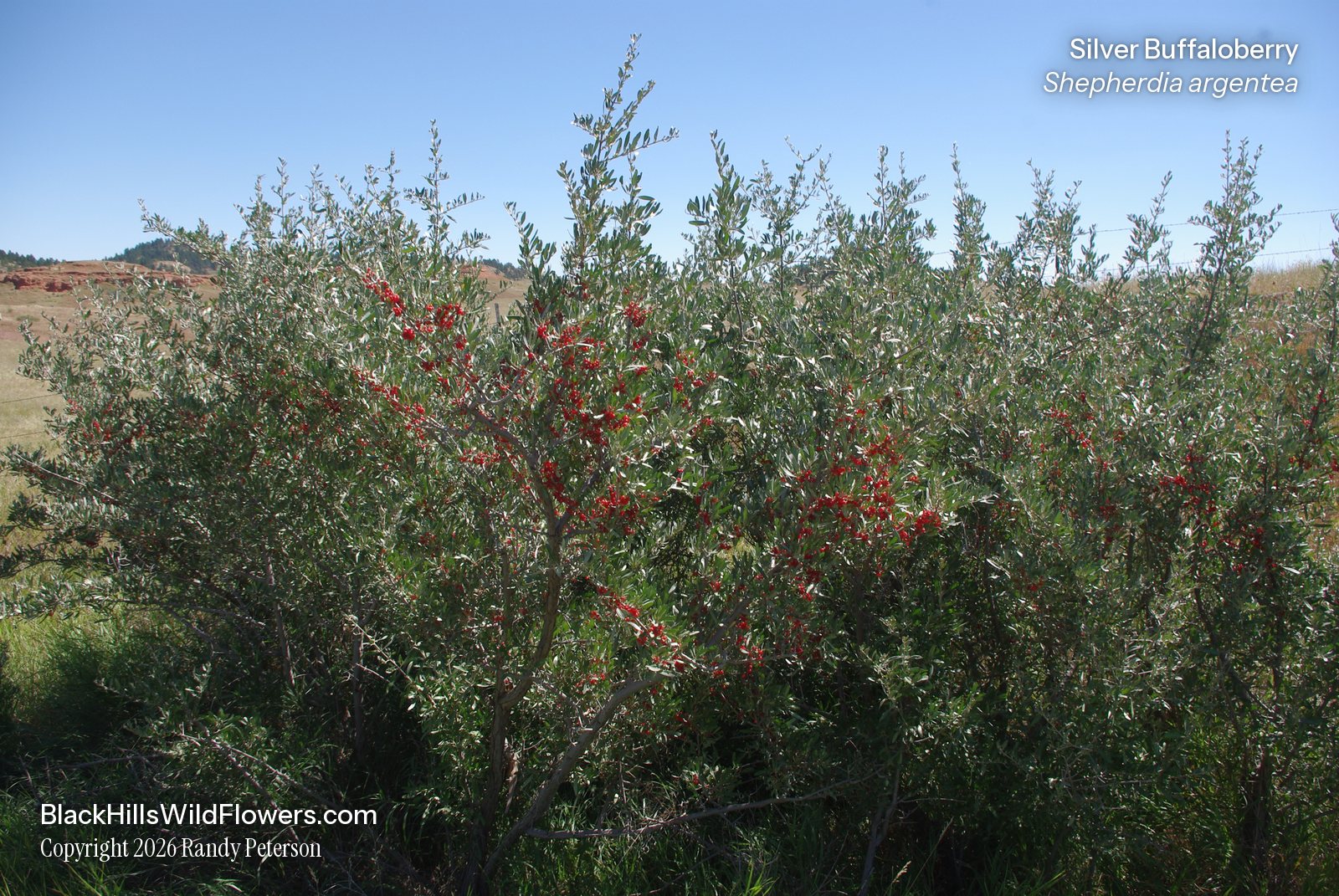
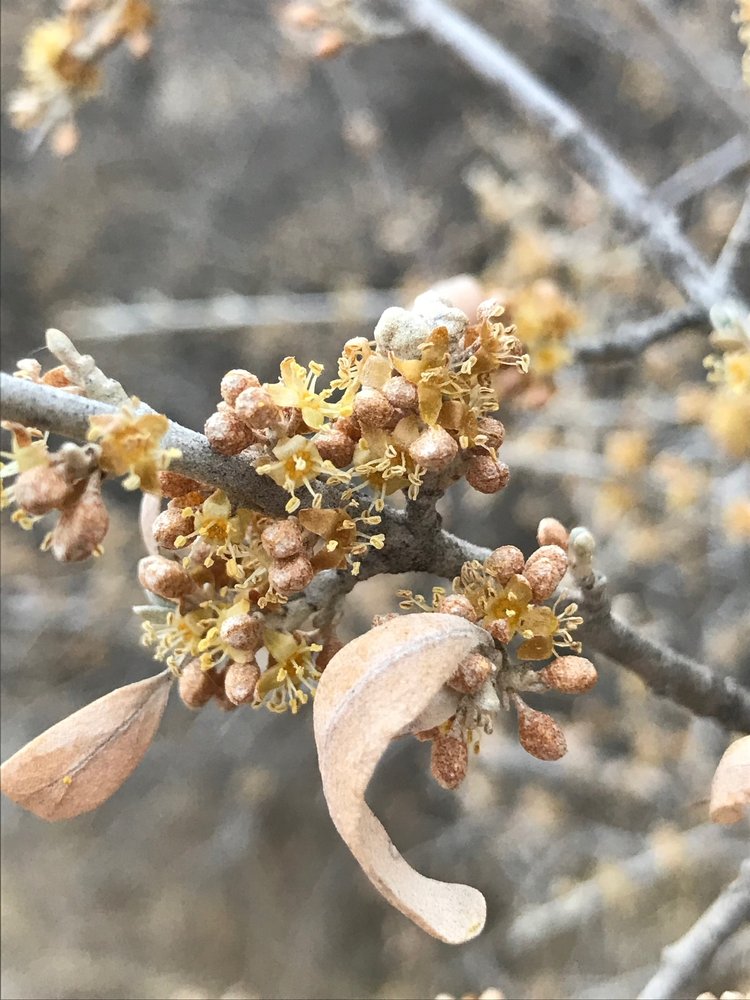
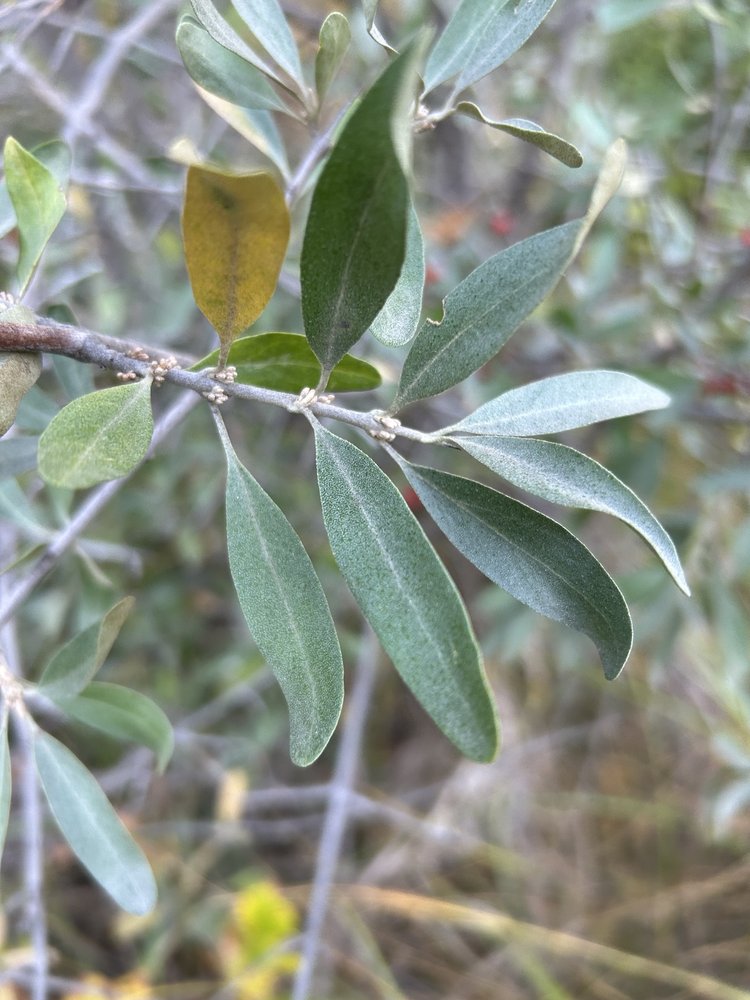
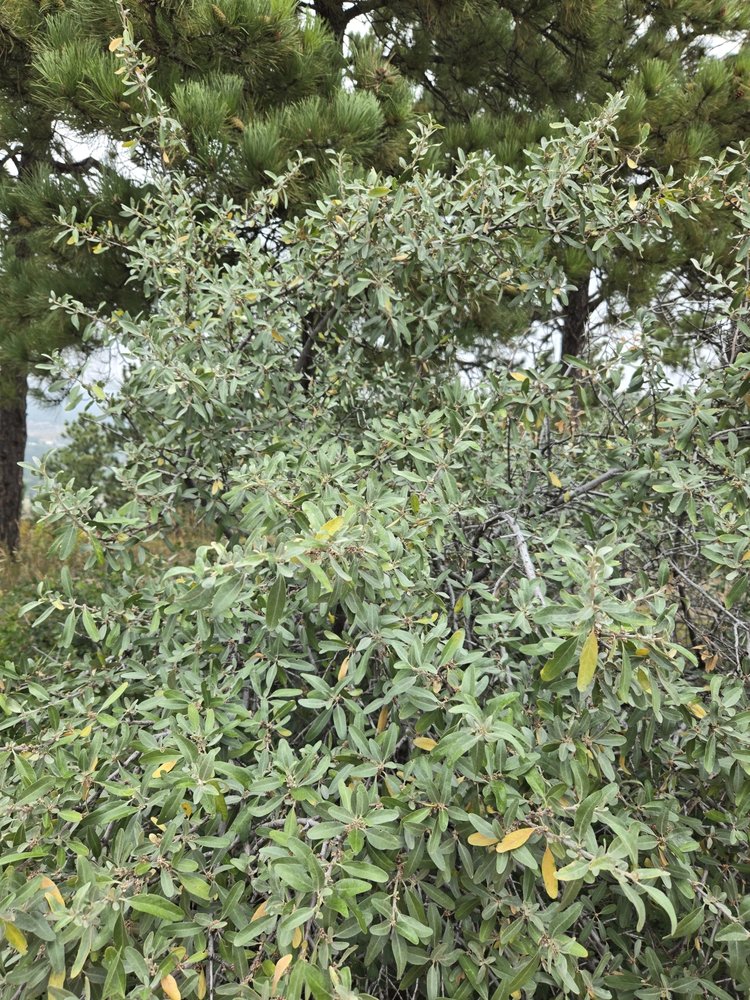
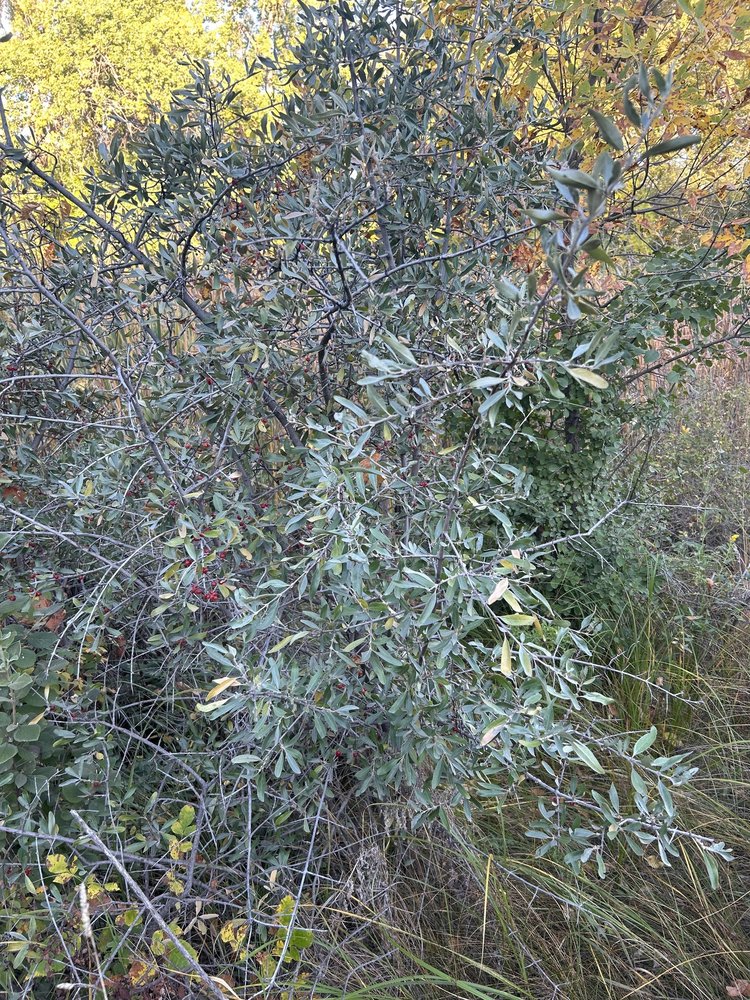
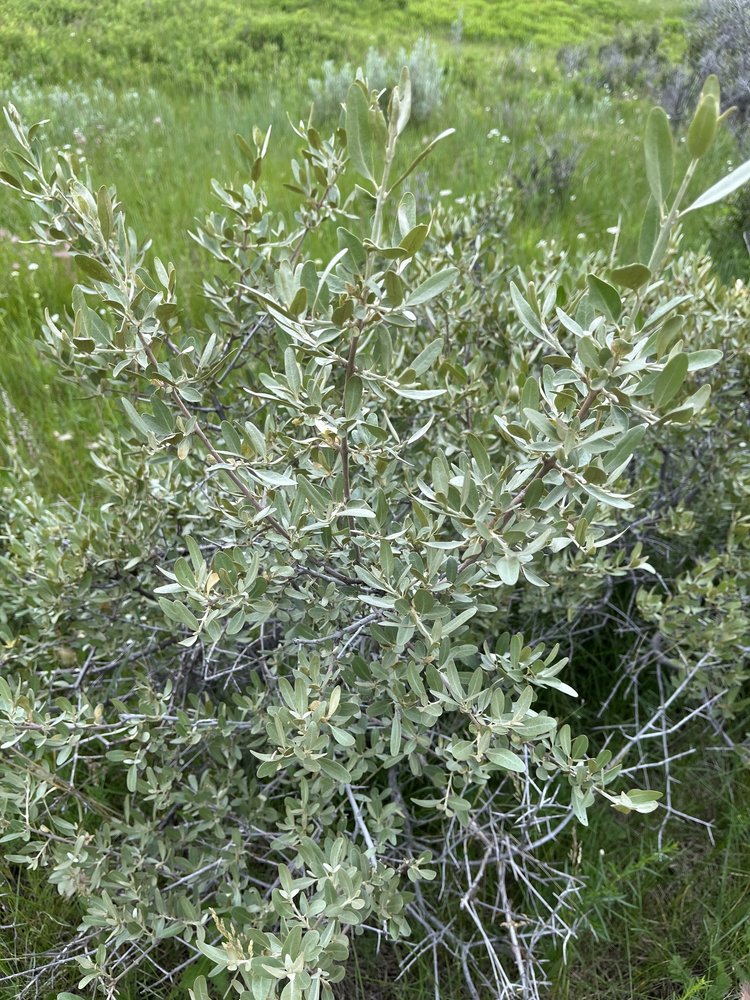
Silver Buffaloberry (Shepherdia argentea) is a native, thorny, thicket-forming shrub or small tree, 1–6 m (3–20 ft) tall, with opposite leaves that are silvery on both faces, tiny yellow petal-less flowers that open before the leaves from April into June, and bright red berries 6–9 mm across that ripen in late summer. In the Black Hills it grows along creeks, in canyon bottoms and in shrubby draws, where the National Park Service lists it at Wind Cave, Jewel Cave and Devils Tower and herbarium specimens go back to 1892. Photographed in the Black Hills.
Free photos from other sources
| Family | Elaeagnaceae · Oleaster |
|---|---|
| Status | Native deciduous shrub |
| Blooms | April into June, before the leaves; the red berries ripen in late summer and can hang on through winter |
| Height | 1–6 m (3–20 ft) |
| Where | Creek banks, canyon bottoms, coulees and shrubby draws, and moist open hillsides, in dense thickets |
| Also called | Buffaloberry, Thorny buffaloberry, Bull berry, Silverleaf buffaloberry, maštíŋčaphuté (Lakota) |
| Synonym | Hippophae argentea, Elaeagnus utilis, Lepargyrea argentea |
| Toxicity | The berries contain saponin, which can irritate the digestive system. |
| Traditional use | Black Elk and Flying By (1998) record that the Lakota ate the berries fresh or dried them for later, usually gathering them after the first frost because they are sour before that, and note that the berries are mildly laxative. |
Roots, seeds & germination
Root: The shrubs sprout from a network of underground stems and rootstocks, and neighboring shrubs can be joined underground for up to 6 m (20 ft); they also sprout from the root crown after browsing or fire. In a western North Dakota study, 12-year-old shrubs 3.6 m (12 ft) tall kept 97 percent of their roots in the top 1.2 m (4 ft) of soil, the longest root ran 6.6 m (22 ft), and the deepest reached 1.74 m (5.8 ft). The roots carry nodules with bacteria that fix nitrogen.
Seed: Each berry holds one small, hard, shiny brown seed. Berries start to form in late May and ripen by late summer, and dried berries that aren't eaten can still hang on the shrub the next spring. A mature plant may carry more than 10,000 seeds. Plants begin to set seed at 4 to 6 years old and bear a good crop every 3 or 4 years, and the seed is spread mainly by birds and other animals, though the North Dakota study found no seedlings among 323 shrubs.
Germination: The seed is dormant and sprouts poorly and unevenly. The Fire Effects Information System says 60 to 90 days of cold, moist storage at 5 °C (41 °F) improves germination, and the USDA plant guide gives 90 days at that temperature for seed started indoors; its field method is to sow untreated seed about 1.3 cm (½ in) deep in mid-September. SDSU instead recommends fall sowing or scratching the seed coat with a file or sandpaper before spring planting.
How do you identify Silver Buffaloberry?
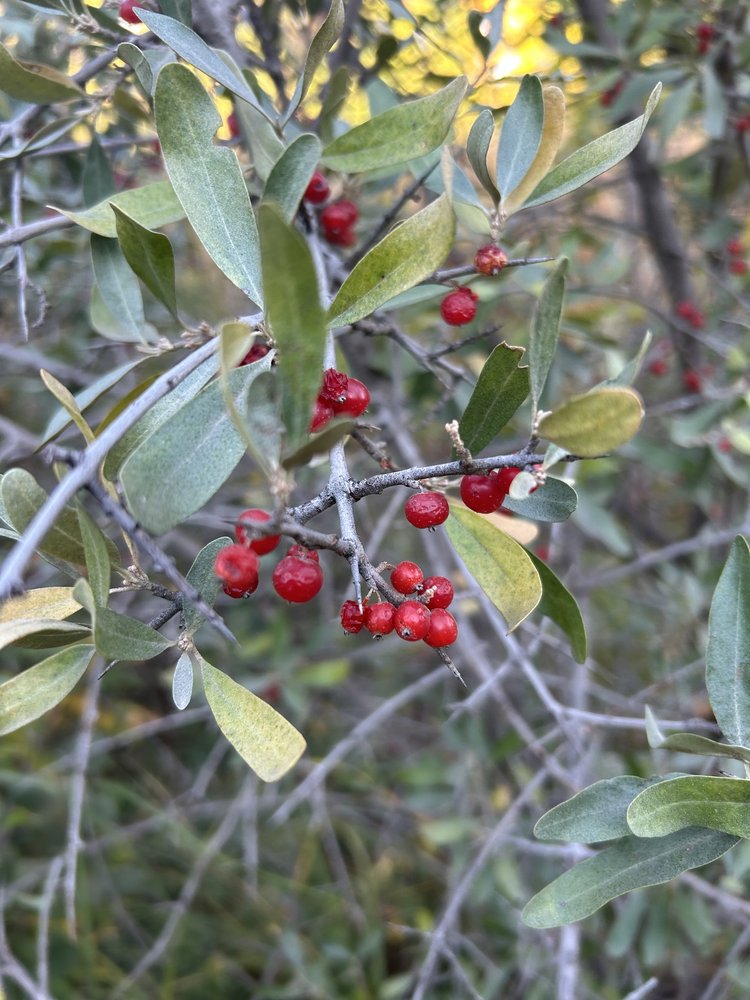
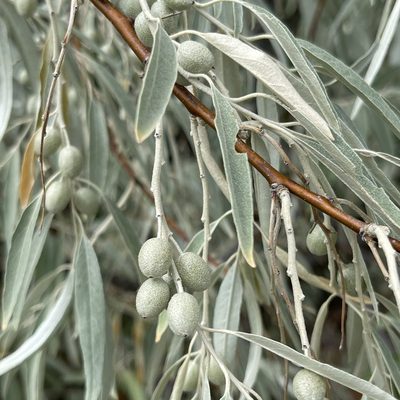
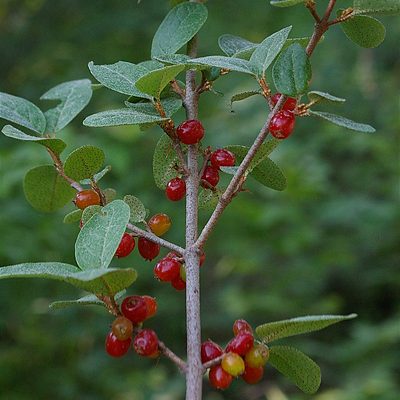
Start with the leaves and thorns. The leaves come in opposite pairs, oblong to narrowly elliptic, 2–5 cm (¾–2 in) long, blunt-tipped and untoothed, and silvery on both faces from a coat of tiny scales. The branches are armed with spines 2–5 cm (¾–2 in) long, often a single thorn at the tip of a short side branch, and new twigs are coated with silvery scales that wear off in their second year. Male and female flowers grow on separate plants, crowded on bare one-year-old twigs before the leaves open: dull yellow, 3–6 mm (⅛–¼ in) across, with no petals, 4 triangular lobes and a ring of 8 nectar glands. The fruit is a round, bright red-orange (rarely yellow) berry 6–9 mm across with one hard seed. Russet Buffaloberry is the close relative. Flora of North America's key separates the two by the leaves: green above and dotted with rust-brown scales below in Russet Buffaloberry, silvery on both faces with no rust scales in Silver Buffaloberry. Its species accounts add that Russet Buffaloberry has no thorns, grows 0.3–3 m tall and doesn't form clonal thickets, and its genus account says Russet Buffaloberry usually flowers after its leaves appear, Silver Buffaloberry before them. Russian Olive also has silvery leaves and shares its range; Minnesota Wildflowers notes that Russian Olive's flowers are much larger, brighter yellow and bell-shaped, its fruit is silvery green, and its leaves are alternate rather than opposite.
When does it bloom?
April into June, before the leaves; the red berries ripen in late summer and can hang on through winter.
Where does it grow?
Riparian ground: the banks of creeks, rivers, lakes and springs, floodplains, canyon bottoms, coulees and shrubby draws, best on moist, well-drained loam but also on dry exposed hillsides and in semi-shaded draws, where it forms dense thickets. The Fire Effects Information System, citing a 1928 Black Hills study, places it in the bur oak and skunkbush sumac community here. The National Park Service lists it at Wind Cave National Park, Jewel Cave National Monument and Devils Tower National Monument, and the 1986 Jewel Cave vegetation survey records it. Herbarium labels from about 900 to 2,000 m (3,000 to 6,500 ft) describe creek banks and streamsides, rocky banks in canyons, oak-shaded and shrubby draws in the foothills, riparian woodland in a canyon below pine forest, a red-clay draw with gypsum, and a steep south-facing slope with scrub oak and pine. They come from Lawrence, Pennington, Custer and Fall River counties, beginning in 1892, and from Crook and Weston counties in Wyoming. iNaturalist holds 20 research-grade Black Hills records.
Other plants to compare
Other buffaloberries in this guide
Oleaster family (Elaeagnaceae): 2 other plants in this guide
Sources: Flora of North America Vol. 10: Shepherdia argentea, eFloras; Flora of North America Vol. 10: Shepherdia canadensis, eFloras; Flora of North America Vol. 10: genus Shepherdia, key and discussion, eFloras; USDA Forest Service Fire Effects Information System: Shepherdia argentea (Esser 1995); USDA NRCS Plant Guide: Silver Buffaloberry, Shepherdia argentea (Knudson 2006); SDSU Open PRAIRIE: Elaeagnaceae: Shepherdia argentea (R. Neil Reese); Minnesota Wildflowers: Shepherdia argentea (Silver Buffaloberry); NPSpecies checklist, Wind Cave National Park vascular plants; NPSpecies checklist, Jewel Cave National Monument vascular plants; NPSpecies checklist, Devils Tower National Monument vascular plants; Marriott and Hartman 1986, A Survey of the Vegetation of Jewel Cave National Monument; GBIF occurrence search: Shepherdia argentea, South Dakota and Wyoming herbarium specimens; GBIF specimen 5895779228: Custer County, SD, 1892, "alt. 6000-6500 Feet"; GBIF specimen 3034738594: Lawrence County, SD, 1990, "moist soil next to creek"; iNaturalist: research-grade Shepherdia argentea observations in the Black Hills; Black Elk and Flying By 1998, Culturally Important Plants of the Lakota (entry 280), filed with the South Dakota PUC.