Rock Shield Lichens Xanthoparmelia sp.
Also called Rock Shields, Xanthoparmelia Lichen
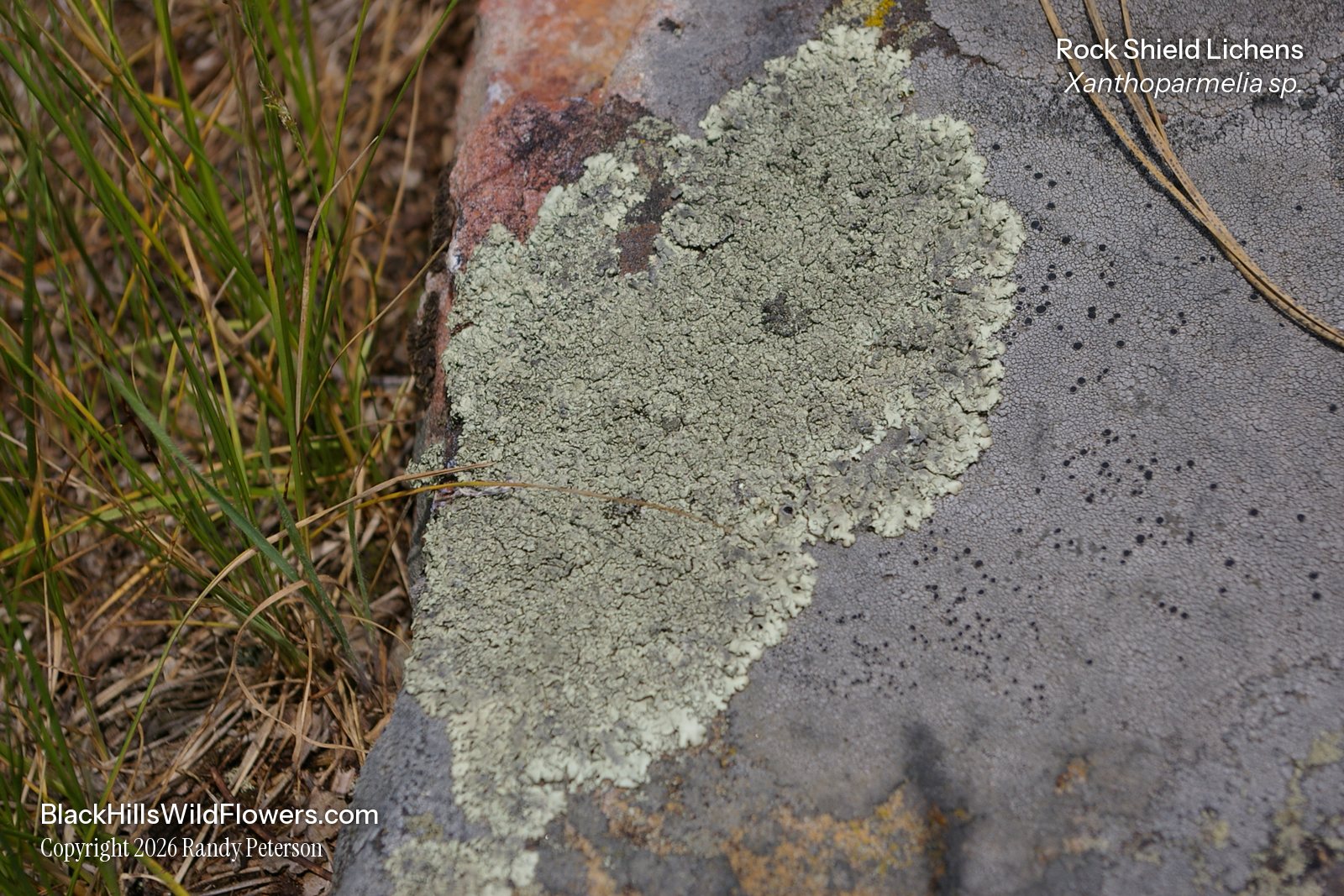
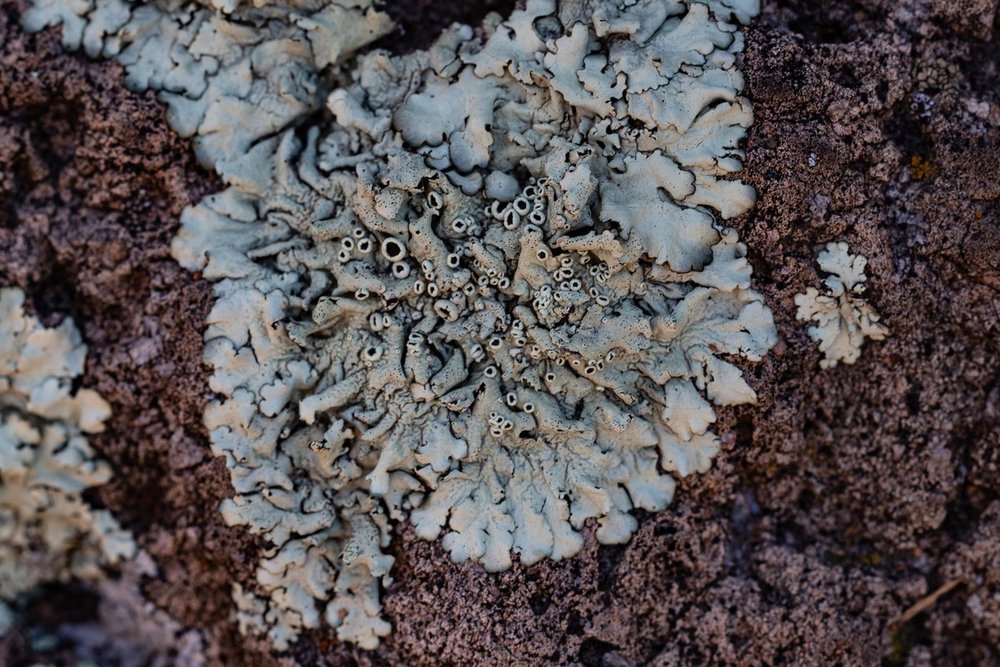
Rock Shield Lichens (Xanthoparmelia species) are leafy lichens, most of them yellow-green, that press flat against rock or lie loose on soil, in patches 3–20 cm (1¼–8 in) across. Herbarium specimens from seven Black Hills counties carry more than 20 Xanthoparmelia species names, most often X. lineola, X. chlorochroa, X. mexicana and X. taractica. Photographed in the Black Hills.
Free photos from other sources
| Family | Parmeliaceae · Shield lichen |
|---|---|
| Status | Native lichen |
| Blooms | Never flowers; spreads by spores and, in some species, isidia |
| Size | Patches 3–20 cm (1¼–8 in) across |
| Where | Rock, mostly acidic; sometimes soil; rarely wood or bark |
| Also called | Rock Shields, Xanthoparmelia Lichen |
| Toxicity | Tumbleweed Shield Lichen (X. chlorochroa) poisoned wild elk in Wyoming: a 2007 study in the Journal of Wildlife Diseases traced the deaths of an estimated 400 to 500 elk in early 2004 to it, and two of three captive elk fed the lichen fell ill the same way. |
Roots, seeds & germination
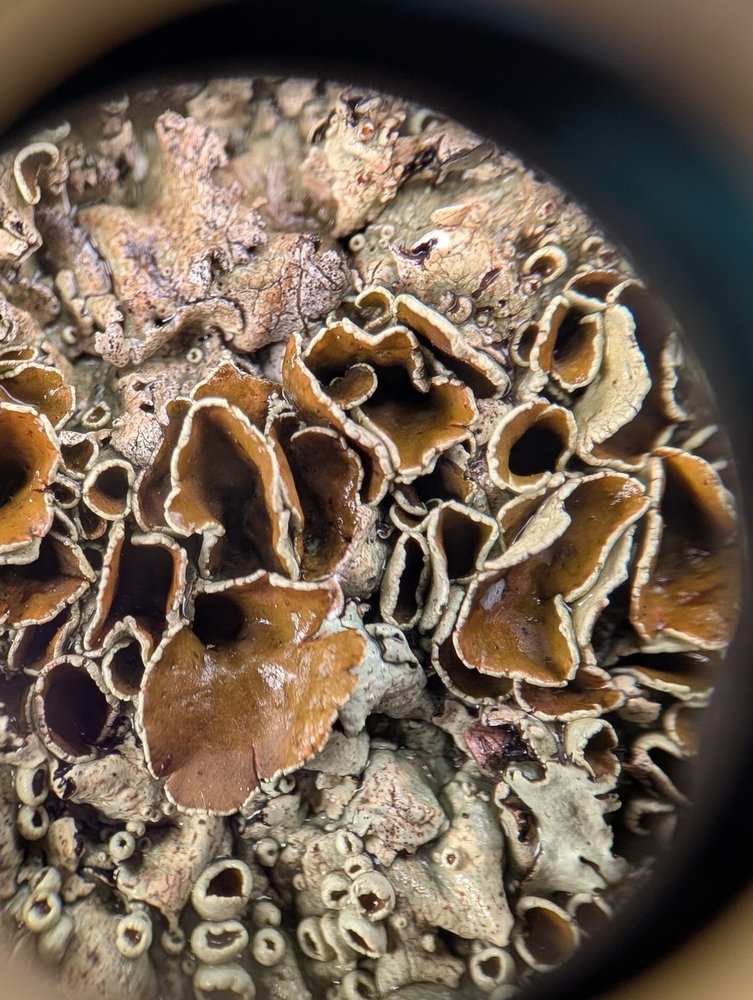
Seed: No seeds. Lichens spread by spores made in spore-bearing discs (apothecia) and by small pieces such as isidia, tiny outgrowths that break off easily and grow into new lichens (Nova Scotia guide glossary). The Consortium gives the discs as common on X. lineola, X. cumberlandia and X. novomexicana, rare on X. mexicana, which makes isidia, and very rare on X. chlorochroa, which breaks apart into separate lobes.
How do you identify Rock Shield Lichens?
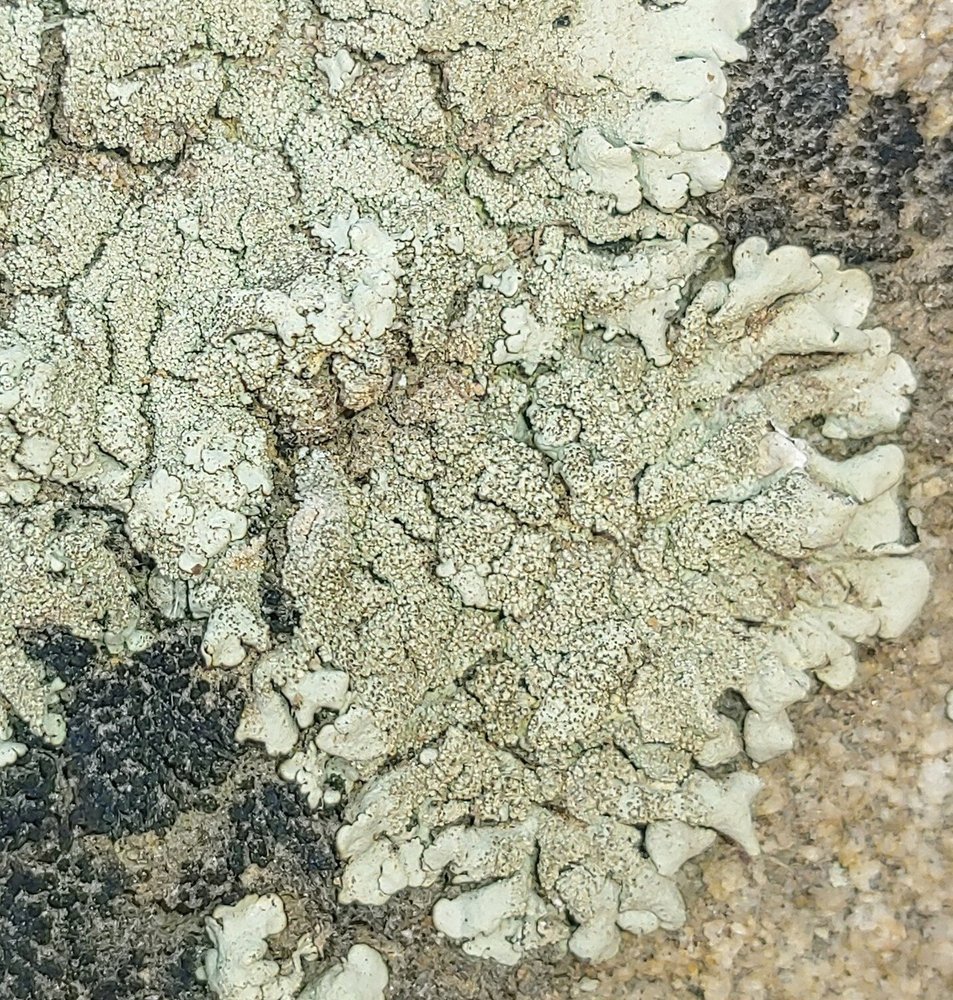
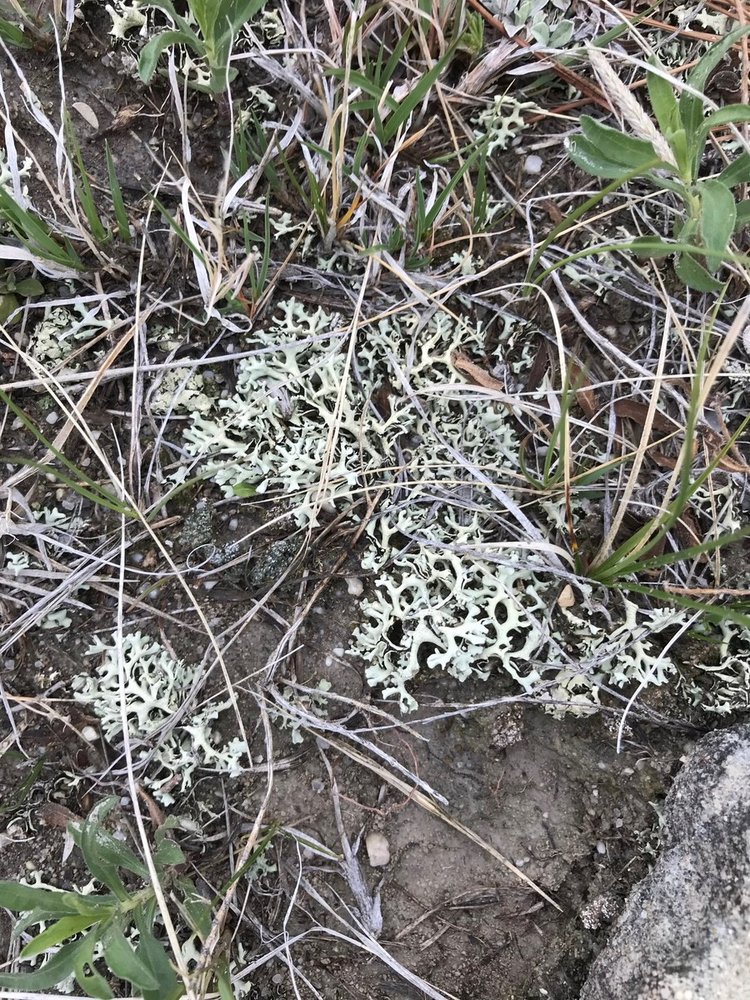
Look for a leafy (foliose) lichen in a rough circle on rock, or lying loose on soil, with lobed edges, an upper surface that is usually yellow-green to yellow (rarely green to blue-green), and a lower surface that is tan, brown or black, with short, mostly unbranched anchoring threads (rhizines) (Consortium of Lichen Herbaria, Xanthoparmelia). A few species are brown on top, such as X. loxodes, which has ten Black Hills specimens (Consortium; GBIF). The Consortium says the lobes are tightly to loosely attached or sometimes not attached at all, and that the center is sometimes cracked into small patches so that it looks like a crust; its descriptions of several species say the upper surface wrinkles or cracks with age. It also says species that look alike are kept apart by their chemistry, so this page does not try to name a species from looks alone. The marks below come from the Consortium's flora of the Sonoran Desert region (Arizona and nearby), not from the Black Hills, and cover most of the names found most often on Black Hills specimens (GBIF). Xanthoparmelia lineola is tightly attached, in patches 4–20 cm (1½–8 in) across, with lobes 0.8–3 mm (1/32–1/8 in) wide, a smooth upper surface that becomes strongly wrinkled with age, no isidia, and a pale to medium brown lower surface. X. mexicana is 4–10 cm (1½–4 in) across with lobes 1.5–4 mm (1/16–1/6 in) wide, and its upper surface carries isidia (tiny outgrowths that break off and start new lichens) with brown to blackish tips; its lower surface is pale to medium brown. X. chlorochroa is very loosely attached and usually free-growing, with more or less tubular, strongly convex lobes 1.5–5 mm (1/16–1/5 in) wide; the pieces are 3–10 cm (1¼–4 in) across or break into separate lobes, the yellow-green surface is shiny and cracks with age, and the pale to dark brown lower surface is strongly curled, though not fully rolled in. X. coloradoensis is tightly to loosely attached, 5–10 cm (2–4 in) across, dark yellow-green to bluish yellow-green, with a pale brown lower surface; the Consortium notes that, in contrast to X. lineola, it is lobulate, with small loose lobes (lobulae) growing from the center or edge. X. cumberlandia is tightly attached, 6–12 cm (2½–5 in) across, yellow-green to sometimes bluish green, smooth and shiny, without isidia, with a pale brown or brown lower surface. X. novomexicana is moderately to loosely attached, 4–20 cm (1½–8 in) across, with lobes 0.8–3 mm (1/32–1/8 in) wide, a yellow to yellow-green upper surface that wrinkles with age, no isidia, and a pale to medium brown lower surface. X. subdecipiens looks very like X. lineola but is more loosely attached and carries a different set of lichen acids. X. stenophylla has a yellow-green upper surface, lobes 1.2–4 mm (1/20–1/6 in) wide and a lower surface that is blackish or brownish (LIAS description on the Consortium site). X. taractica is the name on 21 Black Hills specimens, but the Consortium's X. coloradoensis page says earlier reports from the Southwest usually called X. coloradoensis by that name, and that X. taractica is now treated as a Southern Hemisphere species that is larger, more loosely attached and usually on soil, so the Black Hills name may be out of date. Parmelia sulcata, with about 120 Black Hills specimens (GBIF), is a different shield lichen: it is blue-gray, with a network of sharp ridges, whitish markings, powdery granules along the ridges and bottle-brush-branched rhizines (Nova Scotia guide).
When does it bloom?
Never flowers; spreads by spores and, in some species, isidia.
Where does it grow?
Xanthoparmelia grows mostly on rock that is not limy, usually acidic rock, and sometimes on soil; it is rare on wood, bark or dust-coated tree bases (Consortium of Lichen Herbaria). The Consortium gives X. lineola, X. mexicana, X. coloradoensis, X. cumberlandia and X. novomexicana on acidic rocks, and X. chlorochroa on soil, often in open, arid places. The National Park Service's species list for Mount Rushmore National Memorial includes Xanthoparmelia somloensis, which GBIF treats as a synonym of X. stenophylla. GBIF lists 268 herbarium specimens from the Black Hills, in Lawrence, Custer, Pennington, Meade and Fall River counties in South Dakota and Crook and Weston counties in Wyoming, under 22 species names as GBIF groups them, with three labeled only Xanthoparmelia. The commonest are X. lineola 71, X. chlorochroa 40, X. mexicana 32, X. taractica 21, X. cumberlandia 14, X. coloradoensis 13, X. novomexicana 13, and X. stenophylla, X. loxodes and X. subdecipiens 10 each (eight of the X. stenophylla filed as X. somloensis). Clifford Wetmore collected 175 of them, nearly all in 1960 and 1961, and the dated ones run from 1891 to 2009. The labels that name a setting give rock and boulders in open pine forest, a rocky hilltop with pines, rock under ponderosa pine, ponderosa pine forest with rock outcrops, a north-facing slope and a steep boulder-filled ravine under spruce and ponderosa pine (X. lineola, X. coloradoensis and X. taractica); for X. chlorochroa they give open grassland, grassy hills, open ponderosa pines and a ridge top along a forest edge. No label says whether a lichen was loose or attached. The Black Hills National Forest's 2023 at-risk assessment names five other lichens but no Xanthoparmelia, and South Dakota's rare plant list includes no lichens.
Shield lichen family (Parmeliaceae): 2 other plants in this guide
Sources: Consortium of Lichen Herbaria: Xanthoparmelia (genus description from Lichen Flora of the Greater Sonoran Desert Region, Nash et al. 2002 and 2004); Consortium of Lichen Herbaria: Xanthoparmelia lineola (Lichen Flora of the Greater Sonoran Desert Region); Consortium of Lichen Herbaria: Xanthoparmelia mexicana (Lichen Flora of the Greater Sonoran Desert Region); Consortium of Lichen Herbaria: Xanthoparmelia chlorochroa (Lichen Flora of the Greater Sonoran Desert Region); Consortium of Lichen Herbaria: Xanthoparmelia coloradoensis (Lichen Flora of the Greater Sonoran Desert Region; includes the note on X. taractica); Consortium of Lichen Herbaria: Xanthoparmelia cumberlandia (Lichen Flora of the Greater Sonoran Desert Region); Consortium of Lichen Herbaria: Xanthoparmelia novomexicana (Lichen Flora of the Greater Sonoran Desert Region); Consortium of Lichen Herbaria: Xanthoparmelia subdecipiens (Lichen Flora of the Greater Sonoran Desert Region); Consortium of Lichen Herbaria: Xanthoparmelia stenophylla (description from the LIAS database); Consortium of Lichen Herbaria: Xanthoparmelia taractica (LIAS description: on soil, loosely to moderately attached); Consortium of Lichen Herbaria: Xanthoparmelia loxodes (Lichen Flora of the Greater Sonoran Desert Region, Vol. 1; brown upper surface); Identifying Lichens of Nova Scotia (Brodo, Cameron, Andrachuk and Craig; text from Lichens of North America, Brodo, Sharnoff and Sharnoff 2001): Parmelia sulcata entry and glossary; USDA PLANTS: Xanthoparmelia, xanthoparmelia lichen (XANTH7), native; USDA PLANTS: Xanthoparmelia lineola, xanthoparmelia lichen (XALI), native; GBIF occurrence search: Xanthoparmelia, preserved specimens labeled South Dakota (county and locality fields read for Black Hills counties); GBIF occurrence search: Xanthoparmelia, preserved specimens labeled Wyoming (Crook and Weston counties); GBIF occurrence search: Parmelia sulcata, preserved specimens labeled South Dakota or Wyoming (about 120 from the Black Hills); GBIF: Xanthoparmelia, vernacular names (Catalogue of Life: Rock Shields); GBIF: Xanthoparmelia somloensis, a synonym of Xanthoparmelia stenophylla; iNaturalist: Xanthoparmelia, rock shield lichens; X. lineola, Tight Rock-shield; X. mexicana, Salted Rock-shield; X. chlorochroa, Tumbleweed Shield Lichen; X. coloradoensis, Colorado Rock-shield; X. novomexicana, New Mexican Rock-shield; X. cumberlandia, Cumberland Rock Shield; X. stenophylla, Shingled Rock Shield; National Park Service NPSpecies: Mount Rushmore National Memorial, Fungi checklist (includes Xanthoparmelia somloensis); Cook and others 2007, Paresis and death in elk (Cervus elaphus) due to lichen intoxication in Wyoming, Journal of Wildlife Diseases 43:498-503 (PubMed abstract); Native American Ethnobotany Database (BRIT): searches for Xanthoparmelia and for Parmelia conspersa (no records); Black Hills National Forest Revised Forest Assessment: At-Risk Species (October 2023); South Dakota Natural Heritage Program: Rare Plants of South Dakota.