Pixie Cup Lichens Cladonia sp.
Also called Cup Lichens, Pixie Cups
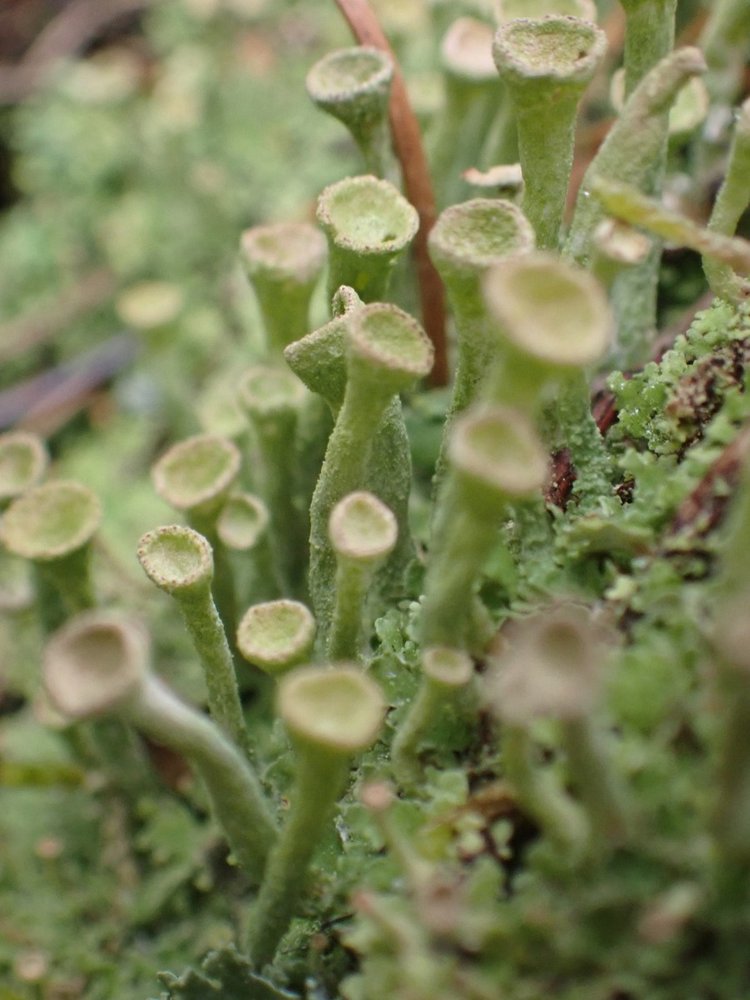
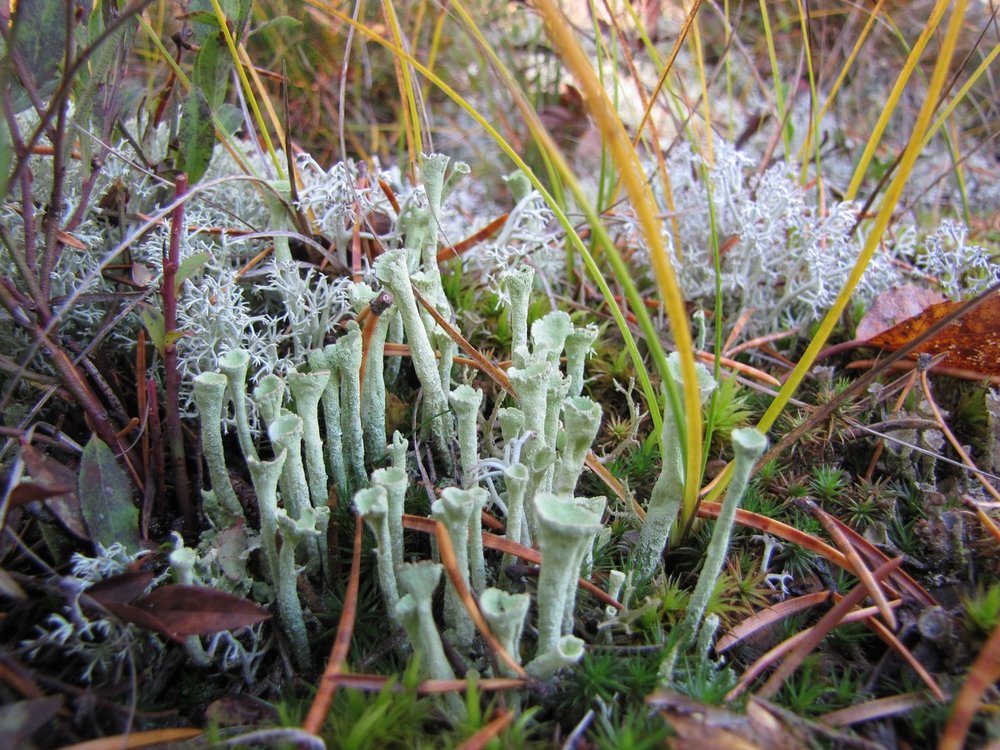
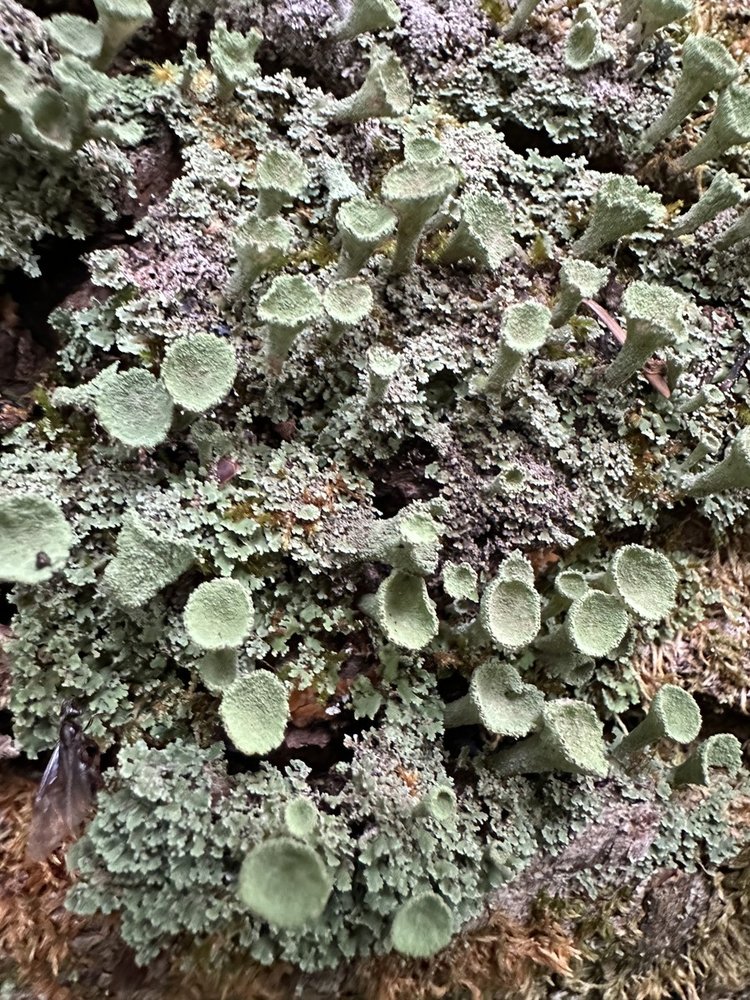
Pixie Cup Lichens (cup-bearing Cladonia species) are small gray-green to pale green lichens whose hollow stalks end in tiny goblet-shaped cups. Herbarium specimens from seven Black Hills counties record many kinds; among the most collected are Cladonia chlorophaea, C. fimbriata and C. pyxidata, which grow on soil, rotting wood and the bases of trees.
Free photos from other sources
| Family | Cladoniaceae · Cladonia |
|---|---|
| Status | Native lichen |
| Blooms | Never flowers; spreads by powdery granules |
| Size | 0.2–3 cm (1/10–1¼ in) tall, rarely to 4.5 cm (1¾ in) |
| Where | Soil, rotting wood, tree bases and trunks, and mossy rock |
| Also called | Cup Lichens, Pixie Cups |
Roots, seeds & germination
Seed: No seeds. Where a species has soredia (powdery granules), as C. fimbriata does on its stalks and cups and C. chlorophaea does in part, they break off and start new lichens. Spore-bearing discs (apothecia) are uncommon on C. fimbriata (brown, up to 1.5 mm) and C. chlorophaea (brown, 2–4 mm) and common on C. pyxidata (reddish brown, up to 8 mm) (Consortium of Lichen Herbaria).
How do you identify Pixie Cup Lichens?
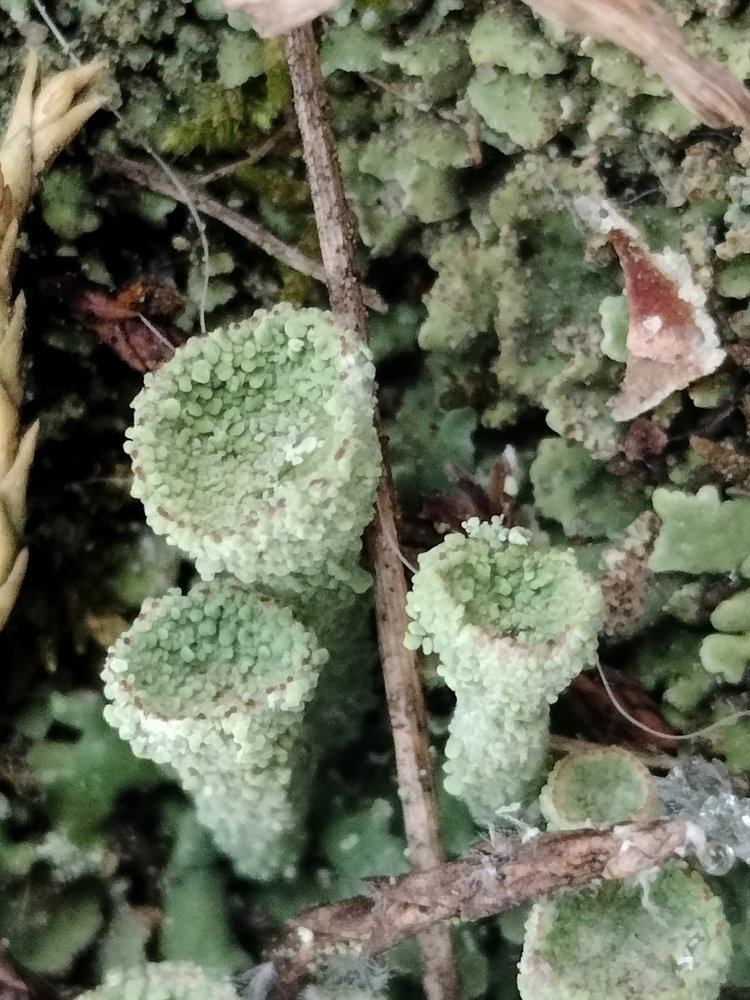
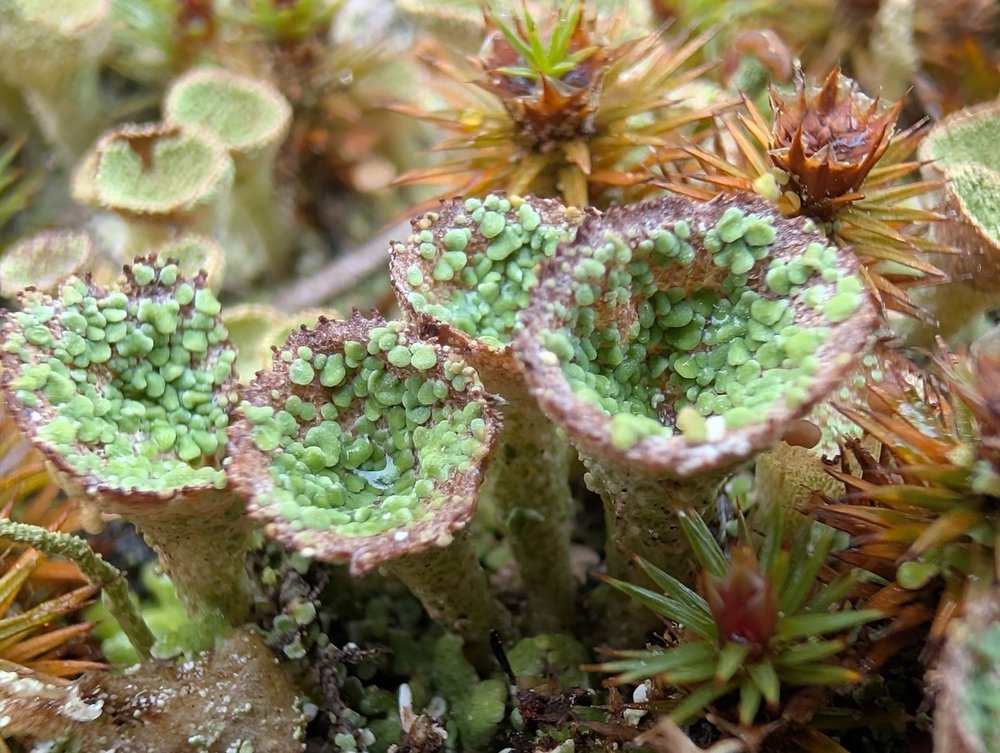
Look for tiny gray-green to pale green lichens with hollow stalks (podetia), each stalk widening at the top into a goblet or cup, rising from a bed of small scales (squamules) on soil, rotting wood or a tree base (Nova Scotia guide; Consortium of Lichen Herbaria). The National Park Service (Mount Rainier) calls the golf-tee forms pixie cups, says each species needs expert identification, and says Cladonia species are extremely hard to tell apart without chemical tests or a microscope. The marks below come from the Consortium's flora of the Sonoran Desert region (Arizona and nearby), not from the Black Hills, and cover three of the cup-bearing species most often collected in the Black Hills (GBIF). Cladonia fimbriata (Trumpet Lichen) has slender stalks 6–30 mm (1/4–1¼ in) tall and 1–2 mm wide, topped with trumpet-shaped cups 2–6 mm (1/12–1/4 in) wide; the stalks and cups wear a thick, persistent coat of very fine, flour-like granules (soredia: a few algae cells wrapped in fungus threads), green, or grayish in full sun, and the cups are mostly symmetrical, often with small fringe-like outgrowths on the rim. C. chlorophaea (Mealy Pixie-cup) has stout to slender, brownish-green to gray stalks 2–15 mm (1/12–5/8 in) tall, rarely to 45 mm (1¾ in), with cups 2–6 mm (1/12–1/4 in) wide; its coat is coarse granules and soredia, bare on old stalks, and its brown spore discs are uncommon. C. pyxidata has wider cups, 8–12 mm (1/3–1/2 in), on stalks 3–20 mm (1/8–3/4 in) tall; the cup is almost stalkless and widens gradually from the base, its warty surface breaks up into granules, small flat scales sit inside the cups even on young ones (they can also appear in mature C. chlorophaea), and its reddish-brown spore discs are common, on short stalks at the cup rim. The Consortium warns that young or old C. chlorophaea and C. pyxidata can be impossible to separate, and that some authors unite them. GBIF lists Black Hills specimens under more than 40 Cladonia names. Others a reader may meet (specimen counts in parentheses): C. coniocraea (98) is usually found without cups, and its cups, when present, are small and shallow, up to 2 mm (1/12 in) wide; C. cenotea (74) has funnel-like openings in its stalks with branches growing from the rims; C. subulata (45) has pointed stalks that finally form cups, narrower and deeper than C. fimbriata's, though the Consortium notes that specimens from northern and interior western North America often carry many cups, often wide ones, on fairly short stalks; C. gracilis (21) is 35–80 mm (1½–3 in) tall, brownish green and smooth, with wide cups; C. sulphurina (24) is greenish yellow, 30–120 mm (1¼–4¾ in) tall, often with split cups; and C. cariosa (89) has branched, split stalks with no cups. This page does not cover the reindeer lichens.
When does it bloom?
Never flowers; spreads by powdery granules.
Where does it grow?
Cladonia species grow on soil, peat, wood, bark and rock, often mixed with mosses (Nova Scotia guide). For the three species above, the Consortium gives C. chlorophaea on rotten wood, tree trunks, mineral soil or humus; C. fimbriata on wood, tree trunks, soil or mossy rock, usually in deep shade; and C. pyxidata on soil, especially acidic mineral soil and thin soil over rock, more rarely on wood. GBIF lists 248 herbarium specimens of these three from Lawrence, Custer, Pennington, Meade and Fall River counties in South Dakota and Crook and Weston counties in Wyoming: 137 of C. chlorophaea, 76 of C. fimbriata and 35 of C. pyxidata, as named on the specimens. Most were collected by Clifford Wetmore in 1960 and 1961, and the dated ones run from 1891 to 2007. The few labels that say what they grew on give limestone rocks and ridges, rock at the base of a stump and the shaded base of cliffs (C. pyxidata), another lichen on sandstone (C. chlorophaea) and a bank on a rocky hill (C. fimbriata); others name ponderosa pine forest, spruce, pine, birch and aspen forest on the Limestone Plateau, open pine forest among rock outcrops, rocky ridges and hilltops, and a deep, moist valley. Most labels that give an elevation fall between about 1,300 and 2,000 m (4,300–6,600 ft). The Black Hills National Forest's 2023 at-risk assessment names five other lichens but no Cladonia, and South Dakota's rare plant list includes no lichens.
Sources: Identifying Lichens of Nova Scotia (Brodo, Cameron, Andrachuk and Craig; text from Lichens of North America, Brodo, Sharnoff and Sharnoff 2001): Cladonia spp. entry and glossary; Consortium of Lichen Herbaria: Cladonia (genus description from Lichen Flora of the Greater Sonoran Desert Region, Nash et al. 2002); Consortium of Lichen Herbaria: Cladonia fimbriata, Trumpet Lichen (Lichen Flora of the Greater Sonoran Desert Region); Consortium of Lichen Herbaria: Cladonia chlorophaea, Mealy Pixie-cup (Lichen Flora of the Greater Sonoran Desert Region); Consortium of Lichen Herbaria: Cladonia pyxidata (Lichen Flora of the Greater Sonoran Desert Region); Consortium of Lichen Herbaria: Cladonia subulata (Lichen Flora of the Greater Sonoran Desert Region); Consortium of Lichen Herbaria: Cladonia coniocraea, Common Powderhorn (Lichen Flora of the Greater Sonoran Desert Region); Consortium of Lichen Herbaria: Cladonia cenotea (Lichen Flora of the Greater Sonoran Desert Region); Consortium of Lichen Herbaria: Cladonia gracilis (Lichen Flora of the Greater Sonoran Desert Region); Consortium of Lichen Herbaria: Cladonia sulphurina (Lichen Flora of the Greater Sonoran Desert Region); Consortium of Lichen Herbaria: Cladonia cariosa, Split-peg Soldiers (Lichen Flora of the Greater Sonoran Desert Region); National Park Service, Mount Rainier National Park: Fruticose Lichens; USDA PLANTS: Cladonia, cup lichen (CLADO3); C. chlorophaea (CLCH3), C. fimbriata (CLFI2) and C. pyxidata (CLPY60), native cup lichens; GBIF occurrence search: Cladonia, preserved specimens labeled South Dakota (county field read for Black Hills counties); GBIF occurrence search: Cladonia, preserved specimens labeled Wyoming (Crook and Weston counties); GBIF species: Cladoniaceae, spindles and structured lichens (Catalogue of Life); iNaturalist: Cladonia, pixie cup and reindeer lichens; C. fimbriata, Trumpet Lichen; C. chlorophaea, Mealy Pixie Cup; C. pyxidata, Pebbled Pixie Cup; Native American Ethnobotany Database (BRIT): search for Cladonia (one record, reindeer lichen only); Black Hills National Forest Revised Forest Assessment: At-Risk Species (October 2023); South Dakota Natural Heritage Program: Rare Plants of South Dakota.