Old Man's Beard Usnea sp.
Also called Beard Lichen
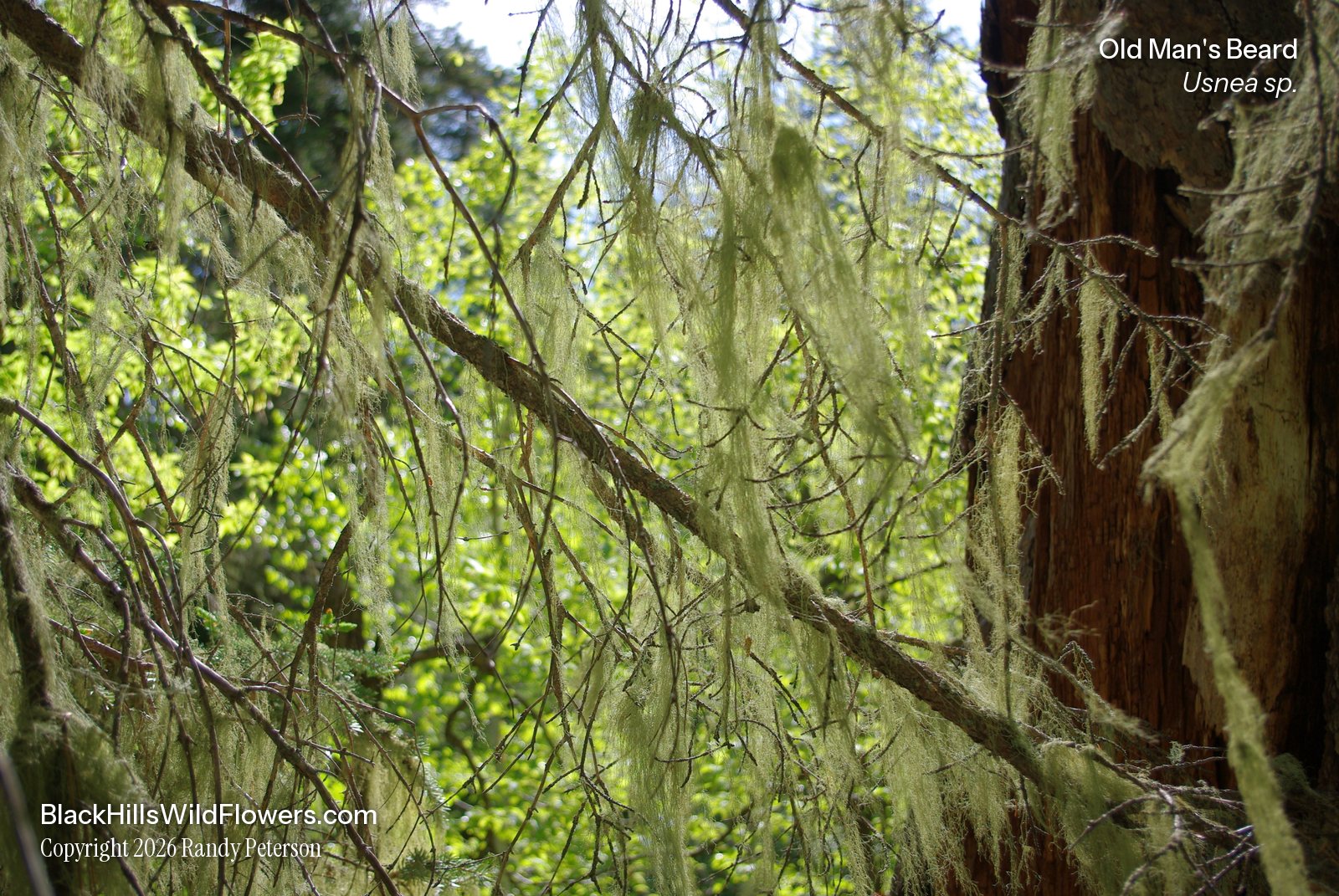
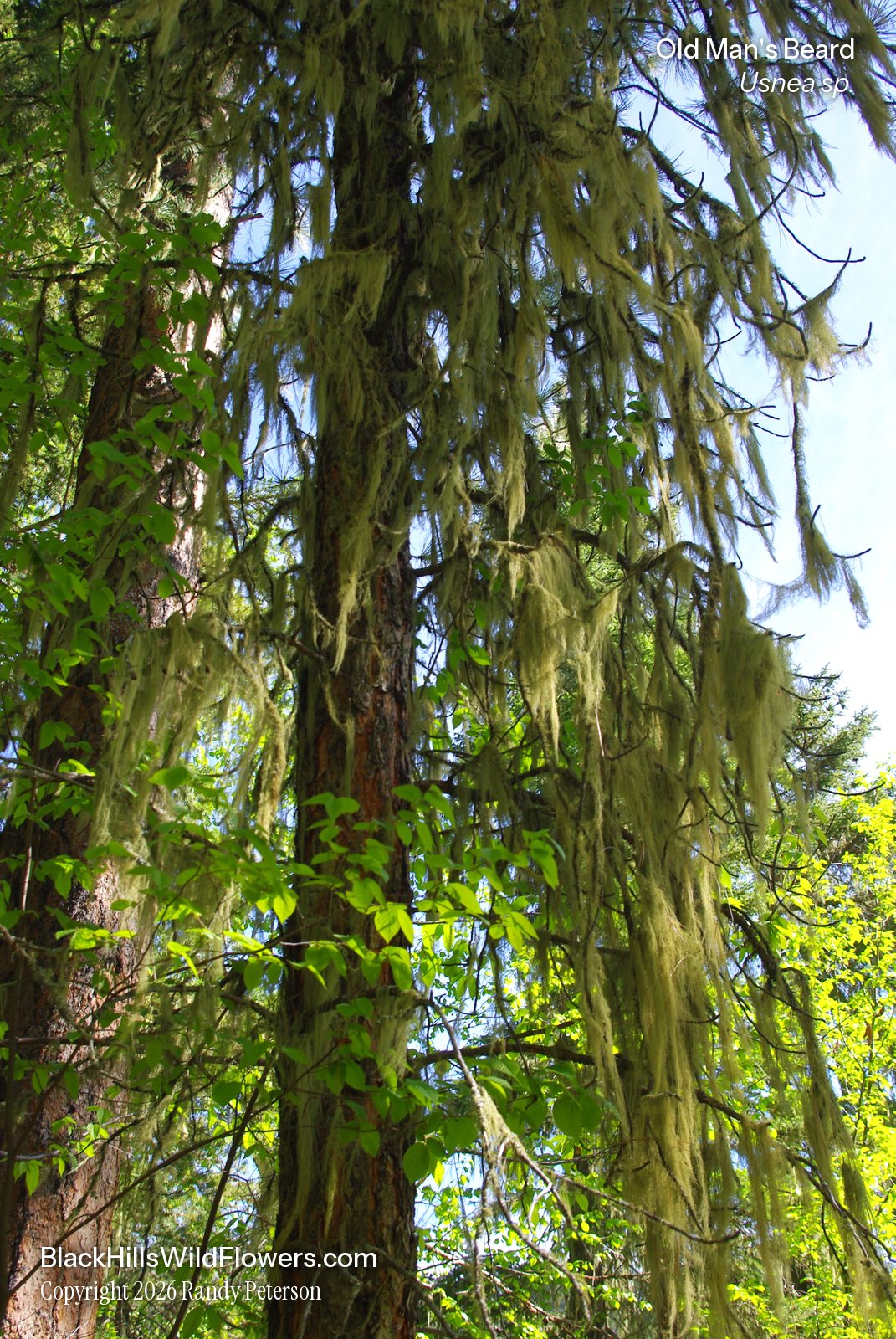
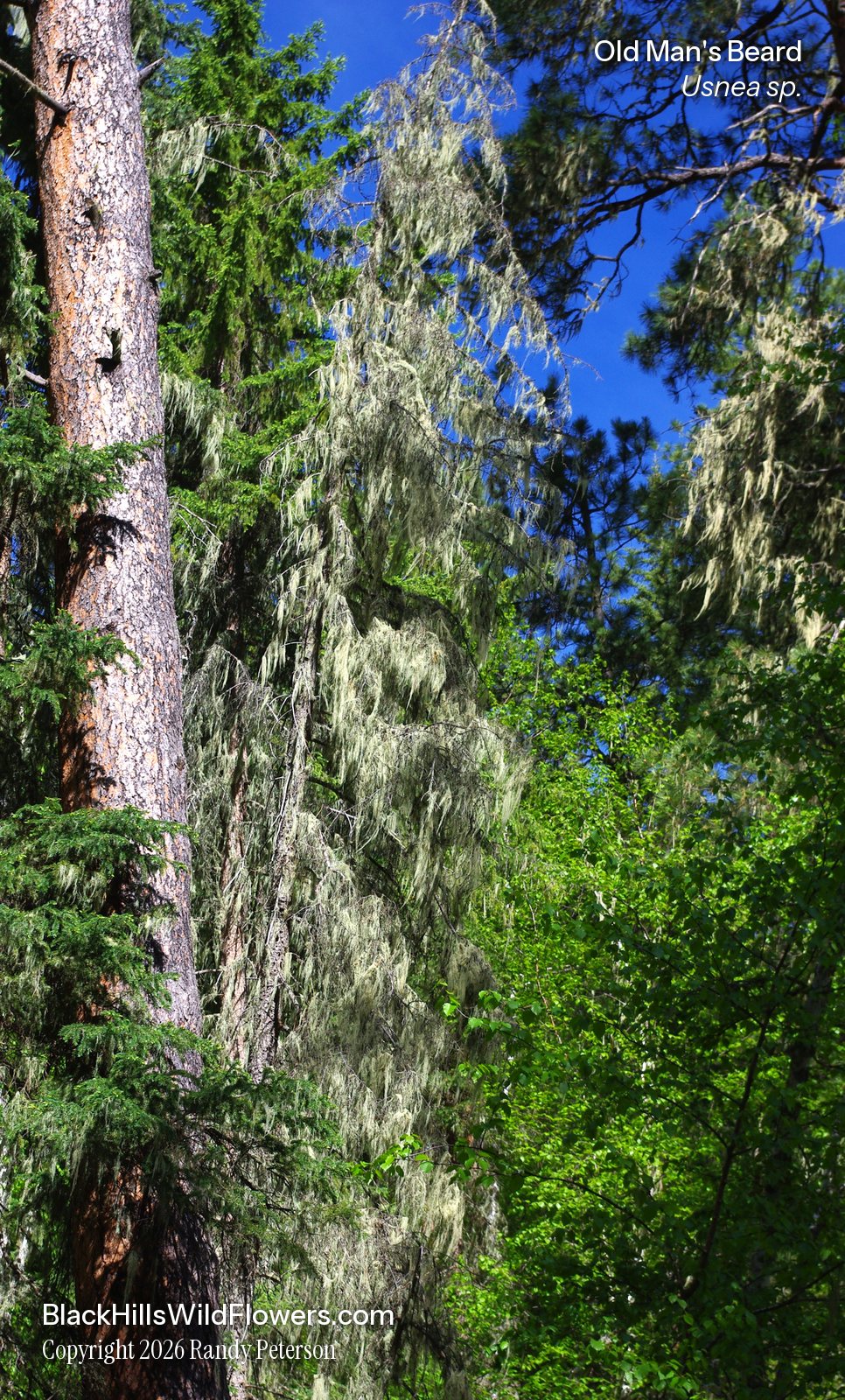
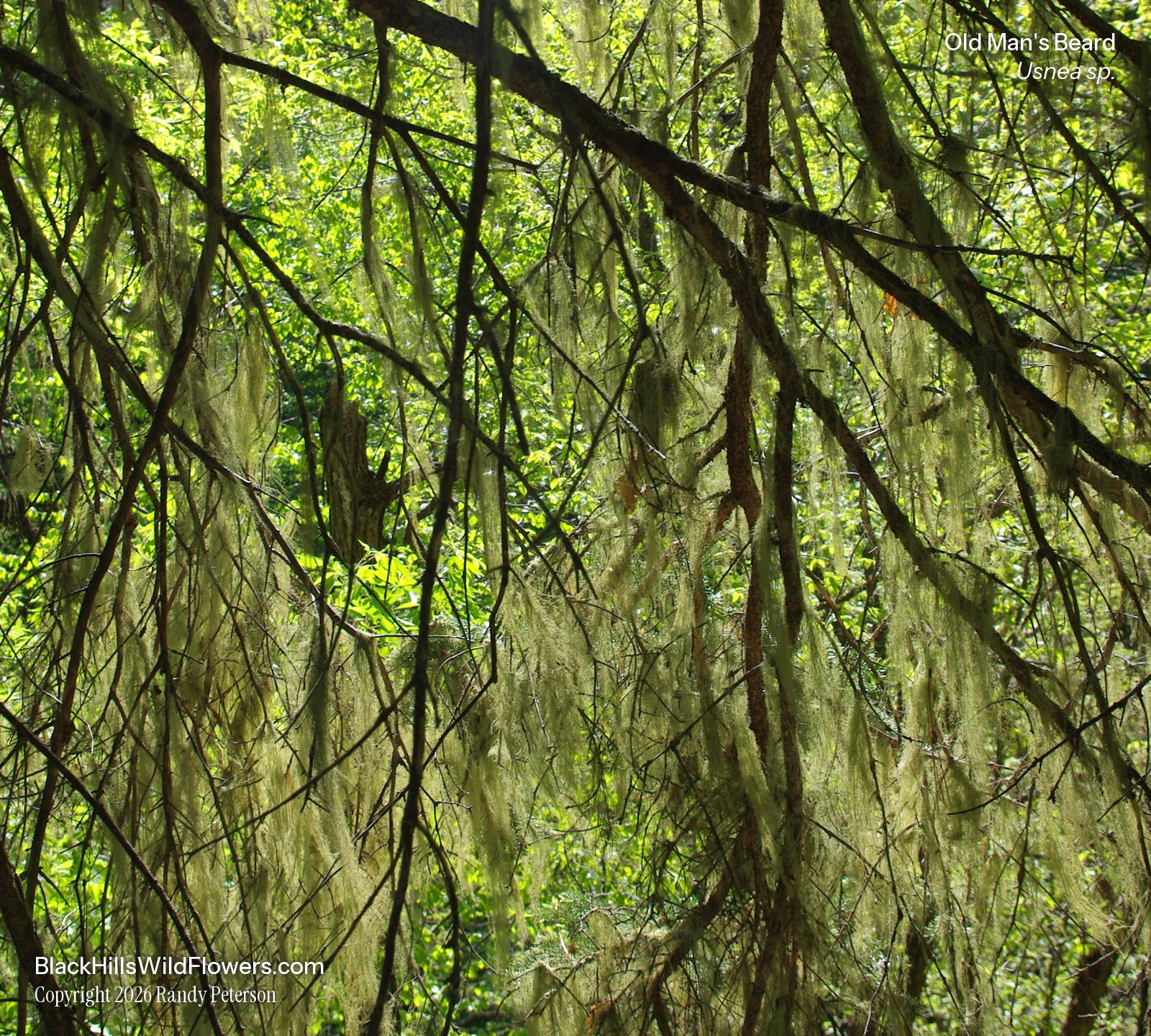
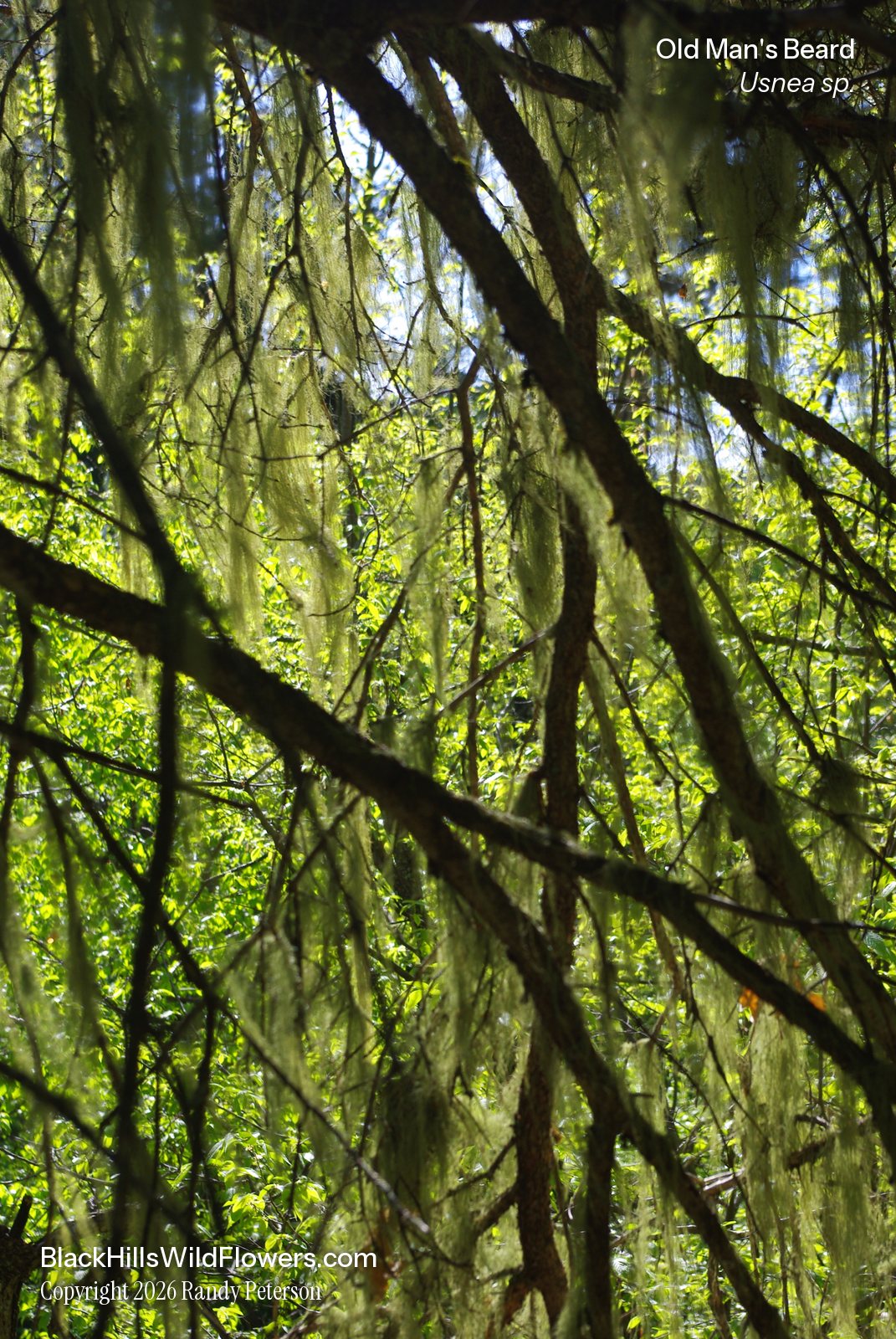
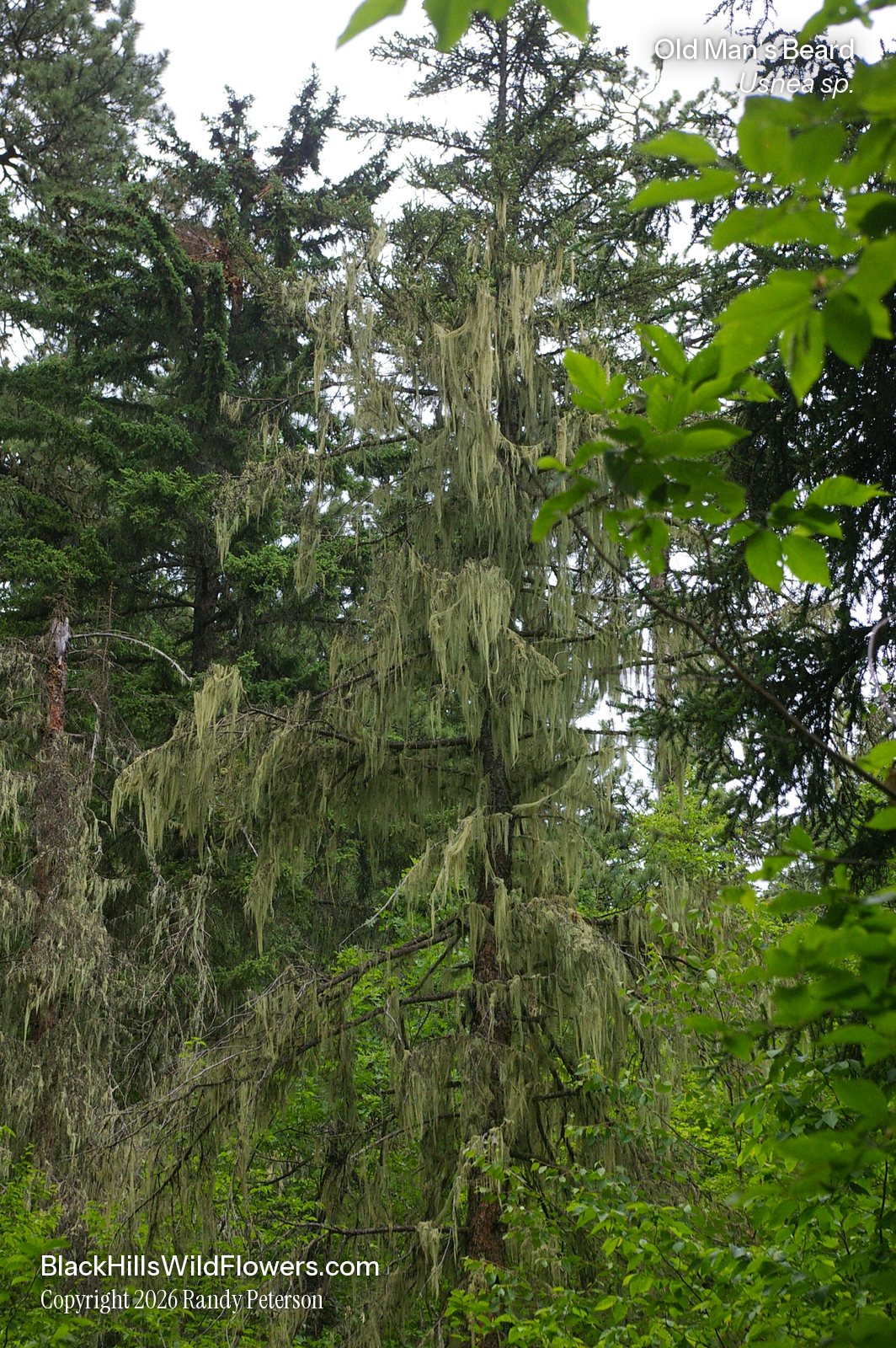
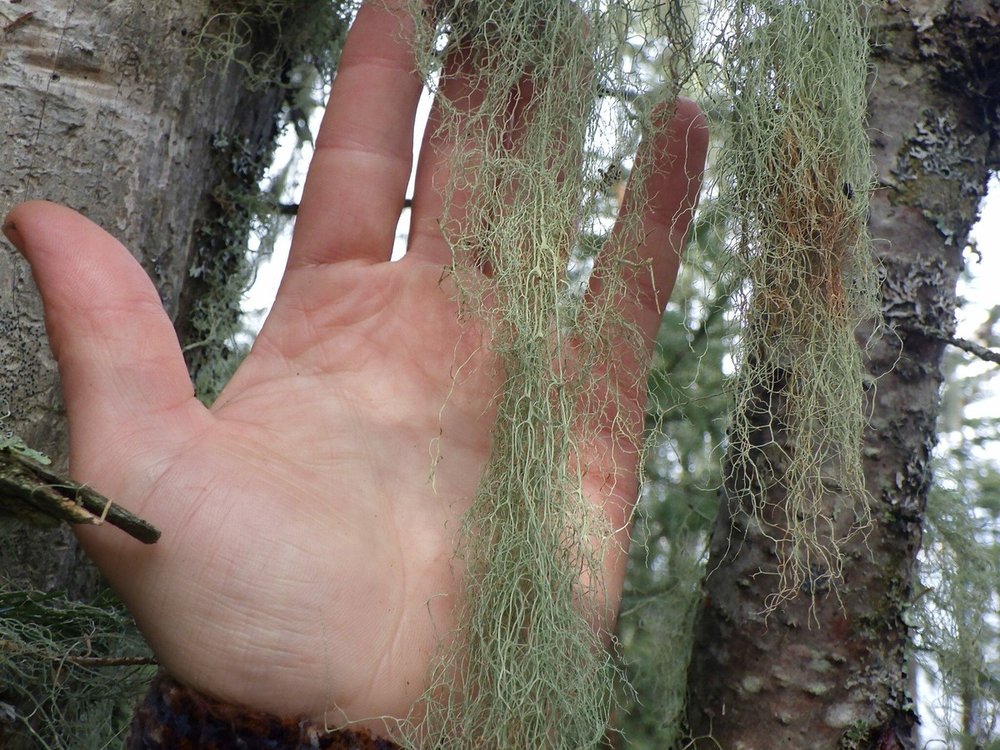
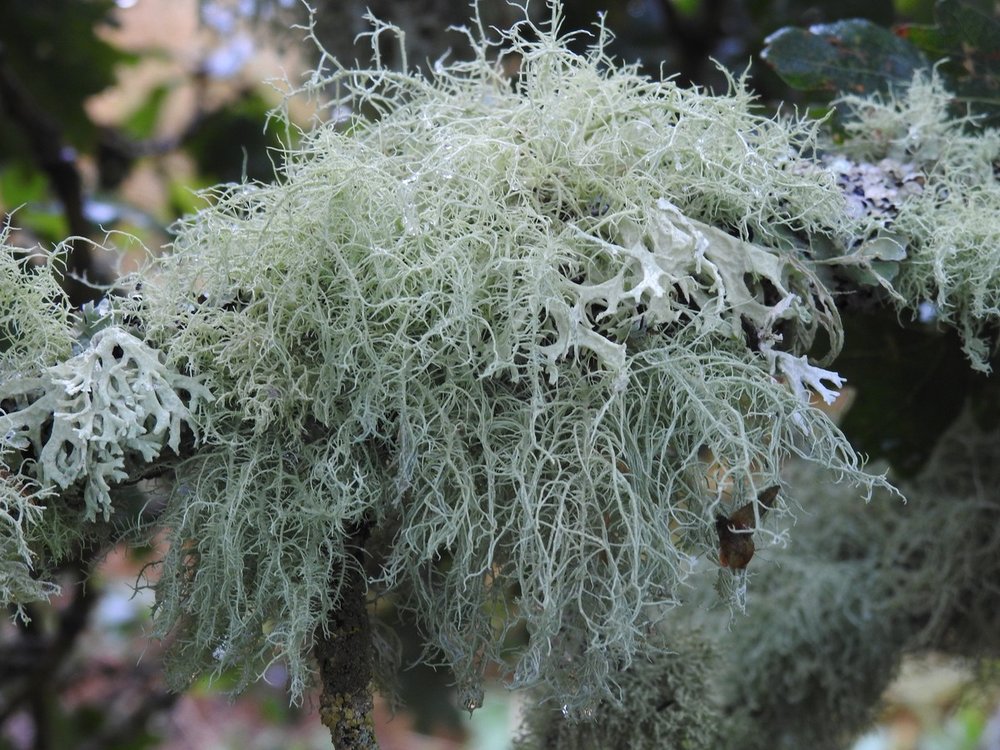
Old Man's Beard (Usnea species) is the common name for the beard lichens, pale yellow-green, thread-like lichens that grow in bushy tufts or hang in long strands from branches, each branch with a tough, stretchy cord down its middle. Herbarium specimens from seven Black Hills counties record about a dozen kinds, most often Usnea hirta, U. cavernosa, U. lapponica and U. subfloridana, on the bark of pine and spruce. Photographed in the Black Hills.
Free photos from other sources
| Family | Parmeliaceae · Shield lichen |
|---|---|
| Status | Native lichen |
| Blooms | Never flowers; spreads by powdery granules and broken pieces |
| Size | Tufts 2–13 cm (1–5 in) long, or hanging up to 60 cm (24 in) |
| Where | Bark and twigs of trees, mainly pine and spruce; a few on rock |
| Also called | Beard Lichen |
| Traditional use | Moerman's ethnobotany database (BRIT) lists eight records for Usnea, all from nations of the Pacific coast of Canada and Washington. The Makah used it as a yellow dye and to stuff pillow bags when feathers were scarce (Gill 1983), the Nitinaht used it for baby diapers (Gill 1983), the Hanaksiala used it as mattresses at seasonal camps (Compton 1993), and the Bella Coola once used it to decorate dance masks (Turner 1973). |
Roots, seeds & germination
Seed: No seeds. Many beard lichens, though not all, make soredia (powdery granules, each a few algae cells wrapped in fungus threads), and pieces that break off can grow into new lichens (Missouri Department of Conservation; Nova Scotia guide). U. cavernosa makes no soredia. Spore-bearing discs (apothecia) are rare on Usnea hirta, very rare on U. cavernosa and not seen on U. lapponica or U. subfloridana (Consortium of Lichen Herbaria).
How do you identify Old Man's Beard?
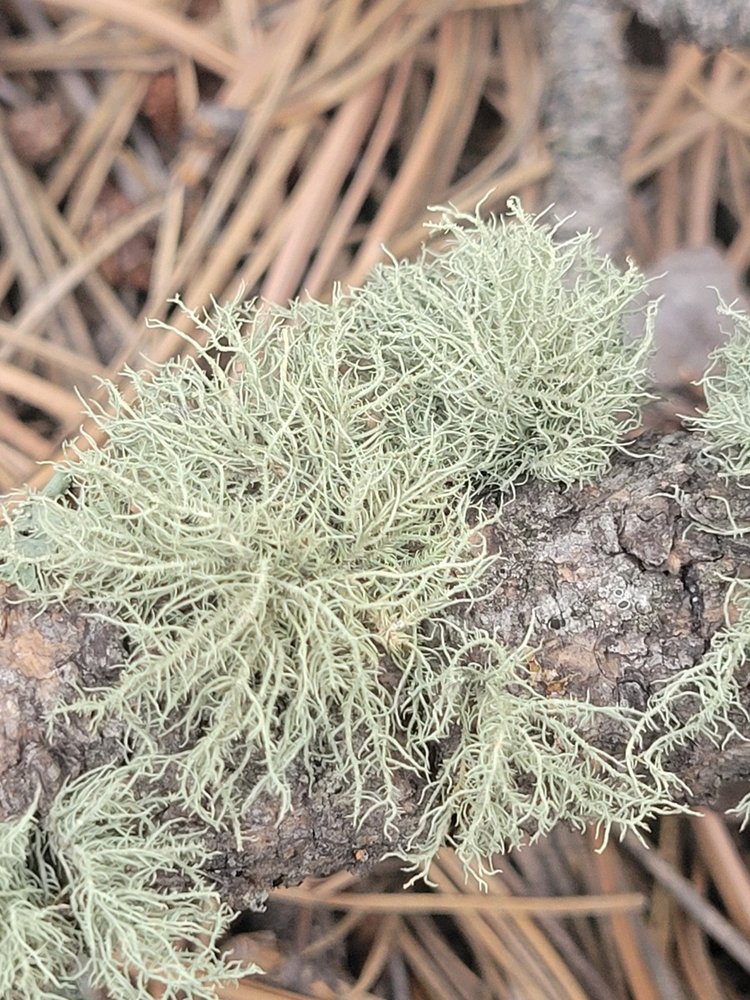
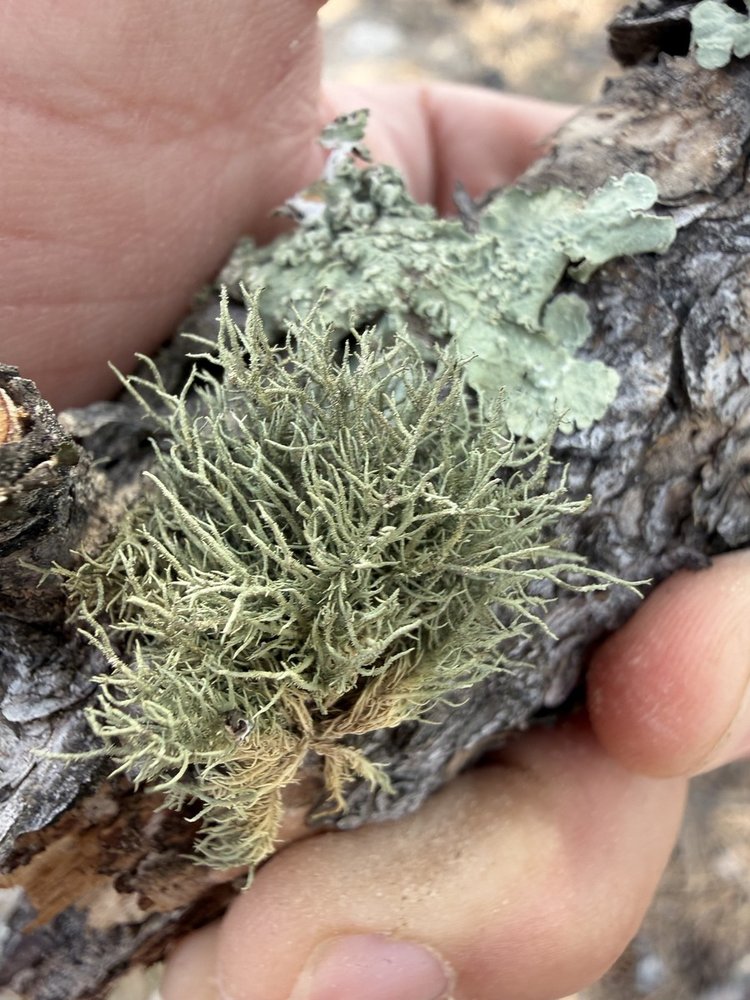
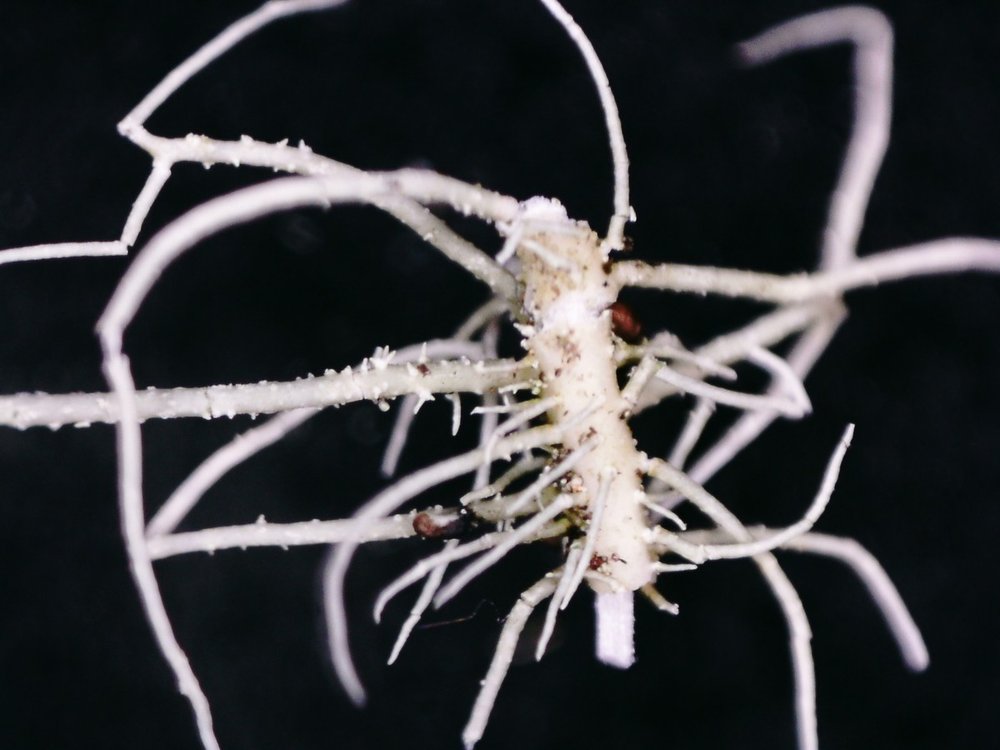
Look for pale yellow-green to gray-green, thread-like lichens that grow in bushy tufts or hang in long strands from branches. Stretch a branch gently: every Usnea has a tough, somewhat elastic cord (the axis) running down the middle of each branch (Nova Scotia guide; Missouri Department of Conservation), and the Consortium of Lichen Herbaria says this cord, with the shrubby or hanging form, sets Usnea apart from all other lichen genera. Naming the species is hard: specialists often use chemical tests (Missouri Department of Conservation), and the Consortium notes that one or two key marks are often missing, especially on young or dying specimens. The marks below come from the Consortium's flora of the Sonoran Desert region (Arizona and nearby), not from the Black Hills, and cover the four species with the most Black Hills specimens (GBIF). Usnea cavernosa is the long one: loose, limp, hanging strands up to 60 cm (24 in), slender and pitted, with thin pale slits along the branches, few or no side spines (fibrils) and no powdery patches. The other three form tufts. U. hirta is up to 5 cm (2 in) long, rarely 13 cm (5 in), with clearly segmented, slightly swollen branches, many cross-wise grooves on the main branches, and fibrils 1–2 mm (1/25–1/12 in) long that give a fishbone look. U. lapponica is 2–12 cm (1–5 in) long, with wart-like bumps (papillae) on the main branches and powdery patches (soralia) as wide as the branch itself, cut deep and often reaching the cord. U. subfloridana is up to 5–7 cm (2–3 in), compact and bushy, with a jet-black base, fibrils about 3 mm (1/8 in) long and many small powdery patches covering the branch tips. Horsehair lichens (Bryoria) also hang from branches in the Hills, with 148 herbarium specimens from the same counties, 100 of them Bryoria fuscescens (GBIF). They are mostly brown, sometimes grayish or blackish, lack the usnic acid that Usnea has in its outer layer, and have a loose, cobwebby interior rather than a central cord (Consortium of Lichen Herbaria; Nova Scotia guide). B. fuscescens is usually grayish brown and 5–15 cm (2–6 in) long in the Consortium's flora, and often hangs but seldom makes long, thick beards. Alectoria, Ramalina and Evernia are also yellowish green and hair-like, bushy or hanging, but none has the central cord (Nova Scotia guide). On Black Hills specimens (GBIF), Ramalina has 78 and Evernia 42, while Alectoria has only two, both from 1951.
When does it bloom?
Never flowers; spreads by powdery granules and broken pieces.
Where does it grow?
Beard lichens grow on trees and shrubs, and a few on rock (Nova Scotia guide). The Consortium's descriptions of the four Black Hills species name bark and wood of pine, spruce, fir and oak trees. The Nova Scotia guide treats every Usnea as very intolerant of air pollution. GBIF lists 413 herbarium specimens of Usnea from Lawrence, Custer, Pennington, Meade and Fall River counties in South Dakota and Crook and Weston counties in Wyoming: 161 of Usnea hirta, 99 of U. cavernosa, 94 of U. lapponica and 14 of U. subfloridana, as named on the specimens, 18 identified only as Usnea, and 27 under nine other names. Most were collected by Clifford Wetmore in 1960 and 1961, and the dated ones run from 1891 to 2017. Labels that name a host give the bark of ponderosa pine and spruce, and the habitats they name include ponderosa pine forest, spruce and aspen forest, mixed pine, spruce, birch and aspen forest, open pine forest among rock outcrops, and north-facing slopes. Most labels that give an elevation fall between about 1,300 and 2,000 m (4,300–6,600 ft). The Black Hills National Forest's 2023 at-risk assessment names five other lichens but no Usnea, and South Dakota's rare plant list includes no lichens.
Shield lichen family (Parmeliaceae): 2 other plants in this guide
Sources: Identifying Lichens of Nova Scotia (Brodo, Cameron, Andrachuk and Craig; text from Lichens of North America, Brodo, Sharnoff and Sharnoff 2001): Usnea spp. entry, key, Alectoria, Ramalina and Evernia notes, glossary; Consortium of Lichen Herbaria: Usnea (genus description from Lichen Flora of the Greater Sonoran Desert Region, Nash et al. 2007); Consortium of Lichen Herbaria: Usnea hirta (Lichen Flora of the Greater Sonoran Desert Region); Consortium of Lichen Herbaria: Usnea lapponica (Lichen Flora of the Greater Sonoran Desert Region); Consortium of Lichen Herbaria: Usnea cavernosa (Lichen Flora of the Greater Sonoran Desert Region); Consortium of Lichen Herbaria: Usnea subfloridana (Lichen Flora of the Greater Sonoran Desert Region); Consortium of Lichen Herbaria: Bryoria fuscescens (Lichen Flora of the Greater Sonoran Desert Region, Nash et al. 2002); Consortium of Lichen Herbaria: Bryoria (genus description from Lichen Flora of the Greater Sonoran Desert Region, Nash et al. 2002); USDA PLANTS: Usnea, beard lichen (USNEA2), native; Bryoria, horsehair lichen (BRYOR2); Usnea cavernosa, cavern beard lichen (USCA60); U. lapponica, Lapland beard lichen (USLA60); Missouri Department of Conservation Field Guide: Beard Lichens (Usnea Lichens); GBIF occurrence search: Usnea, preserved specimens labeled South Dakota (county field read for Black Hills counties); GBIF occurrence search: Usnea, preserved specimens labeled Wyoming (Crook and Weston counties); GBIF occurrence search: Bryoria, preserved specimens labeled South Dakota or Wyoming (county field read for Black Hills counties); GBIF occurrence search: Ramalina, Evernia and Alectoria, preserved specimens labeled South Dakota or Wyoming (county field read for Black Hills counties); GBIF species: Parmeliaceae, shield lichens and allies (Catalogue of Life); iNaturalist: Usnea hirta, Bristly Beard Lichen; U. cavernosa, Pitted Beard Lichen; U. subfloridana, Boreal Beard Lichen; Native American Ethnobotany Database (BRIT): Usnea sp.; Black Hills National Forest Revised Forest Assessment: At-Risk Species (October 2023); South Dakota Natural Heritage Program: Rare Plants of South Dakota.